Business Plan Guidebook - Short Version

Free Word download β€’ Edit online β€’ Save & share with Drive β€’ Export to PDF

29 pagesβ€’2h 30m – 3h 20m to fillβ€’Difficulty: Expert
Learn more ↓
FreeBusiness Plan Guidebook - Short Version Template

At a glance

What it is
A Business Plan Guidebook Short Version is a condensed, structured planning document that captures your company's mission, target market, competitive positioning, operational model, and financial outlook in a focused, readable format β€” typically 8–12 pages versus the 25–35 pages of a full-length plan. This free Word download gives you a guided template you can edit online and export as PDF for lenders, partners, accelerators, or internal leadership alignment.
When you need it
Use it when a full business plan is more than your audience needs β€” for accelerator applications, early-stage investor introductions, SBA microloan requests, or internal strategy reviews where leadership needs a compact reference document rather than a comprehensive operational tome.
What's inside
Executive summary, company description, market analysis, competitive overview, products and services, marketing and sales strategy, operations snapshot, management team highlights, and abbreviated financial projections covering at least 12 months of P&L and cash flow.

What is a Business Plan Guidebook Short Version?

A Business Plan Guidebook Short Version is a condensed, structured planning document that captures every essential element of a traditional business plan β€” market opportunity, competitive positioning, product or service description, go-to-market strategy, operations, team, and financial projections β€” in a focused 8–12 page format. Unlike a full-length plan, it is purpose-built for audiences who need enough substance to evaluate the business without reading a 30-page document. This free Word download provides a guided, section-by-section framework you can edit online and export as PDF for accelerator applications, bank introductions, partner meetings, or internal strategy alignment.

Why You Need This Document

Submitting a 30-page business plan to an accelerator with a 10-page limit, a community bank reviewing a $75K microloan, or a partner expecting a crisp briefing document is a credibility problem before anyone reads a word. Without a short-format plan, you either over-deliver with a document that goes unread, or under-deliver with a pitch deck that lacks the financial and operational detail decision-makers require. A well-structured short business plan closes that gap: it demonstrates that you understand your market, have tested your assumptions, and can communicate your strategy clearly under constraints. Those three signals β€” clarity, rigor, and concision β€” are exactly what accelerator reviewers, loan officers, and early partners use to decide whether to move forward.

Which variant fits your situation?

If your situation is…Use this template
Raising venture capital or seeking angel investmentFull Business Plan
Rapid internal ideation or lean canvas planningOne-Page Business Plan
Opening a food-service or restaurant locationRestaurant Business Plan
Launching or expanding a nonprofit organizationNonprofit Business Plan
Presenting strategy to an existing leadership team or boardStrategic Plan
Applying for an SBA loan above $350K with full diligence requiredBank Loan Business Plan
Planning the launch of a specific product or service lineNew Product Launch Plan

Common mistakes to avoid

❌ Writing the executive summary first

Why it matters: It will misrepresent the rest of the plan, creating internal contradictions that undermine the document's credibility.

Fix: Complete every other section first, then distill the summary from the finished content so every claim has support behind it.

❌ Using top-down market sizing without a bottom-up check

Why it matters: Claiming 1% of a $5B market sounds plausible until a reader asks how many customers that represents β€” and the math doesn't hold.

Fix: Always pair a top-down TAM with a bottom-up estimate: number of reachable customers multiplied by average contract or transaction value.

❌ Projecting revenue without visible assumptions

Why it matters: A Year 1 revenue figure of $400K means nothing if the reader cannot see the unit count, price, and conversion rate behind it β€” it reads as guesswork.

Fix: Show the formula: customers Γ— average sale Γ— close rate = revenue. Embed the assumptions directly in the financial summary or in a brief footnote.

❌ Treating the short version as just a shorter long plan

Why it matters: Cutting a 30-page plan to 10 pages by trimming every section equally produces a document that is thin everywhere and deep nowhere.

Fix: Prioritize the sections your specific audience cares most about β€” a lender needs financials and operations; an accelerator needs market and team β€” and cut accordingly.

The 9 key sections, explained

Executive Summary

Company Description

Market Analysis

Competitive Overview

Products and Services

Marketing and Sales Strategy

Operations Snapshot

Management Team

Financial Summary

How to fill it out

  1. 1

    Start with the company description and mission

    Enter your legal entity name, founding date, location, and a one-sentence mission identifying what you do, for whom, and to what end. This anchors the tone and scope of every section that follows.

    πŸ’‘ Write the mission before anything else and test it by reading it aloud β€” if it could describe a competitor, it is too vague.

  2. 2

    Research and size your market

    Use two independent sources (e.g., a trade association report and a market research firm) to establish a TAM figure. Then build a bottom-up estimate by counting reachable customers and multiplying by your average sale price.

    πŸ’‘ If your top-down and bottom-up estimates differ by more than 50%, revisit your customer segment definition before proceeding.

  3. 3

    Map competitors and articulate your advantage

    List at least three direct or indirect competitors with their pricing and key weaknesses. Write one specific paragraph on your differentiated advantage and why it is defensible.

    πŸ’‘ A simple 2Γ—2 positioning matrix makes this section immediately scannable for busy accelerator reviewers or loan officers.

  4. 4

    Describe your product or service in outcome terms

    Write the products and services section from the customer's perspective β€” what problem is solved, how fast, and at what cost. Avoid internal feature language unless a technical audience requires it.

    πŸ’‘ If you cannot describe the customer outcome in one sentence, the product positioning needs more work before you document it.

  5. 5

    Select and prioritize two to three acquisition channels

    Choose the channels most likely to reach your target segment at a viable cost. Estimate CAC and payback period for each and pick the two to three with the best unit economics for Year 1 focus.

    πŸ’‘ Stating CAC payback above 18 months for a SaaS business without a clear improvement path will raise immediate questions β€” address it proactively.

  6. 6

    Build the financial summary from unit economics up

    Model Year 1 revenue from customer count, average transaction value, and conversion rate β€” never start from a target revenue number and work backward. Add direct costs to calculate gross margin, then layer in operating expenses to find burn rate and break-even.

    πŸ’‘ Include a brief note on what changes if revenue comes in at 70% of plan β€” this one line demonstrates financial maturity and pre-empts the most common investor question.

  7. 7

    Write the executive summary last

    Pull the strongest single data point from each section and compress them into one page. The summary is a trailer for the full document β€” every sentence must earn its place.

    πŸ’‘ If the executive summary runs more than one page in a short-format plan, cut it. Length signals a lack of clarity, not depth.

Frequently asked questions

What is a business plan guidebook short version?

A business plan guidebook short version is a condensed planning document β€” typically 8–12 pages β€” that covers the core elements of a full business plan: market opportunity, competitive positioning, product or service description, marketing strategy, operations, team, and financial projections. It is designed for audiences who need enough detail to evaluate the business without reading a 30-page document.

When should I use a short business plan instead of a full one?

Use a short business plan when applying to accelerators or incubators with page limits, when requesting a microloan or small bank credit line, when introducing your business to a potential partner or early-stage investor before a formal diligence request, or when aligning a small internal team around an annual operating strategy. For institutional capital raises above $500K or complex SBA loans, a full-length plan is typically required.

What financial information should a short business plan include?

At minimum: a 12-month projected P&L showing revenue, cost of goods sold, gross margin, operating expenses, and net income; a cash flow summary showing monthly burn rate and runway; and a break-even analysis. Full three-statement models (P&L, cash flow, balance sheet) are best reserved for the full-length plan, but a concise financial summary with visible assumptions is essential in any version.

How long should a short business plan be?

Eight to twelve pages is the standard range for a short format, excluding any appendices. The executive summary should be no more than one page. Going beyond twelve pages defeats the purpose of a condensed format β€” if you find yourself consistently running long, consider whether you actually need the full business plan template instead.

What is the difference between a short business plan and a one-page business plan?

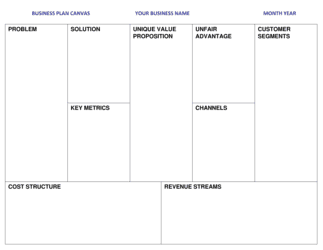
A one-page business plan β€” often called a business model canvas β€” is a rapid-alignment tool for internal ideation and early hypothesis testing. It lacks the financial detail, market evidence, and narrative depth that external audiences like lenders or accelerators require. A short business plan is a proper planning document in condensed form, not a summary framework.

Do I need a financial advisor or consultant to complete this template?

For most early-stage or small business use cases, a well-completed template is sufficient. Engage a financial advisor or business plan consultant when the audience is a formal lender requiring audited figures, the raise exceeds $500K, or the business model involves complex unit economics that need independent validation. A one-to-two hour review with an accountant ($150–$400) is worthwhile before any bank submission.

What is the most important section of a short business plan?

The financial summary is what lenders scrutinize most, and the team section is what investors weigh most heavily. For accelerators, the market analysis and competitive positioning typically carry the most weight. Tailor the depth of each section to your specific audience's priorities rather than distributing effort evenly across all sections.

Can a short business plan be used for an SBA loan application?

For SBA microloans (up to $50K) and some SBA 7(a) loans under $150K, a concise, well-structured short plan is often acceptable. For larger SBA loans β€” particularly those requiring full underwriting β€” lenders typically expect a complete business plan with a three-statement financial model, multi-year projections, and detailed supporting schedules. Check with your specific lender before submitting.

How this compares to alternatives

vs Full Business Plan

A full business plan runs 25–35 pages with a complete three-statement financial model, detailed operational plan, and exhaustive market research. A short guidebook version covers the same core elements in 8–12 pages. Use the short version for accelerators, small loans, or early partner conversations; move to the full version when raising more than $500K or submitting to institutional lenders.

vs One-Page Business Plan

A one-page plan is a rapid hypothesis-testing tool β€” useful internally for ideation but insufficient for any external audience. A short business plan is a proper planning document with financial projections and market evidence. If a one-page plan is step one, the short guidebook version is step two before committing to a full plan.

vs Strategic Plan

A strategic plan is an internal document focused on goals, initiatives, and KPIs for an existing operating business. A short business plan is an external-facing document that adds market context, competitive analysis, and capital context to the strategy. Existing businesses often need both; early-stage ventures typically start with the business plan.

vs Pitch Deck

A pitch deck is 10–15 slides designed for a 20-minute meeting to generate investor interest. A short business plan is a written document requested after the deck lands the follow-up conversation. The deck gets you in the room; the short plan provides the detail that moves the conversation toward a term sheet or loan commitment.

Industry-specific considerations

Retail / E-commerce

Short plans for retail ventures emphasize customer acquisition cost, average order value, inventory turnover, and a clear channel strategy for online versus in-store sales.

Food & Beverage

Restaurant and food-service short plans prioritize location analysis, food cost as a percentage of revenue (target 28–35%), covers-per-day projections, and build-out timeline.

Professional Services

Service firm short plans center on billable utilization rate, average bill rate, client concentration risk, and a clear description of how new clients are acquired and retained.

SaaS / Technology

Tech startup short plans must include MRR or ARR trajectory, churn rate assumption, CAC payback period, and a brief description of the product's technical moat or differentiation.

Template vs pro β€” what fits your needs?

PathBest forCostTime
Use the templateEarly-stage founders, small business owners, and accelerator or microloan applicantsFree1–2 weeks (15–30 hours)
Template + professional reviewFirst bank loan applications, seed raises up to $300K, or franchise submissions$150–$1,000 for an accountant or business advisor review2–3 weeks
Custom draftedInstitutional lenders, formal SBA applications above $350K, or complex regulated industries$1,500–$5,000 for a professional business plan writer3–6 weeks

Glossary

Executive Summary
A 1-page overview of the entire plan β€” problem, solution, market size, traction, team, and funding ask β€” written last but read first.
Value Proposition
A single clear statement of the specific benefit your product or service delivers to a defined customer, and why it beats the alternatives.
Target Market
The specific, defined group of customers most likely to buy your product or service, described by demographics, behaviors, or firmographics.
Competitive Advantage
A specific, sustainable reason why customers choose your offering over alternatives β€” cost, speed, features, brand, or network effects.
Revenue Model
The mechanism by which a business earns money β€” subscription, transactional, licensing, advertising, or a combination.
Gross Margin
Revenue minus the direct cost of goods sold, expressed as a percentage β€” a primary indicator of how profitable the core product or service is.
Burn Rate
Monthly net cash outflow β€” how quickly a company spends its cash reserves before reaching profitability or raising additional capital.
Go-to-Market Strategy
The specific channels, tactics, and sequencing a company uses to acquire its first customers and grow revenue.
Break-Even Point
The revenue level at which total income exactly covers total costs, resulting in neither profit nor loss.
SWOT Analysis
A structured framework for identifying a business's internal Strengths and Weaknesses and external Opportunities and Threats.

Part of your Business Operating System

This document is one of 3,000+ business & legal templates included in Business in a Box.

  • Fill-in-the-blanks β€” ready in minutes
  • 100% customizable Word document
  • Compatible with all office suites
  • Export to PDF and share electronically

Create your document in 3 simple steps.

From template to signed document β€” all inside one Business Operating System.
1
Download or open template

Access over 3,000+ business and legal templates for any business task, project or initiative.

2
Edit and fill in the blanks with AI

Customize your ready-made business document template and save it in the cloud.

3
Save, Share, Send, Sign

Share your files and folders with your team. Create a space of seamless collaboration.

Save time, save money, and create top-quality documents.

β˜…β˜…β˜…β˜…β˜…

"Fantastic value! I'm not sure how I'd do without it. It's worth its weight in gold and paid back for itself many times."

Managing Director Β· Mall Farm
Robert Whalley
Managing Director, Mall Farm Proprietary Limited
β˜…β˜…β˜…β˜…β˜…

"I have been using Business in a Box for years. It has been the most useful source of templates I have encountered. I recommend it to anyone."

Business Owner Β· 4+ years
Dr Michael John Freestone
Business Owner
β˜…β˜…β˜…β˜…β˜…

"It has been a life saver so many times I have lost count. Business in a Box has saved me so much time and as you know, time is money."

Owner Β· Upstate Web
David G. Moore Jr.
Owner, Upstate Web

Run your business with a system β€” not scattered tools

Stop downloading documents. Start operating with clarity. Business in a Box gives you the Business Operating System used by over 250,000 companies worldwide to structure, run, and grow their business.

Free Forever PlanΒ Β·Β No credit card required