- Executive Summary
- A brief opening section — typically half a page to one page — that distills the entire plan into the problem, solution, market size, and funding ask.
- Value Proposition
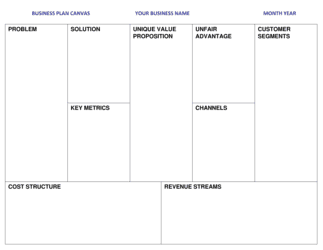
- A clear statement of the specific benefit your product or service delivers to a defined customer, and why it is better than the available alternatives.
- Target Market
- The specific group of customers most likely to buy your product or service, defined by demographics, industry, geography, or behavior.
- Competitive Advantage
- The specific reason customers choose you over competitors — such as lower cost, faster delivery, proprietary technology, or superior service.
- Revenue Model
- The mechanism by which a business generates income — for example, subscription fees, one-time sales, licensing, or service retainers.
- Gross Margin
- Revenue minus the direct cost of goods or services sold, expressed as a percentage — a measure of how much each dollar of revenue contributes to covering overhead.
- Burn Rate
- Monthly net cash outflow for a startup or pre-revenue business — how quickly existing capital is being spent before the business is self-sustaining.
- Use of Funds
- A breakdown of how capital raised or borrowed will be allocated across spending categories such as product development, marketing, staffing, and operations.
- Break-Even Point
- The revenue level at which total income equals total costs, resulting in neither a profit nor a loss — a key milestone for lenders and investors.
- Go-to-Market Strategy
- The specific channels, tactics, and sequencing a business uses to reach its target customers and generate its first or next wave of revenue.