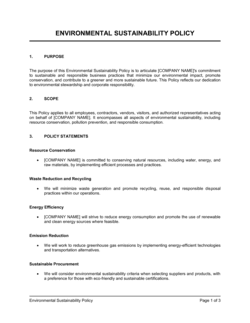
Business Sustainability and Social Impact Guidebook

Free to read • Save or share with one click

FreeBusiness Sustainability and Social Impact Guidebook Template

At a glance

What it is
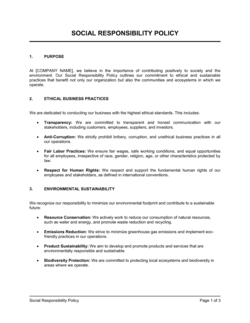
A Business Sustainability and Social Impact Guidebook is a formal governing document that codifies an organization's binding commitments to environmental stewardship, social responsibility, ethical governance, and community impact. This free Word download gives you a structured, board-ready starting point you can edit online and export as PDF to share with stakeholders, investors, regulators, and supply-chain partners.
When you need it
Use it when your organization needs to formalize ESG obligations for investor due diligence, satisfy supply-chain sustainability requirements from enterprise clients, or respond to regulatory mandates requiring documented environmental and social policies. It is also the right tool when launching a public-facing sustainability program that will be audited or reported against.
What's inside
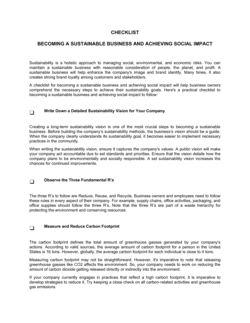
The guidebook covers sustainability vision and governance, environmental targets and measurement methodology, social responsibility and labor standards, community investment commitments, supply-chain conduct requirements, reporting and disclosure cadence, and enforcement and accountability mechanisms.

What is a Business Sustainability and Social Impact Guidebook?

A Business Sustainability and Social Impact Guidebook is a formal governing document that codifies an organization's binding commitments across environmental stewardship, social responsibility, community investment, supply-chain conduct, and ESG reporting. Unlike a mission statement or a marketing pledge, it assigns quantified targets with baseline years, names individual accountability, defines measurement methodologies, and establishes enforcement mechanisms — transforming sustainability intentions into auditable obligations. It serves as the authoritative policy reference for internal teams, external auditors, investors conducting ESG due diligence, enterprise procurement teams, and regulators reviewing disclosure compliance.

Why You Need This Document

Without a formal sustainability guidebook, your ESG commitments exist only as marketing copy — unverifiable, unenforceable, and increasingly exposed to greenwashing claims from regulators in the EU, UK, and US. Enterprise clients now routinely require suppliers to produce documented sustainability policies as a condition of contract award, and impact investors expect board-approved ESG frameworks before closing any funding round. In the EU, CSRD and CSDDD are making formal sustainability governance a legal requirement for large companies and their supply-chain partners. Even smaller businesses face supply-chain due diligence obligations under Canada's Bill S-211 and the US Uyghur Forced Labor Prevention Act. A properly executed guidebook closes all of these gaps in a single document — protecting your contracts, satisfying investor diligence, and giving your sustainability team a defensible, auditable baseline to report against year over year.

Which variant fits your situation?

If your situation is…Use this template
Communicating sustainability progress to external stakeholders and the publicCorporate Social Responsibility Report
Setting out governance, anti-corruption, and board accountability rulesCorporate Governance Policy
Defining environmental management procedures for ISO 14001 complianceEnvironmental Management Policy
Documenting workplace DEI commitments and targetsDiversity and Inclusion Policy
Establishing conduct and ethics standards for employees and contractorsCode of Business Conduct and Ethics
Setting sustainability and labor requirements for vendors and suppliersSupplier Code of Conduct
Reporting greenhouse gas emissions for a carbon disclosure frameworkCarbon Footprint Report

Common mistakes to avoid

❌ Aspirational targets with no baseline year or measurement standard

Why it matters: A commitment to 'reduce emissions significantly' with no baseline is legally and operationally meaningless — regulators in the EU and UK are increasingly treating it as greenwashing, with associated fines and reputational consequences.

Fix: Attach every environmental and social target to a specific base year, a named measurement methodology (e.g., GHG Protocol), and a quantified percentage or absolute number.

❌ Scoping out subsidiaries and joint ventures

Why it matters: ESG rating agencies, enterprise procurement teams, and regulators assess sustainability performance at the consolidated group level. A guidebook that covers the parent entity only creates compliance gaps that surface immediately during third-party audits.

Fix: Extend scope to all wholly-owned subsidiaries and, where contractually possible, to joint ventures where the company holds operational control.

❌ Committing to multiple reporting frameworks without a reconciliation plan

Why it matters: GRI, SASB, TCFD, and CSRD each define materiality differently. Committing to all four without a cross-mapping exercise produces contradictory disclosures that sophisticated investors and auditors will flag.

Fix: Choose one primary framework as the backbone and map secondary frameworks to it. GRI is the most globally accepted starting point; CSRD compliance can be layered on top for EU-facing operations.

❌ No named individual accountable for target performance

Why it matters: Collective organizational accountability for ESG targets routinely results in no accountability at all. When targets are missed, there is no escalation path and no consequence, which signals to investors and regulators that the guidebook is performative.

Fix: Assign each target category — environmental, social, supply chain, community — to a named executive with target performance included in their annual review criteria.

❌ Treating one-time charitable donations as structured community investment

Why it matters: ESG rating agencies and B Corp assessors apply strict criteria distinguishing ad hoc donations from multi-year, percentage-of-profit commitments. Misclassifying donations inflates social impact scores and exposes the company to challenge during third-party review.

Fix: Define community investment as a minimum annual percentage of pre-tax profit, and specify the qualifying program types separately from discretionary charitable giving.

❌ Signing the guidebook without board-level endorsement

Why it matters: Investors conducting ESG due diligence and enterprise clients completing supplier assessments routinely request evidence that sustainability commitments have been approved at board level. An unsigned or management-only document fails this test.

Fix: Obtain formal board or governing body approval and document it in the board minutes before public release. Include a board sign-off block in the guidebook itself.

The 9 key clauses, explained

Purpose, Scope, and Governance

In plain language: States why the guidebook exists, which entities and operations it covers, and who within the organization owns and enforces its commitments.

Sample language
This Guidebook establishes the binding sustainability and social impact framework for [COMPANY NAME] and all wholly-owned subsidiaries operating in [GEOGRAPHIC SCOPE]. The [TITLE OF ROLE / COMMITTEE] is responsible for implementing, reviewing, and reporting on the commitments herein.

Common mistake: Scoping the guidebook to the parent company only. Excluding subsidiaries or joint ventures creates enforcement gaps and contradicts any public-facing ESG claims made at the group level.

Sustainability Vision and Commitments

In plain language: Articulates the organization's overarching sustainability objectives — net-zero targets, social impact goals — and the timeframe for achieving them.

Sample language
[COMPANY NAME] commits to achieving net-zero Scope 1 and 2 greenhouse gas emissions by [YEAR], reducing Scope 3 emissions by [X]% by [YEAR] against a [BASE YEAR] baseline, and directing a minimum of [X]% of annual pre-tax profit toward verified community impact initiatives.

Common mistake: Making aspirational commitments without attaching a baseline year or measurement methodology. Courts and regulators increasingly treat undated, unquantified sustainability pledges as greenwashing.

Environmental Management and Targets

In plain language: Sets specific, measurable environmental targets for energy use, emissions, water, waste, and biodiversity, and defines how progress will be measured and reported.

Sample language
The Company shall reduce absolute Scope 1 and 2 emissions by [X]% by [YEAR] relative to [BASE YEAR]. Energy intensity shall not exceed [X] kWh per [UNIT]. Waste sent to landfill shall be reduced to no more than [X]% of total waste generated by [YEAR].

Common mistake: Setting targets without specifying the measurement standard (e.g., GHG Protocol, ISO 14064). Without a named methodology, different auditors calculate different baselines, making year-over-year comparisons meaningless.

Social Responsibility and Labor Standards

In plain language: Documents the company's commitments to fair labor practices, human rights, workplace health and safety, and diversity, equity, and inclusion.

Sample language
The Company prohibits forced labor, child labor, and discrimination in all forms as defined under ILO Core Conventions. The Company commits to achieving a minimum of [X]% representation of [DEMOGRAPHIC GROUP] in management roles by [YEAR] and maintaining a workplace injury rate at or below [X] per [UNIT].

Common mistake: Referencing ILO or UN standards by name without defining what compliance looks like in practice. External auditors and enterprise procurement teams require specific, measurable labor indicators — not just citations.

Community Investment and Social Impact

In plain language: Defines the company's obligations toward the communities in which it operates — financial contributions, employee volunteering programs, and local supplier commitments.

Sample language
The Company shall invest a minimum of [X]% of annual pre-tax profit in verified community programs, provide each full-time employee with [X] paid volunteering days per year, and source a minimum of [X]% of goods and services from local or diverse-owned suppliers within [GEOGRAPHIC AREA].

Common mistake: Counting one-time charitable donations as recurring community investment. Investors and ESG rating agencies distinguish between ad hoc donations and structured, multi-year commitments tied to a percentage of revenue or profit.

Supply Chain Sustainability and Due Diligence

In plain language: Establishes requirements for suppliers and vendors to meet minimum environmental and social standards, and defines the company's process for verifying compliance.

Sample language
All Tier 1 suppliers must complete the Company's Sustainability Assessment within [X] days of contract execution and maintain a minimum score of [X]/100. The Company reserves the right to audit any supplier with [X] business days' notice and to terminate relationships where material non-compliance is identified.

Common mistake: Applying supply chain requirements only to direct (Tier 1) suppliers. Scope 3 emissions and human rights violations most commonly originate in Tier 2 and Tier 3 supply chains — a Tier-1-only policy leaves the greatest risks unaddressed.

Reporting, Disclosure, and Audit

In plain language: Sets the cadence and format for sustainability reporting, specifies which external frameworks are applied (GRI, SASB, TCFD, CSRD), and establishes internal and third-party audit rights.

Sample language
The Company shall publish an annual Sustainability Report aligned with [GRI Standards / SASB / TCFD] no later than [X] months after fiscal year end. The Report shall be verified by an independent third party every [X] years. Material deviations from targets shall be disclosed within [X] days of identification.

Common mistake: Committing to multiple disclosure frameworks (GRI, SASB, TCFD, CSRD) simultaneously without a plan to reconcile their differing materiality definitions. Overlapping frameworks create reporting conflicts that can expose the company to contradictory disclosures.

Accountability, Escalation, and Enforcement

In plain language: Defines consequences for non-compliance with guidebook commitments, the escalation path for sustainability incidents, and board or senior leadership accountability.

Sample language
Material non-compliance with any commitment in this Guidebook shall be reported to the [BOARD / SUSTAINABILITY COMMITTEE] within [X] business days. The [TITLE] is personally accountable for annual target performance. Repeated or willful non-compliance may result in [REMEDIAL ACTION / CONTRACT CONSEQUENCE].

Common mistake: No named individual is accountable for performance against each target. Without a named owner and a consequence, ESG commitments function as aspirations rather than obligations.

Review, Amendment, and Governing Law

In plain language: States how frequently the guidebook is reviewed, who has authority to amend it, and which jurisdiction's law governs interpretation and enforcement.

Sample language
This Guidebook shall be reviewed annually by the [SUSTAINABILITY COMMITTEE / BOARD] and amended as required to reflect regulatory changes, stakeholder feedback, and target performance. This Guidebook is governed by the laws of [JURISDICTION]. Material amendments require approval by [BOARD / GOVERNING BODY].

Common mistake: No review cycle specified. Sustainability regulations — particularly in the EU and UK — are evolving rapidly; a guidebook with no amendment mechanism becomes non-compliant within 12–18 months of issuance.

How to fill it out

  1. 1

    Define scope and governing body

    Identify which entities, geographies, and operations the guidebook covers. Name the specific committee or executive role — not a department — responsible for implementation and annual reporting.

    💡 Include subsidiaries and joint ventures where the parent holds more than 50% ownership; ESG rating agencies assess performance at the group level regardless of entity structure.

  2. 2

    Conduct a materiality assessment before setting targets

    Survey key stakeholders — employees, investors, clients, and community representatives — to identify the sustainability topics most relevant to your business. Use the output to prioritize which environmental and social clauses to strengthen.

    💡 EU CSRD requires a formal double materiality assessment. Even companies outside the EU benefit from the discipline — it prevents setting targets on low-impact issues while ignoring high-impact ones.

  3. 3

    Set quantified environmental targets with a baseline year

    Enter specific percentage reduction targets for emissions, energy, water, and waste alongside a clearly stated base year and measurement methodology (e.g., GHG Protocol Corporate Standard).

    💡 Align targets to a recognized science-based framework where possible. SBTi validation signals credibility to investors and procurement teams without additional narrative.

  4. 4

    Complete the social responsibility and labor standards section

    State specific diversity, equity, and inclusion targets, reference the ILO conventions your operations comply with, and enter your current workplace injury rate as the baseline for improvement targets.

    💡 Use your most recent HR data to set baseline figures — targets with no stated baseline are unverifiable and create greenwashing risk.

  5. 5

    Define community investment commitments in dollar or percentage terms

    Specify the minimum community investment as a percentage of pre-tax profit or a fixed annual dollar amount, and name the types of programs that qualify — grants, in-kind contributions, or employee volunteer hours.

    💡 Distinguish between cash contributions, in-kind support, and employee time in your accounting methodology; investors and ESG raters value each differently.

  6. 6

    Set supplier assessment requirements and audit rights

    Name the sustainability assessment tool you will use for Tier 1 suppliers, set a minimum compliance score, and specify the notice period and frequency for supplier audits.

    💡 Extend assessment requirements to Tier 2 suppliers for any high-risk categories — electronics, apparel, agriculture — where human rights and environmental violations are most concentrated.

  7. 7

    Select your reporting framework and disclosure cadence

    Choose one primary framework (GRI is the most widely recognized) and specify whether you will pursue third-party assurance. Enter the publication deadline relative to your fiscal year end.

    💡 If you operate in or sell into the EU, check whether CSRD disclosure obligations apply to your company size and revenue threshold — requirements came into force for large companies from 2024 onwards.

  8. 8

    Execute with board approval and named accountability

    Obtain board or governing body sign-off on the final guidebook, assign named individuals to each target category, and schedule the first annual review date in the document before execution.

    💡 Store the fully executed guidebook with board minutes confirming approval — ESG investors and enterprise procurement teams routinely request evidence of board-level endorsement during due diligence.

Frequently asked questions

What is a business sustainability and social impact guidebook?

A business sustainability and social impact guidebook is a formal governing document that sets out an organization's binding commitments across environmental management, social responsibility, community investment, supply-chain conduct, and ESG reporting. Unlike a marketing statement, it assigns named accountability, quantified targets, a measurement methodology, and enforcement mechanisms — making it the authoritative reference for auditors, investors, and regulators.

Is a sustainability guidebook legally binding?

When properly executed with board approval and incorporated by reference into supplier contracts, investor agreements, or employment policies, a sustainability guidebook creates enforceable obligations in most jurisdictions. In the EU, companies subject to CSRD are legally required to disclose sustainability information against defined standards, making a formal guidebook a compliance necessity rather than a voluntary choice. Always consider consulting a lawyer to confirm which obligations are legally binding versus aspirational in your specific jurisdiction.

What is the difference between a sustainability guidebook and a CSR report?

A sustainability guidebook is a forward-looking governing document that establishes binding commitments, targets, and accountability mechanisms. A CSR report is a retrospective disclosure document that measures performance against those commitments over a past period. The guidebook is the policy; the CSR report is the audit against it. Both are typically required by enterprise clients and ESG-focused investors.

What ESG reporting frameworks should my guidebook reference?

GRI Standards are the most globally recognized and cover environmental, social, and governance topics comprehensively. SASB standards are sector-specific and favored by US institutional investors. TCFD focuses on climate-related financial disclosures and is increasingly mandated by regulators in the UK, EU, and Canada. EU companies subject to CSRD must report against the European Sustainability Reporting Standards (ESRS). Choose one primary framework and map secondary requirements to it to avoid contradictory disclosures.

Does my company need a sustainability guidebook if we are a small business?

Small businesses increasingly need one for two reasons. First, enterprise clients routinely require suppliers to complete ESG questionnaires or meet minimum sustainability standards as a condition of contract award. Second, impact investors and lenders are applying ESG screens to businesses of all sizes. A structured guidebook — even a concise one — demonstrates intentionality and provides the documented framework those stakeholders require.

What is double materiality and does it apply to my business?

Double materiality is an EU regulatory concept requiring companies to assess both how sustainability issues affect the business financially (financial materiality) and how the business affects society and the environment (impact materiality). Under CSRD, it applies to large EU companies from 2024 and to listed SMEs from 2026. Non-EU companies that generate significant revenue in the EU may also be subject to it. Conducting a double materiality assessment — even voluntarily — is considered best practice and improves the credibility of your guidebook with sophisticated stakeholders.

How often should a sustainability guidebook be reviewed and updated?

An annual review aligned to your fiscal year is the minimum standard. EU sustainability regulations (CSRD, CBAM, CSDDD) and UK climate disclosure rules are being updated on a rolling basis through 2026 and beyond — a guidebook without a built-in review mechanism will become non-compliant within one to two reporting cycles. Trigger an unscheduled review whenever you make a material acquisition, enter a new market, or receive a regulatory enforcement notice.

What is the difference between Scope 1, 2, and 3 emissions?

Scope 1 covers direct emissions from sources the company owns or controls, such as fuel combustion in company vehicles and on-site equipment. Scope 2 covers indirect emissions from purchased electricity, heat, or steam. Scope 3 covers all other indirect emissions in the value chain — business travel, purchased goods, logistics, and product end-of-life use. For most companies, Scope 3 represents 70–90% of total emissions and is the hardest to measure but increasingly required under CSRD, the UK's SECR, and investor disclosure frameworks.

Does a sustainability guidebook need to be signed?

Yes. For the guidebook to function as a binding governance document rather than a marketing statement, it should be signed by an authorized officer and formally approved by the board or governing body. ESG investors and enterprise procurement teams routinely request evidence of board-level sign-off during due diligence. Store the executed copy alongside the board minutes confirming approval.

How this compares to alternatives

vs Code of Business Conduct and Ethics

A code of conduct governs individual employee behavior — anti-bribery, conflict of interest, confidentiality, and workplace standards. A sustainability guidebook governs organizational commitments at an operational and strategic level — emissions targets, community investment, and supply chain standards. Both documents are typically required; the code governs people, the guidebook governs the business.

vs Supplier Code of Conduct

A supplier code of conduct sets minimum sustainability and ethics standards for external vendors and is incorporated into procurement contracts. A sustainability guidebook is an internal governing document that sets the organization's own commitments. The guidebook defines the standards; the supplier code extends them down the value chain. Both are necessary for a credible ESG program.

vs Corporate Social Responsibility Report

A CSR report is a retrospective annual disclosure measuring performance against prior commitments. A sustainability guidebook is the prospective governing document that creates those commitments in the first place. The guidebook is the policy against which the CSR report is audited. Publishing a CSR report without an underlying guidebook means you are reporting on commitments that were never formally made.

vs Environmental Policy

An environmental policy is a focused document covering only a company's obligations toward the natural environment — emissions, waste, water, and land use. A sustainability guidebook is broader, encompassing social responsibility, community investment, governance, supply chain conduct, and reporting frameworks alongside environmental targets. Use the environmental policy for ISO 14001 certification purposes and the guidebook for comprehensive ESG governance.

Industry-specific considerations

Manufacturing

Scope 1 and 3 emissions intensity targets, supplier labor audits across multi-tier supply chains, water usage reduction commitments, and ISO 14001 alignment.

Financial Services

TCFD climate risk disclosure, sustainable finance commitments, portfolio ESG screening criteria, and regulatory alignment with FCA and SEC climate rules.

Retail / E-commerce

Packaging reduction targets, living-wage commitments for distribution workers, diverse supplier sourcing percentages, and product lifecycle sustainability claims.

Technology / SaaS

Data center energy consumption and renewable energy sourcing, e-waste reduction policies, DEI representation targets in technical roles, and carbon-neutral product commitments.

Professional Services

Business travel emissions reduction targets, pro bono and community investment hours as a percentage of billable time, and client sustainability advisory offerings aligned to the firm's own standards.

Healthcare

Medical waste management commitments, pharmaceutical supply chain human rights due diligence, community health investment programs, and alignment with health-sector GRI topic standards.

Jurisdictional notes

United States

There is no single federal ESG disclosure mandate for private companies as of 2025, but the SEC has proposed climate disclosure rules for public companies. California's SB 253 and SB 261 require large companies doing business in California to disclose Scope 1, 2, and 3 emissions and climate-related financial risks from 2026. Supply chain due diligence obligations are increasing under federal procurement rules and the Uyghur Forced Labor Prevention Act.

Canada

Canada's federal Sustainable Finance Action Council has recommended mandatory TCFD-aligned climate disclosures for large federally regulated financial institutions and public companies. Ontario's Securities Commission and other provincial regulators are aligning with IFRS Sustainability Disclosure Standards (ISSB). The Fighting Against Forced Labour and Child Labour in Supply Chains Act (Bill S-211) requires annual supply chain reporting for large companies from 2024.

United Kingdom

The UK mandates TCFD-aligned climate disclosures for large companies and premium-listed issuers. Streamlined Energy and Carbon Reporting (SECR) requires large UK companies to disclose energy use and carbon emissions annually in their directors' reports. The UK's Modern Slavery Act requires a supply chain transparency statement for companies with annual turnover above £36M. The FCA is implementing ISSB-aligned sustainability disclosure requirements for listed companies from 2025.

European Union

The EU Corporate Sustainability Reporting Directive (CSRD) requires large companies and listed SMEs to report against European Sustainability Reporting Standards (ESRS), including double materiality, from 2024–2028 depending on company size. The Corporate Sustainability Due Diligence Directive (CSDDD) imposes human rights and environmental due diligence obligations on large EU companies and non-EU companies with significant EU revenue. GDPR intersects with stakeholder data collected during materiality assessments and community engagement.

Template vs lawyer — what fits your deal?

PathBest forCostTime
Use the templateSmall and mid-sized businesses formalizing ESG commitments for enterprise client questionnaires or early-stage impact investor diligenceFree1–2 weeks (including materiality assessment)
Template + legal reviewCompanies subject to UK SECR, TCFD disclosure mandates, or operating in sectors with heightened supply chain scrutiny$800–$2,500 for a sustainability consultant or legal review2–4 weeks
Custom draftedLarge enterprises subject to EU CSRD, companies raising ESG-linked debt or impact equity above $5M, or businesses operating in heavily regulated industries$5,000–$25,000+ for specialist ESG counsel and third-party assurance6–12 weeks

Glossary

ESG
Environmental, Social, and Governance — the three pillars used to evaluate a company's sustainability practices and ethical impact.
GHG Emissions
Greenhouse gas emissions produced by an organization's operations, commonly measured in metric tonnes of CO₂ equivalent (CO₂e) across Scopes 1, 2, and 3.
Scope 1 / 2 / 3 Emissions
A GHG Protocol framework: Scope 1 covers direct emissions, Scope 2 covers purchased energy, and Scope 3 covers upstream and downstream value-chain emissions.
Materiality Assessment
A structured process for identifying which sustainability topics are significant enough to a business and its stakeholders to warrant disclosure and action.
Double Materiality
A European reporting concept requiring companies to assess both how sustainability issues affect the business financially and how the business affects society and the environment.
CSR (Corporate Social Responsibility)
A business model in which companies integrate social, environmental, and ethical concerns into their operations and stakeholder relationships voluntarily.
Impact KPI
A measurable indicator — such as tonnes of waste diverted, volunteer hours logged, or percentage of diverse hires — used to track progress against a sustainability commitment.
Supply Chain Due Diligence
A systematic process for identifying and addressing human rights, labor, and environmental risks within a company's supplier and vendor network.
Science-Based Target
A greenhouse gas reduction target aligned with the level of decarbonization required to meet Paris Agreement goals, validated by the Science Based Targets initiative (SBTi).
Stakeholder Engagement
Formal processes by which a company identifies, consults, and responds to the interests of groups affected by or interested in its operations — including employees, communities, investors, and regulators.
B Corp Certification
A third-party certification awarded by B Lab to companies meeting rigorous social and environmental performance, accountability, and transparency standards.

Part of your Business Operating System

This document is one of 3,000+ business & legal templates included in Business in a Box.

  • Fill-in-the-blanks — ready in minutes
  • Compatible with all office suites
  • Export to PDF and share electronically

Create your document in 3 simple steps.

From template to signed document — all inside one Business Operating System.
1
Download or open template

Access over 3,000+ business and legal templates for any business task, project or initiative.

2
Edit and fill in the blanks with AI

Customize your ready-made business document template and save it in the cloud.

3
Save, Share, Send, Sign

Share your files and folders with your team. Create a space of seamless collaboration.

Save time, save money, and create top-quality documents.

★★★★★

"Fantastic value! I'm not sure how I'd do without it. It's worth its weight in gold and paid back for itself many times."

Managing Director · Mall Farm
Robert Whalley
Managing Director, Mall Farm Proprietary Limited
★★★★★

"I have been using Business in a Box for years. It has been the most useful source of templates I have encountered. I recommend it to anyone."

Business Owner · 4+ years
Dr Michael John Freestone
Business Owner
★★★★★

"It has been a life saver so many times I have lost count. Business in a Box has saved me so much time and as you know, time is money."

Owner · Upstate Web
David G. Moore Jr.
Owner, Upstate Web

Run your business with a system — not scattered tools

Stop downloading documents. Start operating with clarity. Business in a Box gives you the Business Operating System used by over 250,000 companies worldwide to structure, run, and grow their business.

Free Forever Plan · No credit card required