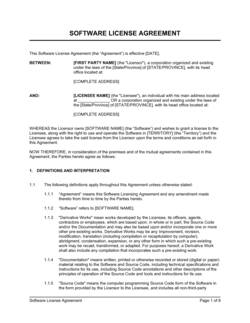
Custom Software Business Partnership Agreement Template

Free Word download β€’ Edit online β€’ Save & share with Drive β€’ Export to PDF

15 pagesβ€’30–45 min to fillβ€’Difficulty: Complexβ€’Signature requiredβ€’Legal review recommended
Learn more ↓
FreeCustom Software Business Partnership Agreement Template

At a glance

What it is
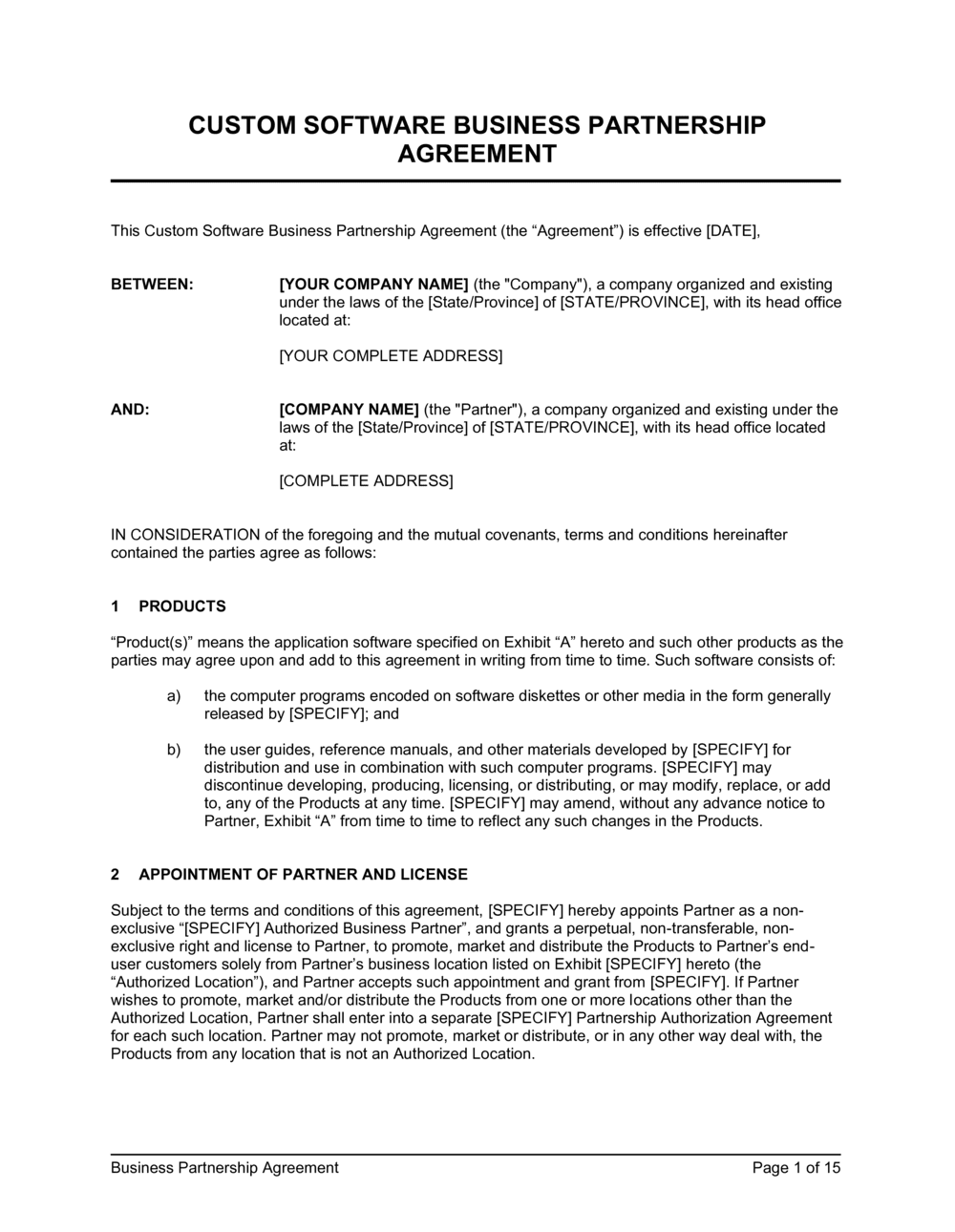
A Custom Software Business Partnership Agreement is a legally binding contract between two or more parties who agree to collaborate on building, launching, or commercializing a custom software product. This free Word download covers IP ownership, development responsibilities, revenue sharing, confidentiality, governance, and exit provisions in a single structured document you can edit online and export as PDF.
When you need it
Use it when two businesses or professionals are co-developing software, combining technical expertise with business or funding resources, or creating a software product to be jointly owned and monetized. It should be signed before any development work begins or any proprietary information is shared.
What's inside
Partner roles and capital contributions, IP ownership and assignment, software development milestones and acceptance criteria, revenue sharing and profit distribution, confidentiality obligations, liability and indemnification, dispute resolution, and partner exit or buyout terms.

What is a Custom Software Business Partnership Agreement?

A Custom Software Business Partnership Agreement is a legally binding contract between two or more parties who agree to co-develop, co-own, and commercially exploit a custom software product. It defines each partner's contributions β€” whether capital, labor, existing technology, or market access β€” and governs the critical issues that general business partnership templates do not address: IP ownership and assignment, development milestones and acceptance criteria, source code rights, revenue sharing mechanics, and what happens to the software when a partner exits. Unlike a software development agreement, where a client pays a vendor and retains full ownership, a partnership agreement creates a shared commercial relationship with mutual obligations and shared upside.

Why You Need This Document

Without a signed agreement in place before development begins, each party's legal position is dangerously unclear. In most jurisdictions, copyright in software vests automatically in the person who wrote the code β€” meaning the partner who funded the entire project may own nothing if there is no written IP assignment. Revenue disputes are equally common: a verbal 50/50 split means nothing if the parties disagree on which costs come out first. And when one partner wants to exit β€” through burnout, a competing opportunity, or a falling-out β€” the absence of a buyout formula routinely forces litigation that costs more than the software itself is worth. A properly drafted custom software business partnership agreement closes all of these gaps before they become disputes, protecting both the technical partner's IP and the business partner's investment from the first line of code through to the product's eventual sale or wind-down.

Which variant fits your situation?

If your situation is…Use this template
Two developers co-building a SaaS product with equal ownershipCustom Software Business Partnership Agreement
One party contributes code, another contributes funding and salesCustom Software Business Partnership Agreement
Hiring an external firm to build software you fully ownSoftware Development Agreement
Protecting code and business logic shared before a deal is signedNon-Disclosure Agreement (NDA)
Licensing your existing software to a partner for resaleSoftware License Agreement
Bringing on a technical co-founder with equity in an incorporated entityCo-Founder Agreement
Formalizing a joint venture between two incorporated companiesJoint Venture Agreement

Common mistakes to avoid

❌ Starting development before signing

Why it matters: Code, designs, and business logic shared before the agreement is signed may not be protected by the confidentiality or IP clauses, leaving each party exposed if the deal falls apart.

Fix: Execute the agreement β€” or at minimum a standalone NDA β€” before any proprietary information is shared or a single line of code is written.

❌ Leaving IP ownership ambiguous with no assignment clause

Why it matters: Without an explicit IP assignment or joint ownership provision, courts in the US, Canada, and UK may default to the creator retaining copyright β€” meaning the Business Partner who funded the software may own nothing.

Fix: Include a clear IP ownership clause that expressly assigns Project IP or declares joint ownership, and have the Developer Partner sign a work-made-for-hire or assignment addendum.

❌ No valuation method for partner buyouts

Why it matters: When a partner wants to exit and no formula exists, parties negotiate from opposed self-interest positions β€” disputes routinely end in litigation costing more than the software is worth.

Fix: Agree on a valuation methodology (revenue multiple, independent appraiser, or shotgun clause) and document it in the exit schedule before signing.

❌ Revenue split agreed without defining deductible costs

Why it matters: A 50/50 net revenue split that deducts only one partner's preferred costs effectively transfers profit to that partner β€” creating resentment and accounting disputes within the first year.

Fix: List every permissible deduction explicitly (hosting, processing fees, support salaries, agreed marketing spend) and require both partners to approve any new cost category.

❌ Background IP not carved out in Schedule C

Why it matters: Any pre-existing code, frameworks, or tools brought into the project by the Developer Partner may be inadvertently assigned to the partnership, stripping the developer of IP they use across multiple clients.

Fix: Prepare a background IP schedule before signing listing every pre-existing asset contributed, and confirm in the agreement that these are licensed to the partnership, not assigned.

❌ Dispute resolution clause limited to litigation in a single jurisdiction

Why it matters: When partners are in different states or countries, a litigation-only clause forces expensive cross-border proceedings β€” frequently costing more than the dispute itself to resolve.

Fix: Include a tiered dispute resolution clause: 30-day good-faith negotiation, then mediation, then binding arbitration in a neutral city β€” with a carve-out for emergency injunctive relief.

The 10 key clauses, explained

Parties, recitals, and definitions

In plain language: Identifies the legal names and roles of each partner, describes the purpose of the partnership, and defines key terms used throughout the agreement.

Sample language
This Custom Software Business Partnership Agreement ('Agreement') is entered into on [DATE] by and between [PARTNER A LEGAL NAME], a [ENTITY TYPE] organized under the laws of [STATE/JURISDICTION] ('Developer Partner'), and [PARTNER B LEGAL NAME], a [ENTITY TYPE] ('Business Partner'). The parties intend to collaborate on the development and commercialization of [SOFTWARE PRODUCT NAME] as described herein.

Common mistake: Using trade names or DBAs instead of the parties' full legal entity names β€” causing enforceability gaps if either party's identity is disputed.

Scope of the software project

In plain language: Describes what software is being built, the core features, platform, and intended market, and references a technical specification document where detailed requirements are documented.

Sample language
The Software shall consist of [BRIEF DESCRIPTION], designed for [TARGET PLATFORM] and serving [TARGET MARKET]. Detailed functional specifications are set out in Schedule A ('Specifications'), which may be amended by written consent of both parties.

Common mistake: Omitting a referenced specification document and relying solely on a vague description β€” creating disputes over what was actually agreed when features or scope change.

Partner contributions and responsibilities

In plain language: States what each partner brings to the arrangement β€” capital, labor, technology, IP, customer relationships, or market access β€” and what obligations each carries during the project.

Sample language
Developer Partner shall contribute [DEVELOPMENT SERVICES / EXISTING CODEBASE / TECHNICAL RESOURCES] valued at approximately $[AMOUNT]. Business Partner shall contribute $[CASH AMOUNT] in capital and [SALES / MARKETING / DISTRIBUTION] resources. Each party's obligations are set out in Schedule B.

Common mistake: Valuing non-cash contributions vaguely (e.g., 'substantial technical expertise') β€” making it impossible to determine the equity split or liability exposure when a partner underperforms.

IP ownership and assignment

In plain language: Allocates ownership of all software code, documentation, and related IP created during the partnership, distinguishing between jointly developed IP and each partner's pre-existing background IP.

Sample language
All IP created jointly under this Agreement ('Project IP') shall be owned [jointly / solely by PARTY] in the proportions set out in Schedule C. Each party retains sole ownership of its Background IP, which is licensed to the other party on a non-exclusive basis solely for the purposes of this Agreement. Developer Partner hereby irrevocably assigns to [OWNER] all right, title, and interest in Project IP.

Common mistake: Failing to define and carve out each party's background IP β€” allowing a partner to claim ownership over pre-existing code or tools that were only licensed into the project.

Development milestones and acceptance

In plain language: Sets out the build schedule as a series of dated milestones with specific deliverables, defines the acceptance testing process, and ties payment obligations to milestone completion.

Sample language
Development shall proceed in accordance with the milestone schedule in Schedule D. Upon delivery of each milestone, Business Partner shall have [14] days to review and either accept or provide written notice of deficiencies. Acceptance shall not be unreasonably withheld.

Common mistake: Setting milestones without specifying acceptance criteria β€” leaving the accepting party able to reject deliverables indefinitely on subjective grounds, stalling the project and payment.

Revenue sharing and profit distribution

In plain language: Defines how gross revenue from the software is divided between partners, how and when distributions are made, which costs are deducted before profit is calculated, and the accounting method used.

Sample language
Net Revenue shall be distributed [X]% to Developer Partner and [X]% to Business Partner, payable within [30] days of each calendar quarter-end. 'Net Revenue' means gross receipts from the Software less hosting costs, payment processing fees, and agreed sales commissions.

Common mistake: Agreeing on a revenue split without defining which costs are deducted first β€” turning a seemingly equal 50/50 split into an unequal arrangement once operational expenses are applied.

Confidentiality and non-solicitation

In plain language: Prohibits each partner from disclosing the other's proprietary information or soliciting their employees and key customers during and for a defined period after the partnership.

Sample language
Each party agrees to hold in strict confidence all Confidential Information of the other party and shall not disclose it to any third party without prior written consent. For [24] months following termination, neither party shall solicit the other's employees or key customers.

Common mistake: Including a confidentiality clause without a definition of 'Confidential Information' β€” allowing a party to argue that disclosed information was not covered because it was not explicitly marked confidential.

Liability, indemnification, and warranties

In plain language: Caps each partner's financial exposure to the other, specifies what each party warrants about its contributions, and sets out indemnification obligations for third-party claims.

Sample language
Each party's aggregate liability under this Agreement shall not exceed $[AMOUNT] or the total contributions made by the liable party, whichever is greater. Developer Partner warrants that the Software will not knowingly infringe any third-party IP. Each party shall indemnify the other against claims arising from its own breach or negligence.

Common mistake: Omitting a liability cap entirely β€” exposing one partner to unlimited damages claims if the software is involved in a data breach, IP infringement, or consequential loss dispute.

Term, termination, and exit

In plain language: States the initial term of the agreement, conditions for early termination (with and without cause), the notice required, and what happens to the software, IP, and revenues when a partner exits.

Sample language
This Agreement commences on [DATE] and continues for an initial term of [X] years, renewing automatically unless terminated on [90] days' written notice. Either party may terminate for cause upon [30] days' written notice if a material breach is uncured. Upon termination, the parties shall execute the exit procedures in Schedule E, including IP transfer and revenue wind-down.

Common mistake: No exit or buyout provision for scenarios where one partner wants out but the other wants to continue β€” forcing the parties into litigation to determine who keeps the software.

Dispute resolution and governing law

In plain language: Specifies the jurisdiction whose law governs the agreement, the process for resolving disputes (negotiation, mediation, then arbitration or litigation), and the venue for formal proceedings.

Sample language
This Agreement is governed by the laws of [STATE/COUNTRY]. Any dispute shall first be submitted to good-faith negotiation for [30] days, then to mediation administered by [ORGANIZATION], and if unresolved, to binding arbitration in [CITY] under the [AAA/JAMS/LCIA] rules, except for claims for injunctive relief.

Common mistake: Selecting a governing law jurisdiction with no connection to either party's location β€” creating enforcement difficulties and additional legal costs when a dispute arises.

How to fill it out

  1. 1

    Identify the parties and define their roles

    Enter the full legal name, entity type, and jurisdiction of incorporation for each partner. Label each party clearly (e.g., Developer Partner, Business Partner) to make obligations unambiguous throughout the document.

    πŸ’‘ Confirm entity names against your corporate registry β€” a mismatch between the contract name and the registered entity can void IP assignment clauses.

  2. 2

    Attach a detailed software specification as Schedule A

    Draft or attach a specification document describing the software's core features, platform, integrations, and acceptance criteria. Reference it in the scope clause rather than embedding technical detail in the agreement body.

    πŸ’‘ Version-control the specification separately from the agreement so scope changes can be documented by amendment without re-signing the full contract.

  3. 3

    Value and document each partner's contributions

    Assign a dollar value to each contribution β€” cash, labor, existing code, licenses, and market access. List contributions in Schedule B with agreed valuations and tie the equity or revenue split to those valuations.

    πŸ’‘ For non-cash technical contributions, use a conservative hourly rate (e.g., $150–$200/hr for senior development) and document the estimated hours in writing.

  4. 4

    Define IP ownership and carve out background IP

    Decide whether jointly developed IP is co-owned, assigned to one party, or held in a jointly owned entity. List each party's pre-existing background IP in Schedule C and confirm it is only licensed β€” not assigned β€” to the partnership.

    πŸ’‘ If one party is providing substantially all the technical work, consider assigning Project IP to them with a perpetual license back to the Business Partner, rather than joint ownership β€” joint ownership requires mutual consent for every future license deal.

  5. 5

    Set milestones with specific acceptance criteria

    Build a milestone schedule in Schedule D with dates, deliverables, and measurable acceptance criteria for each stage. Link milestone acceptance to payment triggers and IP vesting events.

    πŸ’‘ Include a 'deemed accepted' provision: if the Business Partner does not respond within the review window, the milestone is automatically accepted β€” this prevents indefinite delay tactics.

  6. 6

    Agree on the revenue formula and distribution mechanics

    Specify the revenue split percentage, define what costs are deducted before calculating net revenue, set the payment cycle (monthly or quarterly), and require quarterly financial statements to support distributions.

    πŸ’‘ Agree on a reserve fund β€” typically 10–15% of net revenue β€” retained to cover operating costs before distribution, to prevent cash flow disputes in growth periods.

  7. 7

    Draft the exit and buyout terms before signing

    Choose a valuation method for buyouts (e.g., 3Γ— trailing 12-month net revenue, or an independent appraiser), set the right-of-first-refusal period, and specify IP transfer obligations on exit.

    πŸ’‘ A shotgun clause β€” where one partner names a price, and the other must buy or sell at that price β€” is the most effective way to resolve deadlocks in 50/50 partnerships.

  8. 8

    Sign before sharing any code or confidential information

    Both parties must execute the agreement before any proprietary technical information, source code, or business data is exchanged. Post-disclosure signatures lose the confidentiality protection that predates signing.

    πŸ’‘ Use a timestamped e-signature service and store the executed agreement alongside the specification and contribution schedules in a shared secure folder accessible to both parties.

Frequently asked questions

What is a custom software business partnership agreement?

A custom software business partnership agreement is a legally binding contract between two or more parties who collaborate to build, own, and commercialize a custom software product. It governs IP ownership, development responsibilities, revenue sharing, confidentiality, and what happens when a partner exits. It is distinct from a general business partnership agreement because it specifically addresses software IP, development milestones, and technology ownership.

When should this agreement be signed?

It should be signed before any development work begins, before any proprietary code or business information is shared, and before any capital is contributed. Executing the agreement after these events have occurred weakens IP protections, may invalidate the confidentiality provisions for information shared earlier, and raises consideration issues in common-law jurisdictions that could affect the enforceability of restrictive clauses.

Who owns the software under a partnership agreement?

Ownership depends entirely on what the agreement says. Common structures include joint ownership (both partners hold an undivided interest), assignment to one party with a license back to the other, or ownership through a jointly held entity. Without an explicit clause, courts in most jurisdictions default to the creator retaining copyright β€” meaning the partner who funded but did not code the software may own nothing. Always specify ownership explicitly.

What is the difference between a software partnership agreement and a software development agreement?

A software development agreement is a client-contractor arrangement: one party pays another to build software the client owns. A software partnership agreement is a collaborative arrangement where both parties co-own, co-fund, or co-develop the software and share in its commercial success or losses. Partnership agreements require far more detailed governance β€” revenue sharing, exit rights, and IP co-ownership mechanics β€” than a standard development contract.

How should revenue be split in a software partnership?

There is no universal formula. Common approaches include splitting net revenue proportionate to each partner's financial and labor contribution (e.g., 60/40), paying the Developer Partner a hosting and maintenance fee off the top before splitting profit, or structuring tiered percentages that shift as the product reaches revenue milestones. The critical step is defining which costs are deducted before calculating the split β€” vague net revenue definitions are the most common source of partner disputes.

What happens when one partner wants to exit?

The exit clause governs this scenario. A well-drafted agreement specifies a valuation method (revenue multiple, independent appraisal, or shotgun clause), a right-of-first-refusal period giving the remaining partner the chance to buy the exiting partner's interest, and IP transfer obligations. Without these provisions, an exit requires negotiation from scratch β€” often resulting in litigation that can freeze the software's development or commercialization.

Is a software partnership agreement enforceable without a lawyer?

A template-based agreement is generally enforceable in most jurisdictions when properly completed and signed by authorized representatives of each party. However, for partnerships involving material IP value, cross-border partners, complex revenue structures, or equity stakes above $50,000, legal review is strongly recommended. Specific clauses β€” non-competes, IP assignments, and arbitration β€” have jurisdiction-specific enforceability requirements that a template alone cannot address for every scenario.

What is a source code escrow and do we need one?

A source code escrow arrangement deposits the software's source code with a neutral third party, who releases it to the non-developing partner if defined trigger events occur β€” typically the Developer Partner's insolvency, material breach, or cessation of business. It is not required but is strongly advisable when the Business Partner is funding development and does not have direct access to the codebase. Escrow typically costs $1,000–$3,000 per year to maintain.

What non-compete terms are typical in software partnership agreements?

Restrictions of 12–24 months following termination, limited to the specific market segment or product category addressed by the partnership software, are generally enforceable in most US states and Canadian provinces. Broader restrictions β€” covering all software development or all technology markets β€” are routinely struck down as unreasonable. In California and Minnesota, post-termination non-competes are largely unenforceable regardless of scope.

How this compares to alternatives

vs Software Development Agreement

A software development agreement is a client-contractor arrangement where one party pays another to build software the client fully owns. A partnership agreement creates shared ownership, shared risk, and shared commercial upside. If you are paying a developer as a vendor with no revenue sharing or co-ownership, use a development agreement β€” not a partnership agreement.

vs Joint Venture Agreement

A joint venture agreement governs a broader business collaboration between two entities, often creating a separate legal vehicle. A software partnership agreement is narrower β€” focused specifically on a single software product, its IP, and its revenue. Use a joint venture agreement when the partnership extends beyond one product into shared operations, branding, or a jointly incorporated entity.

vs Non-Disclosure Agreement

An NDA protects confidential information shared during negotiations or evaluation β€” it creates no ownership rights, revenue obligations, or governance structure. A software partnership agreement includes confidentiality provisions but also governs IP, milestones, and exit. Use an NDA before the partnership is agreed, and replace it with the partnership agreement once terms are finalized.

vs Software License Agreement

A software license agreement grants one party the right to use software owned by another, without transferring ownership or creating a shared commercial relationship. A partnership agreement creates joint development obligations and shared IP rights. If you are distributing or reselling existing software rather than co-building new software, a license agreement is the correct instrument.

Industry-specific considerations

SaaS / Technology

MRR-based revenue sharing, versioned IP schedules covering APIs and SDKs, source code escrow requirements, and cloud infrastructure cost allocation before profit distribution.

Healthcare / MedTech

HIPAA compliance obligations incorporated by reference, data processing addenda required alongside the agreement, FDA software classification considerations, and enhanced IP protection for clinical algorithms.

Financial Services / Fintech

Regulatory licensing conditions as prerequisites to commercialization, PCI-DSS and SOC 2 compliance obligations written into acceptance criteria, and enhanced liability caps for data breach scenarios.

Professional Services

Client non-solicitation clauses critical given direct customer relationships, milestone-linked payment structures aligned to billable project phases, and IP carve-outs protecting proprietary methodologies contributed by each partner.

Jurisdictional notes

United States

IP assignment must be express and in writing to transfer copyright under the US Copyright Act β€” oral assignments are not recognized. The work-made-for-hire doctrine applies narrowly to software commissioned under written agreement; without that designation, the developer retains copyright. Non-compete enforceability varies sharply by state β€” California and Minnesota ban most post-termination restrictions. Partnership agreements without a governing entity may inadvertently create a general partnership, exposing both parties to unlimited joint liability.

Canada

Copyright in software vests in the author by default under the Copyright Act; assignment requires a written instrument signed by the assignor. Partnerships in Canada are governed by provincial partnership statutes β€” an unincorporated software partnership may expose partners to joint and several liability under applicable provincial law. Quebec partnerships are governed by the Civil Code of Quebec, which differs materially from common-law provinces. Non-compete clauses must be reasonable in scope and duration; Quebec courts apply a particularly strict reasonableness standard.

United Kingdom

Under the Copyright, Designs and Patents Act 1988, software created by an employee in the course of employment belongs to the employer, but software created by a contractor belongs to the contractor unless assigned. Assignment must be in writing and signed. Post-Brexit, EU software-related directives no longer apply automatically in the UK. IR35 rules may apply where a partner operates through a personal service company, affecting tax treatment of contributions.

European Union

The Software Directive (2009/24/EC) provides that copyright in software created by employees belongs to the employer; contractor-created software requires express assignment. GDPR applies where the software processes personal data β€” a Data Processing Agreement is typically required alongside the partnership agreement. Post-termination non-competes generally require financial compensation to the restricted party to be enforceable, with compensation requirements ranging from 25–100% of salary depending on the member state.

Template vs lawyer β€” what fits your deal?

PathBest forCostTime
Use the templateEarly-stage partnerships between known collaborators building software with a combined value under $50,000Free1–3 hours to complete
Template + legal reviewPartnerships involving meaningful IP, cross-border parties, revenue above $100K, or equity-linked arrangements$500–$1,500 for a technology lawyer review3–5 business days
Custom draftedEnterprise co-development deals, regulated-industry software (healthcare, fintech), or partnerships involving significant equity and exit provisions$2,500–$8,000+2–4 weeks

Glossary

IP Assignment
A clause that transfers ownership of software, code, or related intellectual property from one party (or jointly) to a defined owner under the agreement.
Joint Ownership
An arrangement where two or more parties each hold an undivided interest in the same IP β€” typically requiring mutual consent for licensing or sale.
Development Milestone
A defined deliverable or stage in the software build process, used to trigger payments, ownership vesting, or partner obligations.
Acceptance Criteria
Specific, measurable conditions a software deliverable must meet before the receiving party is obligated to accept and pay for it.
Revenue Sharing
A contractual formula dividing gross or net revenue from the software product between partners, expressed as a fixed percentage or tiered structure.
Profit Distribution
The process of allocating net income β€” after costs, fees, and reserves β€” to partners according to their agreed percentage or contribution ratio.
Escrow (Source Code)
An arrangement where source code is deposited with a neutral third party and released to the non-developing partner if defined trigger events occur, such as insolvency.
Non-Compete Clause
A restriction preventing a partner from developing or commercializing a competing software product within a defined time and market during or after the partnership.
Buyout Provision
A clause giving one partner the right β€” or obligation β€” to purchase the other's interest at a defined valuation method upon exit, dissolution, or triggering events.
Governing Law
The jurisdiction whose laws apply to the interpretation and enforcement of the agreement, regardless of where the parties are located.
Work Made for Hire
A US copyright doctrine classifying certain commissioned work as belonging to the hiring party rather than the creator β€” applicable when the agreement expressly designates the work as such.

Part of your Business Operating System

This document is one of 3,000+ business & legal templates included in Business in a Box.

  • Fill-in-the-blanks β€” ready in minutes
  • 100% customizable Word document
  • Compatible with all office suites
  • Export to PDF and share electronically

Create your document in 3 simple steps.

From template to signed document β€” all inside one Business Operating System.
1
Download or open template

Access over 3,000+ business and legal templates for any business task, project or initiative.

2
Edit and fill in the blanks with AI

Customize your ready-made business document template and save it in the cloud.

3
Save, Share, Send, Sign

Share your files and folders with your team. Create a space of seamless collaboration.

Save time, save money, and create top-quality documents.

β˜…β˜…β˜…β˜…β˜…

"Fantastic value! I'm not sure how I'd do without it. It's worth its weight in gold and paid back for itself many times."

Managing Director Β· Mall Farm
Robert Whalley
Managing Director, Mall Farm Proprietary Limited
β˜…β˜…β˜…β˜…β˜…

"I have been using Business in a Box for years. It has been the most useful source of templates I have encountered. I recommend it to anyone."

Business Owner Β· 4+ years
Dr Michael John Freestone
Business Owner
β˜…β˜…β˜…β˜…β˜…

"It has been a life saver so many times I have lost count. Business in a Box has saved me so much time and as you know, time is money."

Owner Β· Upstate Web
David G. Moore Jr.
Owner, Upstate Web

Run your business with a system β€” not scattered tools

Stop downloading documents. Start operating with clarity. Business in a Box gives you the Business Operating System used by over 250,000 companies worldwide to structure, run, and grow their business.

Start freeΒ Β·Β No credit card required