Partnership Agreement Template

Free Word download • Edit online • Save & share with Drive • Export to PDF

8 pages30–40 min to fillDifficulty: ComplexSignature requiredLegal review recommended
Learn more ↓
FreePartnership Agreement Template

At a glance

What it is
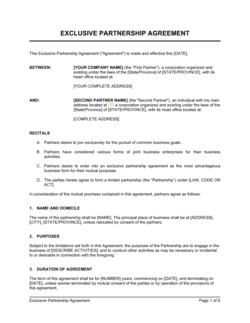
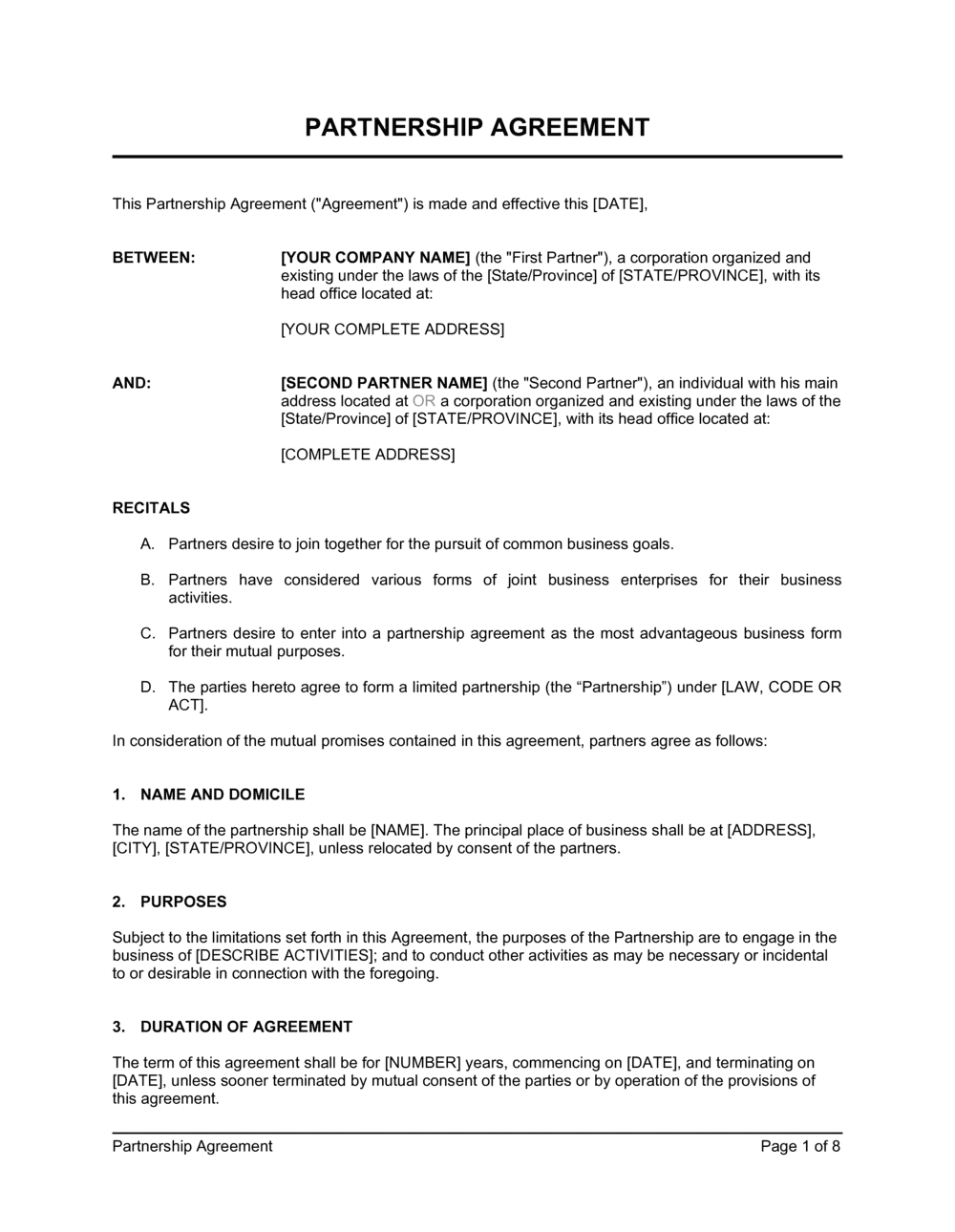
A Partnership Agreement is a legally binding contract between two or more business partners that defines the terms of their relationship — capital contributions, profit and loss sharing, management authority, decision rights, transfer restrictions, and dissolution procedures. This free Word download covers both general and limited partnership structures and can be edited online and exported as PDF before execution.
When you need it
Use it when two or more people or entities are forming a business together and need enforceable rules governing how decisions are made, how money flows, and what happens if a partner wants to leave or the business winds down. Without one, most jurisdictions apply default partnership rules by statute — which rarely match what the partners actually intended.
What's inside
Partner identities and capital contributions, profit and loss allocation ratios, management roles and voting rights, decision-making thresholds, transfer and admission restrictions, dispute resolution procedures, partner withdrawal and buyout mechanics, and dissolution and wind-down provisions.

What is a Partnership Agreement?

A Partnership Agreement is a legally binding contract between two or more partners that governs every material dimension of their shared business: capital contributions, ownership percentages, profit and loss allocation, management authority, voting rights, transfer restrictions, partner exit and buyout mechanics, and the process for winding down the business. Without a written agreement, the partnership is governed entirely by the default rules of the applicable partnership statute — which typically impose equal profit splits and equal voting rights regardless of how much each partner contributed or how much work they actually do. A well-drafted agreement replaces those defaults with rules the partners actually agreed to, before the moment of disagreement arrives.

Why You Need This Document

The cost of operating a partnership without a written agreement emerges precisely when you can least afford it — a partner wants to leave, a major decision produces a deadlock, or the business receives an acquisition offer that not everyone wants to accept. At that point, negotiating terms from scratch means negotiating against someone whose incentives now diverge from yours. Partners who contributed unequal capital, skills, or time discover that the statute treats them identically. A departing partner can demand a court-supervised buyout valuation. A deadlocked 50/50 partnership can be judicially dissolved even when both partners would prefer the business to continue. A signed partnership agreement, executed before any money changes hands, locks in your agreed rules on all of these issues — and gives you a contractual basis to enforce them rather than litigating the intent behind a handshake.

Which variant fits your situation?

If your situation is…Use this template
Two or more partners sharing management and full personal liabilityGeneral Partnership Agreement
One general partner managing operations and limited partners providing capital onlyLimited Partnership Agreement
Professional partners seeking limited liability similar to an LLCLimited Liability Partnership Agreement
Two parties collaborating on a single project without a permanent entityJoint Venture Agreement
Partners who also need a shareholder agreement for a corporationShareholders Agreement
Solo founder converting an existing business into a partnershipBusiness Purchase Agreement
Partners winding down and dissolving the partnershipPartnership Dissolution Agreement

Common mistakes to avoid

❌ Relying on the statutory default rules

Why it matters: Most jurisdictions default to equal profit splits and equal management rights regardless of contribution differences — a 90% capital contributor gets the same vote and profit share as a 10% contributor if the agreement is silent.

Fix: Specify profit allocation, voting weights, and management authority explicitly in the agreement so the partnership runs on your rules, not the state's defaults.

❌ No deadlock mechanism in a 50/50 partnership

Why it matters: An evenly split partnership where partners disagree on a material decision has no path forward — courts can and do order judicial dissolution, destroying the business to resolve a dispute both partners could have survived.

Fix: Include a tiered escalation clause: first good-faith negotiation, then mediation, then a buy-sell (shotgun) provision that forces one partner to buy out the other at a stated price.

❌ Omitting a tax distribution requirement

Why it matters: Partnership income passes through to partners' personal tax returns whether or not cash was distributed. Partners can owe five- or six-figure tax bills on profits that were reinvested in the business.

Fix: Add a mandatory tax distribution clause requiring the partnership to distribute at least enough cash annually to cover each partner's estimated tax liability on their allocated share of income.

❌ No buyout formula or an ambiguous one

Why it matters: When a partner wants to exit and the agreement says only 'fair market value without specifying who determines it or how disagreements are resolved, every exit becomes a negotiation that defaults to litigation.

Fix: Name the pricing mechanism precisely — trailing 12-month EBITDA × a stated multiple, or appraisal by a named firm with a defined tiebreaker process — and include a payment schedule with an interest rate on deferred amounts.

❌ Signing after capital has already been contributed

Why it matters: Partners who have already invested money or begun work have given up nothing new. In common-law jurisdictions, post-contribution restrictions (non-compete, transfer limits) signed without fresh consideration may be unenforceable.

Fix: Execute the agreement before any partner transfers cash, property, or services to the partnership. If circumstances require a later signature, document the specific additional consideration being provided.

❌ No continuation election clause on partner death or bankruptcy

Why it matters: Under most state and provincial partnership statutes, the death, disability, or bankruptcy of a general partner automatically dissolves the partnership — even if the remaining partners want to continue and the business is thriving.

Fix: Include a clause giving remaining partners a defined window (typically 90 days) to elect to continue the partnership and admit a substitute partner, preventing automatic dissolution.

The 10 key clauses, explained

Parties, partnership name, and formation

In plain language: Identifies each partner by legal name, establishes the partnership's official name and principal place of business, and records the formation date and type (general or limited).

Sample language
This Partnership Agreement is entered into as of [DATE] by and among [PARTNER 1 FULL NAME] ('Partner 1'), [PARTNER 2 FULL NAME] ('Partner 2'), and [PARTNER 3 FULL NAME] ('Partner 3') (collectively, 'Partners'). The Partners hereby form a [general / limited] partnership under the name '[PARTNERSHIP NAME]' with its principal office at [ADDRESS].

Common mistake: Using informal names or nicknames instead of legal names. If a dispute reaches court, enforcing the agreement against a party whose name doesn't match their government ID creates procedural delays.

Capital contributions and ownership interests

In plain language: Records each partner's initial contribution — cash, property, or services — and the corresponding ownership percentage they receive in return.

Sample language
Partner 1 shall contribute $[AMOUNT] in cash on or before [DATE] in exchange for a [X]% interest. Partner 2 shall contribute [DESCRIPTION OF PROPERTY OR SERVICES] valued at $[AMOUNT] in exchange for a [Y]% interest. Ownership interests are set out in Schedule A.

Common mistake: Valuing non-cash contributions without a written appraisal or agreed methodology. An undocumented property or service contribution becomes a dispute trigger when profits are distributed or the partnership dissolves.

Profit and loss allocation

In plain language: Sets the percentage or formula by which net profits and losses are divided among partners each fiscal year, which may or may not match ownership percentages.

Sample language
Net profits and losses of the Partnership shall be allocated among the Partners in proportion to their respective ownership interests as set out in Schedule A, unless the Partners unanimously agree in writing to a different allocation for a given fiscal year.

Common mistake: Defaulting to equal splits without considering unequal contributions or workloads. Courts apply the statutory default (equal shares) if the agreement is silent — which rarely reflects what partners actually intended.

Distributions

In plain language: Specifies when and how cash or property is paid out to partners, and whether any minimum distributions are required to cover tax liabilities on allocated income.

Sample language
The Partnership shall make distributions to Partners [quarterly / annually] as determined by a [majority / unanimous] vote of the Partners. In any year in which taxable income is allocated to a Partner, the Partnership shall make a tax distribution equal to [X]% of such Partner's allocated taxable income no later than [March 15].

Common mistake: Omitting a tax distribution requirement. Partners in a pass-through entity owe personal income tax on allocated profits whether or not cash is distributed — leaving them with a tax bill and no cash to pay it.

Management authority and voting rights

In plain language: Defines who manages day-to-day operations, what decisions require a vote, and the voting threshold required for ordinary versus major decisions.

Sample language
Day-to-day management authority is vested in [MANAGING PARTNER NAME / all General Partners]. Decisions requiring a [majority / supermajority of X%] vote include [LIST]. Decisions requiring unanimous consent include: admitting a new partner, amending this Agreement, selling substantially all partnership assets, or incurring debt exceeding $[AMOUNT].

Common mistake: Using a flat majority vote for all decisions regardless of materiality. A 51%-partner can then unilaterally take actions — like selling assets or taking on debt — that a minority partner reasonably expected would require consensus.

Transfer restrictions and right of first refusal

In plain language: Prohibits partners from selling or transferring their interest to an outside party without first offering it to the existing partners on the same terms.

Sample language
No Partner may sell, assign, pledge, or otherwise transfer all or any portion of their interest without the prior written consent of all other Partners. Before any proposed transfer, the transferring Partner must offer the interest to remaining Partners pro rata at the same price and terms offered by the third-party purchaser ('Right of First Refusal'), exercisable within [30] days of written notice.

Common mistake: No transfer restriction at all. Without one, a partner can sell their interest to a competitor, creditor, or estranged family member — giving a stranger decision rights and a claim on profits.

Partner withdrawal, retirement, and buyout

In plain language: Sets the notice period and pricing formula when a partner voluntarily exits, and distinguishes voluntary exit from death, disability, or expulsion.

Sample language
A Partner may withdraw upon [90] days' written notice. The withdrawing Partner's interest shall be purchased by the remaining Partners at a price equal to [FORMULA: e.g., trailing 12-month EBITDA × [X] multiple, or appraised fair market value]. Payment shall be made in [lump sum / installments over X months].

Common mistake: No buyout formula — or a formula that triggers a third-party appraisal without specifying who pays for it or what happens if appraisers disagree. Ambiguity here produces years of litigation.

Dispute resolution

In plain language: Specifies the escalation path for partner disputes — internal negotiation first, then mediation, then binding arbitration — and the seat and rules for arbitration.

Sample language
In the event of a dispute, the Partners shall first attempt good-faith negotiation for [30] days. If unresolved, the dispute shall be submitted to non-binding mediation. If mediation fails, the dispute shall be resolved by binding arbitration administered by [AAA / JAMS] under its Commercial Arbitration Rules, in [CITY, STATE], with one arbitrator. The arbitrator's award shall be final and may be entered as a judgment in any court of competent jurisdiction.

Common mistake: Omitting a deadlock-resolution mechanism for 50/50 partnerships. Without a tie-breaking process, an evenly split partnership can become legally inoperable, forcing an expensive court-supervised dissolution.

Non-compete and non-solicitation

In plain language: Restricts partners from competing with the partnership or soliciting its customers and employees during the partnership and for a defined period after exit.

Sample language
During the term of this Agreement and for [24] months following a Partner's exit, no departing Partner shall (a) engage in a business that directly competes with the Partnership within [GEOGRAPHIC AREA], or (b) solicit any customer, client, employee, or contractor of the Partnership.

Common mistake: Applying an identical restriction to a limited partner with no management role. Courts view restrictions on passive investors with skepticism and are more likely to strike them down as unreasonable.

Dissolution and wind-down

In plain language: States the events that trigger dissolution, the process for winding up operations, settling liabilities, and distributing remaining assets to partners in the correct priority.

Sample language
The Partnership shall dissolve upon: (a) unanimous written consent of all Partners; (b) the sale of all or substantially all partnership assets; (c) entry of a judicial dissolution order; or (d) the death, disability, bankruptcy, or expulsion of a General Partner, unless remaining Partners elect to continue within [90] days. Upon dissolution, assets shall be applied in the following order: (1) creditors, (2) Partner loans, (3) return of capital contributions, (4) remaining balance per ownership percentages.

Common mistake: No continuation election clause. Without one, the death or bankruptcy of a single general partner automatically dissolves the entire partnership under most state statutes — even if the remaining partners want to continue.

How to fill it out

  1. 1

    Identify all partners and the partnership type

    Enter each partner's full legal name, address, and entity type (individual or company). Decide whether the partnership is general (all partners share management and liability) or limited (one GP manages; LPs are passive capital contributors).

    💡 Confirm the legal name of any corporate partner against its current certificate of incorporation — name mismatches delay enforcement.

  2. 2

    Document capital contributions in Schedule A

    List each partner's initial cash contribution, the agreed value of any non-cash contribution (property, IP, or services), and the resulting ownership percentage. Attach supporting appraisals or valuation memos for non-cash items.

    💡 Get an independent valuation for any non-cash contribution above $10,000 — an undocumented valuation is the first thing challenged when a partner exits unhappy.

  3. 3

    Set the profit and loss allocation formula

    State the percentage or formula for dividing net profits and losses annually. Consider whether allocations should match ownership percentages, reflect actual hours contributed, or use a tiered waterfall for preferred returns.

    💡 If allocations differ from ownership percentages, have an accountant confirm the arrangement satisfies the IRS substantial economic effect rules under IRC §704(b).

  4. 4

    Define management authority and voting thresholds

    Name the managing partner (if any), list decisions reserved for majority vote, and specify which decisions require unanimous consent. Common unanimous-consent items: admitting a new partner, amending the agreement, selling major assets, and taking on debt above a set threshold.

    💡 For 50/50 partnerships, add a deadlock mechanism — a designated tiebreaker, a mandatory mediation window, or a buy-sell (shotgun) clause — before you need it.

  5. 5

    Draft the transfer restrictions and right of first refusal

    Prohibit transfers without partner consent and set out the ROFR process: notice period (typically 30 days), pricing mechanism, and what happens if the remaining partners decline to exercise.

    💡 Set the ROFR exercise window at 30 days — shorter creates pressure; longer lets the third-party offer expire before partners can respond.

  6. 6

    Establish the buyout formula and payment terms

    Choose a pricing mechanism for partner exits: trailing EBITDA multiple, appraised fair market value, or book value. State whether payment is in a lump sum or installments, and specify any security (promissory note, UCC filing) for deferred payments.

    💡 Installment buyouts should include an interest rate on deferred amounts — otherwise the selling partner is effectively providing an interest-free loan to the remaining partners.

  7. 7

    Complete the dispute resolution and governing law sections

    Select the arbitration administrator (AAA or JAMS), seat, and number of arbitrators. Confirm the governing law matches the state or province where the partnership is registered and operates.

    💡 For partnerships with partners in multiple states, choose the governing law of the state where the primary business operates — not the state that simply has favorable laws in the abstract.

  8. 8

    Execute before any partner contributes capital or begins work

    All partners must sign the agreement before any capital is transferred or business operations begin. Attach Schedule A (capital contributions), obtain signatures with dates, and store fully executed copies with each partner.

    💡 Use Business in a Box eSign to create a timestamped execution record — execution date is often the deciding factor in disputes over whether the agreement was in force when a problem arose.

Frequently asked questions

What is a partnership agreement?

A partnership agreement is a legally binding contract between two or more partners that governs their business relationship — capital contributions, profit and loss sharing, management authority, decision-making thresholds, transfer restrictions, and what happens when a partner exits or the business winds down. Without one, the partnership is governed by the default rules of the applicable partnership statute, which rarely reflect what the partners actually intended.

Is a partnership agreement legally required?

In most jurisdictions, a written partnership agreement is not legally required to form a partnership — a partnership can arise by conduct alone. However, operating without a written agreement means the partnership is governed entirely by statutory default rules, which typically impose equal profit splits and equal voting rights regardless of unequal contributions. A written agreement is strongly recommended for any partnership with more than minimal stakes.

What is the difference between a general partnership and a limited partnership?

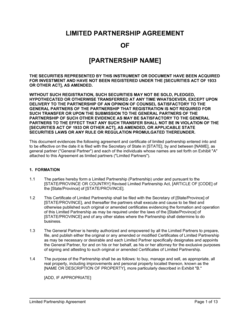
In a general partnership, all partners share management responsibility and bear unlimited personal liability for the debts and obligations of the business. In a limited partnership, at least one general partner manages the business and carries unlimited liability, while one or more limited partners contribute capital but have no management role and their liability is capped at their investment. Most real estate funds, private equity vehicles, and family investment structures use the limited partnership form.

What should a partnership agreement include?

A complete partnership agreement covers: partner identities and capital contributions, ownership percentages, profit and loss allocation formula, distribution schedule and tax distribution requirements, management authority and voting thresholds, transfer restrictions and right of first refusal, partner withdrawal and buyout mechanics, non-compete and non-solicitation restrictions, dispute resolution and deadlock procedures, and dissolution and wind-down provisions. Missing any of these creates gaps that default to statutory rules or court interpretation.

How are profits split in a partnership?

Profits are split however the partners agree in the partnership agreement. Common approaches include splitting in proportion to ownership percentage, splitting equally regardless of ownership, or using a tiered waterfall that first returns contributed capital before splitting residual profits. If the agreement is silent, most jurisdictions default to equal splits among all partners regardless of their capital contributions or workload.

What happens if a partner wants to leave the partnership?

The process depends entirely on what the partnership agreement says. A well-drafted agreement sets a notice period, a pricing formula for the departing partner's interest (such as an EBITDA multiple or appraised value), a right of first refusal for remaining partners, and a payment schedule. Without these provisions, the departing partner and the remaining partners are left to negotiate from scratch — which frequently results in litigation or forced dissolution.

Can a partnership agreement prevent a partner from competing with the business?

Yes, a partnership agreement can include non-compete and non-solicitation clauses that restrict partners from competing during and after their involvement. Enforceability depends on jurisdiction and scope — courts in most US states, Canada, and the UK will enforce restrictions that are reasonable in duration (typically 12–24 months), geographic area, and breadth of activity. California and a handful of other states restrict non-competes significantly. Restrictions on passive limited partners with no competitive knowledge are generally harder to enforce.

Do I need a lawyer to draft a partnership agreement?

For straightforward two-partner businesses with equal contributions and simple structures, a high-quality template is a sound starting point. Engage a lawyer when the partnership involves unequal capital contributions above $50,000, a limited partnership structure, real estate or fund investments, cross-border partners, or material non-compete requirements. A 2–4 hour legal review typically costs $600–$1,500 and is worthwhile any time the financial stakes exceed a few months of operating income.

What happens to a partnership when a partner dies?

Under most partnership statutes, the death of a general partner automatically triggers dissolution of the partnership unless the agreement provides otherwise. A continuation election clause — giving remaining partners 90 days to elect to continue and admit a substitute partner — prevents automatic wind-down. Without this clause, a single partner's death can legally force the liquidation of a profitable business.

How this compares to alternatives

vs Shareholders Agreement

A shareholders agreement governs ownership rights inside a corporation — share classes, board seats, drag-along and tag-along rights, and dividend policy. A partnership agreement performs the same function for an unincorporated partnership. The key distinction is liability: shareholders have limited liability by default; general partners do not. Choose a shareholders agreement when operating through a corporation and a partnership agreement when the entity is a general or limited partnership.

vs Joint Venture Agreement

A joint venture agreement structures a time-limited collaboration on a specific project between two or more parties who otherwise operate independently. A partnership agreement creates an ongoing business entity with shared operations, pooled capital, and continuing obligations. Use a joint venture agreement for a single deal or project; use a partnership agreement when the parties intend to operate together as a permanent business.

vs LLC Operating Agreement

An LLC operating agreement governs a limited liability company — a structure that combines partnership-style pass-through taxation with corporate-style limited liability for all members. A partnership agreement governs an entity where general partners retain personal liability. For most new ventures, an LLC operating agreement provides greater liability protection; a partnership agreement is appropriate when the partners specifically require or prefer the partnership structure for tax, regulatory, or investor reasons.

vs Independent Contractor Agreement

An independent contractor agreement engages a self-employed individual for defined work without creating a partnership, shared ownership, or profit-sharing arrangement. A partnership agreement creates a co-owned business relationship with shared liability and mutual fiduciary duties. Using a contractor agreement where a partnership actually exists exposes both parties to unintended tax and liability consequences — if two parties share profits and losses and make joint decisions, most jurisdictions will treat them as partners regardless of what the document is called.

Industry-specific considerations

Professional services

Law firms, accounting practices, and medical groups rely on partnership agreements to govern equity admission, client non-solicitation, and mandatory retirement provisions for senior partners.

Real estate

Real estate partnerships require detailed waterfall distribution clauses, preferred return thresholds, capital call mechanics, and manager compensation tied to asset performance.

Technology and SaaS

Tech co-founders using a partnership structure need strong IP ownership clauses, vesting-equivalent contribution schedules, and transfer restrictions to prevent a departing founder from taking IP ownership with them.

Retail and food and beverage

Multi-location retail and restaurant partnerships require clear management authority per location, separate capital accounts for each site, and buyout provisions tied to location-level valuation rather than enterprise-wide appraisal.

Jurisdictional notes

United States

General partnerships are governed by state law — most states follow the Uniform Partnership Act (UPA) or Revised Uniform Partnership Act (RUPA). Without a written agreement, default rules apply equal profit splits and equal voting rights. Limited partnerships are governed by the Uniform Limited Partnership Act (ULPA). Non-compete enforceability varies sharply by state; California effectively prohibits post-exit non-competes among partners. The agreement should specify the governing state, as interstate partnership disputes default to the state where the partnership is principally located.

Canada

Each province has its own Partnership Act; Ontario, British Columbia, and Alberta are the most commonly applicable. Without a written agreement, provincial defaults impose equal profit shares regardless of contribution. Limited partnerships require formal registration under provincial limited partnership legislation. Quebec partnerships are governed by the Civil Code of Quebec, and any agreement intended to apply in Quebec should be available in French for provincially regulated entities. Non-competes are enforceable if reasonable in scope, duration, and geography.

United Kingdom

General partnerships are governed by the Partnership Act 1890, which imposes equal profit shares and unlimited joint liability by default. Limited partnerships are registered under the Limited Partnerships Act 1907 with Companies House. Limited Liability Partnerships (LLPs) — a popular structure for professional services firms — are governed by the Limited Liability Partnerships Act 2000 and are treated as separate legal entities. Post-exit restrictive covenants are enforceable if reasonable and supported by legitimate business interests. Written agreements are not required by law but are strongly recommended given the 1890 Act defaults.

European Union

Partnership law is governed at the member-state level with no EU-wide partnership statute. Germany (GbR, OHG, KG), France (SNC, SCS), and the Netherlands (VOF, CV) each have distinct partnership forms and statutory defaults. GDPR applies to any partnership processing personal data of EU residents, requiring appropriate data handling clauses. Post-employment and post-exit non-competes typically require financial compensation to the restricted partner to be enforceable — requirements range from 25% to 100% of average annual income depending on the member state. Cross-border EU partnerships should specify governing law under Rome I Regulation.

Template vs lawyer — what fits your deal?

PathBest forCostTime
Use the templateTwo partners with equal contributions, straightforward profit splits, and a domestic US or Canadian business below $250K in annual revenueFree1–2 hours
Template + legal reviewUnequal contributions, three or more partners, limited partnership structures, or any partnership with non-compete or IP assignment requirements$600–$1,5003–7 days
Custom draftedReal estate funds, professional services firms with equity admission ladders, cross-border partners, or partnerships raising outside capital$2,500–$8,000+2–4 weeks

Glossary

General Partner
A partner who participates in management and bears unlimited personal liability for the debts and obligations of the partnership.
Limited Partner
A partner whose liability is capped at the amount of their capital contribution; they typically have no management authority.
Capital Contribution
The cash, property, services, or other assets a partner contributes to the partnership in exchange for their ownership interest.
Profit and Loss Allocation
The percentage or formula by which net profits and losses are divided among partners, which need not match ownership percentages.
Distributions
Cash or property paid out to partners from partnership earnings, as distinct from salary or guaranteed payments.
Fiduciary Duty
The legal obligation of each partner to act in the best interests of the partnership, including duties of loyalty and care.
Right of First Refusal
A clause giving existing partners the right to purchase a departing partner's interest before it can be sold to an outside party.
Buyout Clause
A provision specifying the mechanism and price formula by which the remaining partners can purchase a departing or expelled partner's interest.
Deadlock
A situation in which partners are evenly split on a material decision and neither side can force a resolution without a tie-breaking mechanism.
Dissolution
The formal process of winding down partnership operations, settling liabilities, liquidating assets, and distributing remaining proceeds to partners.
Guaranteed Payment
A fixed payment made to a partner for services or capital regardless of whether the partnership has profits — treated as a business expense.
Partner Basis
A partner's tax cost in their partnership interest, which determines gain or loss on sale and the deductibility of losses.

Part of your Business Operating System

This document is one of 3,000+ business & legal templates included in Business in a Box.

  • Fill-in-the-blanks — ready in minutes
  • 100% customizable Word document
  • Compatible with all office suites
  • Export to PDF and share electronically

Create your document in 3 simple steps.

From template to signed document — all inside one Business Operating System.
1
Download or open template

Access over 3,000+ business and legal templates for any business task, project or initiative.

2
Edit and fill in the blanks with AI

Customize your ready-made business document template and save it in the cloud.

3
Save, Share, Send, Sign

Share your files and folders with your team. Create a space of seamless collaboration.

Save time, save money, and create top-quality documents.

★★★★★

"Fantastic value! I'm not sure how I'd do without it. It's worth its weight in gold and paid back for itself many times."

Managing Director · Mall Farm
Robert Whalley
Managing Director, Mall Farm Proprietary Limited
★★★★★

"I have been using Business in a Box for years. It has been the most useful source of templates I have encountered. I recommend it to anyone."

Business Owner · 4+ years
Dr Michael John Freestone
Business Owner
★★★★★

"It has been a life saver so many times I have lost count. Business in a Box has saved me so much time and as you know, time is money."

Owner · Upstate Web
David G. Moore Jr.
Owner, Upstate Web

Run your business with a system — not scattered tools

Stop downloading documents. Start operating with clarity. Business in a Box gives you the Business Operating System used by over 250,000 companies worldwide to structure, run, and grow their business.

Start free · No credit card required