Checklist Partnership Agreement

Free download β€’ Use as a template β€’ Print or share

2 pagesβ€’20–25 min to useβ€’Difficulty: Standard
Learn more ↓
FreeChecklist Partnership Agreement Template

At a glance

What it is
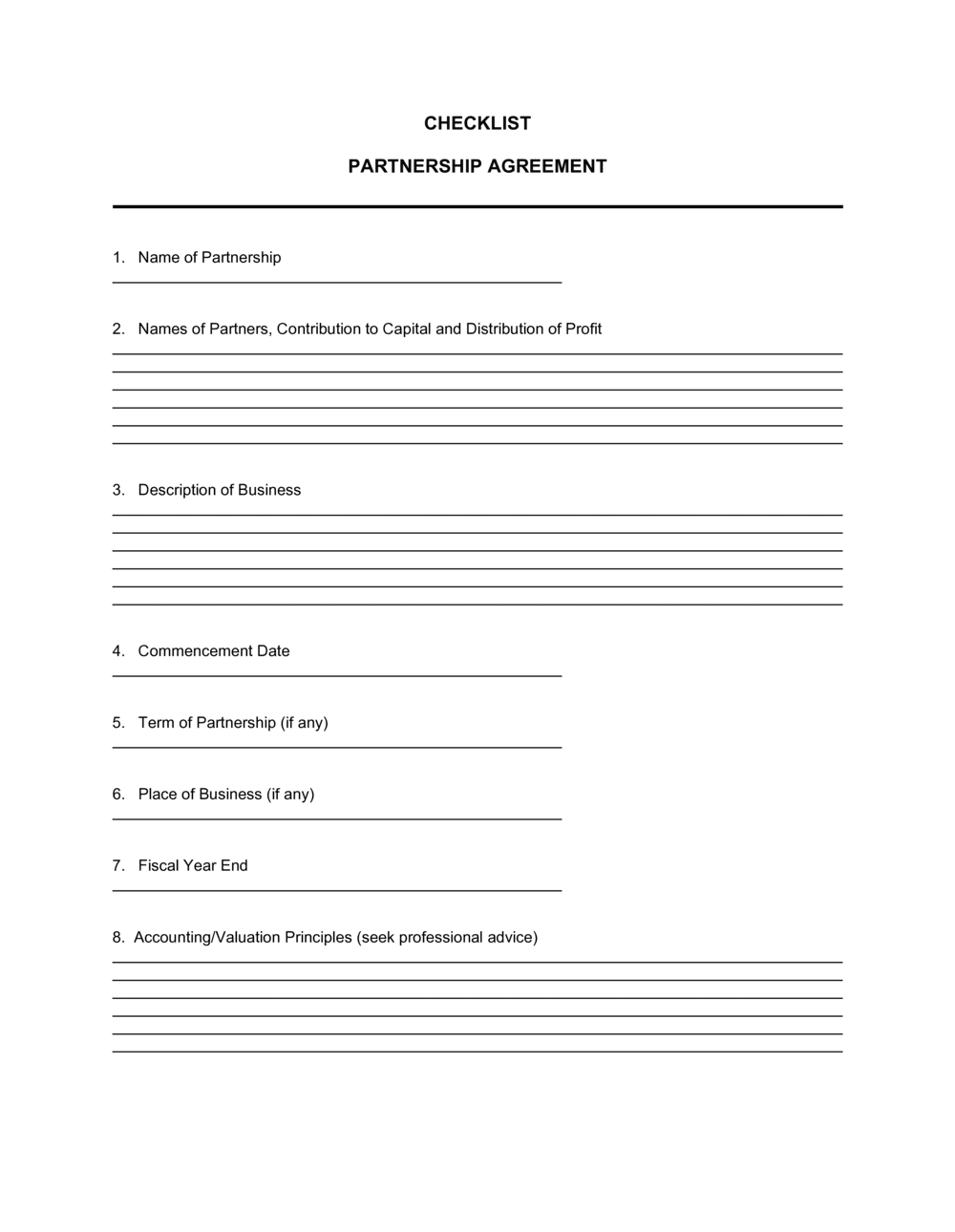
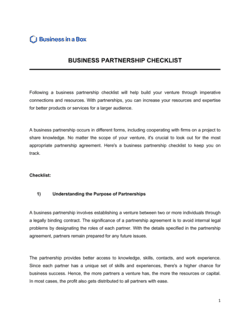
A Checklist Partnership Agreement is a structured verification form that ensures every critical term has been addressed before two or more parties sign a formal partnership agreement. This free Word download walks you through each section β€” contributions, roles, profit splits, decision-making, and exit terms β€” so nothing is overlooked at signing.
When you need it
Use it before executing any general or limited partnership agreement, when onboarding a new business partner, or when reviewing an existing agreement for completeness during a dispute or renegotiation.
What's inside
Structured checklist fields covering party identification, capital contributions, profit and loss allocation, management authority, decision-making thresholds, dispute resolution, and dissolution terms β€” each with a yes/no confirmation and a notes column for flagged gaps.

What is a Checklist Partnership Agreement?

A Checklist Partnership Agreement is a structured verification form that walks partners through every essential term of a partnership agreement before anyone signs. It covers party identification, capital contributions, profit and loss allocation, management authority, decision-making thresholds, dispute resolution, and exit and dissolution terms β€” recording whether each item is confirmed, missing, or flagged for revision. Unlike the partnership agreement itself, the checklist is not a binding document; it is the quality-control step that ensures the agreement you are about to execute actually reflects what all parties discussed and agreed.

Why You Need This Document

Partnership agreements that look complete on a quick read routinely omit a buy-sell valuation method, a loss allocation percentage, or a dissolution distribution order β€” gaps that cause no friction at formation and trigger expensive disputes at exit. Without a systematic pre-signature review, partners sign agreements with silent clauses that courts will later fill using jurisdiction-specific defaults, often in ways no party intended. This checklist prevents that outcome by making gaps visible while there is still time to fix them at zero cost. For small business co-founders, attorneys, and accountants who regularly form partnerships, it turns an inconsistent manual review into a repeatable, documented process that protects every party before the ink is dry.

Which variant fits your situation?

If your situation is…Use this template
Two partners splitting a business equally with shared managementGeneral Partnership Agreement
One investor partner and one operating partner with separate liabilityLimited Partnership Agreement
Reviewing a joint venture rather than an ongoing partnershipJoint Venture Agreement Checklist
Formalizing a partnership between two existing LLCsLLC Partnership Agreement
Ending or winding down an existing partnershipPartnership Dissolution Agreement
Adding a new partner to an existing businessPartnership Amendment Agreement

Common mistakes to avoid

❌ Skipping the checklist because the agreement looks complete

Why it matters: Agreements that look complete on a quick read routinely omit buy-sell valuation methods or loss allocation terms β€” gaps that trigger costly disputes years later.

Fix: Complete every checklist field against the actual agreement text, not from memory. One missed field identified now costs nothing to fix; the same gap costs thousands to litigate.

❌ Marking fields confirmed without reading the corresponding clause

Why it matters: Checking Yes without locating the actual clause in the agreement gives false confidence and defeats the checklist's purpose.

Fix: Enter the page number or section reference next to each confirmed field so any reviewer can verify the source in under 30 seconds.

❌ Not completing the notes column for flagged gaps

Why it matters: A field marked No without a note leaves partners uncertain whether the gap is a drafting oversight or an intentional omission.

Fix: Write a one-sentence description of the gap and whether it needs to be added to the agreement, addressed in a side letter, or is intentionally left silent.

❌ Using the checklist after the agreement is already signed

Why it matters: Identifying gaps post-execution requires a formal amendment, which both partners must agree to β€” often reopening negotiation at the worst possible time.

Fix: Treat the checklist as a pre-signature step in every partnership formation workflow, not a post-mortem review tool.

The 9 key fields, explained

Party identification

Capital contributions

Profit and loss allocation

Management authority and roles

Decision-making thresholds

Partner compensation and draws

Dispute resolution

Buy-sell and exit terms

Dissolution and wind-down procedure

How to fill it out

  1. 1

    Gather the draft partnership agreement

    Obtain the most current version of the partnership agreement all parties are reviewing. Confirm it is the same version for everyone before starting the checklist.

    πŸ’‘ Note the document version number and date at the top of the checklist so there is no confusion if the agreement is revised after review.

  2. 2

    Enter all partner names and the partnership name

    Fill in the legal name, address, and entity type (individual, LLC, corporation) for every partner and the registered partnership name in the party identification field.

    πŸ’‘ Cross-check each partner's name against a government ID or corporate registry filing β€” mismatched names are the most common source of agreement ambiguity.

  3. 3

    Confirm capital contributions with amounts and dates

    Review the contributions section of the agreement and enter each partner's committed amount, asset description or service, and the delivery deadline in the checklist field.

    πŸ’‘ If a contribution is in assets rather than cash, confirm a third-party valuation exists β€” verbal estimates routinely cause post-signing disputes.

  4. 4

    Verify profit, loss, and draw terms

    Check that profit allocation percentages total 100%, loss allocation is separately specified, and partner draw policies are documented with cash-reserve conditions.

    πŸ’‘ A partnership CPA can confirm in 30 minutes whether the allocation structure creates unintended tax consequences for any partner.

  5. 5

    Review management authority and spending limits

    Confirm the managing partner is named, each partner's role is described, and a dollar threshold exists above which both partners must agree before committing funds.

    πŸ’‘ A $5,000–$10,000 unilateral spending limit is common for equal two-partner businesses β€” adjust to the partnership's typical transaction size.

  6. 6

    Check dispute resolution and exit provisions

    Verify that a multi-step dispute resolution process is in place, a buy-sell valuation method is named, and the dissolution trigger conditions and distribution order are explicit.

    πŸ’‘ If any of these three fields are blank in the agreement, flag them as critical gaps before signing β€” these are the clauses most frequently litigated.

  7. 7

    Mark each field confirmed or flag for revision

    For each checklist item, mark Yes if the agreement covers it completely, No if it is missing, and add a note identifying the specific gap or the page reference where the clause appears.

    πŸ’‘ Send the completed checklist back to all partners before finalizing the agreement β€” shared visibility on gaps speeds up the revision cycle.

Frequently asked questions

What is a checklist partnership agreement?

A checklist partnership agreement is a structured verification form used to confirm that a draft or executed partnership agreement covers every essential term before the parties sign. It walks through key areas β€” capital contributions, profit allocation, management authority, dispute resolution, and exit terms β€” and records whether each is addressed, missing, or needs revision. It is not the agreement itself; it is the quality-control step before you sign one.

When should I use a partnership agreement checklist?

Use it before signing any new general or limited partnership agreement, when adding a partner to an existing business, or when reviewing an existing agreement during a dispute or renegotiation. It is most valuable in the 24–48 hours before execution, when there is still time to correct gaps without renegotiating from scratch.

Does completing this checklist replace a partnership agreement?

No. The checklist verifies that a partnership agreement is complete β€” it does not substitute for one. You still need a signed partnership agreement as the binding legal document. The checklist is the pre-flight review that ensures the agreement you are about to sign actually covers what the parties discussed and agreed.

What are the most commonly missed clauses in a partnership agreement?

The four most frequently omitted items are a buy-sell valuation method, a specified loss allocation percentage, a dissolution distribution order, and a multi-step dispute resolution process. Each of these looks minor at formation and becomes critically important at exit or during a disagreement β€” which is exactly why a checklist review catches them early.

Do I need a lawyer to use this checklist?

No β€” the checklist is designed for partners to complete together before they consult a lawyer, or for a lawyer to use during a client review. For straightforward two-partner businesses, completing the checklist and then having a business attorney spend one hour reviewing the flagged gaps is a cost-effective alternative to full custom drafting.

Can this checklist be used for an existing partnership agreement?

Yes. Run the checklist against any existing agreement to identify clauses that were never included. Once you identify the gaps, you can address them through a formal partnership amendment. Reviewing an existing agreement is especially useful after a significant change in the business β€” a new product line, a new partner joining, or a change in profit-sharing terms.

How is a partnership agreement different from an LLC operating agreement?

A partnership agreement governs a general or limited partnership β€” a structure where at least one partner has unlimited personal liability. An LLC operating agreement governs a limited liability company, where all members have liability protection capped at their investment. If the business is registered as an LLC, you need an operating agreement, not a partnership agreement; this checklist covers the partnership structure.

What happens if a partnership agreement is missing a buy-sell clause?

Without a buy-sell clause, a departing partner and the remaining partners have no agreed method for valuing or transferring the departing partner's interest. This almost always results in a dispute over price and payment terms. In some jurisdictions, a partner can force dissolution of the entire partnership if no transfer mechanism exists β€” an outcome that harms all parties.

How this compares to alternatives

vs General Partnership Agreement

A general partnership agreement is the binding legal document that governs the partnership. The checklist is the pre-signature verification form that confirms the agreement is complete. You need both β€” the checklist first to catch gaps, then the signed agreement to create enforceable obligations.

vs LLC Operating Agreement

An LLC operating agreement governs a limited liability company and provides personal liability protection to all members. A partnership agreement governs a general or limited partnership without that same protection for general partners. If the business is registered as an LLC, use the operating agreement checklist instead.

vs Joint Venture Agreement

A joint venture agreement governs a specific, time-limited project between two parties who otherwise remain independent. A partnership agreement governs an ongoing business relationship with shared profits and losses indefinitely. Use the joint venture form when the collaboration has a defined end date or single objective.

vs Partnership Amendment Agreement

A partnership amendment modifies specific terms of an existing agreement β€” adding a partner, changing profit splits, or updating management roles. The checklist is used before the original agreement is signed or alongside an amendment review to confirm no new gaps were introduced by the change.

Industry-specific considerations

Professional Services

Law firms, accounting practices, and consulting partnerships use the checklist to verify non-compete, client non-solicitation, and goodwill valuation clauses before admitting or exiting partners.

Real Estate

Real estate joint ventures and property partnerships require checklist verification of capital call procedures, preferred return thresholds, and asset sale consent requirements.

Retail and Food Service

Co-owned retail stores and restaurant partnerships prioritize management role clarity and draw policy verification to prevent day-to-day operational disputes.

Construction and Trades

Contractor partnerships need confirmed contribution timelines and equipment valuation methods, as delayed capital commitments directly stall project bids.

Template vs pro β€” what fits your needs?

PathBest forCostTime
Use the templatePartners completing a pre-signature review of a standard two- or three-partner agreementFree30–60 minutes
Template + professional reviewPartnerships with unequal contributions, complex profit tiers, or multiple partners$150–$400 (one-hour attorney or accountant review of flagged gaps)1–2 days
Custom draftedHigh-value partnerships, regulated industries, or agreements with significant IP or real estate assets$1,000–$3,500 (attorney-drafted partnership agreement with full review)1–2 weeks

Glossary

General Partnership
A business structure where all partners share management authority and unlimited personal liability for the business's debts.
Limited Partnership
A structure with at least one general partner who manages the business and bears full liability, and one or more limited partners whose liability is capped at their contribution.
Capital Contribution
The cash, assets, or services a partner commits to the partnership at formation or over time.
Profit and Loss Allocation
The agreed percentage or formula determining how net income and losses are divided among partners.
Managing Partner
The partner designated with day-to-day operational authority to make binding decisions on behalf of the partnership.
Fiduciary Duty
The legal obligation each partner owes to act in the best interests of the partnership rather than their own competing interests.
Buy-Sell Provision
A clause specifying how a departing partner's interest is valued and purchased by the remaining partners.
Dissolution
The formal winding down of a partnership, including settling debts, liquidating assets, and distributing any remaining proceeds.
Right of First Refusal
A clause giving existing partners the first opportunity to purchase a departing partner's interest before it is offered to outside parties.

Part of your Business Operating System

This document is one of 3,000+ business & legal templates included in Business in a Box.

  • Fill-in-the-blanks β€” ready in minutes
  • 100% customizable Word document
  • Compatible with all office suites
  • Export to PDF and share electronically

Create your document in 3 simple steps.

From template to signed document β€” all inside one Business Operating System.
1
Download or open template

Access over 3,000+ business and legal templates for any business task, project or initiative.

2
Edit and fill in the blanks with AI

Customize your ready-made business document template and save it in the cloud.

3
Save, Share, Send, Sign

Share your files and folders with your team. Create a space of seamless collaboration.

Save time, save money, and create top-quality documents.

β˜…β˜…β˜…β˜…β˜…

"Fantastic value! I'm not sure how I'd do without it. It's worth its weight in gold and paid back for itself many times."

Managing Director Β· Mall Farm
Robert Whalley
Managing Director, Mall Farm Proprietary Limited
β˜…β˜…β˜…β˜…β˜…

"I have been using Business in a Box for years. It has been the most useful source of templates I have encountered. I recommend it to anyone."

Business Owner Β· 4+ years
Dr Michael John Freestone
Business Owner
β˜…β˜…β˜…β˜…β˜…

"It has been a life saver so many times I have lost count. Business in a Box has saved me so much time and as you know, time is money."

Owner Β· Upstate Web
David G. Moore Jr.
Owner, Upstate Web

Run your business with a system β€” not scattered tools

Stop downloading documents. Start operating with clarity. Business in a Box gives you the Business Operating System used by over 250,000 companies worldwide to structure, run, and grow their business.

Start freeΒ Β·Β No credit card required