How To Plan For Business Growth

Free Word download β€’ Edit online β€’ Save & share with Drive β€’ Export to PDF

15 pagesβ€’30–45 min to fillβ€’Difficulty: Complex
Learn more ↓
FreeHow To Plan For Business Growth Template

At a glance

What it is
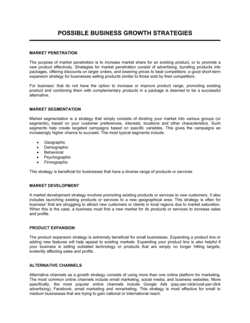
A Business Growth Plan is a structured operational document that translates a company's growth ambitions into specific revenue targets, market expansion steps, capacity investments, and team-scaling milestones for a defined 12–36 month horizon. This free Word download gives you a ready-to-edit framework you can customize for your industry and export as PDF to share with leadership, investors, or lenders.
When you need it
Use it when you are moving from survival mode to deliberate scaling β€” whether that means entering a new market, expanding a product line, hiring a leadership team, or securing growth financing. It is also the document banks and investors request when existing revenue proves the model but capital is needed to accelerate it.
What's inside
Current state assessment, growth goals and KPIs, market opportunity analysis, competitive positioning, go-to-market and revenue strategy, operational capacity plan, team and hiring roadmap, financial projections with funding requirements, risk assessment, and an implementation timeline with milestone checkpoints.

What is a Business Growth Plan?

A Business Growth Plan is an operational document that translates a company's expansion ambitions into concrete revenue targets, market entry steps, capacity investments, and hiring milestones for a defined 12–36 month period. Unlike a startup business plan β€” which exists to prove a concept β€” a growth plan assumes the business model is already working and focuses on the specific actions, investments, and organizational changes needed to scale it deliberately. It combines market analysis, go-to-market strategy, operational planning, and financial projections into a single coordinated document that leadership, lenders, and investors can evaluate and hold the business accountable to.

Why You Need This Document

Without a written growth plan, expansion decisions get made reactively β€” a new hire here, a new channel there β€” with no shared understanding of how the pieces connect or what the business needs to look like at 2Γ— its current size. The cost of this approach is concrete: operational bottlenecks appear without warning, cash runs out before revenue milestones are reached, and the team pulls in conflicting directions because no one has defined what success looks like quarter by quarter. A structured growth plan forces you to stress-test your market assumptions, sequence your investments correctly, and identify the constraints that will break before you hit them. This template gives you a proven framework to build that plan in weeks, not months, so you can spend your time executing it rather than formatting it.

Which variant fits your situation?

If your situation is…Use this template
Raising equity to fund growth from seed or Series A investorsBusiness Plan
Expanding into a new geographic market or territoryBusiness Expansion Plan
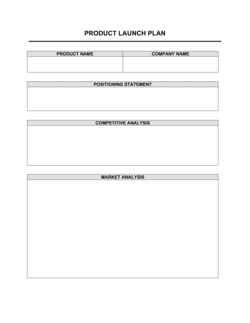
Launching a new product or service line as part of growthNew Product Launch Plan
Quick one-page growth snapshot for internal team alignmentOne-Page Business Plan
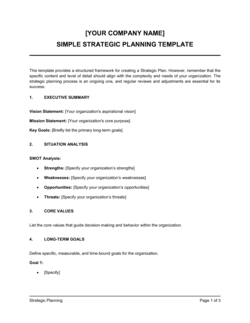
Aligning long-term corporate direction with 3–5 year OKRsStrategic Plan
Planning marketing spend and channel mix to drive growthMarketing Plan
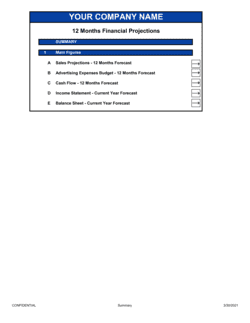
Projecting revenue and cash needs for a 12-month growth periodFinancial Projections (12 Months)

Common mistakes to avoid

❌ Setting growth targets before establishing the baseline

Why it matters: A revenue target of $2M means nothing without knowing whether current revenue is $500K or $1.8M. The gap determines the required effort, investment, and timeline.

Fix: Lock in verified actuals for the trailing 12 months before writing a single projection. Use audited financials or export directly from your accounting system.

❌ Writing a revenue plan without an operational capacity plan

Why it matters: Revenue that outpaces the team's ability to deliver produces service failures, churn, and margin compression β€” turning a growth success into a customer retention crisis.

Fix: For every revenue milestone in the plan, identify the process or staffing constraint that binds first and specify the investment needed to remove it.

❌ Listing growth channels without prioritizing or budgeting them

Why it matters: Pursuing six acquisition channels with limited budget means none of them reach the minimum spend threshold to generate measurable results, wasting the entire marketing budget.

Fix: Rank channels by estimated CAC payback period and commit 80% of the growth budget to the top two channels for the first two quarters before expanding.

❌ No downside financial scenario

Why it matters: A plan with only a base-case model cannot answer the question every lender and investor asks first: what happens if revenue comes in at 70% of forecast?

Fix: Model a downside scenario at 70% of projected revenue and 110% of projected costs, and use the result to determine the minimum capital buffer the business needs.

❌ Annual milestones instead of quarterly checkpoints

Why it matters: An annual milestone discovered to be off-track in month ten leaves no time to change the outcome β€” the year is effectively over before the problem is visible.

Fix: Break every annual goal into four quarterly sub-targets with a scheduled review meeting. A miss in Q1 triggers a response plan before Q2 begins.

❌ Hiring after the growth inflection instead of before it

Why it matters: Understaffed teams at a revenue inflection produce burnout, quality failures, and customer churn that erode the very growth being chased.

Fix: Back-calculate every key hire from the date of expected full productivity, accounting for 90–120 days of posting and onboarding lead time.

The 10 key sections, explained

Current state assessment

Growth goals and KPIs

Market opportunity analysis

Competitive positioning

Go-to-market and revenue strategy

Operational capacity plan

Team and hiring roadmap

Financial projections and funding requirements

Risk assessment and mitigation

Implementation timeline and milestones

How to fill it out

  1. 1

    Complete the current state assessment first

    Pull your last 12 months of revenue, margin, customer count, and headcount data before writing a single growth target. The baseline determines whether your targets are ambitious or arbitrary.

    πŸ’‘ If your accounting system and your CRM show different revenue figures, reconcile them before starting β€” discrepancies in the baseline invalidate every projection built on top of it.

  2. 2

    Set SMART growth goals tied to specific KPIs

    Write each goal with a number, a unit, and a deadline β€” for example, 'grow MRR from $85K to $200K by December 31, 2027.' Then identify one to two leading indicators you will track monthly to confirm you are on pace.

    πŸ’‘ Leading indicators (pipeline value, trial sign-ups, proposal volume) tell you three to six months in advance whether the lagging indicator (revenue) will hit its target.

  3. 3

    Size the market from the bottom up

    Count the number of reachable customers in your target segment, multiply by your average contract or transaction value, and compare the result to a top-down market report. The two figures should be within 30% of each other.

    πŸ’‘ Use LinkedIn Sales Navigator, industry association membership databases, or a trade directory to count reachable accounts β€” this turns a guess into a defensible number.

  4. 4

    Rank growth channels by expected CAC and payback period

    List every channel you are considering, estimate the cost to acquire a customer through each, and select the two or three with the shortest payback period. Commit budget only to those channels for the first 12 months.

    πŸ’‘ Channels with a CAC payback longer than 18 months should be treated as experiments with capped spend, not primary growth drivers.

  5. 5

    Build the operational capacity plan alongside the revenue plan

    For each revenue milestone, identify the process, system, or staffing constraint that will break first if the milestone is hit. Assign a resolution owner and a deadline 60 days before the constraint is expected to bind.

    πŸ’‘ Draw a simple table with revenue ranges in one column and the operational change required to sustain that range in the next β€” this forces honest thinking about what growth actually costs.

  6. 6

    Sequence the hiring roadmap before revenue inflection points

    Identify the quarter in which each key hire must be fully productive, then back-calculate the posting, interview, and onboarding timeline. Most senior hires take 90–120 days from posting to productivity.

    πŸ’‘ Build a one-line hiring budget summary showing total payroll cost at each quarterly headcount milestone β€” this makes the financial impact of hiring decisions immediately visible.

  7. 7

    Model three financial scenarios

    Build a base case (100% of plan), a downside case (70% of plan revenue, 110% of planned costs), and an upside case (130% of plan). The downside case determines your true funding requirement and the minimum runway you need.

    πŸ’‘ The downside scenario is the one lenders and investors test immediately β€” present it proactively rather than waiting to be asked.

  8. 8

    Assign an owner and a quarterly checkpoint to every milestone

    For each item in the implementation timeline, write the responsible person's name β€” not their title β€” and the date of the next scheduled review. Calendar the reviews before the plan is distributed.

    πŸ’‘ A growth plan without a scheduled review cadence becomes a filing cabinet document within 60 days of distribution.

Frequently asked questions

What is a business growth plan?

A business growth plan is an operational document that translates a company's growth ambitions into specific revenue targets, market expansion steps, capacity investments, and hiring milestones for a defined 12–36 month period. It differs from a business plan in that it assumes the model is already proven and focuses on the mechanics of scaling it β€” not on establishing the concept from scratch.

What should a business growth plan include?

A complete growth plan covers ten areas: a current state assessment, growth goals and KPIs, market opportunity analysis, competitive positioning, go-to-market and revenue strategy, operational capacity plan, team and hiring roadmap, financial projections with a funding requirement, risk assessment with mitigation steps, and a quarterly implementation timeline with named owners and measurable milestones.

How is a growth plan different from a business plan?

A business plan is written for a company that needs to prove its concept β€” it covers the problem, solution, market sizing, and initial funding ask. A growth plan assumes the business already has customers and revenue and focuses on how to scale what is already working. Lenders and investors use the growth plan to evaluate expansion financing for businesses past the startup stage.

How long should a business growth plan be?

A working growth plan for internal use typically runs 15–25 pages plus a financial model. A version prepared for a bank loan or investor meeting may be longer, but the core document should be readable in under an hour. Appendices β€” market research, org charts, detailed financial models β€” should be attached separately rather than embedded in the main document.

How often should a growth plan be updated?

Review and update the growth plan quarterly against actual KPI performance. A full rewrite is appropriate when actual results deviate more than 20% from the base case for two consecutive quarters, when a major competitor move changes the market context, or when new funding changes the capital available for growth investments.

Do I need a consultant to write a business growth plan?

Most founders and operators can produce a credible growth plan using a structured template, provided they have reliable historical data and a clear view of their market. Hire a consultant when the raise exceeds $500K, when the plan involves a complex multi-market expansion, or when the financial model requires sophisticated scenario modeling beyond a standard three-statement projection.

What financial projections belong in a growth plan?

Include a monthly P&L for Year 1 and annual projections for Years 2–3, a cash flow statement on the same cadence, and a funding requirements schedule showing the capital needed to reach each major milestone. A unit economics summary β€” CAC, LTV, and gross margin per customer β€” should appear alongside the revenue projections to show the underlying efficiency of the growth model.

How do I identify the right growth channels for my business?

Start by calculating the customer acquisition cost and payback period for every channel you have already tested. Rank them from shortest to longest payback. Commit the majority of your growth budget to the top two channels for the first two quarters before experimenting with new ones. Channels that have never been tested should be treated as experiments with capped spend, not primary drivers.

What risks should a business growth plan address?

The four most common growth risks are: demand risk (the market does not grow as fast as projected), operational risk (the team or infrastructure cannot handle the increased volume), competitive risk (a well-funded competitor accelerates into your target segment), and financial risk (growth takes longer than projected and cash runs out before breakeven). Each risk should have an early warning signal, a named owner, and a specific mitigation action.

How this compares to alternatives

vs Business Plan

A business plan is written to prove a concept and raise initial capital β€” it covers the problem, solution, and market sizing for a company that has not yet established product-market fit. A growth plan assumes the model is proven and focuses on the specific investments, hires, and channel moves needed to scale existing revenue. Lenders and investors use them at different stages of the company's lifecycle.

vs Strategic Plan

A strategic plan sets the long-term direction and competitive positioning of an existing organization β€” typically a three-to-five year horizon with goals, initiatives, and KPIs. A growth plan is more operational and near-term, translating strategic direction into specific quarterly actions, hiring timelines, and financial targets. Most businesses need both: strategy sets the destination; the growth plan maps the next leg of the journey.

vs Marketing Plan

A marketing plan covers one functional dimension of growth β€” acquisition channels, messaging, campaign budgets, and brand positioning. A business growth plan is broader, encompassing operations, hiring, finance, and risk alongside the go-to-market strategy. Use the marketing plan as a supporting appendix to the growth plan, not as a substitute for it.

vs Financial Projections (12 Months)

A financial projections template produces the numbers β€” revenue, expenses, and cash flow for the coming year. A growth plan provides the strategic context that explains why those numbers are credible: market opportunity, competitive positioning, channel strategy, and the operational investments behind each revenue line. Presenting projections without the growth plan leaves readers unable to evaluate the assumptions.

Industry-specific considerations

SaaS / Technology

Growth planning centers on MRR expansion, net revenue retention, CAC payback by channel, and the engineering and customer success headcount ratios needed to scale without service degradation.

Retail / E-commerce

Key planning variables include inventory turnover at higher volumes, fulfillment capacity by SKU, repeat purchase rate targets, and the unit economics of paid acquisition channels at scale.

Professional Services

Growth is constrained by billable headcount, so the hiring roadmap and utilization rate targets are the central operational planning variables alongside client concentration risk.

Food and Beverage

Multi-location expansion plans must address supply chain capacity, food cost percentage at higher volumes, local hiring timelines, and franchisor or regulatory approval lead times.

Manufacturing

Capacity planning focuses on equipment lead times, raw material supplier contracts at higher volumes, and the capital expenditure schedule required before revenue milestones are achievable.

Healthcare / MedTech

Growth plans must account for regulatory approval timelines, credentialing requirements for new hires, reimbursement rate changes, and the compliance cost of scaling into new states or markets.

Template vs pro β€” what fits your needs?

PathBest forCostTime
Use the templateSmall business owners and founders building a growth plan for internal alignment or a standard bank loanFree1–3 weeks (20–40 hours)
Template + professional reviewGrowth-stage companies seeking expansion financing above $250K or preparing for a board presentation$500–$2,000 for a CFO or business advisor review2–4 weeks
Custom draftedMulti-market expansions, PE-backed growth plans, or companies preparing for acquisition or Series B and beyond$3,000–$10,000 for a strategy consultant or fractional CFO engagement4–8 weeks

Glossary

Growth Rate
The percentage increase in a key metric β€” revenue, customers, or units β€” over a defined period, typically expressed as month-over-month or year-over-year.
Scalability
A business's ability to increase revenue without a proportional increase in costs or operational complexity.
KPI (Key Performance Indicator)
A quantified metric tied directly to a strategic objective β€” for example, monthly recurring revenue, customer acquisition cost, or gross margin percentage.
Market Penetration
A growth strategy focused on selling more of an existing product to an existing market, typically by increasing market share from competitors.
Market Expansion
A growth strategy that enters a new geographic region, customer segment, or distribution channel with an existing product or service.
Capacity Plan
An assessment of the staffing, infrastructure, technology, and physical space needed to deliver a higher volume of products or services without quality degradation.
Burn Rate
Monthly net cash outflow β€” the rate at which a company spends capital to fund operations and growth before reaching self-sustaining profitability.
CAGR (Compound Annual Growth Rate)
The mean annual growth rate of a metric over a period longer than one year, smoothing out volatility to show a consistent growth trajectory.
OKR (Objectives and Key Results)
A goal-setting framework pairing a qualitative objective with two to five measurable results that define what achieving it looks like.
Runway
The number of months a business can operate at its current burn rate before exhausting available cash, assuming no new revenue or funding.

Part of your Business Operating System

This document is one of 3,000+ business & legal templates included in Business in a Box.

  • Fill-in-the-blanks β€” ready in minutes
  • 100% customizable Word document
  • Compatible with all office suites
  • Export to PDF and share electronically

Create your document in 3 simple steps.

From template to signed document β€” all inside one Business Operating System.
1
Download or open template

Access over 3,000+ business and legal templates for any business task, project or initiative.

2
Edit and fill in the blanks with AI

Customize your ready-made business document template and save it in the cloud.

3
Save, Share, Send, Sign

Share your files and folders with your team. Create a space of seamless collaboration.

Save time, save money, and create top-quality documents.

β˜…β˜…β˜…β˜…β˜…

"Fantastic value! I'm not sure how I'd do without it. It's worth its weight in gold and paid back for itself many times."

Managing Director Β· Mall Farm
Robert Whalley
Managing Director, Mall Farm Proprietary Limited
β˜…β˜…β˜…β˜…β˜…

"I have been using Business in a Box for years. It has been the most useful source of templates I have encountered. I recommend it to anyone."

Business Owner Β· 4+ years
Dr Michael John Freestone
Business Owner
β˜…β˜…β˜…β˜…β˜…

"It has been a life saver so many times I have lost count. Business in a Box has saved me so much time and as you know, time is money."

Owner Β· Upstate Web
David G. Moore Jr.
Owner, Upstate Web

Run your business with a system β€” not scattered tools

Stop downloading documents. Start operating with clarity. Business in a Box gives you the Business Operating System used by over 250,000 companies worldwide to structure, run, and grow their business.

Free Forever PlanΒ Β·Β No credit card required