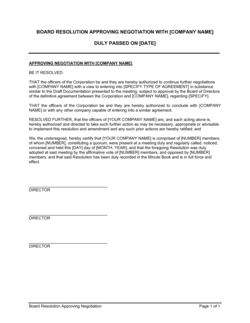
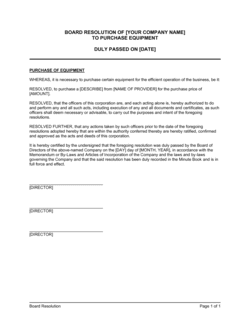
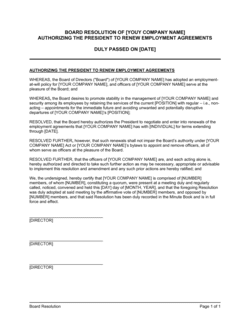
Board Resolution Regarding Banking and Creation of Operations Fund Template

Free Word download • Edit online • Save & share with Drive • Export to PDF

2 pages20–30 min to fillDifficulty: StandardSignature requiredLegal review recommended
Learn more ↓
FreeBoard Resolution Regarding Banking and Creation of Operations Fund Template

At a glance

What it is
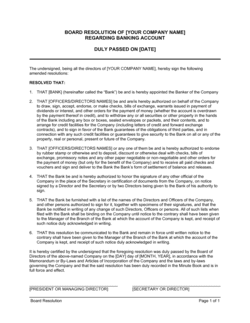
A Board Resolution Regarding Banking and Creation of Operations Fund is a formal corporate governance document in which a company's board of directors officially authorizes the opening or maintenance of a banking relationship, designates authorized signatories, and establishes a dedicated operations fund for day-to-day business expenditures. This free Word download gives you a ready-to-use, board-meeting-ready template you can edit online and export as PDF to submit directly to your financial institution.
When you need it
Use it when incorporating a new entity and opening its first bank account, when adding or replacing authorized signatories after a leadership change, or when the board formally resolves to create a segregated operations fund with defined spending authority and limits.
What's inside
Meeting date and quorum confirmation, authorizing recitals, banking institution designation, operations fund establishment, authorized signatories and signature thresholds, spending limits, fund replenishment terms, and certification by the corporate secretary.

What is a Board Resolution Regarding Banking and Creation of Operations Fund?

A Board Resolution Regarding Banking and Creation of Operations Fund is a formal corporate governance document through which a company's board of directors officially authorizes the establishment of a banking relationship with a named financial institution, designates the officers permitted to operate the account, and creates a dedicated operations fund for recurring day-to-day business expenditures. The resolution records the board's decision in a legally binding, certifiable format — satisfying both the corporation's internal governance requirements and the bank's compliance documentation requirements before an account may be opened or modified. Unlike informal instructions or email approvals, a properly adopted and certified board resolution establishes a clear, auditable chain of authority that protects the company, its directors, and its financial institution from disputes about who was authorized to act and when.

Why You Need This Document

Without a formally adopted banking resolution, most commercial banks will simply refuse to open a corporate account or process signatory changes — full stop. Beyond the banking requirement, operating without documented spending authority and fund controls exposes the corporation and its directors to meaningful fiduciary risk: if funds are misused, misapplied, or disputed, there is no governance record to establish what the board authorized. Auditors, investors, and potential acquirers will scrutinize the minute book for exactly this type of resolution during due diligence, and a gap in the record raises immediate red flags about the quality of the company's governance. For nonprofits, the stakes are even higher — grantors frequently require a certified banking resolution as a condition of disbursement, and the absence of one can freeze incoming grant funds. This template gives you a complete, bank-ready resolution in under 30 minutes, covering every clause a commercial bank's compliance team will expect to see.

Which variant fits your situation?

If your situation is…Use this template
Authorizing a new bank account for a newly incorporated entityBoard Resolution Regarding Banking and Creation of Operations Fund
Replacing or adding authorized signatories only, without fund creationBoard Resolution to Change Authorized Signatories
Authorizing a line of credit or bank loanBoard Resolution to Borrow Funds
Approving a major corporate investment or capital expenditureBoard Resolution Authorizing Investment
Establishing a petty cash or minor expenditure fund onlyBoard Resolution for Petty Cash Fund
Approving annual budget and financial controls at the board levelBoard Resolution Approving Budget
Documenting all board actions from a single meetingBoard Meeting Minutes

Common mistakes to avoid

❌ Using a trade name instead of the registered legal entity name

Why it matters: Banks match the resolution against the entity name on the account application. A mismatch — even a minor one like 'Inc.' vs. 'Incorporated' — can delay account opening by days or weeks.

Fix: Pull the exact legal name from the certificate of incorporation or most recent state/provincial annual filing and use it verbatim throughout the resolution.

❌ Omitting the revocation of prior banking authorizations

Why it matters: If a prior resolution named a former officer as signatory and was never expressly revoked, that officer may retain colorable banking authority — a serious fraud and liability risk.

Fix: Include a standard revocation clause in every new banking resolution, explicitly superseding all prior authorizations with the same depository institution.

❌ Setting no spending restrictions on the operations fund

Why it matters: An unrestricted fund gives management broad discretion to use the money for any purpose, eliminating the internal-control value the fund was created to provide and potentially exposing directors to fiduciary liability.

Fix: List the specific expense categories the fund may cover and explicitly exclude categories such as capital expenditures, executive compensation, and loans to officers.

❌ Submitting an uncertified copy to the bank

Why it matters: Most commercial banks will refuse to act on a corporate resolution that is not certified by the corporate secretary — the account opening or signatory change will be rejected outright.

Fix: Ensure the corporate secretary signs the certification block with their name, title, and the certification date before any copy is submitted to the financial institution.

❌ Naming authorized signatories by title only

Why it matters: If the titleholder changes — through resignation, termination, or promotion — the bank has no way to verify who holds the authority, creating either a gap in banking access or an unauthorized-use risk.

Fix: Always name each signatory by full legal name and title. When signatories change, pass a new resolution that revokes the prior names and designates their replacements.

❌ Passing the resolution after the bank account is already opened

Why it matters: A resolution adopted after the fact does not retroactively authorize the banking activity that preceded it, which can create gaps in the corporation's governance record and complications during due diligence or audits.

Fix: Always pass the banking resolution before or on the same day the account application is submitted to the bank. If an account was opened informally, ratify prior actions explicitly in the resolution language.

The 10 key clauses, explained

Meeting date, attendees, and quorum confirmation

In plain language: Establishes that the resolution was passed at a properly constituted meeting or by unanimous written consent, and that a quorum of directors was present.

Sample language
A duly called meeting of the Board of Directors of [COMPANY LEGAL NAME] (the 'Corporation') was held on [DATE] at [TIME]. The following directors were present: [DIRECTOR NAMES]. A quorum being present, the meeting was called to order.

Common mistake: Omitting the quorum confirmation. Banks and auditors often verify that the required number of directors approved the resolution — without this language, the document's authority can be challenged.

Authorizing recitals

In plain language: States the 'whereas' clauses that explain why the board is acting — the business need for the banking relationship and the operations fund — providing legal context for all resolutions that follow.

Sample language
WHEREAS, it is in the best interests of the Corporation to establish a banking relationship with [BANK NAME] and to create an operations fund to facilitate the efficient management of the Corporation's day-to-day financial obligations;

Common mistake: Skipping recitals entirely and jumping straight to the resolved clauses. Recitals are not legally required in all jurisdictions, but they provide interpretive context that protects the resolution if its scope is ever disputed.

Designation of depository institution

In plain language: Names the specific bank or financial institution where the account will be held, the account type, and the branch location if relevant.

Sample language
RESOLVED, that the Corporation is hereby authorized to establish and maintain a [ACCOUNT TYPE] account at [BANK NAME], located at [BRANCH ADDRESS] (the 'Depository Institution'), for the general banking needs of the Corporation.

Common mistake: Using a trade name instead of the bank's full legal entity name. Financial institution legal names differ from their consumer brands, and using the wrong name can delay account opening.

Creation of operations fund

In plain language: Formally establishes the operations fund as a distinct account or sub-account with a defined purpose, initial funding amount, and restrictions on permitted use.

Sample language
RESOLVED FURTHER, that the Corporation shall establish an Operations Fund in the amount of $[AMOUNT] held at the Depository Institution, to be used exclusively for recurring operational expenses including [EXPENSE CATEGORIES], and not for capital expenditures or executive compensation.

Common mistake: Failing to define the permitted uses of the fund. An operations fund with no spending restrictions provides no internal control value and may create fiduciary liability for directors who approved it.

Designation of authorized signatories

In plain language: Names each individual authorized to sign checks, approve wire transfers, and otherwise operate the account, with their title and specimen signature.

Sample language
RESOLVED FURTHER, that the following officers are hereby authorized to sign checks, drafts, and other instruments drawn on the account: [NAME], [TITLE]; and [NAME], [TITLE]. Specimen signatures of each authorized signatory are attached hereto as Exhibit A.

Common mistake: Naming a person by title only, without their legal name. If the titleholder changes, the bank cannot verify who is authorized without a new resolution, creating an operational gap.

Signing thresholds and dual-signature requirements

In plain language: Sets the dollar amount above which two authorized signatories must both approve a transaction, establishing a check-and-balance for large expenditures.

Sample language
RESOLVED FURTHER, that transactions up to $[LOWER THRESHOLD] may be authorized by any one signatory acting alone, and transactions exceeding $[UPPER THRESHOLD] shall require the joint authorization of any two signatories listed above.

Common mistake: Setting the dual-signature threshold too high — for example, requiring dual signatures only above $100,000 when the operations fund holds $50,000. This defeats the internal control purpose of the threshold.

Fund replenishment authorization

In plain language: Defines when and how the operations fund may be replenished — the trigger balance, the replenishment amount, and who must approve the transfer.

Sample language
RESOLVED FURTHER, that when the Operations Fund balance falls below $[MINIMUM BALANCE], the [CFO / TREASURER] is authorized to transfer up to $[REPLENISHMENT AMOUNT] from the Corporation's primary operating account to restore the fund, subject to notification to the Board within [X] business days.

Common mistake: Granting open-ended replenishment authority with no ceiling or notification requirement. This effectively gives one officer unlimited access to corporate funds without board oversight.

Revocation of prior banking authorizations

In plain language: Explicitly revokes any earlier resolutions or authorizations relating to the same account or signatories, ensuring the current resolution is the sole operative document.

Sample language
RESOLVED FURTHER, that any and all prior authorizations, resolutions, and designations relating to the banking authority of the Corporation with the Depository Institution are hereby revoked and superseded by this Resolution.

Common mistake: Omitting a revocation clause when replacing signatories. Without it, the prior resolution remains technically valid, giving former officers a colorable claim to continued banking authority.

Bank indemnification authorization

In plain language: Authorizes the corporation to provide the depository institution with a certified copy of the resolution and agrees to indemnify the bank for acting in reliance on it.

Sample language
RESOLVED FURTHER, that the Corporation shall provide the Depository Institution with a certified copy of this Resolution and hereby agrees to indemnify and hold harmless the Depository Institution for any action taken in reliance upon this Resolution.

Common mistake: Submitting an uncertified photocopy to the bank. Most institutions will not open an account or honor signatory changes without a copy certified by the corporate secretary.

Corporate secretary certification

In plain language: The corporate secretary attests that the resolution was duly adopted, that the named individuals hold the stated offices, and that the document is a true record of board action.

Sample language
I, [CORPORATE SECRETARY NAME], Secretary of [COMPANY LEGAL NAME], hereby certify that the foregoing is a true and correct copy of resolutions duly adopted by the Board of Directors on [DATE], and that such resolutions are in full force and effect as of the date hereof.

Common mistake: Having the CEO or CFO (an interested party) certify the resolution instead of the corporate secretary. Banks require the secretary's certification specifically because that officer has no personal interest in the transaction.

How to fill it out

  1. 1

    Enter the corporation's legal name and jurisdiction of incorporation

    Use the exact registered legal name as it appears in your articles of incorporation or certificate of formation. Include the state, province, or country of incorporation in the opening clause.

    💡 Cross-reference the name against your most recent annual report filing — trade names and legal names diverge more often than founders expect.

  2. 2

    Confirm quorum and list attending directors

    Record the date, time, and location of the meeting (or note that this is a unanimous written resolution). List all directors present by full legal name and confirm the quorum requirement is met based on your bylaws or articles.

    💡 Check your bylaws for the quorum definition — some require a majority of the total board, others require a majority of directors then in office. The difference matters if any seats are vacant.

  3. 3

    Identify the depository institution by full legal name

    Enter the bank's full registered legal name, the branch address, and the type of account being opened or maintained (e.g., commercial checking, money market).

    💡 Call the bank's commercial banking team before completing this section to confirm the exact entity name they require on corporate resolutions — it often differs from the consumer brand name.

  4. 4

    Define the operations fund amount and permitted uses

    Set the initial dollar amount of the operations fund and list the specific expense categories it covers — payroll, utilities, office supplies, vendor payments — along with any excluded uses such as capital expenditures or executive bonuses.

    💡 Align the fund size to approximately 4–8 weeks of average monthly operational spend so the fund is operationally useful without holding excess idle cash.

  5. 5

    Name authorized signatories and attach specimen signatures

    List each authorized signatory by full legal name and title. Attach a signature page (Exhibit A) where each person signs in the space provided — banks will compare these specimens to verify future transactions.

    💡 Limit authorized signatories to the minimum required for operations. Every additional signatory is an additional fraud-risk surface.

  6. 6

    Set signing thresholds for single and dual authorization

    Choose a dollar threshold above which two signatories must jointly approve a transaction. A common starting point is single-signature authority up to $5,000 and dual-signature for amounts above that.

    💡 Set the dual-signature threshold at a level that covers your 90th-percentile single transaction, not your average transaction — the control should catch unusual spending, not slow down routine payments.

  7. 7

    Define replenishment authority and notification requirements

    State the minimum balance that triggers a replenishment, the maximum transfer amount permitted per replenishment event, and whether the designated officer must notify the board within a set number of business days.

    💡 Board notification within five business days of any replenishment transfer strikes a practical balance between operational speed and oversight.

  8. 8

    Have the corporate secretary certify and distribute

    The corporate secretary signs the certification block, dates it, and produces certified copies — at minimum one for the bank and one for the corporate minute book. Do not submit uncertified copies to the bank.

    💡 Many banks now accept PDF-certified copies submitted via their commercial onboarding portal — confirm the bank's preferred format before scheduling the meeting.

Frequently asked questions

What is a board resolution regarding banking and creation of an operations fund?

A board resolution regarding banking and creation of an operations fund is a formal corporate governance document in which a company's board of directors authorizes a banking relationship with a named financial institution, establishes a dedicated operations fund for day-to-day expenses, designates authorized signatories, and sets the spending controls that govern how the fund may be used. It creates a binding, auditable record of the board's decision and is the document most banks require before opening a corporate account or honoring signatory changes.

Do I need a board resolution to open a business bank account?

Most commercial banks require a corporate resolution before opening an account for a corporation, LLC, or nonprofit entity. The resolution confirms that the board has authorized the account, identifies who is permitted to operate it, and provides specimen signatures for verification. Sole proprietorships and single-member LLCs typically face fewer requirements, but any entity with multiple directors or managers will almost universally need a signed resolution to satisfy the bank's know-your-customer compliance requirements.

What is an operations fund, and why does a board need to create it formally?

An operations fund is a designated pool of cash held in a specific account and reserved exclusively for recurring operational expenses — payroll, rent, utilities, and vendor payments. Creating it formally by board resolution establishes the fund's purpose, spending limits, and replenishment authority in an auditable record. Without a resolution, there is no documented governance basis for how the fund is used, which can create fiduciary liability for directors and compliance issues during an audit or due diligence process.

Who must sign a board resolution for it to be valid?

The resolution itself is adopted by the directors at a duly constituted meeting (or by unanimous written consent in jurisdictions that allow it). The corporate secretary then certifies the resolution — signing a certification block that attests the document is a true and correct copy of a resolution duly adopted by the board. Banks specifically require the secretary's certification because that officer has no personal interest in the banking transaction, adding an independent layer of authentication.

Can a board resolution be passed without a meeting?

In most US states, Canadian provinces, the UK, and EU member states, directors may adopt resolutions by unanimous written consent in lieu of a formal meeting, provided all directors sign. Some jurisdictions require that the articles or bylaws expressly permit this mechanism. Where even one director declines to sign, a formal meeting must be called. Check your governing documents and the applicable corporate statute before relying on written consent.

What signing threshold should we set for the operations fund?

A common starting point is single-signature authority for transactions up to $5,000 and dual-signature for transactions above that level, though the appropriate threshold depends on your organization's size and average transaction profile. The dual-signature level should be set at a point that captures unusual or large transactions — typically above the 90th percentile of routine spending — without slowing down normal day-to-day payments. Review and update the threshold annually as the business grows.

How do I update authorized signatories after a leadership change?

Pass a new board resolution that names the incoming signatory by full legal name and title, explicitly revokes the authority of the departing individual, and directs the corporate secretary to certify and deliver a copy to the bank. Do this before or on the same day the leadership change takes effect. Delaying the resolution while the new officer has operational banking needs — or while the former officer technically retains authority — creates both an access gap and a security risk.

Is a board resolution the same as board meeting minutes?

No. Board meeting minutes are a comprehensive narrative record of an entire meeting — attendance, discussion, motions, votes, and actions taken on all agenda items. A board resolution is a stand-alone, formal statement of a single specific decision, extracted from the minutes or passed separately as a written consent. Banks and third parties prefer a standalone certified resolution because it is concise, focused, and easy to act on without reviewing an entire meeting transcript.

Does a board resolution require notarization?

Notarization is generally not required for a corporate banking resolution in the US, Canada, the UK, or the EU. The corporate secretary's certification is the accepted authentication mechanism for these documents. However, some international banking relationships, foreign account openings, or government contracts may require a notarized or apostilled copy. Confirm the bank's specific requirements before executing the document.

How long should we keep a board resolution on file?

Corporate resolutions relating to banking authority should be retained permanently in the corporate minute book, as they form part of the official governance record. Many jurisdictions require corporations to maintain minute books and resolutions for the life of the entity plus a defined period after dissolution — commonly 7–10 years. In practice, banks, auditors, and acquirers in due diligence will look for a complete resolution history, so permanent retention is the safest policy.

How this compares to alternatives

vs Board Meeting Minutes

Board meeting minutes are a full narrative record of everything discussed and decided at a meeting — all agenda items, votes, and actions. A banking resolution is a concise, stand-alone authorization document focused on a single decision. Banks and third parties require the resolution specifically because it is self-contained and certifiable without sharing the entire meeting transcript. Both documents should exist and cross-reference each other.

vs Corporate Bylaws

Bylaws establish the rules governing how the corporation makes decisions — including how board meetings are called, what constitutes a quorum, and who holds what offices. A banking resolution is a specific exercise of authority granted by the bylaws. Without valid bylaws in place, a banking resolution has a weaker governance foundation. Bylaws answer 'how decisions are made'; the resolution answers 'what was decided.'

vs Loan Authorization Resolution

A loan authorization resolution specifically authorizes the corporation to borrow funds, execute promissory notes, and grant security interests — actions lenders require board approval for before advancing credit. A banking and operations fund resolution authorizes account opening and routine fund management without creating any debt obligation. If the corporation needs both a loan and an account, two separate resolutions are typically required.

vs Officer Authorization Certificate

An officer authorization certificate confirms the identity and authority of specific executives to act on behalf of the corporation in transactions with third parties. It is often attached to contracts, real estate transactions, or financing agreements. A board resolution is broader — it records the board's formal decision — while an officer certificate is a derivative document that flows from that decision. Banks typically require both: the resolution as authorization and the certificate as identity verification.

Industry-specific considerations

Technology / SaaS

Startup incorporations frequently trigger an immediate banking resolution requirement; venture-backed entities often add signing-threshold controls tied to their investor rights agreements.

Nonprofit organizations

Grantors, foundations, and government funders routinely require a board-certified banking resolution as a condition of receiving funds, and auditors verify compliance annually.

Real estate

Property-holding LLCs and REITs establish operations funds for maintenance and property management expenses, with dual-signature thresholds protecting against unauthorized distributions.

Professional services

Law firms, accounting practices, and consulting firms use banking resolutions to segregate client trust funds from operating accounts and to document authorized trust account signatories.

Healthcare

Medical practices and health systems establish operations funds for payroll and vendor payments, with heightened signatory controls required by compliance programs and hospital board governance policies.

Manufacturing

Manufacturing entities use operations funds to manage high-frequency supplier payments and payroll, with dual-signature thresholds calibrated to purchase order values and production cycle costs.

Jurisdictional notes

United States

Corporate banking resolutions in the US are governed by state corporation law, not federal statute. Most states follow the Model Business Corporation Act, which permits unanimous written consent resolutions unless the articles prohibit them. Delaware, the most common incorporation jurisdiction, allows board action by written consent under DGCL §141(f). Some states require specific language confirming quorum and vote count — review the applicable state statute before finalizing.

Canada

Under the Canada Business Corporations Act and provincial equivalents, directors may pass resolutions by unanimous written consent in lieu of a meeting. The resolution must be signed by all directors entitled to vote, not merely a majority. Quebec-incorporated entities must comply with the Business Corporations Act (Quebec), which has parallel provisions but may require French-language documentation for provincially regulated activities. Canadian banks typically have their own required resolution form — confirm whether the bank will accept a custom template or requires their standard form.

United Kingdom

Under the Companies Act 2006, private companies may pass written resolutions signed by the required majority of eligible members or directors. Banking resolutions typically require a majority of the board unless the articles specify otherwise. UK banks routinely provide their own 'bank mandate' form, which serves the same function as a banking resolution — many UK financial institutions require completion of their own form in addition to or instead of a standalone corporate resolution. Confirm the bank's requirements before preparing documentation.

European Union

Corporate governance rules vary significantly by EU member state. Germany requires notarized board minutes for certain banking authorizations; France's Code de commerce permits written board resolutions but has specific procedural requirements. GDPR considerations arise when sharing director personal data (names, specimen signatures) with financial institutions — ensure your data-sharing practices with the bank are covered by your privacy policy. Cross-border EU entities should obtain local counsel confirmation before relying on a template resolution.

Template vs lawyer — what fits your deal?

PathBest forCostTime
Use the templateStandard domestic incorporations, routine bank account openings, and straightforward signatory updates at small to mid-size companiesFree15–30 minutes
Template + legal reviewEntities with complex ownership structures, multiple classes of shares, or investor rights agreements that restrict banking authority$200–$5001–2 days
Custom draftedRegulated industries, cross-border banking relationships, entities subject to lender covenants, or large nonprofits with grantor compliance requirements$500–$2,000+3–7 days

Glossary

Board Resolution
A formal written record of a decision made by a company's board of directors, which carries the same legal authority as a vote taken at a duly convened meeting.
Authorized Signatory
An individual, named in the resolution, who is permitted to sign checks, authorize transfers, and enter into banking transactions on behalf of the corporation.
Operations Fund
A designated pool of money, established by board authority, held in a specific account and reserved exclusively for recurring day-to-day business expenses.
Quorum
The minimum number of directors who must be present or represented at a board meeting for any resolution passed at that meeting to be legally valid.
Corporate Secretary
The officer responsible for maintaining the company's official records, including the minute book, and certifying that resolutions accurately reflect board decisions.
Signing Threshold
A dollar amount above which two or more authorized signatories are required to approve a transaction, used to prevent unauthorized large expenditures.
Unanimous Written Resolution
A resolution signed by all directors in lieu of a formal meeting, treated as equivalent to a resolution passed at a duly held board meeting in most jurisdictions.
Banking Resolution
The specific document a financial institution requires before opening a corporate account, confirming that the board has authorized the account and designated who may operate it.
Replenishment Authorization
A provision in the resolution that defines the process and approval threshold for topping up the operations fund when its balance falls below a specified level.
Minute Book
The corporation's official binder or digital record containing all shareholder and board resolutions, meeting minutes, and key corporate documents required to be kept by law.
Depository Institution
The specific bank, credit union, or trust company named in the resolution where the authorized account or operations fund will be held.

Part of your Business Operating System

This document is one of 3,000+ business & legal templates included in Business in a Box.

  • Fill-in-the-blanks — ready in minutes
  • 100% customizable Word document
  • Compatible with all office suites
  • Export to PDF and share electronically

Create your document in 3 simple steps.

From template to signed document — all inside one Business Operating System.
1
Download or open template

Access over 3,000+ business and legal templates for any business task, project or initiative.

2
Edit and fill in the blanks with AI

Customize your ready-made business document template and save it in the cloud.

3
Save, Share, Send, Sign

Share your files and folders with your team. Create a space of seamless collaboration.

Save time, save money, and create top-quality documents.

★★★★★

"Fantastic value! I'm not sure how I'd do without it. It's worth its weight in gold and paid back for itself many times."

Managing Director · Mall Farm
Robert Whalley
Managing Director, Mall Farm Proprietary Limited
★★★★★

"I have been using Business in a Box for years. It has been the most useful source of templates I have encountered. I recommend it to anyone."

Business Owner · 4+ years
Dr Michael John Freestone
Business Owner
★★★★★

"It has been a life saver so many times I have lost count. Business in a Box has saved me so much time and as you know, time is money."

Owner · Upstate Web
David G. Moore Jr.
Owner, Upstate Web

Run your business with a system — not scattered tools

Stop downloading documents. Start operating with clarity. Business in a Box gives you the Business Operating System used by over 250,000 companies worldwide to structure, run, and grow their business.

Start free · No credit card required