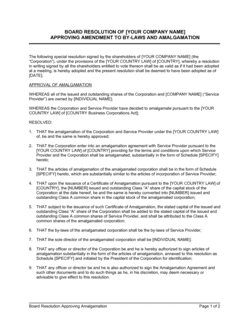
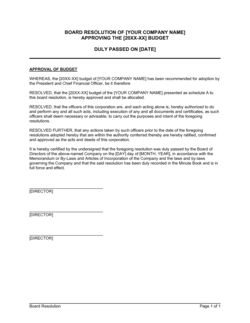
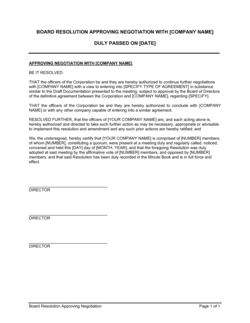
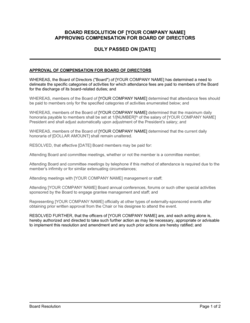
Board Resolution Approving Change of Address of Registered Office Template

Free Word download • Edit online • Save & share with Drive • Export to PDF

1 page20–30 min to fillDifficulty: StandardSignature requiredLegal review recommended
Learn more ↓
FreeBoard Resolution Approving Change of Address of Registered Office Template

At a glance

What it is
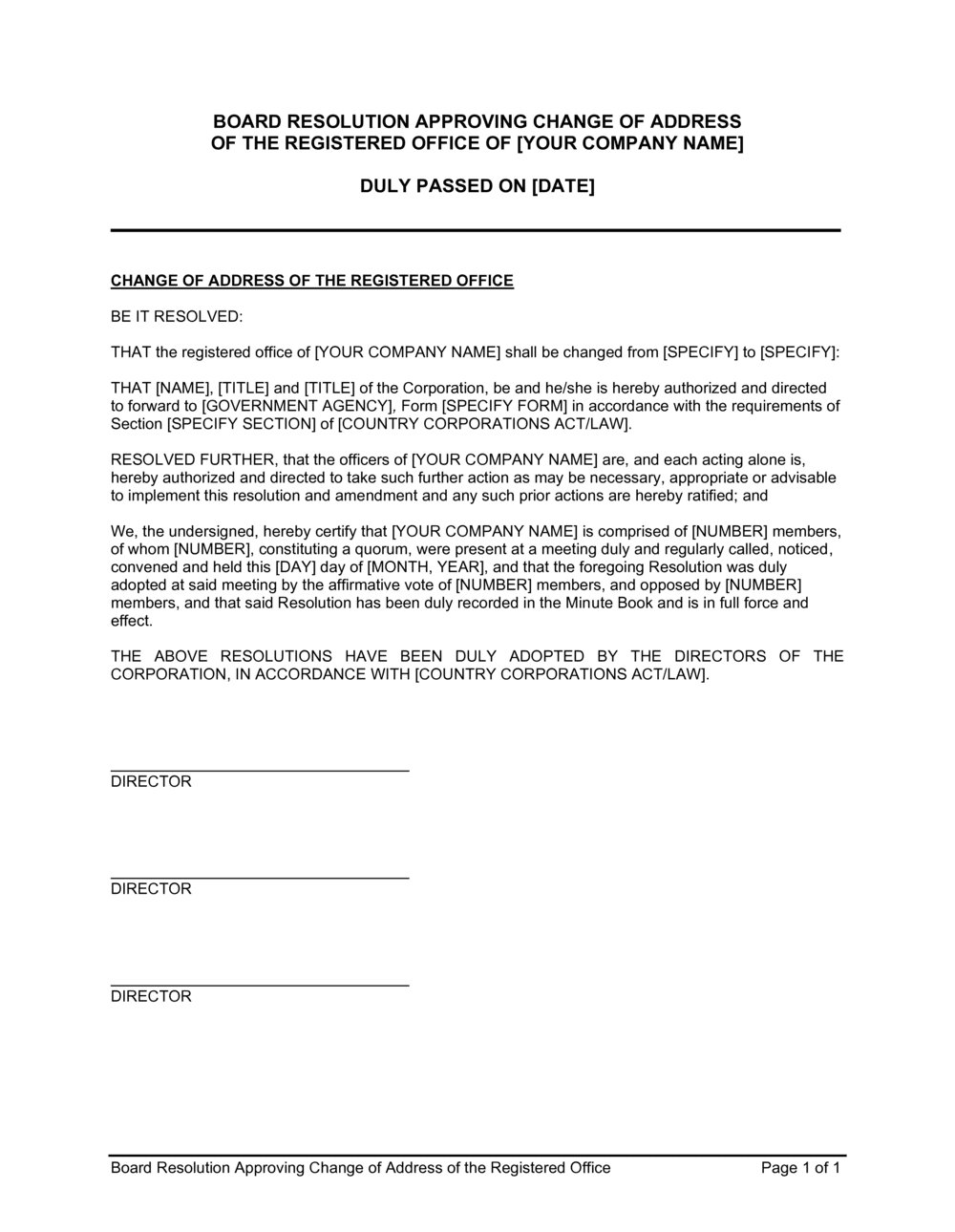
A Board Resolution Approving Change of Address of Registered Office is a formal corporate document in which a company's board of directors officially votes to relocate the company's registered office to a new address. This free Word download gives you a ready-to-edit template you can adapt in minutes and export as PDF for director signatures and regulatory filing.
When you need it
Use it any time your company moves its registered office — whether relocating to a new city, changing registered agent addresses, or shifting from a home address to a commercial premises. Most jurisdictions require the change to be approved by the board before it can be reported to the relevant corporate registry or government authority.
What's inside
Company identification details, recitals stating the reason for the change, the old and new registered office addresses, the resolution clause formally approving the change, authorization for officers to file required notices, director signatures, and a record of the vote. The template covers both unanimous written consent and formal meeting formats.

What is a Board Resolution Approving Change of Address of Registered Office?

A Board Resolution Approving Change of Address of Registered Office is a formal written decision by a corporation's board of directors to officially relocate the company's registered office from its current address to a new one. The registered office is the legal address recorded with the corporate registry — the address to which government notices, legal correspondence, and service of process are delivered. Because this address is a matter of public statutory record, changing it requires documented board authority before any government filing can be made. The resolution records the old and new addresses, the effective date, and an authorization for named officers to complete all required filings and third-party notifications.

Why You Need This Document

Operating with an outdated registered office address on the corporate registry creates compounding legal and operational risks. Government notices, tax correspondence, and legal process served to the old address are deemed validly delivered — meaning your company can miss a tax assessment, a regulatory deadline, or a court summons without ever receiving it. Banks and counterparties running due diligence flag a discrepancy between the operating address and the registry address as a compliance gap, which can delay financing closings and commercial transactions. Without a properly adopted board resolution on file, the registry filing itself lacks the internal corporate authority required to make it binding — exposing the company to a challenge that the change was never properly approved. This template gives you a complete, registry-ready document that closes the authorization gap, protects your minute book, and gives every officer involved a clear mandate to act.

Which variant fits your situation?

If your situation is…Use this template
All directors agree and no formal meeting is neededUnanimous Written Consent — Change of Registered Office
Change requires a shareholder vote under the company's articlesShareholder Resolution Approving Change of Registered Office
Company is also changing its principal place of business, not just registered officeBoard Resolution Approving Change of Principal Place of Business
Company is changing its registered agent at the same time as the addressBoard Resolution Approving Change of Registered Agent
Address change accompanies a corporate name changeBoard Resolution Approving Change of Corporate Name
LLC rather than a corporation needs to record the changeLLC Member Resolution — Change of Registered Office
Change of registered office is needed for a nonprofit or charityNonprofit Board Resolution — Change of Registered Office

Common mistakes to avoid

❌ Using a trade name instead of the registered legal entity name

Why it matters: The corporate registry matches the resolution against the exact name on file. A mismatch — even a missing comma or abbreviated 'Inc.' — results in rejection of the filing and delays the effective change.

Fix: Pull a current company extract or certificate of status from the registry and copy the legal name character-for-character into the resolution.

❌ Not recording the old address alongside the new address

Why it matters: Regulators and auditors need both addresses to verify the chain of corporate record. A resolution that states only the new address cannot be matched to the existing registry entry without additional correspondence.

Fix: Always include a 'from [OLD ADDRESS] to [NEW ADDRESS]' construction in the resolution clause, using the exact address currently on the registry.

❌ Signing the resolution without a quorum or required number of directors

Why it matters: A resolution signed by fewer directors than the articles or bylaws require is void from the outset. Any filing made on its authority can be challenged or reversed.

Fix: Check the corporation's articles, bylaws, and the applicable corporate statute before circulation to confirm the minimum signature requirement for this type of resolution.

❌ Omitting the authorization clause for filing and notification

Why it matters: Without explicit authorization, the person who attempts to file the registry change form has no documented authority to do so. Some registries and banks will refuse to accept the filing or act on the instruction.

Fix: Include a 'RESOLVED FURTHER' clause naming the authorized officer and specifying their authority to file all required forms and notify all relevant parties.

❌ Setting the effective date before the registry can process the filing

Why it matters: If the resolution states an effective date of tomorrow but the registry takes 10 business days to process, there is a legal gap during which the registered office is at neither address in the official record.

Fix: Check the registry's current processing times before setting the effective date and build in sufficient buffer, or use language such as 'on the date of filing' to tie the effective date to actual registry processing.

❌ Failing to update the minute book and internal records after filing

Why it matters: A resolution filed with the registry but not recorded in the minute book creates a discrepancy that surfaces during due diligence, financing, or sale of the company — and can delay or kill a transaction.

Fix: Designate the corporate secretary to update the minute book on the same day the registry filing is confirmed, and attach the filing confirmation receipt to the resolution in the minute book.

The 9 key clauses, explained

Corporation Identification

In plain language: States the full legal name of the corporation, its jurisdiction of incorporation, and any relevant registration numbers, establishing the entity the resolution governs.

Sample language
The undersigned, being all of the directors of [CORPORATION LEGAL NAME] (the 'Corporation'), a corporation incorporated under the laws of [STATE / PROVINCE / COUNTRY], registration number [REGISTRATION NUMBER], hereby adopt the following resolution.

Common mistake: Using a trade name or DBA instead of the exact registered legal name. A mismatch between the resolution and the corporate registry record can cause the filing to be rejected.

Recitals (Background)

In plain language: Explains the reason the board is passing this resolution — typically that the corporation is relocating its registered office — and sets out the factual context.

Sample language
WHEREAS, the Corporation currently maintains its registered office at [CURRENT ADDRESS]; and WHEREAS, the Corporation intends to relocate its registered office to [NEW ADDRESS] effective [DATE].

Common mistake: Omitting the recitals entirely. Without a brief 'whereas' statement, the resolution lacks the business context that regulators and auditors expect to see in a minute book.

Resolution Clause (Approval of Change)

In plain language: The operative clause in which the board formally votes to approve the change of registered office from the old address to the new address.

Sample language
RESOLVED, that the registered office of the Corporation be, and hereby is, changed from [OLD ADDRESS, CITY, STATE/PROVINCE, POSTAL CODE] to [NEW ADDRESS, CITY, STATE/PROVINCE, POSTAL CODE], effective [EFFECTIVE DATE].

Common mistake: Stating only the new address and not the old one. Regulators and auditors need both addresses to verify continuity of the corporate record.

Authorization to File and Notify

In plain language: Grants one or more named officers or directors the authority to file all required government forms, notify relevant authorities, and take any other steps needed to give effect to the change.

Sample language
RESOLVED FURTHER, that any officer of the Corporation, including but not limited to [OFFICER NAME / TITLE], be and hereby is authorized and directed to file all necessary notices, forms, and documents with the applicable government authorities to effect the change of registered office.

Common mistake: Failing to authorize anyone to act. Without this clause, every subsequent filing step may require another resolution, slowing the process.

Update of Corporate Records

In plain language: Directs the corporate secretary to update the company's minute book, share register, and any other internal corporate records to reflect the new registered office address.

Sample language
RESOLVED FURTHER, that the Secretary of the Corporation be and hereby is directed to update all corporate records, books, and registers to reflect the new registered office address effective as of [EFFECTIVE DATE].

Common mistake: Passing the resolution but never updating the minute book or internal records. An outdated minute book creates compliance gaps discovered during due diligence or audits.

Notification to Third Parties

In plain language: Instructs officers to notify banks, government agencies, regulatory bodies, suppliers, and other relevant parties of the change of address.

Sample language
RESOLVED FURTHER, that the appropriate officers of the Corporation are authorized to notify all relevant third parties — including financial institutions, tax authorities, and regulatory agencies — of the Corporation's new registered office address.

Common mistake: Assuming the government filing automatically notifies all parties. Banks, tax agencies, and regulators typically require separate direct notification and will continue sending correspondence to the old address otherwise.

Effective Date

In plain language: Specifies the exact date on which the change of registered office takes legal effect, which must align with the date filed with the corporate registry.

Sample language
This resolution shall take effect as of [EFFECTIVE DATE], or such later date as may be required by the applicable corporate registry upon filing.

Common mistake: Using the signing date as the effective date when the registry requires a future date or a processing period. The mismatch can create a gap during which the registered office is legally ambiguous.

Director Signatures and Date

In plain language: Records the signatures of all directors (for unanimous written consent) or the presiding officer and secretary (for a formal meeting), along with the date of execution.

Sample language
IN WITNESS WHEREOF, the undersigned directors of the Corporation have executed this resolution as of [DATE]. [DIRECTOR NAME] _______________________ Date: ___________ [DIRECTOR NAME] _______________________ Date: ___________

Common mistake: Having only one director sign when the articles or bylaws require a majority or all directors. A resolution signed by fewer directors than required is void.

Certification by Corporate Secretary

In plain language: A brief statement by the corporate secretary certifying that the resolution was duly adopted in accordance with the corporation's governing documents and applicable law.

Sample language
I, [SECRETARY NAME], Secretary of [CORPORATION LEGAL NAME], hereby certify that the foregoing is a true and correct copy of a resolution duly adopted by the Board of Directors of the Corporation in accordance with its [bylaws / articles] and applicable law.

Common mistake: Skipping the secretary's certification. Many registries, banks, and counterparties will not accept a resolution without a certification confirming its authenticity and due adoption.

How to fill it out

  1. 1

    Enter the corporation's legal name and registration details

    Fill in the exact legal name as it appears on the corporate registry, the jurisdiction of incorporation, and the registration or company number. Check the corporate registry database directly rather than relying on internal documents.

    💡 Cross-reference the name character-by-character against the registry record — punctuation and 'Inc.' vs 'Incorporated' matter.

  2. 2

    Confirm the current registered office address

    Enter the full street address, suite number, city, state or province, country, and postal code of the existing registered office. This must match what is currently on file with the registry.

    💡 Download a current certificate of status or company extract from the registry to verify the address on record before completing this field.

  3. 3

    Enter the new registered office address

    Record the complete new address in the same format. Confirm the address is in a jurisdiction where the corporation is permitted to maintain a registered office under its governing statute.

    💡 In many US states and Canadian provinces, the registered office must be a physical street address — P.O. boxes are not accepted.

  4. 4

    Set the effective date

    Choose the date on which the change should take legal effect. Check the registry's processing times — some jurisdictions process filings in 1–2 business days; others take 2–4 weeks. Set the effective date to allow for this lag.

    💡 Where the registry allows a future effective date, choose one that gives at least 5 business days of buffer after your expected filing date.

  5. 5

    Name the authorized officer

    Insert the name and title of the officer or director authorized to file the registry forms and notify third parties. This should be the person who will actually complete the filing, typically the CEO, president, or corporate secretary.

    💡 Naming a specific person rather than 'any officer' creates clearer accountability and is preferred by some registries and banks.

  6. 6

    Obtain director signatures

    Have all required directors sign and date the resolution. For a unanimous written consent, all directors must sign. For a formal meeting resolution, the chair and secretary sign, and the meeting minutes must reflect the vote count.

    💡 Use a digital signature tool with timestamping to execute and store the resolution — many registries accept electronic signatures.

  7. 7

    Have the corporate secretary certify the resolution

    The corporate secretary completes the certification block, confirms the resolution was adopted in accordance with the governing documents, and attaches it to the minute book.

    💡 File the resolution in the minute book immediately after execution — a signed but unfiled resolution is as problematic as no resolution at all.

  8. 8

    File with the registry and notify third parties

    Submit the required government form (e.g., Articles of Amendment, Notice of Change) together with any fees. Then separately notify the company's bank, tax authority, insurers, and any regulatory bodies of the address change.

    💡 Keep a signed copy of the registry confirmation as part of the corporate record. It proves the change was filed on the date reflected in the resolution.

Frequently asked questions

What is a board resolution approving a change of registered office?

A board resolution approving a change of registered office is a formal written decision by a corporation's board of directors to officially relocate the company's registered office address. It records the old and new addresses, the effective date, and the authorization for officers to file the required government notices. Most corporate statutes require this type of resolution before the address change can be reported to the corporate registry.

Is a board resolution required to change a registered office address?

In most jurisdictions — including US states, Canadian provinces, the UK, and EU member states — yes. The change must be approved by the board before a statutory filing can be made with the corporate registry. Some jurisdictions additionally require shareholder approval if the governing articles specify it. Filing without a board resolution can result in the change being challenged or reversed.

What is the difference between a registered office and a principal place of business?

A registered office is the official legal address on file with the corporate registry — it receives statutory notices, government correspondence, and legal process. The principal place of business is where the company actually operates day-to-day. They are often the same address, but a company may have its registered office at a registered agent's address in one state while operating primarily from another location. Both addresses may require separate notifications when they change.

Can all directors approve the resolution without holding a meeting?

Yes — most corporate statutes permit unanimous written consent, which allows directors to approve a resolution by all signing a written document instead of convening a formal meeting. This is typically faster and simpler for routine administrative changes like a registered office address update. Check the corporation's bylaws and the applicable corporate statute to confirm the unanimous consent procedure is available and what signing requirements apply.

How quickly does a change of registered office take effect?

The resolution itself takes effect on the date specified as the effective date. However, the change does not appear in the public corporate registry until the required government form is filed and processed. Processing times range from same-day (for online filings in some US states) to 2–4 weeks (for paper filings in some Canadian provinces and UK Companies House during busy periods). Set the effective date accordingly to avoid gaps.

Who needs to be notified after a registered office address changes?

The corporate registry is the primary filing destination, but a change of registered office typically also requires notification to the company's bank, tax authority (IRS, CRA, HMRC), business licenses and permits office, insurance providers, regulatory bodies in the company's industry, and any government agencies with which the company is registered. The board resolution should authorize an officer to handle all such notifications.

Does the new registered office address need to be in the same jurisdiction?

Generally, yes. Most corporate statutes require the registered office to be located in the jurisdiction where the corporation is incorporated or registered. Moving to a different state, province, or country typically requires a separate process — such as redomiciliation, continuance, or qualification as a foreign corporation — rather than a simple change of address resolution. Consult a lawyer before attempting a cross-border address change.

Do shareholders need to approve a change of registered office?

In most jurisdictions, a change of registered office is a board-level decision that does not require shareholder approval. However, some companies' articles of incorporation or shareholders' agreements require a shareholder vote for any change to the registered office. Review the corporation's governing documents before relying solely on a board resolution, particularly if the company has investor directors or shareholder-protective provisions.

How should the board resolution be stored after it is signed?

The signed resolution should be filed in the corporation's minute book immediately after execution, alongside the registry filing confirmation. A digital copy should be stored in a secure document management system with access controls. During due diligence for financing or a sale, buyers and lenders will request the minute book — a missing resolution for a registered office change is a common compliance gap that can stall or reprice a transaction.

How this compares to alternatives

vs Board Resolution Approving Change of Registered Agent

A change-of-registered-agent resolution replaces the person or company designated to receive legal service of process, while keeping the registered office address the same. A change-of-registered-office resolution updates the physical address on the corporate registry. The two changes can occur separately or together, but each requires its own resolution.

vs Board Resolution Approving Change of Corporate Name

A name-change resolution triggers a more extensive filing process — including articles of amendment, updated certificates, and rebranding of contracts and licenses — than a registered office change. Address changes are typically processed by the registry within days; name changes can take weeks and require broader third-party notification.

vs Annual General Meeting Minutes

AGM minutes record all resolutions passed at a company's annual general meeting, including potentially a change of registered office. A standalone board resolution is used when the change occurs between AGMs or when shareholder presence is not required. Using AGM minutes alone, without a separate resolution, may not satisfy some registries or third parties that require a dedicated document.

vs Articles of Amendment

Articles of amendment are the government form filed with the corporate registry to record the change — they are the public filing instrument. The board resolution is the internal corporate authority that justifies and precedes the articles of amendment filing. Both documents are needed: the resolution proves the board approved the change; the articles of amendment make it official in the public record.

Industry-specific considerations

Technology / SaaS

Fast-growing tech companies frequently change registered offices as they move from home addresses or co-working spaces to leased premises, making a compliant board resolution essential to keep the corporate record current for investor due diligence.

Professional Services

Law firms, accounting practices, and consultancies changing office locations must update their registered office to maintain good standing with professional regulators and licensing bodies that rely on the registry address for correspondence.

Real Estate

Real estate holding companies and development entities regularly change registered offices as projects complete and offices relocate, requiring a clean corporate record to satisfy lender due diligence and title insurance requirements.

Retail / E-commerce

Retailers expanding or contracting their physical footprint often change their registered office when principal locations shift, and must update the address across business licenses, tax registrations, and supplier contracts simultaneously.

Jurisdictional notes

United States

Each US state has its own procedure for changing a registered office. Most states require filing a Statement of Change of Registered Office with the Secretary of State, accompanied by a fee ranging from $5 to $50. Some states — including Delaware and Nevada — allow same-day online processing. The registered office must be a physical street address in the state of incorporation; P.O. boxes are not permitted. If the change crosses state lines, a separate foreign qualification or redomiciliation process applies.

Canada

Under the Canada Business Corporations Act and provincial equivalents, a registered office must be located within the province or territory of incorporation. A federal corporation files a Notice of Change of Registered Office with Corporations Canada; provincial corporations file with their respective registry (e.g., ServiceOntario, Registraire des entreprises in Quebec). Quebec requires that all corporate correspondence and filings be in French for provincially regulated entities. Processing times range from same-day (online) to 15 business days for paper filings.

United Kingdom

UK companies registered at Companies House must file a Change of Registered Office Address (form AD01) within 14 days of the change taking effect, with no filing fee. The registered office must be in the same country as the company's jurisdiction of registration — an England and Wales company cannot move its registered office to Scotland without re-registration. The new address appears on the public Companies House register within 1–2 business days of online filing. A PO box is permitted only if a physical address in the same postcode is also provided.

European Union

EU member states implement registered office requirements through national company law, with significant variation. Germany requires notarized board minutes for address changes filed with the Handelsregister. France requires an M2 form filed with the INPI within one month. The EU Cross-Border Conversions Directive (2019/2121) governs cross-border seat transfers, which require a significantly more complex procedure than a domestic address change. GDPR also requires that the supervisory authority be notified if the change affects the location of the company's data protection representative.

Template vs lawyer — what fits your deal?

PathBest forCostTime
Use the templateCorporations with a straightforward domestic registered office change, experienced corporate secretaries, or established minute-book practicesFree15–30 minutes
Template + legal reviewCompanies with investor shareholders, complex articles, or those changing address in a jurisdiction with non-standard filing requirements$150–$400 for a brief legal review1–2 business days
Custom draftedCross-border address changes, redomiciliation scenarios, regulated industries where the registered office address triggers licensing obligations, or companies in litigation where service-of-process continuity is critical$500–$2,000+3–10 business days

Glossary

Registered Office
The official legal address of a corporation or company as recorded with the government corporate registry — the address to which statutory notices and legal correspondence are sent.
Board Resolution
A formal written record of a decision made by a company's board of directors, serving as the authoritative evidence that the board voted to take a specific action.
Unanimous Written Consent
A procedure allowing directors to approve a resolution without holding a formal meeting, by having every director sign a written document stating their agreement.
Quorum
The minimum number of directors who must be present or participating for a board meeting to be valid and its decisions to be legally binding.
Corporate Registry
The government authority responsible for maintaining official records of companies — including their registered addresses, directors, and shareholders.
Minute Book
The corporate record-keeping file that holds all board and shareholder resolutions, meeting minutes, share registers, and other statutory documents.
Registered Agent
A person or company designated to receive legal and government documents on behalf of a corporation in the jurisdiction where it is registered.
Articles of Incorporation
The founding legal document filed with a government authority to formally create a corporation, which may specify requirements for changing the registered office.
Notice Period
The minimum advance time required by statute or a company's governing documents before a board meeting can be validly held or a resolution can take effect.
Authorized Officer
A director or officer specifically named in a resolution and granted authority to execute documents, file forms, or take actions on behalf of the corporation.
Effective Date
The specific calendar date on which the change of registered office legally takes effect, which may differ from the date the resolution is signed.

Part of your Business Operating System

This document is one of 3,000+ business & legal templates included in Business in a Box.

  • Fill-in-the-blanks — ready in minutes
  • 100% customizable Word document
  • Compatible with all office suites
  • Export to PDF and share electronically

Create your document in 3 simple steps.

From template to signed document — all inside one Business Operating System.
1
Download or open template

Access over 3,000+ business and legal templates for any business task, project or initiative.

2
Edit and fill in the blanks with AI

Customize your ready-made business document template and save it in the cloud.

3
Save, Share, Send, Sign

Share your files and folders with your team. Create a space of seamless collaboration.

Save time, save money, and create top-quality documents.

★★★★★

"Fantastic value! I'm not sure how I'd do without it. It's worth its weight in gold and paid back for itself many times."

Managing Director · Mall Farm
Robert Whalley
Managing Director, Mall Farm Proprietary Limited
★★★★★

"I have been using Business in a Box for years. It has been the most useful source of templates I have encountered. I recommend it to anyone."

Business Owner · 4+ years
Dr Michael John Freestone
Business Owner
★★★★★

"It has been a life saver so many times I have lost count. Business in a Box has saved me so much time and as you know, time is money."

Owner · Upstate Web
David G. Moore Jr.
Owner, Upstate Web

Run your business with a system — not scattered tools

Stop downloading documents. Start operating with clarity. Business in a Box gives you the Business Operating System used by over 250,000 companies worldwide to structure, run, and grow their business.

Free Forever Plan · No credit card required