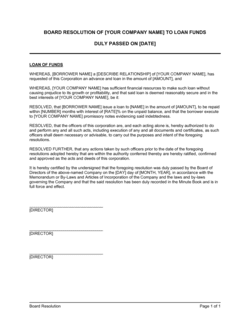
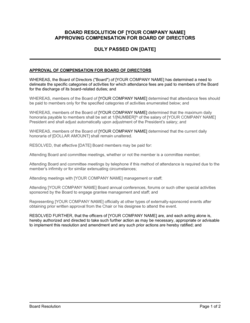
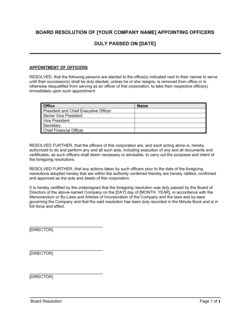
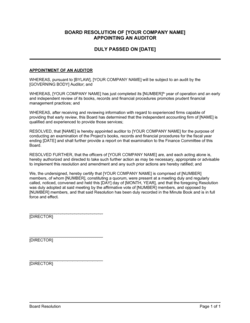
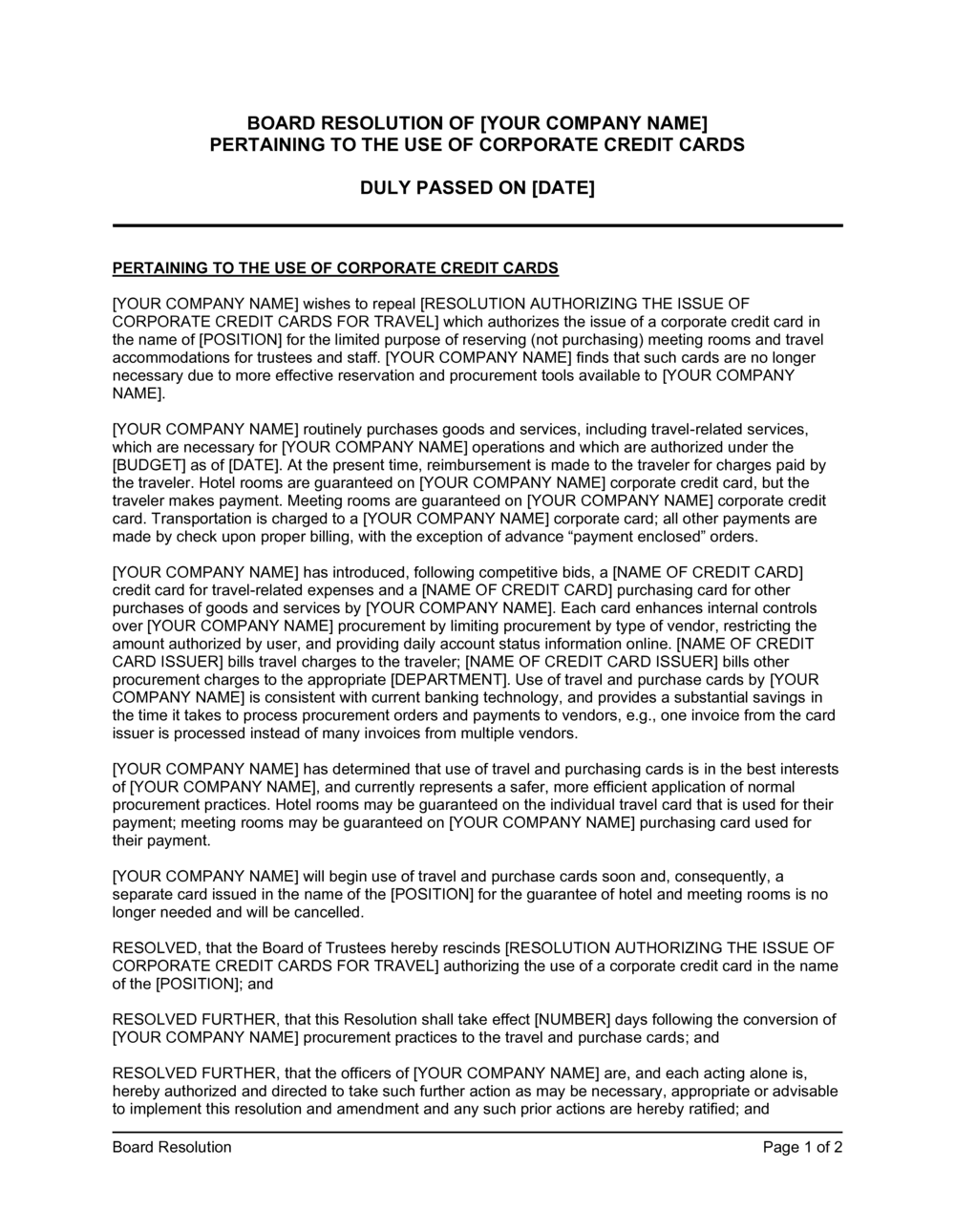
Board Resolution Pertaining to the Use of Corporate Credit Cards Template

Free Word download • Edit online • Save & share with Drive • Export to PDF

2 pages25–30 min to fillDifficulty: StandardSignature requiredLegal review recommended
Learn more ↓
FreeBoard Resolution Pertaining to the Use of Corporate Credit Cards Template

At a glance

What it is
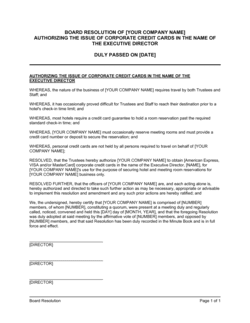
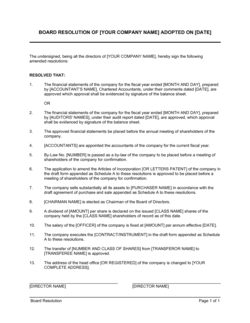
A Board Resolution Pertaining to the Use of Corporate Credit Cards is a formal binding document adopted by a company's board of directors that officially authorizes the issuance and use of corporate credit cards by designated employees. This free Word download sets out the spending limits, eligible cardholders, permitted expense categories, expense reporting obligations, and consequences for misuse — creating a corporate governance record that satisfies auditors, banks, and regulators.
When you need it
Use it when a company first applies for a corporate credit card program, when adding new authorized cardholders beyond those originally approved, or when updating spending limits and usage policies as the business grows. Banks and card issuers typically require a certified board resolution before issuing cards in the company's name.
What's inside
Meeting date and quorum confirmation, authorization of the credit card program and named financial institution, cardholder eligibility and spending limits per cardholder and per transaction, permitted expense categories, expense reporting and receipt-submission requirements, liability allocation between the company and employee, and the officer authorized to execute related agreements with the card issuer.

What is a Board Resolution Pertaining to the Use of Corporate Credit Cards?

A Board Resolution Pertaining to the Use of Corporate Credit Cards is a formal written decision adopted by a company's board of directors that authorizes the organization to obtain, issue, and administer a corporate credit card program. It identifies the issuing financial institution, names or describes eligible cardholders, sets spending limits and permitted expense categories, establishes expense reporting obligations, and allocates liability between the company and individual employees. Beyond its internal governance function, the resolution serves as the certified legal instrument that banks and card issuers require before opening a corporate account — without it, no cards can be issued in the company's name.

Why You Need This Document

Operating a corporate credit card program without a board resolution creates compounding risk across governance, finance, and operations simultaneously. Without documented board authorization, the individuals who signed the card agreement may lack proper corporate authority — exposing the company to challenges on the enforceability of the credit agreement itself. Without defined spending limits and permitted categories embedded in a binding resolution, expense policy violations become an HR matter rather than a contractual breach, weakening the company's ability to recover unauthorized charges from employees. Auditors, external accountants, and grant funders routinely request a certified copy of the resolution to confirm that card expenditures have proper board oversight — an inability to produce one raises a governance red flag. This template gives you a complete, bank-ready board resolution in under 30 minutes, with all the clauses needed to establish authority, set controls, and protect the company from misuse.

Which variant fits your situation?

If your situation is…Use this template
Authorizing a new corporate credit card program for the first timeBoard Resolution — Corporate Credit Card Use
Authorizing a specific officer to open a bank accountBoard Resolution to Open a Bank Account
Authorizing a signatory for company checks and wire transfersBoard Resolution Authorizing Signatory
Establishing a full expense reimbursement policy for all employeesEmployee Expense Reimbursement Policy
Setting a broader travel and entertainment spending policyTravel and Expense Policy
Approving a major capital expenditure or equipment purchaseBoard Resolution Authorizing Capital Expenditure
Authorizing the company to enter a banking services agreementBoard Resolution Authorizing Execution of Agreement

Common mistakes to avoid

❌ Using a trade name instead of the registered legal entity name

Why it matters: Card issuers match the resolution against the account application. A name mismatch causes the bank to reject the resolution, delaying card issuance by days or weeks.

Fix: Pull the exact corporate name from your articles of incorporation or certificate of formation and use it verbatim in every field of the resolution.

❌ No per-cardholder spending sublimits

Why it matters: Without individual sublimits, a single cardholder can exhaust the entire program credit line, leaving the rest of the team unable to transact and exposing the company to concentrated liability.

Fix: Set a monthly per-cardholder limit and a per-transaction pre-approval threshold in the resolution, then confirm the card issuer programs them as hard controls at enrollment.

❌ Omitting the expense report submission deadline

Why it matters: Without a stated deadline, cardholders submit at their convenience — often months late — making month-end reconciliation unreliable and creating tax deduction timing issues.

Fix: State a specific number of days (typically 15 or 30) from the charge date by which the cardholder must submit receipts and an expense report, and link non-compliance to personal liability for the charge.

❌ Failing to include a supersession clause

Why it matters: If an older corporate credit card resolution is on file with the bank, the institution may honor limits or authorizations from the prior document when the new one conflicts, creating a gap in governance control.

Fix: Include an explicit clause stating that the current resolution supersedes and replaces all prior resolutions of the board on the same subject, and send a certified copy to the card issuer immediately after adoption.

❌ Authorizing 'any officer' to execute card agreements

Why it matters: Banks and card issuers require a specifically identified individual to sign account agreements; a generic 'any officer' designation is often rejected or creates ambiguity about who can bind the company.

Fix: Name a specific individual by full name and title, with an alternative named individual in case the primary is unavailable, rather than using a generic officer reference.

❌ No recoupment or personal liability clause for unauthorized charges

Why it matters: Without explicit recoupment language, the company may need a separate legal proceeding to recover personal charges from an employee's wages, and labor laws in some jurisdictions restrict wage deductions without prior written consent.

Fix: Include a clause requiring employees to sign a cardholder agreement at enrollment acknowledging personal liability for unauthorized charges and consenting to wage deductions as permitted by applicable law.

The 10 key clauses, explained

Recitals and meeting authority

In plain language: Confirms the date and location of the meeting, that proper notice was given, and that a quorum of directors was present — establishing the legal validity of the resolution.

Sample language
WHEREAS, a duly noticed meeting of the Board of Directors of [COMPANY LEGAL NAME] (the 'Company') was held on [DATE] at [LOCATION / VIRTUAL PLATFORM], at which a quorum of [NUMBER] directors was present and acting throughout;

Common mistake: Omitting the quorum confirmation. A resolution passed without quorum is voidable, and banks routinely ask for proof that the meeting was properly constituted before accepting the document.

Authorization of the credit card program

In plain language: States the board's decision to authorize the company to obtain and maintain a corporate credit card account with a named financial institution.

Sample language
NOW, THEREFORE, BE IT RESOLVED that the Company is hereby authorized to establish and maintain a corporate credit card account with [BANK / CARD ISSUER NAME] for the purpose of facilitating legitimate business expenditures.

Common mistake: Naming only the card network (Visa, Mastercard) rather than the issuing bank. Card issuers require their specific institution to be named in the certified resolution they receive.

Authorized cardholders and eligibility criteria

In plain language: Identifies the specific employees or job titles permitted to hold a card, or delegates to a named officer the authority to designate cardholders within defined parameters.

Sample language
BE IT FURTHER RESOLVED that the following officers and employees are hereby authorized to hold and use a corporate credit card: [NAME / TITLE]; [NAME / TITLE]; or such other employees as the [CFO / CEO] may designate in writing from time to time.

Common mistake: Listing only names rather than titles. When named employees leave, the resolution becomes outdated and either requires a new board resolution or creates an authorization gap.

Spending limits per cardholder and per transaction

In plain language: Sets the maximum charge permitted per transaction and the maximum balance or monthly spend per cardholder, which the card issuer programs as hard limits.

Sample language
BE IT FURTHER RESOLVED that individual cardholder credit limits shall not exceed $[MONTHLY LIMIT] per billing cycle, with no single transaction exceeding $[TRANSACTION LIMIT] without prior written approval from [APPROVING OFFICER / TITLE].

Common mistake: Setting a single aggregate company limit without per-cardholder sublimits. Without individual limits, one employee can consume the entire program balance, leaving others unable to transact.

Permitted and prohibited expense categories

In plain language: Lists the business expense types for which the card may be used and explicitly prohibits personal use, cash advances, and any other off-policy charges.

Sample language
BE IT FURTHER RESOLVED that corporate credit cards shall be used exclusively for the following business purposes: [TRAVEL], [MEALS AND ENTERTAINMENT], [OFFICE SUPPLIES], [SOFTWARE SUBSCRIPTIONS]. Personal charges, cash advances, and gambling transactions are expressly prohibited.

Common mistake: Using a vague catch-all like 'business expenses' without specifying categories. Vague authorization invites interpretation disputes and weakens the company's position when seeking to recoup unauthorized charges.

Expense reporting and receipt submission requirements

In plain language: Requires cardholders to submit itemized expense reports with receipts within a defined number of days and names the person or department responsible for review and approval.

Sample language
BE IT FURTHER RESOLVED that each authorized cardholder shall submit a completed expense report with original receipts or digital equivalents to [FINANCE DEPARTMENT / CFO] within [30] days of the charge date. Failure to submit timely documentation may result in personal liability for the charge.

Common mistake: Setting no submission deadline. Without a deadline, expense reports accumulate for months, creating reconciliation backlogs, tax reporting errors, and difficulty recovering unauthorized charges.

Liability allocation between company and employee

In plain language: States whether the company bears full corporate liability for all charges or whether the employee bears individual liability for any unauthorized or unreimbursed charges.

Sample language
BE IT FURTHER RESOLVED that the Company shall bear corporate liability for all authorized charges submitted in accordance with this resolution and the Company's expense policy. Any charge deemed personal, unauthorized, or unsupported by documentation shall be the sole personal liability of the cardholder and may be deducted from wages to the extent permitted by applicable law.

Common mistake: Assuming corporate liability covers everything without including a recoupment clause. Without explicit recoupment language, recovering unauthorized charges from an employee's paycheck may require a separate legal proceeding.

Authorized officer to execute card agreements

In plain language: Names the specific officer (typically the CEO, CFO, or Treasurer) empowered to sign the card issuer's application, cardholder agreements, and any amendments on behalf of the company.

Sample language
BE IT FURTHER RESOLVED that [NAME], [TITLE] of the Company, is hereby authorized and directed to execute any and all agreements, applications, and documents required by [CARD ISSUER] to establish and administer the corporate credit card program.

Common mistake: Authorizing 'any officer' to execute agreements. Card issuers and courts require a specifically named individual; a generic authorization may be rejected or challenged.

Consequences for misuse and enforcement

In plain language: States what happens if a cardholder violates the policy — card cancellation, personal liability for the charge, disciplinary action up to termination, and civil or criminal referral for fraud.

Sample language
BE IT FURTHER RESOLVED that misuse of a corporate credit card, including but not limited to personal charges, exceeding authorized limits, or falsification of expense reports, shall result in immediate card cancellation, personal liability for unauthorized charges, and disciplinary action up to and including termination of employment.

Common mistake: Omitting the fraud and falsification reference. Without it, an employee who fabricates receipts may argue the company's recourse is limited to an employment-law remedy rather than a criminal or civil fraud claim.

Certification and effective date

In plain language: States when the resolution takes effect, confirms that it supersedes any prior conflicting resolutions, and includes the corporate secretary's certification signature block.

Sample language
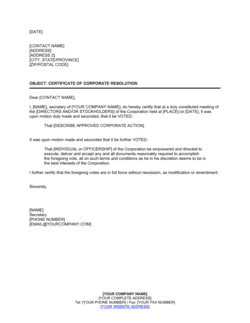
This Resolution shall be effective as of [DATE] and supersedes any prior resolutions of the Board relating to the issuance or use of corporate credit cards. I, [SECRETARY NAME], Secretary of [COMPANY LEGAL NAME], hereby certify that the foregoing is a true and correct copy of a resolution duly adopted by the Board of Directors.

Common mistake: Forgetting to include a supersession clause. If an old, conflicting resolution is still on file with the card issuer, disputes over authority or limits may reference the older document.

How to fill it out

  1. 1

    Enter the company's legal name and state of incorporation

    Use the full registered legal name exactly as it appears in your corporate charter — not a trade name or DBA. Include the state or jurisdiction of incorporation.

    💡 Cross-check the corporate charter or articles of incorporation; the name on the resolution must match the name on the bank's account documentation exactly.

  2. 2

    Record the meeting date, location, and quorum

    Fill in the exact date and location (or virtual platform) of the board meeting, and confirm the number of directors present constituted a quorum under your bylaws.

    💡 If you are adopting the resolution by written consent rather than at a meeting, replace the meeting recitals with a unanimous written consent clause and collect signatures from all directors.

  3. 3

    Name the card issuer and account type

    Insert the full legal name of the bank or financial institution issuing the cards — not just the card network. Specify whether the program is a corporate liability, individual liability, or hybrid account.

    💡 Confirm the exact institution name with your bank relationship manager before finalizing; 'Chase' and 'JPMorgan Chase Bank, N.A.' are not interchangeable in a certified resolution.

  4. 4

    List authorized cardholders or delegate the designation authority

    Either name specific individuals by full name and title, or authorize a named officer (CFO or CEO) to designate cardholders in writing going forward. The latter approach reduces the need for new resolutions as staff changes.

    💡 Using title-based delegation future-proofs the resolution — when an employee leaves, their successor in the role is automatically covered without a board amendment.

  5. 5

    Set per-cardholder and per-transaction spending limits

    Enter a monthly spending limit per cardholder and a maximum per-transaction amount above which pre-approval is required. These figures will be programmed by the card issuer as hard controls.

    💡 Set limits slightly below actual expected spend to preserve a compliance buffer — you can always approve exceptions in writing, but breaching a hard limit triggers an automatic decline.

  6. 6

    Define permitted expense categories and prohibited uses

    List the specific categories authorized (travel, meals, software, office supplies) and explicitly prohibit personal use, cash advances, and any industry-specific off-limits categories.

    💡 Align your permitted-category list exactly with your expense report coding structure so cardholders do not need to re-categorize charges at submission time.

  7. 7

    State the expense reporting deadline and approval chain

    Specify how many days after the charge date a cardholder must submit receipts and an expense report, and name the department or officer who reviews and approves submissions.

    💡 A 30-day submission window is standard; tighten it to 15 days for high-spend roles to keep reconciliation current with monthly billing cycles.

  8. 8

    Have the board sign and the corporate secretary certify

    Obtain director signatures (or written consent signatures) per your bylaws, then have the corporate secretary sign the certification block and affix the corporate seal if required by your jurisdiction or the card issuer.

    💡 Request a certified copy requirement from your bank before finalizing — some institutions require the secretary's signature to be notarized or require an original wet-ink copy rather than a scanned PDF.

Frequently asked questions

What is a board resolution for corporate credit card use?

A board resolution for corporate credit card use is a formal written decision adopted by a company's board of directors that officially authorizes the organization to obtain and administer a corporate credit card program. It names the issuing bank, identifies authorized cardholders, sets spending limits and permitted expense categories, and specifies expense reporting obligations. Banks and card issuers require a certified copy before opening the account or adding cards.

Why do banks require a board resolution before issuing corporate credit cards?

Banks require a board resolution to confirm that the individual signing the card application and cardholder agreements has proper corporate authority to bind the company. Without it, the bank has no documented evidence that the company's governing body approved the liability associated with the credit program. Regulated financial institutions are required to maintain this documentation for compliance and anti-money-laundering purposes.

Can a sole proprietor or single-member LLC use this resolution?

A sole proprietor has no board of directors and does not need a resolution — the owner's signature on the application is sufficient. A single-member LLC may also be able to apply without a formal resolution depending on the bank's requirements, though some institutions still request a manager's certificate or operating agreement excerpt. Multi-member LLCs and corporations should always use a formal resolution to create a clear governance record.

What spending limits should the board set in the resolution?

Typical per-cardholder monthly limits range from $2,000 for junior staff to $25,000 or more for executives, depending on role and expected business travel. A per-transaction pre-approval threshold of $1,000–$2,500 is common for mid-sized businesses. Set limits that reflect actual expected spend — limits that are too low cause operational friction; limits that are too high reduce the financial control benefit of the policy.

Does the resolution need to be notarized?

Most card issuers accept a resolution certified by the corporate secretary without notarization. However, some banks — particularly for high-credit-limit programs or for companies in certain jurisdictions — require a notarized certification or an original wet-ink signature rather than a scanned PDF. Confirm your specific bank's requirements before finalizing the document.

How often should the board update this resolution?

Review and re-adopt the resolution whenever you change your card issuer, materially adjust spending limits, add or remove categories of authorized employees, or update the expense reporting policy. As a best practice, include a resolution review on the annual board meeting agenda to confirm it reflects current policy. A resolution that is more than two to three years old may no longer reflect actual practice and creates audit risk.

What happens if an employee misuses a corporate credit card?

If the resolution includes a personal liability and recoupment clause, the company can hold the employee responsible for unauthorized charges, deduct the amount from wages with the employee's prior written consent, terminate employment, and — for intentional fraud — refer the matter to law enforcement. Without these clauses documented in the resolution and a signed cardholder agreement, the company's recourse is limited and recovery becomes a costly legal dispute.

Is a board resolution the same as a corporate credit card policy?

No. A board resolution is the formal governance act that authorizes the credit card program and satisfies the bank's legal requirements. A corporate credit card policy is an internal operational document that provides detailed day-to-day guidance — receipt requirements, approval workflows, and expense categories — for employees and managers. The resolution should reference the policy, and both documents should be kept current and consistent with each other.

Can the resolution delegate cardholder designation authority to a single officer?

Yes, and this is often the most practical approach. Instead of listing individual names — which requires a new resolution every time an employee joins or leaves — the board can authorize a named officer such as the CFO or CEO to designate cardholders in writing within the limits set by the resolution. This approach keeps the resolution current without repeated board action while maintaining clear accountability at the officer level.

How this compares to alternatives

vs Board Resolution to Open a Bank Account

A bank account resolution authorizes opening a deposit account and designates signatories for checks and wire transfers. A corporate credit card resolution authorizes a revolving credit program with spending limits, cardholder eligibility, and expense controls. Some companies adopt both resolutions at the same meeting when establishing a new banking relationship, but they serve different purposes and are kept as separate documents.

vs Corporate Credit Card Policy

A credit card policy is an internal HR and finance document that guides daily employee behavior — receipt requirements, approval workflows, and reimbursement timelines. A board resolution is the governing legal act that authorizes the program and satisfies bank compliance requirements. The resolution creates the authority; the policy operationalizes it. Both are needed and should cross-reference each other.

vs Expense Reimbursement Policy

An expense reimbursement policy governs out-of-pocket employee spending that is later repaid by the company — typically where no corporate card exists or where the card was not used. A corporate credit card resolution governs direct company liability through the card program. The two documents often coexist and should use consistent expense categories, dollar thresholds, and receipt requirements.

vs Signing Authority Board Resolution

A signing authority resolution delegates power to one or more officers to execute contracts, agreements, and financial instruments on behalf of the board. A corporate credit card resolution is narrower — it specifically authorizes a credit facility and defines cardholder controls. Signing authority resolutions often accompany or reference credit card resolutions when an officer needs authority both to sign the card agreement and to administer the program.

Industry-specific considerations

Professional Services

Travel-heavy billing models require per-project expense coding; the resolution typically separates client-billable and non-billable expense categories to streamline client invoicing and audit trails.

Construction and Real Estate

Field supervisors and project managers need cards for materials and equipment purchases on short notice; the resolution often includes project-code or cost-center tagging requirements for each transaction.

Healthcare

Physician and administrative card programs must comply with anti-kickback regulations; the resolution explicitly excludes entertainment spending that could constitute a prohibited benefit to referral sources.

Nonprofit Organizations

Grant funders and auditors require documented board authorization for any expenditure instrument; the resolution must align permitted categories with grant restrictions and fund accounting requirements.

Retail and E-commerce

Purchasing managers need cards for inventory, packaging, and platform fees; the resolution typically caps individual transactions at a lower threshold and requires same-day digital receipt submission.

Technology / SaaS

Software subscriptions, cloud hosting, and conference registrations dominate card spend; the resolution should explicitly include recurring subscription charges and set a process for approving new vendor auto-billing arrangements.

Jurisdictional notes

United States

Corporate authority requirements vary by state of incorporation. Delaware and Nevada corporations generally require a board resolution or unanimous written consent to authorize any credit facility. The Truth in Lending Act (TILA) governs card issuer obligations, not the company's internal resolution. Wage deduction for unauthorized charges must comply with state labor laws — California, for example, restricts most wage deductions without a separate written authorization.

Canada

Canadian corporations governed by the CBCA or provincial business corporations acts require board authorization for significant financial transactions. Quebec civil law imposes additional formality requirements. Wage deductions for unauthorized charges must comply with provincial employment standards legislation — most provinces require a separate written assignment from the employee and prohibit deductions that reduce wages below minimum wage.

United Kingdom

UK companies governed by the Companies Act 2006 require board resolutions to authorize credit facilities where the articles of association vest such power in the board. The resolution should reference whether it is passed at a quorate board meeting or as a written resolution under s.288–s.292. Wage deductions for unauthorized card use are governed by the Employment Rights Act 1996, which requires a prior written deduction agreement.

European Union

EU member states vary significantly in formality requirements for corporate credit authorizations — German GmbHs and French SAS structures each have distinct governance frameworks governing who may bind the company to credit obligations. GDPR considerations apply where cardholder transaction data is shared with third-party expense platforms or stored outside the EEA. Companies operating across multiple member states should obtain country-specific legal confirmation that the resolution format is sufficient.

Template vs lawyer — what fits your deal?

PathBest forCostTime
Use the templateSmall to mid-sized companies establishing a standard corporate card program with a domestic bankFree20–30 minutes
Template + legal reviewCompanies with complex cardholder structures, international card programs, or regulated industries (healthcare, financial services)$200–$500 for a corporate lawyer or accountant review1–3 days
Custom draftedLarge enterprises, publicly traded companies, or organizations subject to fiduciary duty rules requiring customized governance language$500–$2,000+1–2 weeks

Glossary

Board Resolution
A formal written decision adopted by a company's board of directors that is recorded in the corporate minutes and carries binding authority on the organization.
Authorized Cardholder
An employee or officer specifically named or described in the resolution as permitted to hold and use a corporate credit card.
Spending Limit
The maximum dollar amount an authorized cardholder may charge per transaction or per billing cycle, as set by the board in the resolution.
Permitted Expense Category
The specific types of business expenditure — such as travel, meals, office supplies, or software subscriptions — for which the corporate card may be used.
Corporate Liability
An arrangement where the company is legally responsible for all charges made on a corporate card, regardless of whether the employee is reimbursed or disciplined.
Individual Liability
An arrangement where the employee is personally liable for all card charges and is reimbursed by the company only after submitting valid expense reports.
Certified Resolution
A copy of a board resolution signed by the corporate secretary attesting that it was duly adopted at a valid meeting, which banks and card issuers accept as proof of authority.
Quorum
The minimum number of directors required to be present at a board meeting for any resolution passed at that meeting to be legally valid.
Expense Report
A formal document submitted by a cardholder itemizing each charge, supported by receipts, within a specified number of days after the expense is incurred.
Personal Use Prohibition
A clause explicitly forbidding cardholders from using the corporate card for non-business purchases, with stated consequences for violation.
Recoupment Clause
A provision allowing the company to deduct unauthorized or personal charges from the employee's paycheck or hold the employee personally liable for repayment.

Part of your Business Operating System

This document is one of 3,000+ business & legal templates included in Business in a Box.

  • Fill-in-the-blanks — ready in minutes
  • 100% customizable Word document
  • Compatible with all office suites
  • Export to PDF and share electronically

Create your document in 3 simple steps.

From template to signed document — all inside one Business Operating System.
1
Download or open template

Access over 3,000+ business and legal templates for any business task, project or initiative.

2
Edit and fill in the blanks with AI

Customize your ready-made business document template and save it in the cloud.

3
Save, Share, Send, Sign

Share your files and folders with your team. Create a space of seamless collaboration.

Save time, save money, and create top-quality documents.

★★★★★

"Fantastic value! I'm not sure how I'd do without it. It's worth its weight in gold and paid back for itself many times."

Managing Director · Mall Farm
Robert Whalley
Managing Director, Mall Farm Proprietary Limited
★★★★★

"I have been using Business in a Box for years. It has been the most useful source of templates I have encountered. I recommend it to anyone."

Business Owner · 4+ years
Dr Michael John Freestone
Business Owner
★★★★★

"It has been a life saver so many times I have lost count. Business in a Box has saved me so much time and as you know, time is money."

Owner · Upstate Web
David G. Moore Jr.
Owner, Upstate Web

Run your business with a system — not scattered tools

Stop downloading documents. Start operating with clarity. Business in a Box gives you the Business Operating System used by over 250,000 companies worldwide to structure, run, and grow their business.

Start free · No credit card required