Board Resolution Appointing an Auditor Template

Free Word download • Edit online • Save & share with Drive • Export to PDF

1 page20–30 min to fillDifficulty: StandardSignature requiredLegal review recommended
Learn more ↓
FreeBoard Resolution Appointing an Auditor Template

At a glance

What it is
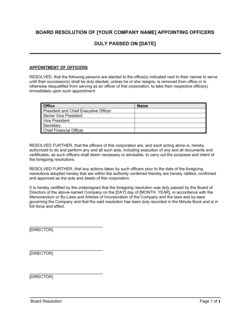
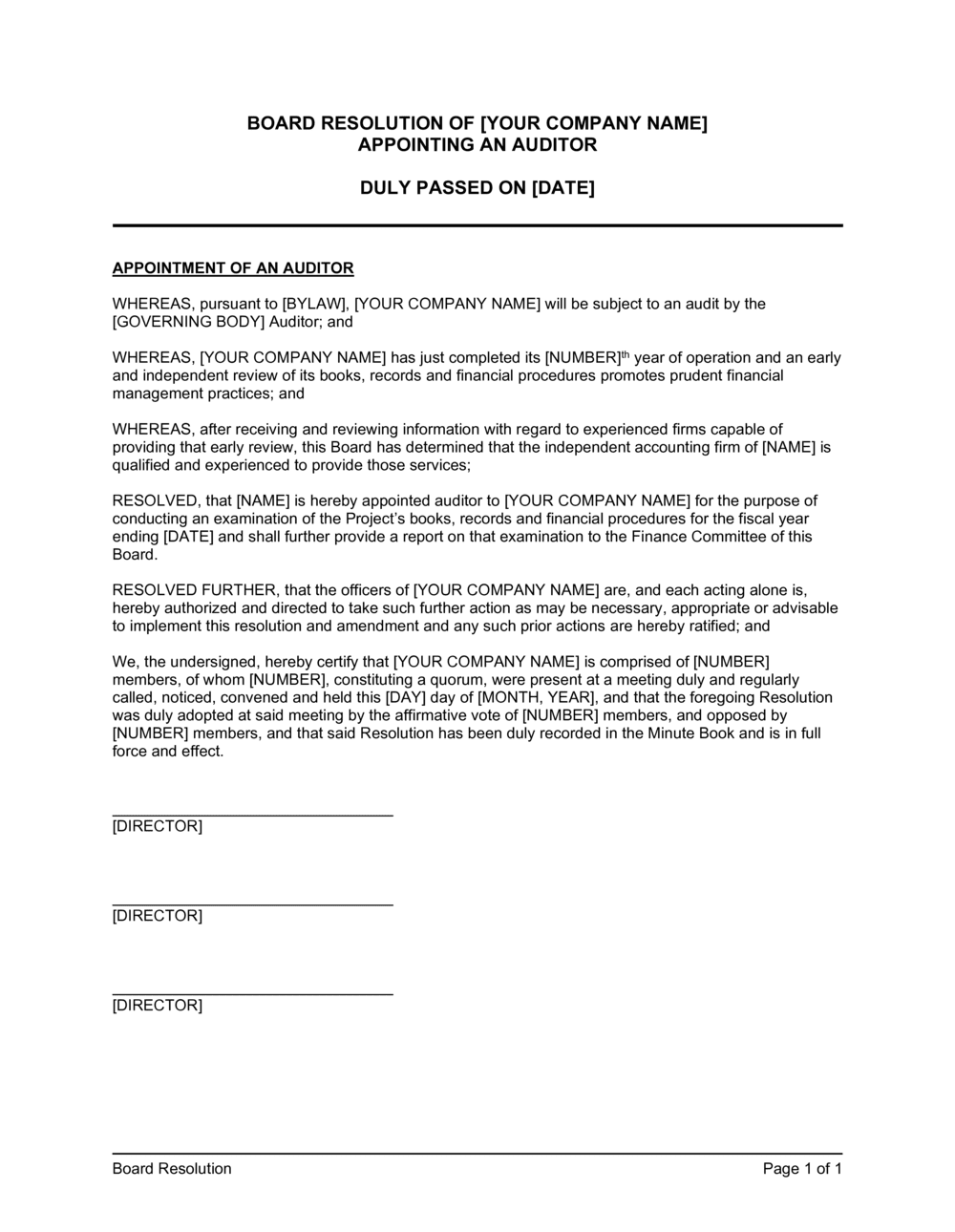
A Board Resolution Appointing an Auditor is a formal corporate document recording the board of directors' decision to engage a specific audit firm or individual auditor for a defined term. This free Word download provides a ready-to-edit template that captures the authorization, auditor details, engagement scope, fee range, and effective date — and can be exported as PDF for inclusion in the corporate minute book.
When you need it
Use it at the annual general meeting cycle when the board selects or re-appoints an auditor, when replacing an auditor mid-term, or when a company is required by statute, lender covenant, or investor agreement to formally document auditor appointments in board minutes.
What's inside
Recitals confirming the board's authority, the auditor's name and firm, the engagement scope and fiscal year covered, fee authorization, the chairperson's certification, and signature blocks for the requisite directors or corporate secretary confirming the resolution was duly passed.

What is a Board Resolution Appointing an Auditor?

A Board Resolution Appointing an Auditor is a formal corporate document that records the board of directors' official decision to engage a specific audit firm or individual auditor for a defined fiscal year. It identifies the auditor by registered legal name, authorizes the scope of the engagement and the fee range, confirms that the auditor's independence has been reviewed, and delegates authority to a named officer to execute the engagement letter. Once signed by the required directors and certified by the corporate secretary, the resolution becomes a permanent entry in the company's minute book and constitutes the legal basis for the auditor's mandate to examine the company's financial statements.

Why You Need This Document

Without a formal board resolution, an auditor's appointment lacks documented corporate authorization — a gap that becomes acutely visible during lender due diligence, regulatory examinations, and acquisition data-room reviews. Audit firms themselves require evidence of a board-authorized mandate before commencing fieldwork; proceeding without one can prompt the auditor to qualify their report or suspend the engagement. For companies subject to investor agreements or debt covenants requiring annual audited financials, a missing or defective resolution can constitute a technical breach triggering remedies. The resolution also sets a fee cap that gives the board contractual control over audit costs and creates the paper trail regulators expect to see when reviewing a company's governance history. This template provides a ready-to-use structure that closes all of those gaps in under 30 minutes, with clear placeholders guiding you through every clause that auditors, lenders, and regulators look for.

Which variant fits your situation?

If your situation is…Use this template
Appointing an auditor at the annual general meetingBoard Resolution Appointing an Auditor (Annual)
Replacing a resigned or dismissed auditor mid-termBoard Resolution Removing and Replacing an Auditor
Appointing an internal audit committee rather than an external firmAudit Committee Charter
Documenting board approval of the auditor's engagement letter termsBoard Resolution Approving an Engagement Letter
Recording the full AGM at which the auditor appointment was madeAnnual General Meeting Minutes
Authorizing the CFO to negotiate and sign the audit engagement letterBoard Resolution Authorizing Officer to Execute Contracts
Approving audited financial statements prepared by the appointed firmBoard Resolution Approving Financial Statements

Common mistakes to avoid

❌ Passing the resolution without a confirmed quorum

Why it matters: A resolution adopted without a legal quorum is procedurally void. The auditor's appointment can be challenged, and any work performed under it may lack authorized scope — a serious problem during regulatory review or litigation.

Fix: Confirm the quorum count before the vote and record the names of the directors present in the resolution's recitals. If the required number is not available, reschedule or use written consent procedures.

❌ Using the audit firm's brand name instead of its registered legal entity

Why it matters: Regulatory filings, engagement letters, and bank covenant compliance certificates all require the exact registered firm name. A mismatch can trigger a documentation objection from regulators or lenders.

Fix: Obtain the firm's full registered legal name from its engagement letter or its registration on the relevant professional licensing database before completing the resolution.

❌ Omitting the fee authorization cap

Why it matters: An open-ended fee authorization removes any contractual ceiling on the audit cost and limits the board's ability to question or dispute invoices that exceed the original estimate.

Fix: Set the cap at the engagement letter estimate plus a 10–15% buffer, and specify that any fees above the cap require a supplemental board resolution.

❌ Skipping the independence confirmation step

Why it matters: Independence is a statutory requirement in most jurisdictions and a condition of engagement under every major auditing standard. Failing to document the review leaves the company exposed if the auditor's independence is later questioned.

Fix: Request a written independence declaration from the audit firm before the board meeting, attach it to the resolution, and record that the board reviewed it with no disqualifying findings.

❌ Backdating the resolution after the audit has already begun

Why it matters: Auditing standards require the appointment to pre-date the engagement. A backdated resolution signals a governance failure and can prompt the auditor to qualify their report or resign.

Fix: Pass and sign the resolution before the audit firm begins any fieldwork or reviews any company records. If timing is tight, use a written consent resolution executed by all directors.

❌ Filing the executed resolution outside the minute book

Why it matters: Regulators, acquirers, and lenders conducting due diligence expect auditor appointment resolutions to appear in the minute book in chronological order. A missing or misfiled resolution raises a red flag about overall governance quality.

Fix: Establish a standing process to file all executed resolutions in the minute book within 10 business days of adoption, with a chronological index entry.

The 9 key clauses, explained

Recitals and authority

In plain language: States the date and place of the board meeting, confirms a quorum was present, and cites the legal authority (articles of incorporation, bylaws, or applicable statute) under which the board is empowered to appoint an auditor.

Sample language
WHEREAS, the Board of Directors of [COMPANY LEGAL NAME] (the 'Company') is authorized under Article [X] of its Bylaws and applicable law to appoint an independent auditor for each fiscal year; and WHEREAS, a quorum of [NUMBER] directors was duly convened on [DATE] at [LOCATION];

Common mistake: Citing the wrong bylaw article or omitting the quorum confirmation. A resolution passed without a documented quorum can be challenged as invalid, voiding the auditor's appointment.

Appointment of auditor

In plain language: Formally names the audit firm or individual auditor being appointed, including their registered firm name, license number where applicable, and business address.

Sample language
NOW, THEREFORE, BE IT RESOLVED that [AUDIT FIRM NAME], a licensed public accounting firm located at [ADDRESS], License No. [NUMBER], is hereby appointed as the independent auditor of the Company for the fiscal year ending [DATE].

Common mistake: Using a trading name instead of the registered firm name. Audit engagement letters and regulatory filings require the exact legal name; a mismatch creates compliance gaps.

Scope and engagement terms

In plain language: Defines what the auditor is engaged to do — typically an audit of annual financial statements in accordance with a named auditing standard — and cross-references the engagement letter.

Sample language
The auditor is engaged to conduct an independent audit of the Company's financial statements for the fiscal year ending [DATE] in accordance with [GAAS / IFRS / PCAOB / ISA] standards, as further detailed in the Engagement Letter dated [DATE], which is incorporated herein by reference.

Common mistake: Omitting the reference to auditing standards. Without specifying the applicable standard, the scope is ambiguous and may not satisfy regulatory or lender requirements.

Fee authorization

In plain language: Authorizes the company to pay the auditor's fees within a stated range or cap, and may delegate authority to the CFO or audit committee to approve invoices within that limit.

Sample language
The Board hereby authorizes payment of audit fees in an amount not to exceed $[AMOUNT], subject to the terms of the Engagement Letter. The Chief Financial Officer is authorized to approve individual invoices within this limit without further board approval.

Common mistake: Authorizing fees without a cap. An open-ended fee authorization gives the auditor no contractual ceiling and limits the company's ability to dispute overruns.

Term and renewal

In plain language: Specifies the duration of the appointment — typically one fiscal year — and states whether the appointment automatically renews or requires a new resolution each year.

Sample language
This appointment shall be effective as of [DATE] and shall continue through the completion of the audit for the fiscal year ending [END DATE], unless earlier terminated in accordance with this resolution or applicable law.

Common mistake: Leaving the term open-ended. An undated or perpetual auditor appointment creates uncertainty about when a new resolution is needed and may conflict with statutory rotation requirements.

Independence confirmation

In plain language: Records the board's confirmation that it has reviewed the auditor's independence declaration and found no disqualifying relationships under applicable auditing standards.

Sample language
The Board has reviewed the independence declaration provided by [AUDIT FIRM NAME] dated [DATE] and confirms that, to its knowledge, there are no relationships or circumstances that would impair the auditor's independence under [APPLICABLE STANDARD].

Common mistake: Skipping the independence confirmation entirely. Regulators and investors treat the independence review as a separate, documented step — not something implied by the appointment itself.

Authority to execute engagement letter

In plain language: Delegates authority to a named officer — typically the CFO, CEO, or corporate secretary — to sign the engagement letter and any ancillary documents on behalf of the company.

Sample language
The Chief Financial Officer, [NAME], is hereby authorized and directed to execute the Engagement Letter with [AUDIT FIRM NAME] and any related documents necessary to give effect to this resolution, on behalf of the Company.

Common mistake: Authorizing a generic 'officer' without naming a specific person or title. Audit firms require a named authorized signatory on the engagement letter and will not proceed without one.

Certification by corporate secretary

In plain language: The corporate secretary certifies that the resolution was duly adopted at a properly constituted meeting, that a quorum was present, and that the resolution accurately reflects the board's decision.

Sample language
I, [CORPORATE SECRETARY NAME], being the duly appointed Corporate Secretary of [COMPANY LEGAL NAME], hereby certify that the foregoing resolution was duly adopted by the Board of Directors at a meeting held on [DATE], at which a quorum was present and acting throughout.

Common mistake: Having the CEO rather than the corporate secretary certify the resolution. Certification by an officer who also voted on the resolution creates a conflict that auditors and regulators may flag.

Signature block

In plain language: Captures the dated signatures of the required directors or the corporate secretary confirming adoption, with title and date fields for each signatory.

Sample language
______________________________ Date: ________ [DIRECTOR NAME], [TITLE] ______________________________ Date: ________ [DIRECTOR NAME], [TITLE]

Common mistake: Collecting only one director's signature when the bylaws require a minimum of two. A single-signature resolution is procedurally defective under most corporate constitutions.

How to fill it out

  1. 1

    Confirm the meeting date, location, and quorum

    Enter the exact date and place the board meeting was held and verify the number of directors present meets your bylaw quorum requirement. Record the names of all directors present in the recitals.

    💡 If the resolution is passed by written consent rather than at a live meeting, replace the meeting recitals with a 'unanimous written consent' header and ensure all directors sign.

  2. 2

    Enter the auditor's full legal name and registration details

    Use the audit firm's registered legal name — not its marketing brand — along with its business address and, where required, its CPA firm license number or PCAOB registration ID.

    💡 Cross-check the firm name against the engagement letter they will send you; any discrepancy between the resolution and the engagement letter creates a documentation gap.

  3. 3

    Define the fiscal year and engagement scope

    State the exact fiscal year end date covered by the appointment and specify the applicable auditing standard (GAAS, ISA, PCAOB, or IFRS). Reference the engagement letter by date.

    💡 If the engagement letter has not yet been finalized, use 'substantially in the form to be agreed' language and update the cross-reference once the letter is signed.

  4. 4

    Set the fee authorization cap

    Enter a maximum authorized fee amount based on the estimated audit fee from the engagement letter, plus a 10–15% buffer for scope adjustments. Name the officer authorized to approve invoices within this limit.

    💡 Align the cap with the number in the engagement letter — setting it too low requires a supplemental resolution to authorize payment of the final invoice.

  5. 5

    Complete the independence confirmation

    Attach or reference the auditor's written independence declaration dated before the resolution. Record in the resolution that the board reviewed it and found no disqualifying relationships.

    💡 Request the independence letter from the audit firm before the board meeting so the review can be documented in the same resolution — not in a separate follow-up.

  6. 6

    Name the authorized signatory for the engagement letter

    Insert the full name and title of the officer authorized to execute the engagement letter and any related documents. Confirm this person has signing authority under your bylaws.

    💡 If your audit committee charter requires the committee chair to co-sign the engagement letter, add them as an additional authorized signatory here.

  7. 7

    Have the corporate secretary certify and all required directors sign

    The corporate secretary completes the certification block with their name, title, and the meeting date. Collect signatures from the number of directors required by your bylaws or governing statute.

    💡 File the executed resolution in the minute book within 10 business days of the meeting — most corporate statutes and audit standards require contemporaneous documentation.

Frequently asked questions

What is a board resolution appointing an auditor?

A board resolution appointing an auditor is a formal corporate document recording the board of directors' decision to engage a specific audit firm or individual for a defined fiscal year. It identifies the auditor by registered name, authorizes the engagement scope and fees, confirms the auditor's independence, and delegates authority to execute the engagement letter. The signed resolution becomes part of the company's minute book and serves as the legal basis for the auditor's mandate.

Is a board resolution required to appoint an auditor?

In most jurisdictions, yes — corporations laws in the US, Canada, the UK, and EU member states require that auditor appointments be formally authorized by the board or shareholders, depending on company type and size. Even where not legally mandated, lenders, investors, and audit standards bodies expect a documented board resolution as evidence of proper governance. Operating without one creates a gap in the corporate record that is difficult to remedy retroactively.

Who signs a board resolution appointing an auditor?

The resolution is typically signed by the chairperson of the board and certified by the corporate secretary. The number of director signatures required depends on the company's bylaws — many require at least two directors. The corporate secretary's certification is a separate act confirming the resolution was duly adopted at a properly constituted meeting with a quorum present.

How often does a board resolution to appoint an auditor need to be renewed?

Typically once per fiscal year. Most corporate statutes and governance codes require annual re-appointment or ratification of the auditor, even if the same firm continues. In publicly listed companies, shareholder ratification at the AGM is commonly required in addition to the board resolution. Some jurisdictions also impose mandatory auditor rotation after a defined number of years, requiring a new resolution appointing a different firm.

What is the difference between a board resolution and an auditor engagement letter?

A board resolution is the internal corporate document authorizing the appointment — it records the board's decision and is filed in the minute book. An engagement letter is the bilateral contract between the company and the audit firm, signed by both parties, specifying the scope of work, fees, timelines, and each party's responsibilities. The resolution typically authorizes a named officer to execute the engagement letter; both documents are needed to establish a valid audit mandate.

Can a board resolution appointing an auditor be passed by written consent?

Yes, in most jurisdictions a written consent resolution signed by all directors (or the required majority, depending on local law and company bylaws) has the same legal effect as a resolution passed at a physical meeting. The resolution should recite that it is being adopted by written consent and include signature lines dated by each director. Some jurisdictions require unanimous consent for written resolutions — check your applicable corporate statute before using this procedure.

What happens if a company appoints an auditor without a board resolution?

The auditor's mandate lacks formal corporate authorization, which can expose the company to governance challenges, regulatory scrutiny, and due-diligence objections during financing or acquisition. The auditor themselves may decline to issue a report without evidence of a formal appointment. In regulated industries — banking, insurance, listed companies — the absence of documented auditor authorization can trigger regulatory penalties.

Does the resolution need to specify the audit fee?

The resolution should authorize a maximum fee or fee range, not necessarily a fixed amount, since the final fee is typically set in the engagement letter. Authorizing a cap gives the board control over spending and creates a clear approval threshold — invoices within the cap can be paid by the CFO without returning to the board, while any fees above the cap require a supplemental resolution. Omitting fee authorization entirely leaves an open-ended obligation.

Do shareholders need to approve the auditor appointment?

For private companies, shareholder approval is generally not required — the board resolution is sufficient. For public companies and certain regulated entities, shareholder ratification of the auditor at the annual general meeting is required under securities laws in the US (SEC rules), Canada, and the UK (Companies Act 2006). The board resolution initiates the appointment; the shareholder vote ratifies it. Both steps should be documented separately.

How this compares to alternatives

vs Annual General Meeting Minutes

AGM minutes record the full proceedings of the annual general meeting, including shareholder votes on multiple agenda items, of which auditor ratification may be one. A board resolution appointing an auditor is a standalone document focused solely on the board-level authorization decision. For public companies, both documents are needed — the resolution authorizes, and the AGM minutes record shareholder ratification.

vs Audit Committee Charter

An audit committee charter defines the standing mandate, composition, and responsibilities of the audit committee — including its role in recommending an auditor to the board. A board resolution appointing an auditor is the executable document that actually records the specific appointment decision for a given fiscal year. The charter governs the process; the resolution records the outcome.

vs Board Resolution Approving Financial Statements

A board resolution approving financial statements records the board's review and sign-off on the audited accounts prepared by the appointed auditor. It is produced at the end of the audit cycle. A resolution appointing an auditor is produced at the beginning of the audit cycle to authorize the engagement. Both are required in sequence for a complete annual governance record.

vs Engagement Letter

An engagement letter is a bilateral contract between the company and the audit firm establishing the terms of the audit work — scope, fees, timelines, and responsibilities. A board resolution appointing an auditor is the internal corporate authorization that precedes and enables the engagement letter. The resolution delegates authority to sign the engagement letter; the engagement letter executes the commercial arrangement.

Industry-specific considerations

Financial Services

Regulatory bodies such as the SEC, FCA, and OSFI require auditor appointment resolutions as part of annual regulatory filings, with additional requirements for auditor independence and firm rotation in banking and insurance.

Technology / SaaS

Venture-backed SaaS companies face investor agreement requirements for annual audits, and board resolutions appointing Big Four or mid-market firms are standard deliverables for Series A and later funding rounds.

Nonprofit Organizations

Grant funders and state charity regulators often require a formal board resolution confirming auditor appointment as a condition of grant disbursement or annual registration renewal.

Healthcare

Hospitals, managed care organizations, and healthcare systems subject to CMS conditions of participation or state health authority oversight must maintain formal auditor appointment records as part of their compliance documentation.

Manufacturing

Manufacturing companies with bonded debt covenants or public debt instruments are typically required to provide annual auditor appointment resolutions to bondholders or indenture trustees alongside audited financial statements.

Professional Services

Law firms, accounting partnerships, and consulting firms structured as corporations or LLPs use auditor appointment resolutions to satisfy partnership agreement requirements and professional liability insurer due-diligence requests.

Jurisdictional notes

United States

For private companies, auditor appointments are governed by state corporate statutes and the company's bylaws — Delaware General Corporation Law, for example, permits the board to appoint auditors annually. Public companies listed on US exchanges must have the auditor ratified by shareholders at the AGM under SEC rules and comply with PCAOB independence standards. The Sarbanes-Oxley Act requires audit committee pre-approval of all audit and non-audit services, which the resolution should reference for SOX-covered companies.

Canada

Under the Canada Business Corporations Act and provincial equivalents, shareholders of distributing corporations must appoint or re-appoint the auditor at each AGM. The board resolution authorizing the appointment precedes and supports the shareholder vote. Reporting issuers must comply with Canadian Auditing Standards (CAS) and National Instrument 52-108, which imposes additional independence and audit committee oversight requirements. Quebec-incorporated companies should ensure the resolution is available in French.

United Kingdom

Under the Companies Act 2006, private companies may appoint auditors by ordinary resolution of shareholders or, where the articles permit, by board resolution. Public companies and quoted companies must appoint auditors by shareholder resolution at each AGM. The resolution should reference the auditor's eligibility under the Statutory Auditors and Third Country Auditors Regulations 2016. Listed companies must also comply with the UK Corporate Governance Code's requirements for audit committee oversight and mandatory tendering after 10 years with the same firm.

European Union

EU Regulation 537/2014 on statutory audits of public-interest entities imposes mandatory auditor rotation after 10 years (extendable to 20 with a tender process) and restricts non-audit services. Member state company law governs private company appointment procedures, which vary — German GmbHs and French SARLs have different shareholder versus supervisory board approval thresholds. GDPR considerations arise if the engagement letter involves processing employee or customer data; the resolution should reference the audit firm's data processing agreement if applicable.

Template vs lawyer — what fits your deal?

PathBest forCostTime
Use the templatePrivate companies with straightforward governance and a domestic auditor appointment for a single fiscal yearFree15–30 minutes
Template + legal reviewCompanies with lender covenants, investor agreements, or multi-jurisdiction operations requiring auditor appointment documentation$200–$500 (corporate counsel review)1–2 days
Custom draftedPublic companies, regulated financial institutions, or companies undergoing a pre-IPO audit requiring auditor appointment documentation meeting SEC, FCA, or TSX standards$1,000–$3,000+3–7 days

Glossary

Board Resolution
A formal written record of a decision made by a company's board of directors, carrying the same legal authority as a vote taken at a duly convened meeting.
Quorum
The minimum number of directors who must be present at a board meeting for any vote or resolution to be legally valid.
Auditor
A qualified independent accountant or registered audit firm engaged to examine and verify a company's financial statements.
Engagement Letter
A written contract between the company and the audit firm specifying the scope of work, fees, timelines, and responsibilities before audit work begins.
Corporate Secretary
The officer responsible for maintaining the company's statutory records, including the minute book, and for certifying that resolutions were duly passed.
Minute Book
The official corporate record containing all board and shareholder meeting minutes and resolutions, required by law in most jurisdictions.
Recitals
Introductory clauses in a resolution or agreement that set out the background facts and authority under which the board is acting.
Fiscal Year
The 12-month accounting period for which the auditor is engaged to examine financial statements — may or may not align with the calendar year.
Incumbent Auditor
The audit firm or individual currently appointed to a company, as opposed to a new firm being engaged for the first time.
Independence
The requirement that an auditor have no financial, personal, or business relationship with the company that could impair objectivity — a statutory prerequisite in most jurisdictions.
Statutory Audit
An audit required by law rather than chosen voluntarily, typically triggered by company size thresholds, regulated industry status, or public listing.

Part of your Business Operating System

This document is one of 3,000+ business & legal templates included in Business in a Box.

  • Fill-in-the-blanks — ready in minutes
  • 100% customizable Word document
  • Compatible with all office suites
  • Export to PDF and share electronically

Create your document in 3 simple steps.

From template to signed document — all inside one Business Operating System.
1
Download or open template

Access over 3,000+ business and legal templates for any business task, project or initiative.

2
Edit and fill in the blanks with AI

Customize your ready-made business document template and save it in the cloud.

3
Save, Share, Send, Sign

Share your files and folders with your team. Create a space of seamless collaboration.

Save time, save money, and create top-quality documents.

★★★★★

"Fantastic value! I'm not sure how I'd do without it. It's worth its weight in gold and paid back for itself many times."

Managing Director · Mall Farm
Robert Whalley
Managing Director, Mall Farm Proprietary Limited
★★★★★

"I have been using Business in a Box for years. It has been the most useful source of templates I have encountered. I recommend it to anyone."

Business Owner · 4+ years
Dr Michael John Freestone
Business Owner
★★★★★

"It has been a life saver so many times I have lost count. Business in a Box has saved me so much time and as you know, time is money."

Owner · Upstate Web
David G. Moore Jr.
Owner, Upstate Web

Run your business with a system — not scattered tools

Stop downloading documents. Start operating with clarity. Business in a Box gives you the Business Operating System used by over 250,000 companies worldwide to structure, run, and grow their business.

Free Forever Plan · No credit card required