Board Resolution to Retain an Attorney Template

Free Word download β€’ Edit online β€’ Save & share with Drive β€’ Export to PDF

1 pageβ€’20–30 min to fillβ€’Difficulty: Standardβ€’Signature requiredβ€’Legal review recommended
Learn more ↓
FreeBoard Resolution to Retain an Attorney Template

At a glance

What it is
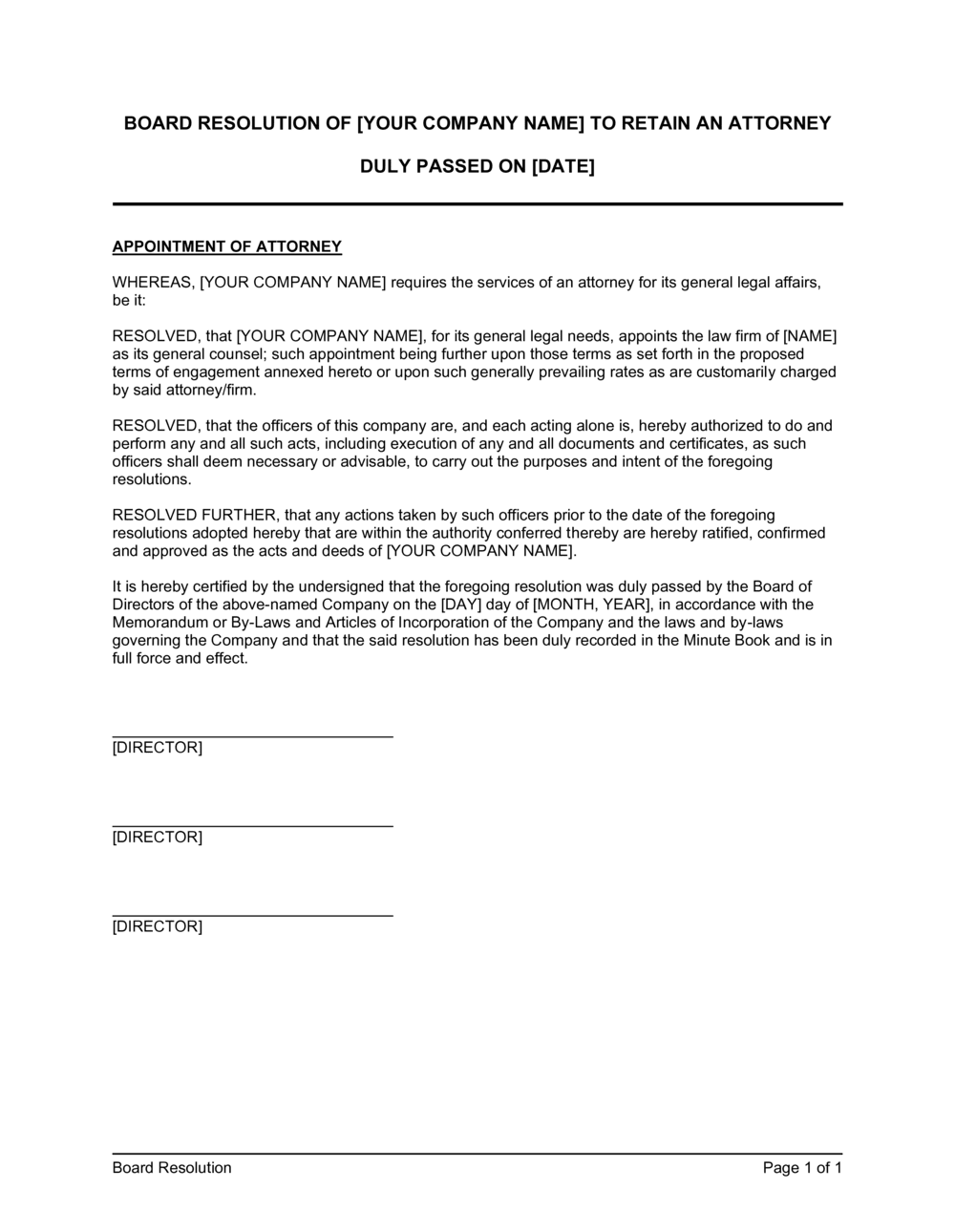
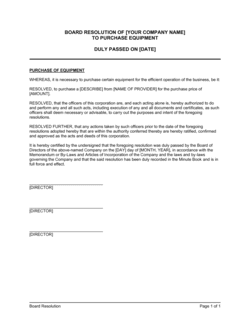
A Board Resolution to Retain an Attorney is a formal corporate document in which a company's board of directors officially authorizes the engagement of outside legal counsel for a defined purpose. This free Word download gives you a ready-to-edit template that records the board's decision, names the attorney or firm retained, defines the scope of engagement, and authorizes a designated officer to execute any resulting retainer agreement.
When you need it
Use it when your corporation, LLC, or nonprofit needs to engage outside counsel for litigation, a regulatory investigation, a major transaction, or any other matter requiring board-level authorization under your governing documents or applicable law.
What's inside
Recitals identifying the company and the legal matter, a resolution clause authorizing retention, attorney and firm identification, defined scope of representation, fee and budget authorization, designated signatory authority, and director signatures confirming adoption.

What is a Board Resolution to Retain an Attorney?

A Board Resolution to Retain an Attorney is a formal corporate governance document in which a company's board of directors officially authorizes the engagement of outside legal counsel for a defined legal matter. It records the board's decision in writing, identifies the attorney or law firm by name, specifies the scope of representation, approves the fee arrangement and budget, and designates an officer to execute the resulting retainer agreement. Once signed by the required directors and certified by the corporate secretary, the resolution becomes a permanent part of the company's corporate minute book and serves as the authoritative record that the officer who signed the retainer had proper board authority to do so.

Why You Need This Document

Without a board resolution, an officer who signs a retainer agreement technically acts without confirmed corporate authority β€” a gap that surfaces immediately during M&A due diligence, financing transactions, and regulatory audits, where counterparties routinely request proof that outside counsel was properly authorized. Beyond third-party requirements, the resolution protects the company internally: a defined scope of representation and a board-approved spending cap create a governance checkpoint that prevents open-ended legal fees from accumulating without oversight. The absence of documentation also complicates attorney-client privilege arguments if the engagement is later challenged, since the privilege must attach to a properly authorized client relationship. This template gives you a complete, ready-to-sign resolution in 15–30 minutes β€” eliminating the most common deficiency found in corporate records reviews.

Which variant fits your situation?

If your situation is…Use this template
Authorizing counsel for an active or anticipated lawsuitBoard Resolution to Retain an Attorney (Litigation)
Engaging a law firm to handle a merger or acquisitionBoard Resolution to Retain an Attorney (M&A)
Retaining IP counsel for patent or trademark filingsBoard Resolution to Retain an Attorney (IP)
Approving outside counsel for a regulatory investigationBoard Resolution to Retain an Attorney (Regulatory)
Authorizing general corporate counsel on an ongoing retainerBoard Resolution to Retain an Attorney (General Retainer)
Recording a board action taken without a formal meetingWritten Consent of Board of Directors in Lieu of Meeting
Documenting any other board-authorized corporate actionGeneral Board Resolution Template

Common mistakes to avoid

❌ No spending cap on legal fees

Why it matters: Without a budget ceiling in the resolution, officers can commit the company to unlimited legal fees without triggering any governance review. Disputes over runaway legal costs are significantly harder to resolve when the authorizing resolution imposes no limit.

Fix: Always include a dollar cap on the initial engagement and specify the threshold above which the officer must return to the board for additional authorization.

❌ Vague scope of representation

Why it matters: A resolution that authorizes counsel for 'all legal matters' or 'general advice' gives the attorney open-ended authority and makes it nearly impossible to define the engagement's boundaries in the retainer agreement or in future board discussions.

Fix: Tie the scope clause specifically to the matter described in the recitals β€” name the transaction, case, regulatory proceeding, or project β€” and limit the authority to that defined purpose.

❌ Signing after the attorney has already been engaged

Why it matters: A resolution adopted after the retainer is signed does not cure the original lack of board authority β€” it may ratify prior acts, but the attorney-client relationship began without proper corporate authorization, creating potential enforceability and privilege issues.

Fix: Adopt the resolution before executing the retainer agreement. If prior contact occurred, add an explicit ratification clause and back-date the ratification to the date of first contact.

❌ Omitting the attorney's or firm's full legal name

Why it matters: Referring to 'outside counsel' or 'the Company's attorney' without naming the individual or firm creates an unverifiable record. Third parties β€” banks, regulators, acquirers β€” routinely require that the resolution name the retained counsel specifically.

Fix: Enter the attorney's full name and firm name, or the firm's full registered name, in both the recitals and the operative resolution clause.

❌ Failing to record the full vote count

Why it matters: Filing a resolution that shows only approving signatures, with no record of the total vote, makes it impossible to confirm quorum was met or that the required vote threshold was satisfied.

Fix: The corporate secretary's certification should state the total number of directors, the number present or signing, the number voting in favor, and any votes against or abstentions.

❌ Using a trade name instead of the registered legal entity name

Why it matters: A resolution that names 'Acme Solutions' when the registered entity is 'Acme Solutions Inc.' creates a mismatch that banks, courts, and counterparties will flag β€” potentially requiring a corrected or amended resolution before they will act on it.

Fix: Use the exact registered corporate name as it appears in the current state or provincial corporate registry filing, including all suffixes (Inc., LLC, Corp., Ltd.).

The 9 key clauses, explained

Recitals (Whereas clauses)

In plain language: Sets out the background facts β€” who the company is, what legal matter has arisen, and why retaining outside counsel is necessary.

Sample language
WHEREAS, [COMPANY NAME], a [STATE] [ENTITY TYPE] (the 'Company'), is involved in [DESCRIPTION OF LEGAL MATTER]; and WHEREAS, the Board has determined that it is in the best interest of the Company to retain outside legal counsel to advise and represent the Company in connection therewith;

Common mistake: Writing recitals that are so vague they could apply to any matter. Vague recitals undermine the resolution's usefulness as a governance record and can create ambiguity about what the attorney was authorized to handle.

Resolution to retain

In plain language: The operative clause that formally authorizes the company to engage the named attorney or law firm.

Sample language
RESOLVED, that the Company is hereby authorized to retain [ATTORNEY/FIRM NAME], located at [ADDRESS], to represent the Company in connection with [SPECIFIC MATTER].

Common mistake: Omitting the attorney's or firm's full legal name. A resolution that refers to 'our attorney' or 'outside counsel' without naming them provides no verifiable governance record.

Scope of representation

In plain language: Defines exactly what legal work the attorney is authorized to perform β€” limiting the engagement to the specified matter and preventing scope creep.

Sample language
RESOLVED FURTHER, that the scope of such representation shall be limited to [SPECIFIC SERVICES, e.g., defense of the litigation captioned [CASE NAME] in [COURT], including all pre-trial, trial, and appellate proceedings].

Common mistake: Defining scope so broadly β€” 'all legal matters' β€” that the resolution provides no practical limit on fees or authority, making future budget disputes difficult to resolve.

Fee and budget authorization

In plain language: States the approved fee arrangement β€” hourly rates, flat fee, or contingency β€” and sets a spending ceiling the authorized officer may commit to without returning to the board.

Sample language
RESOLVED FURTHER, that the Company is authorized to pay [ATTORNEY/FIRM NAME] at rates not to exceed $[HOURLY RATE] per hour, with a total initial budget not to exceed $[DOLLAR AMOUNT], subject to further board approval for amounts in excess thereof.

Common mistake: No spending cap at all. Without a defined budget ceiling, officers can commit the company to open-ended legal fees without triggering any governance checkpoint.

Authorized signatory

In plain language: Names the specific officer authorized to execute the retainer agreement, engagement letter, and any related documents on the company's behalf.

Sample language
RESOLVED FURTHER, that [OFFICER TITLE β€” e.g., the President and CEO] of the Company, [OFFICER NAME], is hereby authorized and directed to execute and deliver a retainer agreement and any related engagement documents with [ATTORNEY/FIRM NAME] on behalf of the Company.

Common mistake: Designating a position title without a named individual. If that position changes hands before the agreement is signed, the authority chain breaks and the executing officer may lack clear authorization.

Ratification of prior acts

In plain language: Retroactively approves any actions already taken by officers in connection with retaining the attorney before the resolution was formally adopted.

Sample language
RESOLVED FURTHER, that all actions heretofore taken by any officer or director of the Company in connection with the retention of [ATTORNEY/FIRM NAME] are hereby ratified, confirmed, and approved.

Common mistake: Omitting a ratification clause when the attorney has already been contacted or preliminary work has begun. Without ratification, those prior acts technically lack board authority.

Certification of adoption

In plain language: States that the resolution was duly adopted by the board at a meeting at which a quorum was present, or by written consent, and identifies the date.

Sample language
The undersigned, being the Secretary of [COMPANY NAME], hereby certifies that the foregoing resolution was duly adopted by the Board of Directors at a [meeting / action by written consent] held on [DATE], at which a quorum was [present / acting].

Common mistake: Dating the certification before all directors have signed. A resolution dated prematurely can create enforceability questions if a signatory later claims they had not yet approved it.

Director signatures

In plain language: The signature block where each director signs to confirm their vote in favor of the resolution, or signs the written consent in lieu of meeting.

Sample language
IN WITNESS WHEREOF, the undersigned Directors of [COMPANY NAME] have executed this Resolution as of [DATE]. [DIRECTOR NAME] ___________________________ [DIRECTOR NAME] ___________________________

Common mistake: Collecting only the majority's signatures and filing the resolution without recording the full vote count. Corporate records should reflect the total votes for, against, and abstaining β€” not just the signatures of approving directors.

Governing law and authority

In plain language: Confirms the jurisdiction whose corporate law governs the resolution and confirms that the board acted within its authority under the company's governing documents.

Sample language
This Resolution is adopted pursuant to the [COMPANY NAME] Bylaws and the laws of the State of [STATE], and the Board of Directors hereby confirms it has full authority to adopt this Resolution under such Bylaws and applicable law.

Common mistake: Skipping this clause for single-state companies on the assumption it is unnecessary. If the company is later redomiciled or acquired, the absence of a governing-law reference creates ambiguity about which statutory framework applied.

How to fill it out

  1. 1

    Identify the legal matter and confirm board authority

    Review your bylaws or operating agreement to confirm the board has authority to authorize outside counsel retention and to identify any quorum or vote threshold requirements. Note the specific legal matter that requires counsel.

    πŸ’‘ Some governing documents require a supermajority vote for expenditures above a threshold β€” check before scheduling the board meeting.

  2. 2

    Insert the company's full legal name and entity type

    Use the registered legal name exactly as it appears in your state or provincial corporate registry β€” not a trade name or abbreviation. Include the entity type (corporation, LLC, etc.) and the state or province of formation.

    πŸ’‘ Cross-reference your most recent annual report filing to confirm the exact registered name before finalizing the resolution.

  3. 3

    Draft the recitals with specific matter details

    Describe the legal matter clearly enough that a reader unfamiliar with the company understands why counsel is needed. Include relevant case names, regulatory docket numbers, or transaction names if applicable.

    πŸ’‘ Specific recitals protect the company later β€” if a dispute arises about what the attorney was authorized to do, the recitals are the first reference point.

  4. 4

    Name the attorney or law firm and define scope

    Enter the attorney's full name and firm name, or the firm name alone if multiple attorneys will work on the matter. Write the scope of representation as a single specific sentence tied to the matter identified in the recitals.

    πŸ’‘ If the scope may expand β€” e.g., litigation that could go to appeal β€” include a clause authorizing the officer to approve scope expansions up to a defined additional budget without another board meeting.

  5. 5

    Set the fee authorization and spending cap

    Enter the agreed hourly rate or fee structure and the initial budget cap. For matters with uncertain duration, set a threshold (e.g., $25,000) at which the officer must return to the board for additional authorization.

    πŸ’‘ Ask the attorney for a fee estimate by phase β€” initial advice, drafting, negotiation, trial β€” so the budget cap reflects a realistic range rather than an arbitrary number.

  6. 6

    Designate the authorized signatory by name and title

    Name the specific individual (not just their title) who is authorized to sign the retainer agreement. If that person may be unavailable, name an alternate officer in a second clause.

    πŸ’‘ Confirm the named officer's signature authority is consistent with your bank's corporate authorization requirements β€” many banks require resolutions to match their own officer-authorization records.

  7. 7

    Add a ratification clause if preliminary contact has occurred

    If any officer or director has already spoken with the attorney, requested a proposal, or shared company documents, include a ratification clause covering those prior acts.

    πŸ’‘ Even a single email asking for a fee quote should be ratified β€” privilege and agency questions can arise from pre-authorization communications.

  8. 8

    Obtain signatures and file in corporate records

    Have the required directors sign the resolution in accordance with your quorum and voting requirements. The corporate secretary should certify adoption, date the document, and file the original in the corporate minute book.

    πŸ’‘ Store a signed PDF copy in your secure document repository immediately β€” resolutions are routinely requested during due diligence for transactions and regulatory audits.

Frequently asked questions

What is a board resolution to retain an attorney?

A board resolution to retain an attorney is a formal corporate document in which a company's board of directors officially authorizes the engagement of outside legal counsel for a specific matter. It records the board's decision, identifies the attorney or firm, defines the scope of representation and the approved budget, and designates an officer to sign the resulting retainer agreement. The resolution becomes part of the company's official corporate minutes and governance record.

When does a company need a board resolution to hire an attorney?

Most corporations and LLCs require a board resolution before retaining outside counsel whenever the engagement involves material expenditure, litigation, regulatory proceedings, or significant transactions such as mergers or financings. Even where bylaws do not explicitly require it, adopting a resolution creates a clean governance record, satisfies due diligence requirements, and confirms that the officer who signs the retainer agreement had board authority to do so.

Does every attorney engagement require a board resolution?

Not always. Routine legal matters that fall within an officer's ordinary authority β€” such as a CEO consulting general counsel on a minor contract question β€” may not require a formal resolution. However, any engagement involving significant fees, litigation, regulatory investigations, or transactions where third parties will rely on the company's authority to retain counsel should be documented by a board resolution to ensure clear corporate authorization.

Can a board resolution be adopted without a formal meeting?

Yes. In most US states, Canadian provinces, and the UK, a board may adopt a resolution by written consent in lieu of a meeting β€” provided all directors (or in some jurisdictions, a majority) sign the written consent. This is the most common method for straightforward resolutions where scheduling a formal meeting would cause unnecessary delay. Check your bylaws and applicable corporate statute for any specific requirements.

What should the scope of representation clause say?

The scope clause should describe the specific legal matter the attorney is authorized to handle β€” by case name, transaction type, regulatory docket, or project description β€” and exclude anything outside that matter. For litigation, it should specify whether authorization covers pre-trial, trial, and appeal. For transactions, it should identify the deal by name or counterparty. A narrow, specific scope protects the company if fees escalate or the engagement's direction is later disputed.

How specific does the fee authorization need to be?

The resolution should state the approved fee structure β€” hourly rate, flat fee, or contingency β€” and a dollar cap above which the officer must return to the board for additional approval. For litigation, a phased budget (e.g., $20,000 through discovery, $50,000 through trial) is more useful than a single total cap. Vague authorizations such as "reasonable fees" provide no governance protection and invite disputes.

What is the difference between a board resolution and a retainer agreement?

A board resolution is an internal corporate governance document that records the board's decision to authorize the engagement. A retainer agreement is the contract between the company and the attorney that defines the terms of the legal relationship β€” services, fees, billing, and termination. The resolution authorizes an officer to sign the retainer; the retainer governs the engagement itself. Both are needed for a complete, properly authorized attorney engagement.

Does this document need to be notarized?

Notarization is not required for a board resolution to retain an attorney in most jurisdictions. The document derives its authority from the signatures of duly authorized directors acting within quorum, as confirmed by the corporate secretary's certification. Some banks or government agencies may request a notarized certified copy β€” if so, the corporate secretary's certification can be notarized without affecting the underlying resolution's validity.

What happens if an officer signs a retainer agreement without a board resolution?

The retainer may still be binding on the company under apparent authority doctrines if the officer typically has authority to engage service providers. However, the absence of a resolution creates governance risk, may breach fiduciary duties if the engagement is material, and will surface as a deficiency in any M&A or financing due diligence. The cleanest fix is to adopt a resolution with a ratification clause as soon as the gap is discovered.

How this compares to alternatives

vs General Board Resolution

A general board resolution records any board decision β€” approving a budget, authorizing a contract, or electing an officer. A resolution to retain an attorney is a specialized form that adds attorney identification, scope of representation, and fee authorization clauses specific to a legal engagement. Use the specialized form whenever attorney authority is the subject matter.

vs Retainer Agreement

A retainer agreement is the contract between the company and the attorney that governs fees, services, and termination. A board resolution is the internal corporate document that authorizes an officer to sign that contract. The resolution must precede the retainer; both are needed for a complete, properly authorized engagement.

vs Written Consent of Board of Directors in Lieu of Meeting

A written consent in lieu of meeting is a procedural document that replaces a formal board meeting by collecting unanimous or majority director signatures. A resolution to retain an attorney can be adopted either at a formal meeting or by written consent β€” the written consent is the vehicle; the resolution is the substantive decision. When time is short, the written consent format is typically faster.

vs Corporate Authorization Letter

A corporate authorization letter is a less formal document signed by an officer confirming that a specific individual is authorized to act on the company's behalf. It does not record a board-level decision. Courts and regulators give a board resolution significantly more legal weight than an officer authorization letter when the authority of outside counsel is challenged.

Industry-specific considerations

Technology / SaaS

Frequently used to authorize IP counsel for patent filings, outside litigation counsel for infringement suits, or M&A counsel for acquisition transactions.

Financial Services

Regulators and examiners routinely request board resolutions confirming authorized legal representation during investigations, enforcement actions, or licensing proceedings.

Healthcare

HIPAA enforcement actions, CMS audits, and malpractice defense engagements all require documented board authorization for outside counsel to satisfy governance and insurance requirements.

Real Estate

Property acquisitions, zoning disputes, and construction litigation each require a separate resolution naming the authorized firm and defining the matter-specific scope and budget.

Jurisdictional notes

United States

State corporate statutes govern board authority and quorum requirements β€” Delaware General Corporation Law Section 141 and similar provisions in other states allow written consent in lieu of meeting. California requires unanimous written consent for action without a meeting unless the articles provide otherwise. Non-compete and fee-cap clauses in retainer agreements are subject to state bar ethics rules, which vary significantly.

Canada

Federal corporations under the Canada Business Corporations Act and provincial corporations under statutes such as Ontario's Business Corporations Act may pass resolutions by written consent of all directors entitled to vote. Quebec-incorporated entities must ensure the resolution and any retainer are accessible in French for provincially regulated operations. Law Society rules in each province govern retainer agreements and fee structures.

United Kingdom

Under the Companies Act 2006, board resolutions may be passed at a duly convened meeting or, for private companies, by written resolution signed by the requisite majority. The Solicitors Regulation Authority requires engagement letters that align with the authorized scope recorded in the resolution. Attorney-client privilege in the UK is referred to as legal professional privilege and applies to communications made in connection with litigation or the giving of legal advice.

European Union

EU member states each have their own corporate law governing board authority β€” Germany's GmbH and AG structures, France's SAS and SA, and others have distinct quorum and voting requirements. Legal professional privilege rules vary by jurisdiction; in-house counsel in some EU countries do not have the same privilege protections as outside counsel. GDPR considerations arise if the retainer involves sharing personal data with the law firm.

Template vs lawyer β€” what fits your deal?

PathBest forCostTime
Use the templateStandard attorney retentions for routine matters β€” general corporate advice, minor transactions, or straightforward litigation β€” where board authority is undisputedFree15–30 minutes
Template + legal reviewMaterial litigation, regulatory investigations, or significant transactions where fee exposure exceeds $50,000 or the scope of authority may be contested$150–$400 (one-hour review by general counsel or outside corporate attorney)1–2 days
Custom draftedComplex multi-party litigation, SEC or regulatory enforcement actions, or cross-border engagements where jurisdictional authority and privilege need to be addressed specifically$500–$1,5003–5 days

Glossary

Board Resolution
A formal written record of a decision made by a company's board of directors, which becomes part of the official corporate minutes.
Recitals
Introductory 'Whereas' clauses in a resolution that provide background context β€” identifying the company, the legal matter, and the reason the resolution is needed.
Retainer Agreement
A contract between a client and an attorney that defines the scope of legal services, fee structure, billing frequency, and termination terms.
Scope of Representation
The specific legal matter or matters the retained attorney is authorized to handle β€” limiting counsel's authority to the defined purpose.
Authorized Officer
The individual β€” typically the CEO, president, or secretary β€” empowered by the resolution to sign the retainer agreement and act on the board's decision.
Quorum
The minimum number of directors required to be present at a board meeting for the meeting to be valid and its resolutions to be legally effective.
Written Consent in Lieu of Meeting
A mechanism allowing directors to adopt a resolution by unanimous written signature without holding a formal meeting, permitted in most US states and Canadian provinces.
Attorney-Client Privilege
The legal protection that keeps communications between a client and their retained attorney confidential and shielded from disclosure in litigation.
Fee Authorization
The board-approved spending limit for legal fees β€” expressed as a dollar cap or hourly rate ceiling β€” that the designated officer may commit to without returning to the board.
Corporate Minutes
The official written record of a board meeting, including resolutions adopted, votes cast, directors present, and the date and location of the meeting.
Ratification
A board's retroactive approval of an action already taken β€” used when an officer engaged counsel before formal board authorization was obtained.

Part of your Business Operating System

This document is one of 3,000+ business & legal templates included in Business in a Box.

  • Fill-in-the-blanks β€” ready in minutes
  • 100% customizable Word document
  • Compatible with all office suites
  • Export to PDF and share electronically

Create your document in 3 simple steps.

From template to signed document β€” all inside one Business Operating System.
1
Download or open template

Access over 3,000+ business and legal templates for any business task, project or initiative.

2
Edit and fill in the blanks with AI

Customize your ready-made business document template and save it in the cloud.

3
Save, Share, Send, Sign

Share your files and folders with your team. Create a space of seamless collaboration.

Save time, save money, and create top-quality documents.

β˜…β˜…β˜…β˜…β˜…

"Fantastic value! I'm not sure how I'd do without it. It's worth its weight in gold and paid back for itself many times."

Managing Director Β· Mall Farm
Robert Whalley
Managing Director, Mall Farm Proprietary Limited
β˜…β˜…β˜…β˜…β˜…

"I have been using Business in a Box for years. It has been the most useful source of templates I have encountered. I recommend it to anyone."

Business Owner Β· 4+ years
Dr Michael John Freestone
Business Owner
β˜…β˜…β˜…β˜…β˜…

"It has been a life saver so many times I have lost count. Business in a Box has saved me so much time and as you know, time is money."

Owner Β· Upstate Web
David G. Moore Jr.
Owner, Upstate Web

Run your business with a system β€” not scattered tools

Stop downloading documents. Start operating with clarity. Business in a Box gives you the Business Operating System used by over 250,000 companies worldwide to structure, run, and grow their business.

Start freeΒ Β·Β No credit card required