Board Resolution Approving Amalgamation Template

Free Word download • Edit online • Save & share with Drive • Export to PDF

2 pages20–30 min to fillDifficulty: StandardSignature requiredLegal review recommended
Learn more ↓
FreeBoard Resolution Approving Amalgamation Template

At a glance

What it is
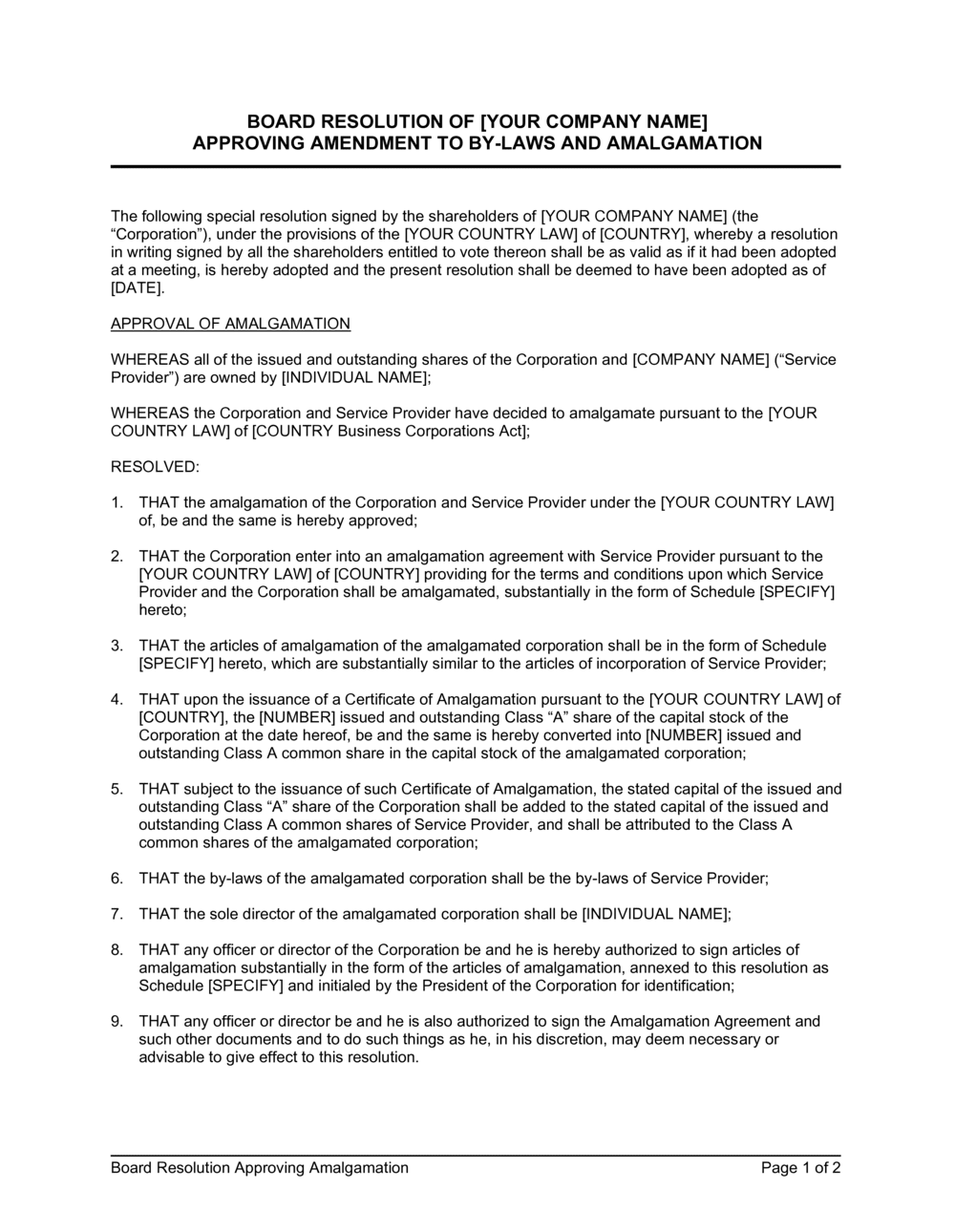
A Board Resolution Approving Amalgamation is a formal corporate record in which a company's board of directors votes to authorize the merger of two or more legal entities into a single successor corporation. This free Word download gives you a structured, execution-ready starting point covering authority recitals, amalgamation agreement approval, officer delegation, shareholder notification, and filing authorization — editable online and exportable as PDF for execution and corporate minute-book filing.
When you need it
Use it when two or more corporations have negotiated amalgamation terms and each board must formally authorize the transaction before proceeding to shareholder approval, regulatory filings, or the effective date of the amalgamation. Most corporate statutes require a written board resolution before any amalgamation agreement can be put to a shareholder vote or filed with the relevant government authority.
What's inside
Recitals establishing the board's authority and the transaction background, operative resolutions approving the amalgamation agreement, clauses delegating authority to named officers, provisions for shareholder notice and meeting calls, filing and regulatory authorization, and signature blocks for all directors or the required quorum.

What is a Board Resolution Approving Amalgamation?

A Board Resolution Approving Amalgamation is a formal corporate record in which a company's board of directors votes to authorize the combination of two or more corporations into a single successor entity. The resolution establishes the board's legal authority to proceed, approves the negotiated amalgamation agreement, delegates execution powers to named officers, triggers the shareholder notification process, and authorizes the filing of articles of amalgamation with the applicable government registry. Without this resolution, no officer of the corporation has documented authority to sign the amalgamation agreement or submit the statutory filing that gives the transaction legal effect. It is a foundational document in the corporate approval chain for any amalgamation transaction, and it must be passed and properly filed in the corporate minute book before the process can move forward.

Why You Need This Document

An amalgamation that proceeds without a formally documented board resolution exposes the corporation to a chain of downstream problems that can be costly to unwind. Counterparties and corporate registries require evidence of board authorization before accepting executed agreements or government filings — missing documentation at closing can stall or kill a transaction. Shareholders who later challenge the amalgamation have a significantly stronger case if the board approval process was informal, undocumented, or procedurally defective. In jurisdictions with statutory dissent rights, a flawed approval process can extend appraisal liability beyond the closing date. Officers who execute documents without a valid board resolution also risk personal liability for acting outside their actual authority. This template gives you a structured, jurisdiction-aware starting point that covers every material approval requirement — from quorum confirmation and agreement attachment through dissent rights notice and long-stop filing deadlines — so your transaction has a clean, auditable authorization trail from day one.

Which variant fits your situation?

If your situation is…Use this template
Board approval of a short-form amalgamation between a parent and wholly-owned subsidiaryBoard Resolution — Short-Form Amalgamation
Shareholder vote required to ratify the amalgamation after board approvalShareholder Resolution Approving Amalgamation
Approving a merger or acquisition that does not involve full amalgamationBoard Resolution Approving Merger Agreement
Recording board approval of a share exchange rather than amalgamationBoard Resolution Approving Share Exchange
Documenting consent of a sole director or written resolution without a formal meetingUnanimous Written Resolution of Directors
Approving a plan of arrangement as an alternative to amalgamationBoard Resolution Approving Plan of Arrangement
Recording the election of officers for the amalgamated successor corporationBoard Resolution Electing Officers

Common mistakes to avoid

❌ Using trade names instead of registered corporate names

Why it matters: Corporate registries match the names in a filing against their registry records precisely. A trade name or slight spelling variation causes the articles of amalgamation to be rejected, delaying the transaction and triggering legal costs to re-execute documents.

Fix: Pull the current corporate profile from the applicable registry for each amalgamating entity and copy the registered name character-for-character into the resolution.

❌ Approving a draft amalgamation agreement rather than the final version

Why it matters: If material terms change after the resolution is passed — share exchange ratio, assumed liabilities, representations — the board's approval technically does not cover the actual agreement executed at closing, creating a gap in the authorization chain.

Fix: Hold the board meeting only after the amalgamation agreement is finalized and signed. Attach the executed agreement as Schedule A and reference it by date and version in the resolution.

❌ Omitting the dissent rights notice requirement

Why it matters: Most corporate statutes require that shareholders be formally notified of their right to dissent and receive fair value for their shares. Failing to include this in the resolution and the shareholder materials exposes the corporation to appraisal proceedings after closing.

Fix: Add a standalone dissent rights clause referencing the specific statutory section and confirm that the management information circular describes the procedure in full.

❌ No long-stop date on the filing authorization

Why it matters: Without an expiry on the officers' authority to file articles of amalgamation, the authorization remains open indefinitely. If circumstances change materially — a party's financial condition, a regulatory block — officers could theoretically file on outdated terms.

Fix: Insert a long-stop date of 90 to 120 days from the board meeting date. If the transaction is not completed within that window, require the board to re-authorize before filing proceeds.

❌ Passing the resolution without confirming quorum

Why it matters: A resolution passed without the required quorum is voidable under most corporate statutes and by-laws. If challenged — by a dissenting shareholder, a creditor, or a regulator — the entire amalgamation authorization could be declared invalid.

Fix: Record the names of all directors present at the start of the meeting and confirm that quorum requirements are met before any vote is taken. Include this confirmation explicitly in the resolution's recitals.

❌ Failing to account for a unanimous shareholder agreement

Why it matters: A USA can restrict or transfer director powers, including the power to approve major transactions such as amalgamations. A board resolution that ignores a USA's consent requirements may be overridden, leaving the authorization void.

Fix: Before drafting the resolution, review all unanimous shareholder agreements and any other constating documents to confirm whether shareholder consent must precede or accompany the board vote.

The 10 key clauses, explained

Recitals and Background

In plain language: Sets out the context for the resolution — the names of the amalgamating corporations, their relationship, and why the amalgamation is being pursued.

Sample language
WHEREAS, [CORPORATION A] and [CORPORATION B] have negotiated the terms of an amalgamation pursuant to which the two corporations shall amalgamate to form [AMALGAMATED CORPORATION NAME] (the 'Amalgamated Corporation') under the laws of [JURISDICTION];

Common mistake: Using informal trade names instead of the full registered corporate names. A mismatch between the resolution and the articles of amalgamation filing causes the registry to reject the filing.

Authority Recital

In plain language: Confirms that the board is duly constituted, that a quorum is present, and that the board has the statutory and constitutional authority to approve the amalgamation.

Sample language
WHEREAS, the board of directors has reviewed the Amalgamation Agreement dated [DATE] and has determined that the amalgamation is in the best interests of the Corporation and its shareholders;

Common mistake: Failing to confirm quorum in the recitals. If the resolution is later challenged, the absence of a quorum statement creates doubt about whether the vote was validly taken.

Approval of the Amalgamation Agreement

In plain language: The operative resolution formally approving the amalgamation agreement and all its terms, including the share exchange ratio and the structure of the successor corporation.

Sample language
BE IT RESOLVED that the Amalgamation Agreement between [CORPORATION A] and [CORPORATION B], substantially in the form attached as Schedule A, is hereby approved, ratified, and confirmed in all respects.

Common mistake: Approving a described version of the agreement rather than attaching the final executed form. If terms change after the resolution, the approval may not cover the actual agreement signed at closing.

Shareholder Notice and Meeting Authorization

In plain language: Authorizes the corporation to send the required statutory notice to shareholders and call a special meeting at which shareholders will vote on the amalgamation.

Sample language
BE IT RESOLVED that the officers of the Corporation are hereby authorized to provide notice of a special meeting of shareholders to be held on [DATE] for the purpose of considering and, if deemed advisable, approving the amalgamation, in accordance with [APPLICABLE STATUTE] and the Corporation's by-laws.

Common mistake: Setting a meeting date that does not meet the statutory minimum notice period. Most jurisdictions require 21 to 60 days' notice — booking a meeting before the notice window closes voids the shareholder vote.

Information Circular or Management Proxy Authorization

In plain language: Authorizes the preparation and distribution of a management information circular or proxy materials describing the amalgamation to shareholders ahead of the vote.

Sample language
BE IT RESOLVED that the officers of the Corporation are authorized to prepare, approve, and distribute to shareholders a management information circular describing the amalgamation and including the information required by [APPLICABLE SECURITIES LAW / CORPORATE STATUTE].

Common mistake: Omitting this clause where securities regulations require a circular. For publicly traded corporations, distributing proxy materials without board authorization is a regulatory violation.

Delegation of Authority to Officers

In plain language: Authorizes one or more named officers to execute the amalgamation agreement, related ancillary documents, and all government filings on behalf of the corporation.

Sample language
BE IT RESOLVED that [NAME], [TITLE], and [NAME], [TITLE], are hereby authorized, jointly or severally, to execute and deliver the Amalgamation Agreement, the Articles of Amalgamation, and all other documents, instruments, and filings required to complete the amalgamation.

Common mistake: Naming a title without specifying the individual. If the officer changes before closing, counterparties and registries may refuse to recognize execution by an unnamed successor.

Regulatory and Government Filing Authorization

In plain language: Expressly authorizes the filing of articles of amalgamation and any related regulatory applications with the applicable corporate registry and government bodies.

Sample language
BE IT RESOLVED that the authorized officers are hereby directed to file Articles of Amalgamation with [REGISTRAR / MINISTRY OF GOVERNMENT SERVICES / COMPANIES HOUSE] and to take all steps necessary to give effect to the amalgamation on or before [LONG-STOP DATE].

Common mistake: No long-stop or outside date in the authorization. Without one, officers can theoretically file articles months or years later, potentially after material circumstances have changed.

Effective Date Confirmation

In plain language: States the intended effective date of the amalgamation or authorizes the officers to select the effective date, subject to receipt of government approval.

Sample language
BE IT RESOLVED that the effective date of the amalgamation shall be the date on which the Articles of Amalgamation are accepted for filing by [REGISTRAR], or such other date as the authorized officers may determine in consultation with legal counsel.

Common mistake: Hard-coding a specific calendar date without a fallback. If the registry is delayed, a fixed effective date creates a gap period during which neither the predecessor nor the successor corporation is clearly the surviving legal entity.

Dissent Rights Notice

In plain language: Confirms that the board has considered or will communicate shareholder dissent rights as required by the applicable corporate statute.

Sample language
BE IT RESOLVED that the Corporation shall provide shareholders with notice of their right to dissent from the amalgamation pursuant to [SECTION X] of the [APPLICABLE CORPORATE ACT], and that the management information circular shall describe the dissent procedure in full.

Common mistake: Omitting the dissent rights notice clause entirely. In most Canadian and US jurisdictions, failure to notify shareholders of dissent rights exposes the corporation to appraisal claims even after the amalgamation is complete.

Ratification of Prior Acts

In plain language: Ratifies any actions already taken by officers or advisors in connection with the amalgamation prior to the board meeting, to the extent consistent with the resolution.

Sample language
BE IT RESOLVED that all prior actions taken by officers, directors, and advisors of the Corporation in connection with the preparation and negotiation of the Amalgamation Agreement are hereby ratified, confirmed, and approved.

Common mistake: Ratifying acts in blanket terms without limiting to amalgamation-related activities. An overbroad ratification clause can inadvertently approve unrelated transactions or commitments made by officers.

How to fill it out

  1. 1

    Identify the amalgamating corporations and confirm their legal names

    Enter the full registered corporate name, jurisdiction of incorporation, and corporation number for each amalgamating entity. Confirm these against the current corporate registry profile before completing the resolution.

    💡 A name mismatch between the resolution and the articles of amalgamation is the single most common reason a filing is rejected — check the registry record, not the company letterhead.

  2. 2

    Confirm quorum and the date of the board meeting

    Record the date, time, and location of the board meeting, the names of directors present, and confirmation that quorum was met under the corporation's articles or by-laws.

    💡 If directors are participating by telephone or video conference, confirm that the by-laws and applicable statute permit remote participation — some older statutes do not.

  3. 3

    Attach the finalized amalgamation agreement as Schedule A

    Ensure the version of the amalgamation agreement attached to the resolution is the final negotiated form, not a draft. The board is approving the specific document attached, not a general description of terms.

    💡 Date-stamp and initial every page of Schedule A at the time of signing so the attachment cannot be substituted after the fact.

  4. 4

    Set the shareholder meeting date and confirm the statutory notice period

    Calculate the required notice period under the applicable corporate statute and set a meeting date that gives shareholders the minimum number of days' notice. Record that date in the resolution.

    💡 Build in at least five additional days beyond the statutory minimum to allow for mailing delays and to account for weekends and holidays.

  5. 5

    Name the authorized officers and define their delegation scope

    Insert the full legal name and title of each officer authorized to execute documents on the corporation's behalf. State whether they may act jointly or severally.

    💡 List a primary and an alternate officer in case the primary is unavailable at closing — registry filings and counterparty executions often happen on tight timelines.

  6. 6

    Insert the regulatory filing details and long-stop date

    Identify the applicable registry or government authority with which articles of amalgamation will be filed and insert a long-stop date by which the filing must occur or the authorization lapses.

    💡 A long-stop date 90 to 120 days from the board meeting date is typical — short enough to prevent stale authorizations, long enough to accommodate regulatory review timelines.

  7. 7

    Include the dissent rights notice clause

    Confirm that the shareholder information materials will describe dissent rights in full, referencing the specific statutory section applicable in the governing jurisdiction.

    💡 If the corporation has a unanimous shareholder agreement, review it before the board meeting — it may impose additional consent requirements that the resolution must address.

  8. 8

    Execute and file in the corporate minute book

    Obtain signatures from all directors present at the meeting, or from the required majority, and file the executed resolution in the corporation's minute book alongside the meeting minutes.

    💡 If passing the resolution by written consent rather than at a meeting, every director typically must sign in most jurisdictions — confirm whether your statute permits a written resolution by less than unanimous consent.

Frequently asked questions

What is a board resolution approving amalgamation?

A board resolution approving amalgamation is a formal corporate record in which a company's directors vote to authorize the merger of two or more corporations into a single successor entity. It documents the board's decision, approves the amalgamation agreement, delegates execution authority to named officers, and authorizes the required government filings. Most corporate statutes require this resolution before the transaction can proceed to a shareholder vote or regulatory filing.

Is a board resolution required for every amalgamation?

In most jurisdictions, yes — both a board resolution and a shareholder resolution are required for a standard long-form amalgamation. A limited exception applies to short-form amalgamations, where a parent corporation absorbs a wholly owned subsidiary and only a board resolution is typically needed, with no shareholder vote required. Check the specific statute governing each amalgamating entity to confirm the exact requirements.

What is the difference between an amalgamation and a merger?

Amalgamation is the term used in Canadian, UK, and many Commonwealth corporate statutes for the combination of two or more corporations into one successor entity. In the United States, the equivalent transaction is typically called a statutory merger. The mechanics differ by jurisdiction, but both result in a single continuing entity that holds all the assets and liabilities of the predecessor corporations by operation of law.

Do shareholders need to approve the amalgamation after the board passes this resolution?

For a long-form amalgamation, yes — in most jurisdictions shareholders of each amalgamating corporation must approve the amalgamation by a special resolution (typically two-thirds of votes cast) at a duly called meeting. The board resolution authorizes the transaction and calls the shareholder meeting; it does not replace shareholder approval. Short-form amalgamations between a parent and its wholly owned subsidiaries generally do not require a shareholder vote.

What are dissent rights and why does the resolution reference them?

Dissent rights are a statutory protection allowing shareholders who vote against or object to an amalgamation to demand that the corporation pay them fair value for their shares rather than accepting shares in the amalgamated entity. Corporate statutes in Canada, the United States, the United Kingdom, and most other jurisdictions require that shareholders be formally notified of these rights before the vote. The board resolution triggers the obligation to include this notice in the shareholder information circular.

What documents need to be filed with the government after the board passes this resolution?

After both the board and shareholders have approved the amalgamation, the authorized officers typically file articles of amalgamation with the applicable corporate registry — for example, Corporations Canada under the CBCA, the relevant provincial registry in Canada, Companies House in the UK, or the Secretary of State in the applicable US state. The articles set out the name, structure, and share capital of the amalgamated corporation. The amalgamation takes legal effect on the date the registry accepts the filing, or on a later effective date specified in the articles.

How long does a board authorization to file articles of amalgamation remain valid?

The resolution itself does not expire unless it includes a long-stop date, which is strongly recommended. Best practice is to include a provision stating that the filing authorization lapses if articles of amalgamation are not filed within 90 to 120 days of the board meeting. If circumstances change materially or the deadline passes, the board should re-convene and pass a fresh resolution rather than relying on a stale authorization.

Do I need a lawyer to prepare a board resolution approving amalgamation?

For straightforward amalgamations between privately held corporations in a single jurisdiction — particularly short-form parent-subsidiary combinations — a well-structured template with a legal review is generally sufficient. For transactions involving public companies, multi-jurisdictional entities, complex share exchange ratios, significant third-party debt, or regulatory approvals, engaging corporate counsel is strongly recommended. Errors in the authorization chain can require the entire approval process to be restarted, delaying closing and generating significant legal costs.

How this compares to alternatives

vs Shareholder Resolution Approving Amalgamation

A board resolution authorizes the amalgamation at the director level and calls the shareholder meeting; a shareholder resolution records the shareholders' own approval vote at that meeting. Both are required for a standard long-form amalgamation — the board resolution comes first and creates the procedural framework within which the shareholder vote occurs. Neither can substitute for the other.

vs Board Resolution Approving Merger Agreement

A merger agreement resolution is used in jurisdictions — primarily the United States — where the statutory mechanism is a merger rather than an amalgamation. The operative mechanics differ: in a US merger, one entity typically survives and the other dissolves; in a statutory amalgamation, both predecessor entities cease to exist and a new successor is created. Use the correct document for the applicable jurisdiction and transaction structure.

vs Articles of Amalgamation

The board resolution authorizes the amalgamation internally and records the directors' decision. The articles of amalgamation are the statutory government filing that gives the transaction legal effect and creates the successor corporation in the public record. The resolution must be passed before the articles can be signed and filed — one is the internal corporate authority; the other is the external legal instrument.

vs Unanimous Written Resolution of Directors

A unanimous written resolution achieves the same legal effect as a resolution passed at a board meeting, but is executed in writing by all directors rather than voted on in person. It is suitable for straightforward short-form amalgamations or closely held corporations with a small number of directors who all consent. Where any director dissents or where the transaction is contested, a formal meeting with recorded votes is the safer approach.

Industry-specific considerations

Financial Services and Banking

Amalgamations in banking and insurance require concurrent regulatory approvals from bodies such as OSFI, the FCA, or the OCC — the board resolution must authorize officers to engage with regulators and satisfy statutory notice periods that often exceed standard corporate timelines.

Technology and SaaS

Tech company amalgamations frequently involve IP ownership consolidation, employee option plan treatment, and data privacy compliance across jurisdictions — the resolution should delegate authority to address these ancillary matters alongside the core filing.

Professional Services

Law firms, accounting practices, and engineering firms amalgamating must address professional regulatory body approvals and partnership or shareholder continuity — the resolution often references companion regulatory consent filings specific to the licensed profession.

Real Estate and Construction

Amalgamating real estate holding corporations triggers land transfer tax assessments and title transfer requirements in most provinces and states — the board resolution should authorize officers to address title and mortgage documentation as part of the amalgamation completion steps.

Jurisdictional notes

United States

In the United States, the equivalent of an amalgamation is typically a statutory merger governed by state corporate law — the DGCL in Delaware, for example. Each state sets its own board and shareholder approval thresholds, notice periods, and dissenter rights procedures under Chapter 13 (California) or equivalent appraisal statutes. Where a transaction spans multiple states, each incorporating state's statute applies to that entity's internal approvals independently.

Canada

The Canada Business Corporations Act (CBCA) and each provincial Business Corporations Act set out detailed amalgamation procedures, including the requirement for a special resolution (two-thirds of votes cast) by shareholders of each amalgamating corporation. Short-form amalgamations under s.184 of the CBCA require only a board resolution. Quebec amalgamations must comply with the Business Corporations Act (Quebec) and, for provincially regulated entities, French-language document requirements may apply.

United Kingdom

UK amalgamations of companies registered under the Companies Act 2006 are typically structured as schemes of arrangement or statutory mergers under the Companies (Cross-Border Mergers) Regulations 2007, rather than as a direct amalgamation. The board resolution framework is similar in principle, but the procedural requirements — including court sanction for schemes and employee information obligations — are more extensive. Pure domestic amalgamations are more common for Scottish and Northern Irish partnerships than for English limited companies.

European Union

Cross-border mergers within the EU are governed by Directive 2017/1132, which requires board approval, a detailed merger plan, an independent expert report, and employee information and consultation obligations before shareholders vote. Member states have implemented the Directive differently — Germany, France, and the Netherlands each have distinct procedural requirements for domestic amalgamations. GDPR considerations apply where the amalgamation involves transfer of employee or customer personal data between entities in different member states.

Template vs lawyer — what fits your deal?

PathBest forCostTime
Use the templateOwners of small, closely held private corporations completing a straightforward short-form parent-subsidiary amalgamation in a single jurisdictionFree1–2 hours to complete and execute
Template + legal reviewStandard long-form amalgamations between two private companies in one jurisdiction, with legal counsel reviewing for statutory compliance before filing$500–$1,500 for a corporate lawyer's review and signing opinion3–7 business days
Custom draftedMulti-jurisdictional amalgamations, publicly traded companies, transactions requiring regulatory approvals, or deals involving complex share structures and dissent rights exposure$3,000–$15,000+ depending on complexity and jurisdiction2–8 weeks

Glossary

Amalgamation
A statutory process by which two or more corporations combine into a single successor corporation, with all assets, liabilities, and obligations of the predecessor entities vesting in the amalgamated corporation by operation of law.
Amalgamation Agreement
The negotiated contract between the amalgamating corporations setting out the terms of the combination, including share exchange ratios, the name and structure of the amalgamated entity, and any dissent rights.
Successor Corporation
The single legal entity that continues in existence after the amalgamation, holding all the assets and obligations of the predecessor corporations.
Short-Form Amalgamation
A simplified amalgamation procedure available in many jurisdictions when a parent corporation amalgamates with one or more wholly owned subsidiaries, typically not requiring shareholder approval.
Dissent Rights
A statutory right allowing shareholders who oppose an amalgamation to demand fair value payment for their shares rather than accepting the shares of the amalgamated entity.
Quorum
The minimum number or percentage of directors who must be present and voting for a board resolution to be validly passed.
Minute Book
The corporate record book containing all resolutions, share register entries, and statutory filings — the board resolution approving the amalgamation must be filed here.
Articles of Amalgamation
The statutory filing submitted to the applicable government registry to give legal effect to the amalgamation and formally create the successor corporation.
Effective Date
The date on which the amalgamation legally takes effect, typically the date the articles of amalgamation are accepted by the relevant government authority.
Unanimous Shareholder Agreement (USA)
A contract among all shareholders of a corporation that may restrict or transfer board powers — relevant to amalgamations if the USA requires shareholder consent before directors can authorize a transaction.
Delegation of Authority
A clause in the board resolution authorizing one or more named officers to execute the amalgamation agreement and related documents on behalf of the corporation without further board approval.

Part of your Business Operating System

This document is one of 3,000+ business & legal templates included in Business in a Box.

  • Fill-in-the-blanks — ready in minutes
  • 100% customizable Word document
  • Compatible with all office suites
  • Export to PDF and share electronically

Create your document in 3 simple steps.

From template to signed document — all inside one Business Operating System.
1
Download or open template

Access over 3,000+ business and legal templates for any business task, project or initiative.

2
Edit and fill in the blanks with AI

Customize your ready-made business document template and save it in the cloud.

3
Save, Share, Send, Sign

Share your files and folders with your team. Create a space of seamless collaboration.

Save time, save money, and create top-quality documents.

★★★★★

"Fantastic value! I'm not sure how I'd do without it. It's worth its weight in gold and paid back for itself many times."

Managing Director · Mall Farm
Robert Whalley
Managing Director, Mall Farm Proprietary Limited
★★★★★

"I have been using Business in a Box for years. It has been the most useful source of templates I have encountered. I recommend it to anyone."

Business Owner · 4+ years
Dr Michael John Freestone
Business Owner
★★★★★

"It has been a life saver so many times I have lost count. Business in a Box has saved me so much time and as you know, time is money."

Owner · Upstate Web
David G. Moore Jr.
Owner, Upstate Web

Run your business with a system — not scattered tools

Stop downloading documents. Start operating with clarity. Business in a Box gives you the Business Operating System used by over 250,000 companies worldwide to structure, run, and grow their business.

Free Forever Plan · No credit card required