1
Identify the contract and review its termination provisions
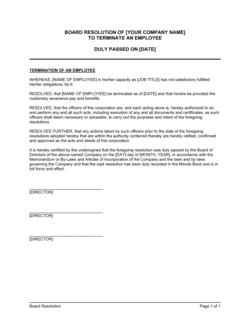
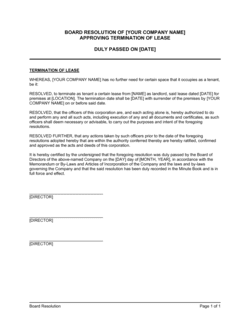
Locate the original contract and note the exact legal name of the agreement, the date it was executed, the full legal name of the counterparty, and any termination-for-cause or termination-for-convenience clauses. Note required notice periods and any cure periods.
💡 Highlight the exact section numbers governing termination before drafting — recitals that cite specific sections are substantially harder for a counterparty to challenge.
2
Determine the grounds for termination
Decide whether you are terminating for cause (citing a specific breach or default), for convenience (using a contractual exit right), or by mutual agreement. The grounds determine the effective date, any wind-down obligations, and whether notice must be served.
💡 If you are relying on breach, confirm that any required cure notice has already been issued and the cure period has expired — attempting termination before the cure period runs is itself a breach in most contracts.
3
Confirm quorum and meeting requirements
Check your corporate bylaws for the minimum number of directors required to adopt a resolution. If a physical meeting is impractical, confirm that your jurisdiction and bylaws permit written consent in lieu of meeting.
💡 For consent-in-lieu resolutions, every director whose signature is required must sign the same document or counterparts that together constitute the full execution — missing one signature can void the resolution.
4
Complete the caption and recitals
Enter the corporation's full legal name, state or province of incorporation, and meeting details. Draft recitals that identify the contract precisely and state the factual basis for termination in specific, documented terms.
💡 Cross-reference any prior breach notices, cure letters, or board communications in the recitals — this creates a documented timeline that is invaluable if the termination is later litigated.
5
Draft the operative resolutions
Complete the 'NOW, THEREFORE, BE IT RESOLVED' clauses covering the termination decision, the effective date or notice trigger, and authorization of a named officer. Add further resolutions addressing outstanding obligations and indemnification.
💡 Use 'BE IT FURTHER RESOLVED' for each distinct authorization — separating them makes it easy for third parties (counterparty counsel, banks) to identify the exact authority granted.
6
Add ratification language if officers have already acted
If any officer has already issued a preliminary breach notice, frozen payments, or communicated the termination intent to the counterparty, include a ratification clause covering those prior acts.
💡 List the specific prior acts being ratified by date and description rather than using a blanket ratification — it signals deliberate board oversight rather than retroactive cleanup.
7
Circulate for signatures and file in the minute book
Obtain signatures from the required number of directors and the corporate secretary. File the signed resolution in the corporate minute book and retain a copy in the contract file alongside the termination notice.
💡 Send a certified copy of the resolution with the termination notice itself — it demonstrates to the counterparty that your authority to terminate is documented and unambiguous, which often shortens dispute timelines.
8
Serve the termination notice within the required timeframe
Have the authorized officer execute and deliver the formal termination notice to the counterparty by the method specified in the contract (e.g., certified mail, email with read receipt, courier). Confirm delivery and retain proof.
💡 Use the same day you adopt the resolution to serve the notice wherever possible — any gap between the resolution date and the notice date can be used by a counterparty to argue the termination was not properly authorized when the notice was sent.