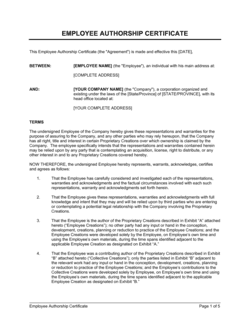
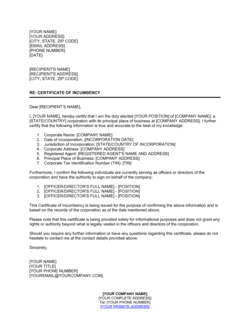
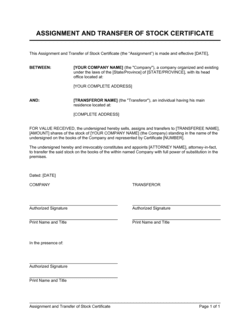
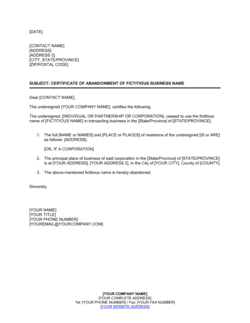
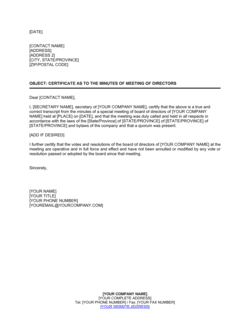
Authorship Certificate Template

Free Word download • Edit online • Save & share with Drive • Export to PDF

5 pages25–30 min to fillDifficulty: ComplexSignature requiredLegal review recommended
Learn more ↓
FreeAuthorship Certificate Template

At a glance

What it is
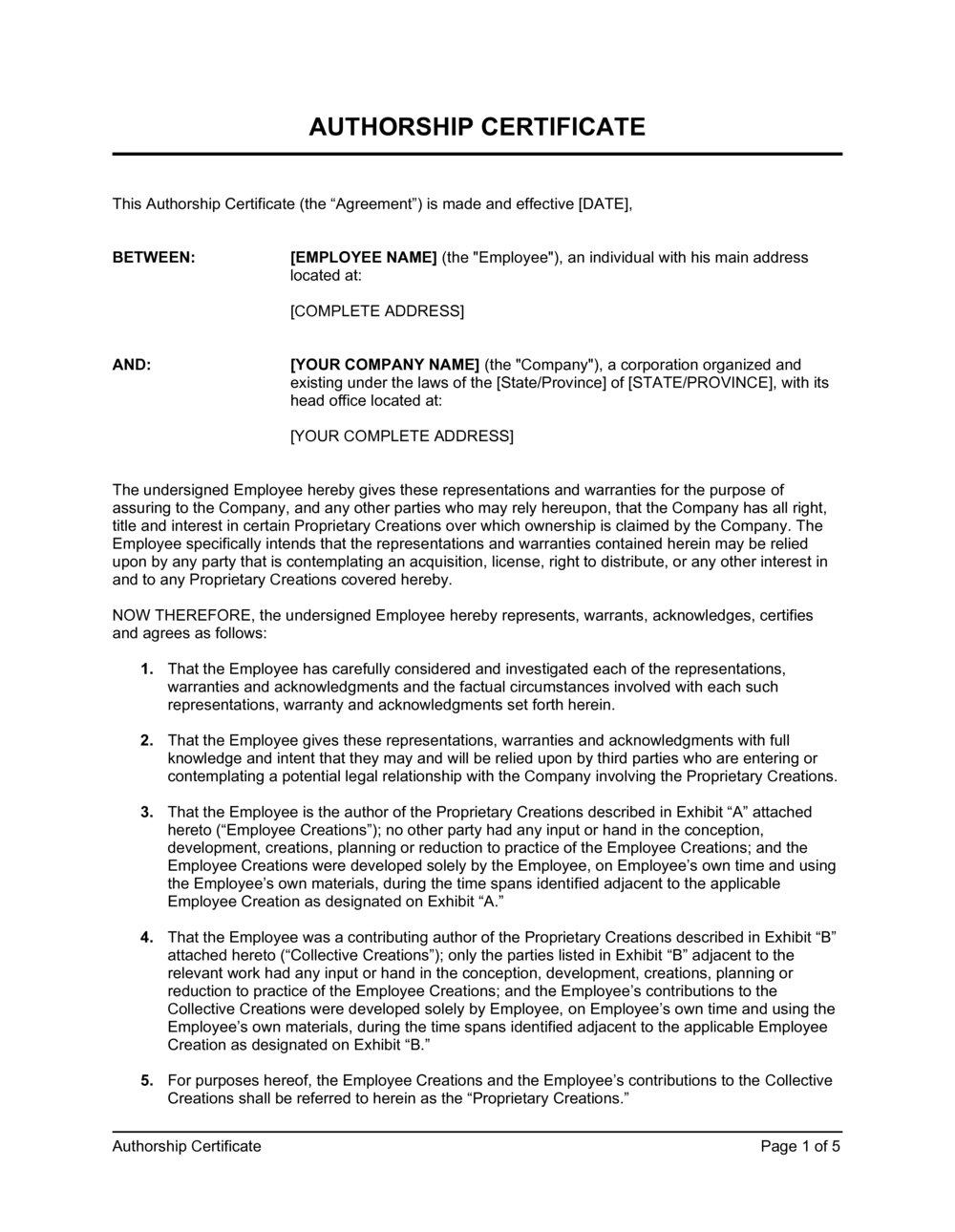
An Authorship Certificate is a formal legal document that records the identity of the original author or creator of a work — written, visual, musical, or digital — and certifies their claim of authorship and copyright ownership. This free Word download gives you an editable, signable template you can complete online and export as PDF to register, license, or defend your intellectual property rights.
When you need it
Use it whenever you need documented proof of who created an original work — before licensing content, publishing under a pseudonym, assigning rights to a publisher or employer, or resolving an authorship dispute. It is also commonly required by publishers, galleries, software registries, and academic institutions as a condition of submission or contract.
What's inside
Author identification and contact details, a precise description of the work being certified, the date of creation and first publication or disclosure, statements of originality and sole or joint authorship, copyright ownership declaration, any work-for-hire or assignment provisions, representations and warranties, and notarized or witnessed signatures.

What is an Authorship Certificate?

An Authorship Certificate is a formal legal document in which the original creator of a work — written, visual, musical, or digital — certifies their authorship, declares the work's originality, and records current copyright ownership in a signed, notarized instrument. Unlike an informal credit line or a simple declaration, an authorship certificate creates enforceable representations and warranties: the author vouches under legal obligation that every stated fact is accurate, that the work does not infringe third-party rights, and that no undisclosed encumbrance affects their ability to own, license, or assign the work. Courts, publishers, copyright registries, academic institutions, and acquiring companies treat the document as prima facie evidence of the facts it contains.

Why You Need This Document

Without a formal authorship certificate, proving who created a work — and when — becomes a credibility contest rather than a documented fact. In an infringement dispute, the party with a timestamped, notarized authorship record starts with a decisive evidentiary advantage over one relying on a folder of unmarked drafts and verbal recollections. Publishers routinely require the certificate before signing a book contract; performing rights organizations demand one before accepting a composition registration; software acquirers expect it as part of IP due diligence during M&A. For joint works, the absence of a written authorship record creates an implied equal-ownership arrangement that lets any co-author license the work independently — potentially destroying the exclusivity a publisher or investor is paying for. This template gives individual creators, employers, and commissioning parties a complete, ready-to-sign instrument that closes every one of those gaps in under 30 minutes.

Which variant fits your situation?

If your situation is…Use this template
Certifying sole authorship of a written workAuthorship Certificate (Individual)
Two or more creators sharing authorship of a single workJoint Authorship Certificate
Employee creating a work within the scope of employmentWork-for-Hire Agreement
Transferring full copyright ownership to a third partyCopyright Assignment Agreement
Granting limited usage rights while retaining ownershipContent License Agreement
Protecting confidential creative materials before disclosureNon-Disclosure Agreement
Registering software authorship before open-source releaseSoftware Development Agreement

Common mistakes to avoid

❌ Dating the certificate with the signing date, not the creation date

Why it matters: If the certificate's only date is when it was signed — potentially years after creation — it provides no evidence of priority against an earlier competing claim. Courts and registries examine creation dates, not execution dates.

Fix: Enter the actual creation start date and fixation date in the body of the document, separate from the execution date in the signature block. Support these dates with timestamped source files or version history.

❌ Issuing a work-for-hire certificate without a pre-existing written agreement

Why it matters: For independent contractors in the US, work-for-hire status requires a written agreement signed before the work is created. A certificate signed after the fact does not create work-for-hire status retroactively and the copyright may remain with the contractor.

Fix: Execute a formal work-for-hire agreement before the contractor begins work. Reference that agreement in the authorship certificate and keep both documents together in the IP file.

❌ Omitting disclosure of prior licenses or assignments

Why it matters: A certificate that certifies unencumbered ownership when an exclusive license or partial assignment already exists exposes the author to fraud claims and voids the document's reliability in any subsequent transaction.

Fix: Conduct a title review before executing the certificate. Disclose all prior exclusive licenses and assignments in a dedicated section, with the name of the counterparty and the effective date of each.

❌ Skipping notarization because no statute requires it

Why it matters: An unnotarized authorship certificate carries less evidentiary weight in infringement proceedings and is routinely rejected by publishers, academic journals, and some copyright registries that treat notarization as a de facto requirement.

Fix: Notarize all authorship certificates regardless of local statutory requirements. The marginal cost — typically $10–$25 — is negligible compared to the increased evidentiary value and reduced friction with institutional recipients.

❌ Using a vague work description that could encompass unrelated material

Why it matters: An overly broad description — 'all writings created by Author in 2024' — may inadvertently certify ownership of material the author does not fully own, such as jointly created drafts or works incorporating third-party licensed elements.

Fix: Describe only the specific, finished work being certified, identified by title, format, completion date, and length. Attach the work as a labeled exhibit or reference its SHA-256 hash for digital works.

❌ Failing to have all co-authors sign in a joint authorship situation

Why it matters: A certificate signed by only one co-author creates an incomplete record. The unsigned co-author retains the ability to grant independent licenses to third parties, potentially undermining an exclusive deal the signing co-author intends to enter.

Fix: Require all co-authors to sign the same certificate before it is used in any transaction. If co-authors are in different locations, use a multi-party e-signature workflow and store a consolidated executed version.

The 10 key clauses, explained

Author identification

In plain language: Names the individual or entity claiming authorship, including legal name, pseudonym if applicable, address, and contact information.

Sample language
The undersigned, [AUTHOR LEGAL NAME] ('Author'), residing at [ADDRESS], hereby certifies authorship of the Work described below. Author also publishes under the pseudonym [PSEUDONYM], if applicable.

Common mistake: Using only a pen name or trade name without the author's legal identity. If the certificate is needed to enforce rights in court or complete a copyright registration, the legal name is required and its omission can delay or invalidate proceedings.

Description of the work

In plain language: Precisely identifies the work being certified — title, format, medium, word count or duration, and any version or edition — so there is no ambiguity about what is covered.

Sample language
The Work is titled '[TITLE],' a [FORMAT — e.g., novel / software application / musical composition / photograph] of approximately [LENGTH / DURATION / FILE SIZE], first completed on [DATE] ('the Work').

Common mistake: Describing the work so broadly that it could apply to derivative or unrelated works. A vague description weakens the certificate's evidentiary value and may inadvertently cover material the author does not own.

Date of creation and fixation

In plain language: States when the work was created and the date it was first fixed in a tangible medium, establishing the timeline that supports the authorship claim.

Sample language
The Work was originally created by Author commencing on [START DATE] and was first fixed in a tangible medium of expression on [COMPLETION DATE].

Common mistake: Leaving the creation date blank or entering only the signing date. The certificate's evidentiary value in a priority dispute depends on a documented, credible creation timeline backed by source files, drafts, or version history.

Statement of originality

In plain language: Declares that the work is the author's own original creation and does not copy, reproduce, or infringe any third-party copyright, patent, or other proprietary right.

Sample language
Author represents and warrants that the Work is an original work of authorship created solely by Author and does not, to the best of Author's knowledge, copy or infringe any third-party intellectual property rights.

Common mistake: Omitting a knowledge qualifier ('to the best of Author's knowledge'). An unqualified warranty of non-infringement exposes the author to breach of warranty claims if a third-party element was unknowingly incorporated.

Sole or joint authorship declaration

In plain language: Confirms whether authorship is individual or shared, and if shared, identifies all co-authors and their respective contributions or ownership percentages.

Sample language
Author certifies that [they are the sole author of the Work / the Work was jointly created by Author and [CO-AUTHOR NAME], each contributing as follows: [DESCRIPTION], with ownership allocated [X]% to Author and [X]% to Co-Author].

Common mistake: Failing to specify contribution scope in a joint authorship certificate. Without a written allocation, each co-author is presumed to hold an equal undivided share and can license the work independently — an outcome most co-authors do not intend.

Copyright ownership declaration

In plain language: States who holds the copyright in the work — the author personally, a jointly owned arrangement, or an employer/commissioning party under a work-for-hire doctrine.

Sample language
Author declares that copyright in the Work is owned by [AUTHOR / COMPANY NAME] as of [DATE], and that no prior assignment, exclusive license, or encumbrance affecting that ownership has been granted except as disclosed herein.

Common mistake: Issuing an authorship certificate without disclosing a prior assignment or exclusive license. A certificate that misrepresents the chain of title can expose the author to fraud claims and voids the document's credibility with publishers or registries.

Work-for-hire and assignment provisions

In plain language: If the work was created for an employer or under contract, this clause formally acknowledges the work-for-hire relationship or records the assignment of rights from author to the commissioning party.

Sample language
The Work was created by Author within the scope of Author's employment with [EMPLOYER NAME] / pursuant to a written agreement dated [DATE]. Accordingly, copyright in the Work vests in [EMPLOYER NAME] as a work made for hire under applicable law, and Author hereby assigns all rights therein to [EMPLOYER NAME] to the extent not already vested.

Common mistake: Assuming verbal work-for-hire instructions are sufficient. In the US and most other jurisdictions, work-for-hire status for independent contractors requires a written signed agreement predating creation — a retroactive certificate does not cure the absence of that agreement.

Representations and warranties

In plain language: Author's formal promises that the information in the certificate is accurate, that they have authority to make the declarations, and that the work does not defame, invade privacy, or violate any other legal right.

Sample language
Author represents and warrants that: (a) all statements in this Certificate are true and accurate; (b) Author has full authority to execute this Certificate; (c) the Work does not defame any person or violate any privacy, publicity, or other third-party right; and (d) Author has not previously granted any right that would conflict with the declarations herein.

Common mistake: Limiting representations to copyright and ignoring defamation or privacy warranties. Publishers and licensees routinely require defamation and privacy representations, and omitting them can cause the certificate to be rejected as incomplete.

Governing law and jurisdiction

In plain language: Specifies which jurisdiction's law governs interpretation of the certificate and where disputes will be resolved.

Sample language
This Certificate is governed by the laws of [STATE / PROVINCE / COUNTRY], without regard to conflict-of-law principles. Any dispute arising hereunder shall be resolved in the courts of [CITY / JURISDICTION].

Common mistake: Selecting a governing law that has no connection to where the author lives or works. A court in the chosen jurisdiction may refuse to enforce the certificate, or the chosen law may provide weaker authorship protections than the author's home jurisdiction.

Notarization and signature block

In plain language: Provides the execution block for the author's signature, date, and — where required — a notary public's acknowledgment confirming the author's identity and voluntary execution.

Sample language
Signed by: [AUTHOR LEGAL NAME] _________________________________ Date: ____________. Notary acknowledgment: On this [DATE], before me, [NOTARY NAME], personally appeared [AUTHOR NAME], known to me or proved by satisfactory evidence to be the individual described herein, and acknowledged execution of this Certificate for the purposes stated.

Common mistake: Skipping notarization because the jurisdiction does not require it by statute. Even when not legally required, a notarized authorship certificate carries significantly greater evidentiary weight in infringement proceedings and is often demanded by copyright registries, publishers, and academic institutions.

How to fill it out

  1. 1

    Enter the author's full legal name and contact details

    Add the author's legal name exactly as it appears on government-issued ID, along with address, email, and any pseudonym used in publication. If the certificate is for a corporate employer under a work-for-hire arrangement, enter the company's registered name.

    💡 If the work will be registered with the US Copyright Office, the name in the certificate must match the registration application exactly — inconsistencies can delay or block registration.

  2. 2

    Describe the work precisely

    Record the full title, format, medium, approximate length or file size, and any version or edition number. For software, include the programming language and application type. For music, include the composition's duration and instrumentation.

    💡 Attach a digital fingerprint or checksum of the work file as an exhibit if the certificate will be used to prove creation date in a dispute — this links the certificate to a specific, unaltered version.

  3. 3

    Enter creation and fixation dates

    Record both the date creation began and the date the work was first fixed in a tangible medium — the date of the first saved draft, recording, or photograph. If creation spanned multiple sessions, record the full range.

    💡 Back up your creation date claim with timestamped source files, email chains, or version-control commit logs stored separately from the certificate itself.

  4. 4

    Confirm sole or joint authorship

    Check the appropriate authorship type. For joint authorship, list each co-author's legal name, describe their contribution, and record the agreed ownership percentage. Ensure all co-authors sign the same certificate or execute matching companion certificates.

    💡 If one co-author's contribution is not yet final, delay execution until all contributions are complete — a certificate signed before the work is finished may not accurately reflect the final authorship split.

  5. 5

    Declare copyright ownership and any prior encumbrances

    Identify the current copyright owner. If rights have already been partially assigned or exclusively licensed, disclose that fact in the certificate with the relevant party's name and the date of the prior agreement.

    💡 A title search with the US Copyright Office or relevant national registry before signing confirms there are no conflicting registrations that would undermine the certificate.

  6. 6

    Complete work-for-hire or assignment provisions if applicable

    If the work was created as an employee or under a contractor agreement, complete the work-for-hire clause and ensure the underlying written agreement pre-dates the work's creation. For an assignment, enter the assignee's name and the effective date of transfer.

    💡 For contractor work-for-hire arrangements, confirm that the underlying agreement lists the specific work as one of the nine categories eligible for work-for-hire treatment under US copyright law before relying on this clause.

  7. 7

    Review representations and sign in front of a notary

    Read each representation carefully before signing — by executing the certificate, the author warrants that every statement is accurate. Sign in the presence of a notary public and have the notary complete the acknowledgment block.

    💡 Bring government-issued photo ID to the notary appointment. Some publishers and copyright registries require two forms of identification to authenticate the notary acknowledgment.

  8. 8

    Store originals and distribute executed copies

    Retain the original notarized certificate in a secure location — physical and digital. Provide executed copies to any publisher, employer, or registry that requires them. File a copy with your copyright registration if one is pending.

    💡 Store a scanned PDF copy in at least two separate cloud locations with access-log tracking. In a future infringement dispute, proving an unbroken chain of custody for the original document strengthens its evidentiary value.

Frequently asked questions

What is an authorship certificate?

An authorship certificate is a formal legal document in which the creator of an original work — written, visual, musical, or digital — declares their authorship, certifies the work's originality, and records copyright ownership as of a specific date. It is used to establish an evidence trail for copyright registration, licensing transactions, publisher submissions, academic credit, and infringement proceedings. It does not replace copyright registration but complements it by providing a detailed, signed statement of authorship facts.

Is an authorship certificate legally binding?

Yes, an authorship certificate is generally enforceable as a binding legal document when properly executed. The representations and warranties it contains create legal obligations — a false declaration can give rise to breach of warranty or fraud claims. A notarized certificate carries additional evidentiary weight because the notary independently verified the signatory's identity. Courts in most jurisdictions treat a signed, notarized authorship certificate as prima facie evidence of the facts it declares, though it can be rebutted by contrary evidence.

Who should sign an authorship certificate?

The original author or authors must sign. For a sole-authored work, only the individual creator needs to sign. For jointly authored works, all co-authors should sign the same certificate — or each execute a companion certificate cross-referencing the others. For work-for-hire works, the individual who created the work typically signs alongside an authorized representative of the employing or commissioning entity to confirm the work-for-hire relationship and the resulting ownership structure.

What is the difference between an authorship certificate and a copyright assignment?

An authorship certificate records who created the work and who currently holds copyright — it is a declaration of existing facts. A copyright assignment is an operative transfer document that moves copyright ownership from one party to another. You may need both: the authorship certificate establishes the chain of title from creation, and the assignment records the transfer to the publisher, employer, or acquirer. Neither document alone serves both purposes.

Can I use an authorship certificate to prove ownership if my work is copied?

An authorship certificate is strong supporting evidence in an infringement dispute, particularly if it is notarized and predates the alleged copying. In the US, it is most effective when paired with a federal copyright registration, which is required to bring an infringement lawsuit and entitles the rights holder to statutory damages of up to $150,000 per willful infringement. The certificate strengthens the overall evidentiary record but does not substitute for registration when enforcement is the goal.

Does an authorship certificate cover moral rights?

An authorship certificate can reference and preserve moral rights — the right of attribution and the right to object to derogatory treatment — but whether those rights are legally enforceable depends on jurisdiction. The UK, Canada, France, Germany, and most EU member states recognize robust statutory moral rights. The US provides limited moral rights only for works of visual art under the Visual Artists Rights Act (VARA). If moral rights protection is important for your work, include explicit attribution and integrity language in the certificate and consult a lawyer about enforcement options in your jurisdiction.

Do I need a notary for an authorship certificate?

Notarization is not universally required by statute, but it is strongly recommended for any authorship certificate intended for use in a legal proceeding, copyright registration, publisher contract, or institutional submission. A notary independently verifies the signatory's identity and the voluntariness of execution, which significantly increases the document's credibility. Several academic journals and performing rights organizations treat notarization as a de facto requirement. The cost — typically $10–$25 — is minimal relative to the protection it provides.

What happens to authorship in a work-for-hire situation?

In a work-for-hire situation, copyright vests in the employer or commissioning party rather than the individual creator — the employer is treated as the legal author for copyright purposes. For employees, this applies automatically to works created within the scope of employment. For independent contractors, work-for-hire status requires a written agreement signed before the work begins, and the work must fall within one of nine enumerated categories under US copyright law. An authorship certificate in this context should document the individual creator's identity while confirming that rights vest in the employer.

How this compares to alternatives

vs Copyright Assignment Agreement

An authorship certificate declares who created a work and confirms existing ownership — it is a statement of fact, not a transfer. A copyright assignment agreement actively moves ownership from the author to a third party such as a publisher or employer. The certificate establishes chain of title; the assignment transfers it. Both documents are often executed together in publishing and IP acquisition transactions.

vs Work-for-Hire Agreement

A work-for-hire agreement is executed before or during creation to establish that a contractor's output will vest in the commissioning party. An authorship certificate is executed after the work is complete to formally record who created it and confirm current ownership. The two documents serve different moments in the IP lifecycle and are complementary rather than interchangeable.

vs Non-Disclosure Agreement

An NDA protects confidential information shared during negotiations or collaboration — it does not establish authorship or ownership. An authorship certificate establishes who owns a work. For a creative project shared under an NDA, both documents are typically needed: the NDA protects the work during the relationship; the authorship certificate records ownership once it is finalized.

vs License Agreement

A license agreement grants a third party permission to use a copyrighted work under defined conditions while the author retains ownership. An authorship certificate establishes that the author has the legal standing to grant that license in the first place. Publishers and content platforms typically require an authorship certificate before executing a license to confirm the licensor actually owns what they are licensing.

Industry-specific considerations

Publishing and Media

Publishers require authorship certificates before executing book contracts to confirm chain of title, verify the author's right to grant publication rights, and satisfy errors-and-omissions insurers.

Technology and Software

Software companies use authorship certificates to document that employee or contractor-created code vests in the company as a work for hire, which is essential during due diligence for M&A transactions and IP audits.

Music and Entertainment

Composers and lyricists file authorship certificates alongside registration with performing rights organizations such as ASCAP, BMI, and SOCAN to establish ownership before distribution and sync licensing.

Academic and Research Institutions

Universities and journals require authorship certificates to resolve contributor disputes, comply with grant conditions that require IP disclosure, and meet open-access licensing obligations tied to public funding.

Jurisdictional notes

United States

Copyright arises automatically upon fixation in the US, but registration with the US Copyright Office is required before filing an infringement lawsuit. Authorship certificates are not submitted to the Copyright Office directly but support the registration application and can be filed as supplementary documentation. Work-for-hire status for independent contractors requires a written agreement covering one of nine statutory categories under 17 USC §101. The Visual Artists Rights Act (VARA) provides limited moral rights only for works of visual art.

Canada

Canadian copyright arises automatically upon creation and fixation without registration; registration with CIPO creates a presumption of ownership but is optional. Moral rights are non-waivable by default under the Copyright Act and must be expressly waived in writing — an authorship certificate is an appropriate vehicle to include a moral rights waiver where one is needed. Work-for-hire rules apply to employees but not automatically to independent contractors. Quebec's civil law tradition may affect interpretation of authorship-related agreements for provincially regulated entities.

United Kingdom

Under the Copyright, Designs and Patents Act 1988, copyright in a work created by an employee in the course of employment vests automatically in the employer. Moral rights — including the right of attribution and the right to object to derogatory treatment — attach to literary, dramatic, musical, and artistic works but must be asserted in writing; an authorship certificate is a practical way to make that assertion. The UK has no mandatory copyright registration system; an authorship certificate provides important evidence of creation date and ownership in the absence of a registration record.

European Union

EU copyright law is harmonized by the InfoSoc Directive and the Digital Single Market Directive, but moral rights and work-for-hire rules vary by member state — France and Germany provide some of the strongest author protections in the world, with French law prohibiting full assignment of moral rights regardless of contract language. The EU has no unified copyright registry; authorship certificates serve as primary private evidence of creation and ownership. GDPR considerations apply if the certificate contains personal data that will be shared with third parties outside the EEA.

Template vs lawyer — what fits your deal?

PathBest forCostTime
Use the templateIndividual creators, freelancers, and small businesses certifying authorship of a single original work for standard licensing or publisher submissionsFree20–30 minutes
Template + legal reviewJoint authorship situations, work-for-hire arrangements with contractors, or certificates needed for copyright registration in a regulated industry$200–$500 for a one-hour IP attorney review2–5 business days
Custom draftedHigh-value IP transactions, M&A due diligence involving software or media assets, or international authorship disputes requiring multi-jurisdiction analysis$1,000–$4,000+1–3 weeks

Glossary

Authorship
The status of being the original human creator of a work that is eligible for copyright protection.
Copyright
The exclusive legal right of a creator to reproduce, distribute, adapt, display, or perform their original work, arising automatically upon creation in most jurisdictions.
Work for Hire
A work created by an employee within the scope of employment, or by a contractor under a written work-for-hire agreement, where copyright vests in the employer or commissioning party rather than the individual creator.
Joint Authorship
A work created by two or more authors with the intention that their contributions be merged into a single inseparable whole, giving each co-author equal ownership rights unless otherwise agreed.
Moral Rights
Rights that protect the personal and reputational connection between an author and their work — typically the right of attribution and the right to object to derogatory treatment — recognized in many jurisdictions but not fully in US copyright law.
Copyright Registration
A formal filing with a government registry (such as the US Copyright Office) that creates a public record of ownership and is required before filing an infringement lawsuit in the US.
Originality
The threshold requirement for copyright protection: the work must be independently created by the author and possess at least a minimal degree of creativity — it need not be novel or unique.
Assignment
A transfer of copyright ownership from the original author or rights holder to another party, typically requiring a written, signed instrument to be effective.
Performing Rights Organization (PRO)
A collective licensing body — such as ASCAP, BMI, SOCAN, or PRS — that collects royalties on behalf of music authors and composers when their works are publicly performed.
Fixation
The requirement that a work be recorded in a tangible medium of expression — written, recorded, saved to disk — before copyright protection attaches in most jurisdictions.
Pseudonym
A pen name or alias under which an author publishes, which affects how the copyright term is calculated and how authorship is identified in public records.

Part of your Business Operating System

This document is one of 3,000+ business & legal templates included in Business in a Box.

  • Fill-in-the-blanks — ready in minutes
  • 100% customizable Word document
  • Compatible with all office suites
  • Export to PDF and share electronically

Create your document in 3 simple steps.

From template to signed document — all inside one Business Operating System.
1
Download or open template

Access over 3,000+ business and legal templates for any business task, project or initiative.

2
Edit and fill in the blanks with AI

Customize your ready-made business document template and save it in the cloud.

3
Save, Share, Send, Sign

Share your files and folders with your team. Create a space of seamless collaboration.

Save time, save money, and create top-quality documents.

★★★★★

"Fantastic value! I'm not sure how I'd do without it. It's worth its weight in gold and paid back for itself many times."

Managing Director · Mall Farm
Robert Whalley
Managing Director, Mall Farm Proprietary Limited
★★★★★

"I have been using Business in a Box for years. It has been the most useful source of templates I have encountered. I recommend it to anyone."

Business Owner · 4+ years
Dr Michael John Freestone
Business Owner
★★★★★

"It has been a life saver so many times I have lost count. Business in a Box has saved me so much time and as you know, time is money."

Owner · Upstate Web
David G. Moore Jr.
Owner, Upstate Web

Run your business with a system — not scattered tools

Stop downloading documents. Start operating with clarity. Business in a Box gives you the Business Operating System used by over 250,000 companies worldwide to structure, run, and grow their business.

Start free · No credit card required