Certificate Of Ownership Template

Free Word download β€’ Edit online β€’ Save & share with Drive β€’ Export to PDF

1 pageβ€’20–30 min to fillβ€’Difficulty: Standardβ€’Signature requiredβ€’Legal review recommended
Learn more ↓
FreeCertificate Of Ownership Template

At a glance

What it is
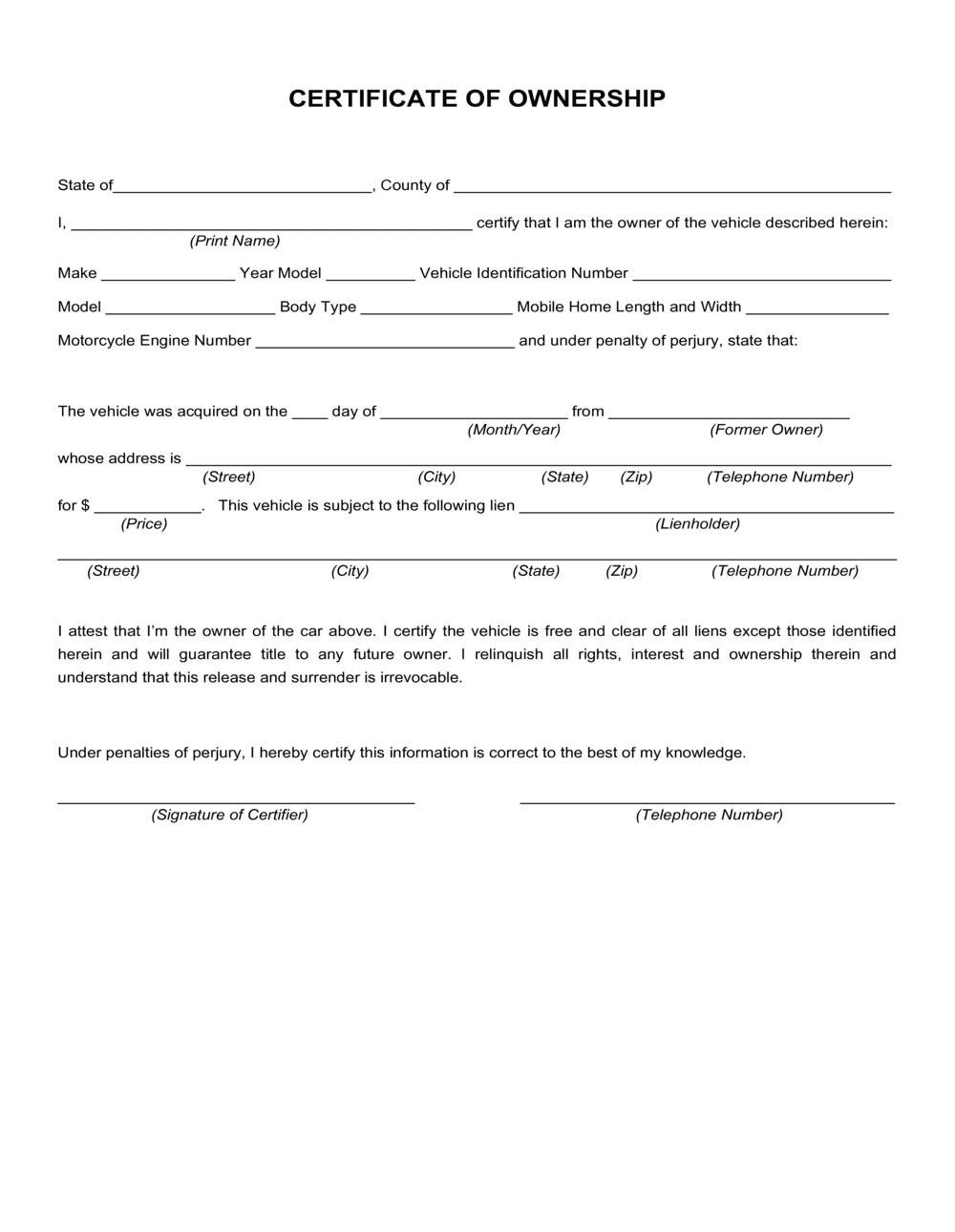
A Certificate of Ownership is a formal document that evidences a named individual's or entity's legal title to a specific asset β€” including shares in a company, a vehicle, real property, or intellectual property. This template is a free Word download you can edit online, populate with the owner's details and a precise asset description, and export as PDF for use in transfers, financing applications, or registration with public authorities.
When you need it
Use it when you need written proof of title to an asset β€” at the point of purchase or transfer, when pledging an asset as collateral for a loan, or when registering ownership with a government body or corporate registry.
What's inside
Issuing party details, full legal name of the owner, a precise description of the asset (including serial numbers, registration identifiers, or parcel references), the date ownership was acquired, any encumbrances or restrictions on the asset, and signature and certification blocks.

What is a Certificate of Ownership?

A Certificate of Ownership is a formal document that certifies a named individual or entity as the legal owner of a specific asset β€” whether shares in a private company, a motor vehicle, a parcel of real property, or an intellectual property right. It records the owner's legal name, a precise description of the asset including all unique identifying numbers, the date ownership was acquired, and any encumbrances or transfer restrictions that affect the asset. Unlike a bill of sale, which records the transaction that moved title, a certificate of ownership evidences the ownership position that resulted from that transaction, serving as a reference point for subsequent transfers, financing, and registration with public authorities.

Why You Need This Document

Without a formally executed certificate of ownership, proving title to an asset becomes a matter of assembling fragmented records β€” purchase receipts, correspondence, and informal notes β€” none of which individually satisfy the evidentiary standard required by banks, registries, or courts. Lenders routinely decline financing applications where ownership of the proposed collateral cannot be demonstrated cleanly. Government registries reject transfers that lack matching documentation. Title disputes between co-owners, heirs, or competing creditors are far harder to resolve when no authoritative ownership record exists at the time of the dispute. Issuing a certificate at the point of acquisition β€” with accurate identifiers, a disclosed encumbrance status, and a properly authorized signature β€” creates an unambiguous starting point for every subsequent transaction involving that asset, and costs a fraction of what title litigation or a rejected financing application will cost later.

Which variant fits your situation?

If your situation is…Use this template
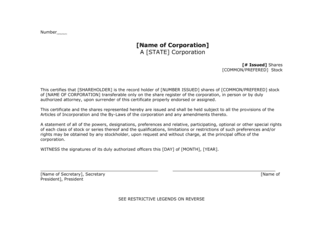
Evidencing ownership of shares in a private companyShare Certificate
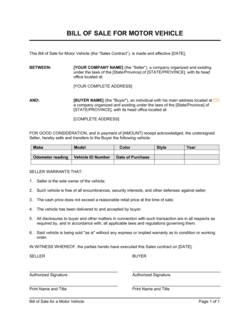
Transferring title to a motor vehicle in a private saleVehicle Bill of Sale
Documenting ownership of real property between partiesProperty Deed
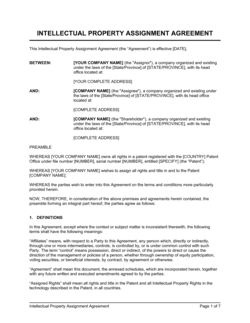
Assigning ownership of intellectual property to a businessIP Assignment Agreement
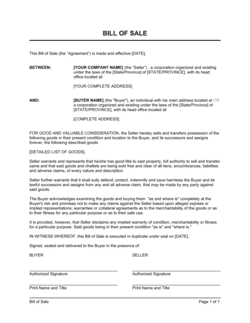
Transferring personal or business property as part of a saleBill of Sale
Recording the transfer of ownership of an asset within an estateAsset Transfer Agreement
Confirming business ownership for a sole proprietor or partnershipBusiness Ownership Agreement

Common mistakes to avoid

❌ Vague or incomplete asset description

Why it matters: A certificate that describes the asset as 'one vehicle' or 'company shares' without unique identifiers cannot be matched to a specific asset in a registry or dispute, making it worthless as proof of title.

Fix: Always include every available unique identifier β€” VIN, serial number, share class and certificate number, or legal property description β€” and pull the language directly from official records.

❌ Certifying encumbered assets as free and clear

Why it matters: Representing an asset as unencumbered when a lien or mortgage exists is misrepresentation and can expose the issuer to fraud liability, rescission of a transaction, and personal financial claims.

Fix: Conduct a lien search through the appropriate registry before issuing the certificate, and disclose all encumbrances accurately in the designated clause.

❌ Using informal or incorrect name variants

Why it matters: A certificate issued to 'John Smith' when the owner's legal name is 'Jonathan R. Smith III' will not match government ID or registry records, blocking transfers, registration, and financing.

Fix: Verify the owner's exact legal name against government-issued ID or corporate registration documents before drafting the certificate.

❌ Omitting the governing law clause

Why it matters: Without a governing law clause, courts must determine which jurisdiction's rules apply β€” a process that adds cost and uncertainty, especially for assets that could be subject to multiple jurisdictions.

Fix: Always include a governing law clause specifying the jurisdiction most closely connected to the asset's location or the owner's principal place of business, confirming the choice is consistent with local situs rules.

❌ Signing after an unauthorized transfer has already occurred

Why it matters: Issuing a certificate that post-dates an unrecorded transfer creates a gap in the chain of title that can trigger ownership disputes and make the asset difficult to insure or finance.

Fix: Issue the certificate at the same time as β€” or before β€” the transfer is recorded with the relevant authority, and ensure the execution date matches the transfer date in the underlying transaction documents.

❌ Failing to register or file the certificate with the relevant authority

Why it matters: An unregistered certificate may be valid between the parties but provides no protection against a subsequent purchaser or creditor who registers first under a first-to-register jurisdiction.

Fix: File the certificate or a corresponding instrument with the applicable registry β€” DMV, land titles office, corporate registry, or IP office β€” promptly after execution.

The 9 key clauses, explained

Issuing party identification

In plain language: Identifies who is issuing the certificate β€” the company, authority, or individual transferring ownership β€” and their legal authority to do so.

Sample language
This Certificate of Ownership is issued by [ISSUING PARTY LEGAL NAME], a [ENTITY TYPE] organized under the laws of [JURISDICTION], with its principal office at [ADDRESS].

Common mistake: Using a trade name instead of the issuing party's registered legal name. If the issuer's name does not match public registry records, the certificate may be rejected by banks, title companies, or government agencies.

Owner identification

In plain language: States the full legal name and address of the person or entity to whom ownership is being certified.

Sample language
This Certificate certifies that [OWNER FULL LEGAL NAME], of [OWNER ADDRESS], is the registered owner of the asset described herein as of [DATE].

Common mistake: Using a nickname or informal business name instead of the owner's legal name as it appears on government-issued identification or corporate registration, which creates a discrepancy that can block transfers and financing.

Asset description

In plain language: Provides a precise, unambiguous description of the asset, including all identifying numbers, dimensions, location references, or registration details needed to distinguish it from any similar asset.

Sample language
Asset: [DESCRIPTION], identified by [SERIAL NUMBER / VIN / PARCEL NUMBER / REGISTRATION NUMBER], located at / registered in [LOCATION / JURISDICTION].

Common mistake: Writing a generic description such as 'one motor vehicle' or 'company equipment' without serial numbers or other unique identifiers, making the certificate useless for registration or dispute resolution.

Acquisition date and consideration

In plain language: Records the date ownership was acquired and, where relevant, the consideration paid β€” confirming the transaction is bona fide and not a fraudulent transfer.

Sample language
Owner acquired title to the above-described asset on [DATE] in consideration of [AMOUNT / other consideration], pursuant to [TRANSACTION TYPE β€” purchase / transfer / issuance].

Common mistake: Omitting the acquisition date or stating only the certificate issue date, which leaves a gap in the chain of title and can create questions about the validity of prior transfers.

Encumbrances and restrictions

In plain language: Discloses any liens, mortgages, pledges, or other claims on the asset that exist as of the certificate date, or confirms that the asset is free and clear.

Sample language
The above-described asset is [free and clear of all liens, encumbrances, and claims / subject to the following encumbrances: [DESCRIPTION OF LIEN OR RESTRICTION]].

Common mistake: Representing an encumbered asset as free and clear. This constitutes misrepresentation and can expose the issuer to fraud liability if the certificate is relied upon by a lender or buyer.

Warranties of title

In plain language: The issuing party represents that they have the legal right to certify ownership and that the information on the certificate is accurate to the best of their knowledge.

Sample language
The issuing party warrants that it has the authority to issue this Certificate and that the information herein is accurate as of the date of issuance, to the best of its knowledge and belief.

Common mistake: Including an unconditional warranty of title without verifying the underlying records first. Unverified warranties create liability if the title later proves defective.

Transfer restrictions

In plain language: Sets out any conditions or restrictions on the owner's ability to transfer the asset, such as right-of-first-refusal obligations, shareholder agreement restrictions, or regulatory approval requirements.

Sample language
Any transfer of the above-described asset is subject to the following restrictions: [DESCRIPTION, e.g., prior written consent of the Board / right of first refusal in favor of [PARTY]].

Common mistake: Omitting transfer restrictions that exist under a shareholder agreement or regulatory regime, which can result in an unauthorized transfer that is void or voidable under the governing agreement.

Governing law

In plain language: Specifies which jurisdiction's laws govern the interpretation and enforcement of the certificate.

Sample language
This Certificate of Ownership shall be governed by and construed in accordance with the laws of [STATE / PROVINCE / COUNTRY], without regard to its conflict-of-laws principles.

Common mistake: Choosing a governing law that has no meaningful connection to where the asset is located or registered. For real property and vehicles, most jurisdictions require the law of the situs β€” where the asset is β€” to govern title matters regardless of contractual choice.

Signature and certification block

In plain language: Provides space for the authorized signatory to execute the certificate, including their name, title, and the date of signing, and for any required notarial or witness acknowledgment.

Sample language
Executed this [DAY] day of [MONTH], [YEAR], by [AUTHORIZED SIGNATORY NAME], [TITLE], on behalf of [ISSUING PARTY]. Witnessed / Notarized by: [NOTARY / WITNESS NAME].

Common mistake: Having an unauthorized person sign the certificate β€” for example, a junior employee rather than a director or officer β€” which can make the certificate legally ineffective if challenged.

How to fill it out

  1. 1

    Identify the issuing party and confirm authority

    Enter the full registered legal name of the party issuing the certificate and confirm they hold the authority to certify ownership β€” whether as a corporate officer, registered owner, or authorized agent. Cross-reference your corporate registry or title documents.

    πŸ’‘ If the issuing party is a company, attach a copy of the board resolution or corporate authorization authorizing the issuance of the certificate.

  2. 2

    Enter the owner's full legal name and address

    Use the owner's name exactly as it appears on government-issued ID or corporate registration documents. Include the owner's current registered address. For corporate owners, include the entity type and jurisdiction of formation.

    πŸ’‘ Mismatches between the name on the certificate and the name on registration records are the single most common cause of rejected transfers β€” verify the spelling character by character.

  3. 3

    Describe the asset with all identifying details

    Write a precise description of the asset including every unique identifier available β€” VIN for vehicles, parcel number and legal description for real property, registration or serial number for equipment, or share class and number for securities.

    πŸ’‘ Pull the asset description directly from the original purchase agreement, title deed, or registration document to ensure the language matches official records.

  4. 4

    Record the acquisition date and consideration

    State the exact date on which ownership was acquired and the form of consideration β€” purchase price, gift, inheritance, or equity issuance. If the transfer was for no monetary consideration, state that explicitly rather than leaving the field blank.

    πŸ’‘ Nominal consideration (e.g., $1) is legally valid in many jurisdictions but can attract scrutiny in tax audits β€” document the commercial rationale if used.

  5. 5

    Disclose encumbrances accurately

    Search lien registries, title records, and your own corporate records to identify any mortgages, pledges, or claims on the asset. Either list them specifically or confirm the asset is unencumbered. Do not guess β€” obtain a current lien search.

    πŸ’‘ For vehicles, run a title history check through your state DMV or equivalent authority before certifying the asset as free and clear.

  6. 6

    Add any transfer restrictions

    Review the shareholder agreement, operating agreement, or regulatory license applicable to the asset and note any restrictions on transfer. Include the specific consent or approval required and the party whose approval is needed.

    πŸ’‘ Forgetting to include a right-of-first-refusal can expose the owner to a breach-of-contract claim from the party holding that right if the asset is later transferred without offering it first.

  7. 7

    Execute with the correct signatory and obtain notarization if required

    Have the certificate signed by the authorized signatory β€” typically a director, officer, or registered owner β€” and include the date. Check whether the target jurisdiction, lender, or registry requires notarization or witness signatures.

    πŸ’‘ For real property transactions and cross-border transfers, notarization is almost always required. Budget time to schedule a notary appointment before the closing date.

  8. 8

    Retain originals and register with the relevant authority

    Keep at least one original executed copy in your records and provide the counterparty with a certified copy. File or register the certificate with any government body, corporate registry, or lender as required by the asset type and jurisdiction.

    πŸ’‘ Scan the fully executed original to a secure cloud location immediately after signing β€” lost originals for real property or share certificates can take months and significant legal expense to replace.

Frequently asked questions

What is a certificate of ownership?

A certificate of ownership is a formal document that identifies a named individual or entity as the legal owner of a specific asset β€” such as shares in a company, a motor vehicle, real property, or intellectual property. It records the asset's unique identifying details, the date ownership was acquired, any encumbrances, and is executed by an authorized party to serve as evidence of title for transfers, financing, and registration with public authorities.

What types of assets can a certificate of ownership cover?

Certificates of ownership are commonly used for shares and securities in private companies, motor vehicles, real property parcels, business equipment with serial numbers, and intellectual property rights. The specific legal form and registration requirements vary significantly by asset type and jurisdiction, so the template should be tailored to match the asset category and the rules of the governing authority.

Is a certificate of ownership legally binding?

A certificate of ownership is generally evidence of title rather than title itself β€” the underlying legal right derives from the transaction (purchase, issuance, or transfer) that preceded it. When properly executed and, where required, registered with the relevant authority, it is typically recognized by courts, lenders, and registries as reliable proof of ownership. Consider consulting a lawyer to confirm enforceability for the specific asset type and jurisdiction.

Does a certificate of ownership need to be notarized?

Notarization requirements depend on the asset type and jurisdiction. Real property transfers in most US states and many other jurisdictions require notarization. Vehicle title transfers often require a notarized signature in certain states. Share certificates for private companies typically do not require notarization but may need to be witnessed. Always check the requirements of the specific registry or authority where the certificate will be filed.

What is the difference between a certificate of ownership and a bill of sale?

A bill of sale documents the transaction that transfers ownership β€” it records the agreement between buyer and seller, the price paid, and the date of transfer. A certificate of ownership evidences the resulting title β€” it certifies that a named person is the current legal owner after the transfer has occurred. Both documents together form a complete record of a transfer; the bill of sale proves the transaction, and the certificate proves the resulting ownership status.

Can a certificate of ownership be used as collateral documentation?

Yes. Lenders frequently require a certificate of ownership when an asset is pledged as collateral for a loan, to confirm the borrower holds clear title and to identify any existing encumbrances. The lender will typically also conduct an independent lien search and may require the certificate to be updated to reflect a new lien in their favor before releasing funds.

What happens if there is an error on a certificate of ownership?

Errors on a certificate of ownership β€” particularly in the owner's name, asset description, or identifying numbers β€” should be corrected by issuing a corrected certificate before any transfer or registration takes place. Once an erroneous certificate has been filed with a registry, correcting the record typically requires a formal application, supporting evidence, and in some cases a court order. Catching errors before filing is significantly less costly than correcting a registered error.

Do I need a lawyer to issue a certificate of ownership?

For straightforward asset ownership documentation β€” a vehicle, a small share issuance, or basic business equipment β€” a well-drafted template is typically sufficient for most small business and personal use cases. Engage a lawyer when the asset is high value, when real property is involved, when the certificate will be used in cross-border transactions, or when title is contested or subject to complex encumbrances.

How long should a certificate of ownership be retained?

Retain a certificate of ownership for as long as you own the asset and for the full limitation period after you transfer it β€” typically 6–10 years depending on jurisdiction. For real property and corporate shares, indefinite retention is advisable because chain-of-title questions can arise decades after a transaction. Store originals in a fireproof location and maintain scanned copies in a secure cloud environment.

How this compares to alternatives

vs Bill of Sale

A bill of sale documents the transaction through which ownership changes hands β€” the agreement, the price, and the transfer date. A certificate of ownership evidences the resulting ownership status after that transaction is complete. Both are needed for a complete transfer record: the bill of sale proves how title moved; the certificate proves who holds it now.

vs Vehicle Bill of Sale

A vehicle bill of sale is a transaction-specific document recording the sale terms, odometer reading, and buyer-seller details for a motor vehicle transfer. A certificate of ownership is the broader ownership evidence document that may accompany the bill of sale and is required by DMVs and lenders to confirm current title. For vehicle transactions, you typically need both.

vs IP Assignment Agreement

An IP assignment agreement is the contractual instrument that transfers intellectual property rights from one party to another, including representations, warranties, and consideration. A certificate of ownership for IP evidences the outcome of that assignment β€” confirming the assignee now holds title. The assignment agreement drives the legal transfer; the certificate records and communicates the resulting ownership.

vs Business Ownership Agreement

A business ownership agreement governs the ongoing relationship between co-owners of a business β€” setting out equity splits, decision-making rights, and exit provisions. A certificate of ownership records the static fact of who holds a specific asset or share interest at a given point in time. The ownership agreement creates and structures the relationship; the certificate documents the current ownership position.

Industry-specific considerations

Automotive and transportation

Vehicle identification numbers, odometer disclosure requirements, and state or provincial DMV registration procedures make precise asset description and notarization especially important.

Real estate and property

Legal property descriptions using metes-and-bounds or lot-and-block references, parcel numbers, and mandatory registration with a land titles office distinguish real property certificates from all other asset types.

Technology and SaaS

IP ownership certificates for software, patents, and trade secrets are critical at funding rounds, where investors conduct IP diligence to confirm the company β€” not a founder personally β€” holds title to core assets.

Financial services and investment

Share certificates for private companies must align with the share register and shareholder agreement; discrepancies between the certificate and the register create governance risk and can complicate regulatory filings.

Jurisdictional notes

United States

Requirements vary significantly by asset type and state. Real property transfers require a deed recorded with the county recorder's office; certificates of ownership for vehicles are administered by each state's DMV with notarization required in many states. For shares in private companies, no federal form is mandated, but the Uniform Commercial Code governs security interests in uncertificated securities. California and New York have additional disclosure requirements for certain asset transfers.

Canada

Vehicle ownership is evidenced by a provincial permit or title document issued by the relevant ministry of transportation, and transfers must be registered with the province. Real property certificates must align with the provincial land titles or land registry system β€” which operates as a Torrens system in most western provinces and a deeds system in Ontario and Atlantic provinces. Share certificates for federally or provincially incorporated companies must comply with the applicable Business Corporations Act. Quebec transfers involving immovable property require notarization before a notaire.

United Kingdom

Real property ownership in England and Wales is registered at HM Land Registry, which issues official title registers rather than private certificates; a private certificate alone does not constitute registered title. Share certificates for private limited companies are governed by the Companies Act 2006 and must align with the company's register of members. Scotland operates a separate land registration system under Registers of Scotland. Vehicle ownership is evidenced by the V5C logbook issued by the DVLA, and private certificates do not replace this official document.

European Union

Ownership documentation requirements vary substantially across EU member states, as property and company law remain national competences. Most member states require notarial involvement for real property transfers and maintain mandatory land registries. Share certificates for private companies must comply with the national companies legislation of the member state of incorporation. Cross-border ownership recognition is supported by EU private international law instruments, but local registration requirements must still be met in each country where an asset is located. GDPR considerations apply where certificates contain personal data processed or stored electronically.

Template vs lawyer β€” what fits your deal?

PathBest forCostTime
Use the templateDocumenting ownership of low-to-mid-value assets, issuing share certificates for small private companies, or supporting standard vehicle transfersFree15–30 minutes
Template + legal reviewAssets pledged as collateral, share issuances with complex restrictions, or certificates required by a lender or government authority$200–$5001–2 days
Custom draftedHigh-value real property, contested title, cross-border transactions, or complex IP ownership structures$500–$3,000+3–10 days

Glossary

Legal Title
The formally recognized ownership right to an asset, as opposed to beneficial interest, which represents the right to use or profit from it.
Encumbrance
A claim, lien, or restriction attached to an asset that limits the owner's ability to transfer or use it freely β€” such as a mortgage or lien.
Chain of Title
The chronological sequence of documented ownership transfers for an asset, used to verify that the current owner holds clear title.
Beneficial Owner
The person who enjoys the economic benefits of an asset even if legal title is held by another party, such as a trustee or nominee.
Lien
A creditor's legal claim against an asset as security for a debt, which must typically be discharged before the asset can be freely transferred.
Serial Number / VIN
A unique identifier assigned to a specific asset β€” such as a Vehicle Identification Number for cars β€” used to distinguish it from all similar assets.
Notarization
The process by which a notary public certifies the authenticity of signatures on a document, adding a layer of legal credibility recognized by courts and registries.
Parcel Number (APN)
An Assessor's Parcel Number assigned by a local authority to uniquely identify a specific plot of real property in tax and title records.
Bill of Sale
A document that records the transfer of ownership of personal property from a seller to a buyer, typically serving as proof of purchase and title passage.
Share Register
A company's official record of all shareholders, the number and class of shares they hold, and the dates shares were issued or transferred.

Part of your Business Operating System

This document is one of 3,000+ business & legal templates included in Business in a Box.

  • Fill-in-the-blanks β€” ready in minutes
  • 100% customizable Word document
  • Compatible with all office suites
  • Export to PDF and share electronically

Create your document in 3 simple steps.

From template to signed document β€” all inside one Business Operating System.
1
Download or open template

Access over 3,000+ business and legal templates for any business task, project or initiative.

2
Edit and fill in the blanks with AI

Customize your ready-made business document template and save it in the cloud.

3
Save, Share, Send, Sign

Share your files and folders with your team. Create a space of seamless collaboration.

Save time, save money, and create top-quality documents.

β˜…β˜…β˜…β˜…β˜…

"Fantastic value! I'm not sure how I'd do without it. It's worth its weight in gold and paid back for itself many times."

Managing Director Β· Mall Farm
Robert Whalley
Managing Director, Mall Farm Proprietary Limited
β˜…β˜…β˜…β˜…β˜…

"I have been using Business in a Box for years. It has been the most useful source of templates I have encountered. I recommend it to anyone."

Business Owner Β· 4+ years
Dr Michael John Freestone
Business Owner
β˜…β˜…β˜…β˜…β˜…

"It has been a life saver so many times I have lost count. Business in a Box has saved me so much time and as you know, time is money."

Owner Β· Upstate Web
David G. Moore Jr.
Owner, Upstate Web

Run your business with a system β€” not scattered tools

Stop downloading documents. Start operating with clarity. Business in a Box gives you the Business Operating System used by over 250,000 companies worldwide to structure, run, and grow their business.

Start freeΒ Β·Β No credit card required