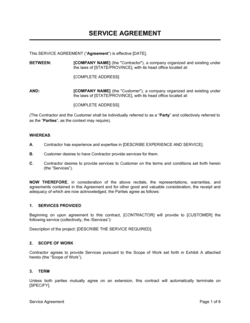
Certificate Of Incumbency Template

Free Word download • Edit online • Save & share with Drive • Export to PDF

1 page20–30 min to fillDifficulty: StandardSignature requiredLegal review recommended
Learn more ↓
FreeCertificate Of Incumbency Template

At a glance

What it is
A Certificate of Incumbency is a formal corporate document that identifies the current officers, directors, and authorized signatories of a company and confirms their authority to act on its behalf. This template is a free Word download you can edit online and export as PDF — ready for banks, counterparties, and government agencies that require verified proof of who holds signing authority within your organization.
When you need it
Use it when opening a corporate bank account, entering a significant commercial contract, completing a cross-border transaction, or responding to a counterparty's due-diligence request for proof of authorized signatories. It is also commonly required when registering a foreign entity or establishing a new banking relationship in a different jurisdiction.
What's inside
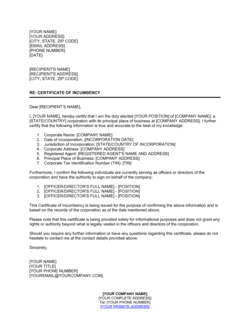
Company identification details, a list of officers and directors with their titles and signatures, a certification of their authority to bind the company, the corporate secretary's attestation and signature, and space for a notarial acknowledgment where required by the receiving institution or jurisdiction.

What is a Certificate of Incumbency?

A Certificate of Incumbency is a formal corporate document issued by a company's corporate secretary that identifies the current officers, directors, and authorized signatories of the organization and certifies their legal authority to act on its behalf. Unlike a government-issued certificate, it originates within the company itself and serves as the company's own attestation that the individuals named hold the roles and signing powers attributed to them. Banks, lenders, counterparties, and government agencies use it to verify who is authorized to open accounts, sign contracts, and execute financial instruments in the company's name — making it one of the most frequently requested documents in corporate due diligence, transaction closings, and banking onboarding worldwide.

Why You Need This Document

Without a current, accurate Certificate of Incumbency, routine but critical business transactions stall. Banks will not open corporate accounts or process significant wire transfers without verified signatory authority on file. Enterprise counterparties withhold contract execution pending confirmation that the person signing actually has authority to bind the company. Cross-border transactions — where the receiving institution cannot easily verify domestic corporate records — come to a complete stop until incumbency is documented. Beyond individual transactions, operating without a maintained incumbency record creates cumulative legal risk: if an outdated certificate circulates and a third party relies on it to engage with a former officer, unwinding the resulting commitments is expensive and contested. This template gives you a professionally structured, bank-ready document you can complete in under 30 minutes, keep current with each officer change, and present with confidence in any due-diligence context.

Which variant fits your situation?

If your situation is…Use this template
Opening a corporate bank account domesticallyCertificate of Incumbency (Standard)
Certifying signatories for a cross-border transaction or foreign bankCertificate of Incumbency with Notarization Block
Confirming authority for an LLC managed by members rather than officersLLC Certificate of Incumbency
Certifying authority specifically for a loan or credit facility closingOfficer's Certificate (Loan Transaction)
Attesting to board resolutions alongside officer identitySecretary's Certificate of Board Resolutions
Confirming ownership and officers for AML/KYC compliance purposesCertificate of Good Standing with Incumbency
Certifying authorized signatories for a government agency or regulatorAuthorized Signatory Certificate

Common mistakes to avoid

❌ Using a trading name instead of the registered legal name

Why it matters: Banks and government agencies verify the certificate against official registry records. A mismatch — even a minor one like 'Inc.' vs 'Incorporated' — triggers rejection and delays the transaction.

Fix: Pull the exact legal name from your certificate of incorporation or current registry filing and copy it character-for-character into the company identification clause.

❌ Issuing a certificate with outdated officer information

Why it matters: A certificate listing a director who resigned six months ago or an officer who was replaced misrepresents the company's current authority structure. Acting on a stale certificate can expose the company to unauthorized-transaction liability.

Fix: Review the officer and director list against board minutes and HR records before every issuance. If any appointment or resignation occurred since the last certificate, update the record and issue a new certificate explicitly superseding the prior one.

❌ Omitting specimen signatures

Why it matters: The primary purpose of a Certificate of Incumbency for banking purposes is to enable the institution to verify signatures on future instruments. A certificate without specimen signatures does not fulfill this function.

Fix: Include a dedicated specimen signature block for every named authorized signatory and collect wet or verified electronic signatures before delivering the certificate.

❌ Leaving the notarial block incomplete on cross-border transactions

Why it matters: A partially completed notarial acknowledgment — with blanks unfilled or the notary seal missing — signals to the foreign recipient that the authentication was incomplete, which is often worse than submitting an un-notarized document.

Fix: Either complete the notarial block fully with a licensed notary or remove it entirely if notarization is not required by the receiving institution. Never submit a certificate with a blank notarial block.

❌ Having the wrong person sign the corporate secretary attestation

Why it matters: The attestation derives its legal weight from the secretary's custodial role over corporate records. An attestation signed by the CEO or CFO in this block — even if they are more senior — does not carry the same authority and may be rejected.

Fix: Confirm who holds the corporate secretary role under the company's governing documents before execution. If the role is vacant, fill it by board resolution before issuing the certificate.

❌ Failing to supersede prior certificates

Why it matters: If multiple versions of the certificate exist without clear supersession language, counterparties may act on an outdated version, creating conflicting authority records and potential liability.

Fix: Include explicit language in every new certificate stating that it supersedes and replaces all prior certificates of incumbency, and provide the issuing date of the most recent prior certificate.

The 9 key clauses, explained

Company Identification

In plain language: States the full legal name of the company, jurisdiction of incorporation, company registration number, and registered address.

Sample language
This Certificate is issued by [COMPANY FULL LEGAL NAME], a [ENTITY TYPE] incorporated under the laws of [STATE / PROVINCE / COUNTRY], registration number [REGISTRATION NUMBER], with its registered office at [REGISTERED ADDRESS].

Common mistake: Using a trading name or brand name instead of the exact registered legal name. If the name on the certificate does not match the company's registration records, banks and counterparties will reject the document.

Date of Certificate

In plain language: Records the specific date on which the certificate is executed, which determines whether the officer information is current.

Sample language
This Certificate is given as of [DATE] and supersedes all prior certificates of incumbency issued by the Company.

Common mistake: Leaving the date blank or using an approximate date. Most banks treat a Certificate of Incumbency as valid for 90–180 days from the stated date; an undated certificate may be rejected outright or treated as immediately stale.

List of Officers and Titles

In plain language: Identifies each current officer by full legal name and exact corporate title, confirming their role within the organization.

Sample language
The following individuals currently hold the offices set out opposite their respective names: [OFFICER FULL NAME] — [TITLE]; [OFFICER FULL NAME] — [TITLE]; [OFFICER FULL NAME] — [TITLE].

Common mistake: Listing informal titles such as 'Co-Founder' or 'Head of' instead of the officer's formally appointed corporate title. Receiving institutions check listed titles against the company's articles or appointment resolutions.

List of Directors

In plain language: Names each member of the board of directors currently in office, distinguishing directors from executive officers where applicable.

Sample language
The following individuals constitute the current Board of Directors of the Company: [DIRECTOR FULL NAME]; [DIRECTOR FULL NAME]; [DIRECTOR FULL NAME].

Common mistake: Omitting directors who hold both a board seat and an officer title. Every current board member should be listed in the directors section regardless of whether they also appear in the officers section.

Specimen Signatures

In plain language: Provides the actual handwritten or electronic signature of each listed officer and authorized signatory so counterparties can authenticate documents.

Sample language
The specimen signature of each officer and authorized signatory named above appears opposite their name: [OFFICER FULL NAME] — Signature: _________________

Common mistake: Omitting specimen signatures on the assumption that the corporate seal is sufficient. Banks that require a Certificate of Incumbency specifically to verify signatories will not accept a certificate without specimen signatures.

Scope of Authority

In plain language: Defines what each authorized signatory is permitted to do — whether they may sign independently or require a co-signatory, and any transactional limits.

Sample language
Each of the officers listed above is authorized to execute agreements, instruments, and documents on behalf of the Company, provided that transactions exceeding $[THRESHOLD] require the joint signature of [TITLE] and [TITLE].

Common mistake: Granting blanket unlimited authority to all listed officers without qualification. This creates risk if a junior officer later executes a major commitment the company cannot honor, and weakens internal controls.

Certification by Corporate Secretary

In plain language: The corporate secretary's attestation that the officer and director information contained in the certificate is true, complete, and current as of the stated date.

Sample language
I, [CORPORATE SECRETARY FULL NAME], Corporate Secretary of [COMPANY NAME], hereby certify that the foregoing information is true, accurate, and complete as of the date of this Certificate, and that the persons named herein are duly elected or appointed to the offices set out opposite their names.

Common mistake: Having an officer other than the corporate secretary sign the certification. In most jurisdictions, the certificate's attestation value derives specifically from the secretary's custodial role over corporate records. A CEO or CFO signature in this block is not a substitute.

Corporate Seal (if applicable)

In plain language: Affixes the company's official corporate seal to authenticate the document, where the company maintains a seal and the receiving institution requires it.

Sample language
[AFFIX CORPORATE SEAL HERE] — The corporate seal of [COMPANY NAME] is affixed hereto as of [DATE].

Common mistake: Assuming a corporate seal is universally required. In the US, the corporate seal is optional in most states and many institutions no longer require it. Including a seal block when the company has no seal creates an incomplete document.

Notarial Acknowledgment Block

In plain language: Provides space for a notary public to verify the corporate secretary's identity and witness their signature, required by foreign banks and cross-border transactions.

Sample language
State of [STATE], County of [COUNTY]. On [DATE], before me, [NOTARY NAME], a Notary Public, personally appeared [CORPORATE SECRETARY NAME], who proved to me on the basis of satisfactory evidence to be the person whose name is subscribed to the within instrument and acknowledged to me that they executed the same in their authorized capacity.

Common mistake: Including a notarial block but leaving it blank and sending the document unsigned by a notary. A partially completed notarial block is worse than no block at all — it signals to the recipient that the authentication step was skipped.

How to fill it out

  1. 1

    Enter the company's full legal name and registration details

    Pull the exact legal name, entity type, jurisdiction of incorporation, registration number, and registered address from your certificate of incorporation or articles of organization. These must match official registry records precisely.

    💡 Cross-reference your jurisdiction's online business registry before completing this step — a single character difference in the legal name can cause rejection.

  2. 2

    Set the date of the certificate

    Enter a specific calendar date — typically today's date or the date of a recent board meeting that confirmed current officer appointments. Do not backdate the certificate.

    💡 Most banks accept a Certificate of Incumbency dated within the last 90 days. If your certificate is approaching that threshold, issue a refreshed certificate rather than altering the original.

  3. 3

    List all current officers with their exact corporate titles

    Enter each officer's full legal name and their formally appointed title as it appears in board resolutions or the company's operating agreement. Include at minimum: President or CEO, Secretary, and Treasurer or CFO.

    💡 If an officer holds multiple titles (e.g., President and Secretary), list them in a single row with both titles noted — do not create two separate entries, which can confuse reviewers.

  4. 4

    List all current directors

    Enter each director's full legal name in the directors section. For a single-member LLC where the member is also the sole director and officer, confirm that your operating agreement supports this structure before listing one person in all three roles.

    💡 If any director appointment is currently in question — pending board vote, disputed resignation — resolve that corporate action before issuing the certificate.

  5. 5

    Collect specimen signatures from each authorized signatory

    Have each listed officer and authorized signatory sign their specimen signature block in ink, using the same signature they use on corporate instruments. For electronic delivery, confirm the receiving institution accepts digital signatures in this block.

    💡 Use blue ink for wet signatures if the certificate will be notarized — it makes originals visually distinguishable from photocopies.

  6. 6

    Define the scope of authority for each signatory

    Specify whether each signatory can act alone or requires a co-signatory, and note any dollar thresholds or transaction-type limitations. This section should reflect your internal authorization matrix.

    💡 Avoid the temptation to grant all officers unlimited joint-and-several authority. Differentiated authority levels make the document more useful as an internal control tool.

  7. 7

    Have the corporate secretary sign and date the certification block

    The corporate secretary must sign the attestation in their capacity as secretary — not in any other officer role. If the company has no designated secretary, the person who maintains corporate records should execute this block and their custodial role should be noted.

    💡 If the corporate secretary is also an authorized signatory listed in the body of the certificate, they sign twice — once as a listed signatory with specimen and once as the certifying secretary.

  8. 8

    Arrange notarization where required

    If the receiving institution — particularly a foreign bank — requires notarization, have the corporate secretary's signature witnessed and acknowledged by a licensed notary public before delivery. For use in countries that are Hague Convention signatories, an apostille may also be required.

    💡 Confirm notarization and apostille requirements with the receiving institution before executing the document — post-execution notarization of a document signed on a different date can raise authenticity questions.

Frequently asked questions

What is a Certificate of Incumbency?

A Certificate of Incumbency is a formal corporate document that identifies a company's current officers, directors, and authorized signatories and certifies their authority to act on the company's behalf. It is issued by the corporate secretary and used by banks, counterparties, and government agencies to verify who is legally authorized to sign contracts, open accounts, and execute financial instruments for the company. It is one of the most commonly requested documents in corporate due diligence and banking onboarding.

When is a Certificate of Incumbency required?

It is most commonly required when opening a corporate bank account, establishing a new lending relationship, closing an M&A transaction, entering a significant commercial contract, registering a foreign subsidiary, or responding to AML and KYC due-diligence requests. Many financial institutions require a refreshed certificate — typically dated within the last 90 to 180 days — any time the company's authorized signatories change.

Who signs a Certificate of Incumbency?

The certificate is signed by the corporate secretary in their official capacity, as they are responsible for maintaining the accuracy of corporate records. Each officer and authorized signatory listed in the certificate also provides their specimen signature. Where notarization is required, a licensed notary public additionally witnesses and acknowledges the corporate secretary's signature.

Does a Certificate of Incumbency need to be notarized?

Notarization is not universally required, but it is commonly requested by foreign banks, cross-border transaction counterparties, and government agencies in jurisdictions outside the company's home country. For documents destined for Hague Convention member countries, an apostille is typically required in addition to notarization. Always confirm the specific requirements with the receiving institution before executing the certificate.

How long is a Certificate of Incumbency valid?

Most banks and financial institutions treat a Certificate of Incumbency as valid for 90 to 180 days from the stated issue date, though this varies by institution and jurisdiction. The document is also effectively invalidated any time an officer or director named in it is appointed, replaced, or resigns — at which point a new certificate should be issued that explicitly supersedes the prior one.

What is the difference between a Certificate of Incumbency and a Certificate of Good Standing?

A Certificate of Incumbency identifies the current officers and directors of a company and confirms their signing authority — it is issued by the company's own corporate secretary. A Certificate of Good Standing is issued by the state or government agency where the company is registered and confirms that the company is legally active and compliant with all filing and fee requirements. Both are often requested together during bank onboarding and M&A due diligence, but they serve distinct purposes.

Can a Certificate of Incumbency be used for an LLC?

Yes, LLCs can and do issue Certificates of Incumbency, though the document must reflect the LLC's management structure. A manager-managed LLC will list managers and their authority in place of traditional corporate officers. A member-managed LLC may list authorized members. The certifying signature should come from the person responsible for maintaining the LLC's records, as designated in the operating agreement.

What happens if information in the Certificate of Incumbency is incorrect?

An incorrect certificate — whether through error or omission — can expose the company to liability for unauthorized actions taken in reliance on it. If a bank extends credit or a counterparty executes a contract based on a certificate listing an officer who was no longer authorized, unwinding those transactions can be costly and contested. The certificate should be reviewed for accuracy immediately before every issuance and any errors corrected before delivery.

Is a Certificate of Incumbency a public document?

No. A Certificate of Incumbency is a private corporate document issued directly to the requesting institution or counterparty. It is not filed with a government registry and is not publicly searchable. Recipients are expected to treat its contents — particularly specimen signatures — as confidential and use them only for the purpose for which the certificate was provided.

How this compares to alternatives

vs Certificate of Good Standing

A Certificate of Good Standing is issued by a government registry and confirms that the company is legally active and compliant with state or provincial requirements. A Certificate of Incumbency is issued by the company itself and identifies who holds authority within it. Banks routinely require both, but they answer different questions — one proves the company exists in good order; the other proves who speaks for it.

vs Board Resolution

A board resolution documents a specific decision made by the directors — authorizing a transaction, appointing an officer, or approving a contract. A Certificate of Incumbency is an ongoing reference document confirming the current officer roster and general signing authority. For specific high-value transactions, counterparties may request both: the certificate to confirm who the officers are and a resolution to confirm the specific transaction was approved.

vs Secretary's Certificate

A Secretary's Certificate typically certifies the authenticity of a specific board resolution or set of minutes — it is transaction-specific. A Certificate of Incumbency is a standing document certifying officer identity and authority. While both are executed by the corporate secretary, they serve different functions and are not interchangeable in banking and legal contexts.

vs Power of Attorney

A Power of Attorney grants a specific individual authority to act on behalf of the company for defined purposes, often broader than their corporate role. A Certificate of Incumbency confirms the existing authority that officers already hold by virtue of their appointment. A counterparty needing ad hoc authority from someone not listed as an officer would typically require a Power of Attorney rather than an incumbency certificate.

Industry-specific considerations

Financial Services and Banking

Required at every new bank account opening and typically refreshed annually; AML and KYC compliance programs treat it as a primary source document for beneficial ownership verification.

Technology and SaaS

Commonly requested by enterprise customers and payment processors during vendor onboarding and when establishing payment disbursement accounts for international subsidiaries.

Professional Services

Law firms and consulting practices issue incumbency certificates when entering joint venture arrangements, trust accounts, or client escrow agreements requiring verified signatory authority.

Manufacturing and Trade

Required by foreign buyers, customs brokers, and trade-finance banks to confirm who may execute letters of credit, shipping documents, and cross-border supply agreements.

Jurisdictional notes

United States

No federal statute mandates a specific form for a Certificate of Incumbency, but state corporation laws — particularly in Delaware, Nevada, and New York — recognize the corporate secretary's authority to certify officer information. Corporate seals are optional in most states. Banks regulated by FinCEN require incumbency documentation as part of their Customer Due Diligence (CDD) rule for legal entity customers.

Canada

Canadian corporations governed by the CBCA or provincial equivalents rely on the corporate secretary to certify officer authority. FINTRAC compliance requires federally regulated financial institutions to collect incumbency information as part of beneficial ownership verification. Quebec civil law corporations should ensure the certificate language is consistent with the Civil Code's provisions on mandate and representation.

United Kingdom

UK companies registered at Companies House have officer information publicly searchable, which sometimes reduces the practical demand for a formal incumbency certificate domestically. However, foreign banks and international counterparties routinely request one for UK entities. The certificate should reference the company's registered number at Companies House. Under the Companies Act 2006, the company secretary role is optional for private companies, so the certifying officer should be clearly identified.

European Union

EU member states have varying registry disclosure requirements — many publish director information in national registers, which are partially interconnected through the Business Registers Interconnection System (BRIS). Despite public registries, banks conducting AML due diligence under the EU's Anti-Money Laundering Directives still request incumbency certificates to verify beneficial owners and authorized signatories. Documents intended for use across multiple EU jurisdictions may require an apostille under the Hague Convention.

Template vs lawyer — what fits your deal?

PathBest forCostTime
Use the templateStandard domestic bank account openings and routine counterparty due-diligence requests for established companies with stable officer rostersFree20–30 minutes
Template + legal reviewCross-border transactions, new foreign banking relationships, or companies that have recently changed officers or directors$150–$4001–2 business days
Custom draftedM&A closings, regulated-industry licensing, foreign registration requiring notarization and apostille, or complex multi-entity structures$500–$2,000+3–7 business days

Glossary

Certificate of Incumbency
A corporate document certifying the names, titles, and signing authority of a company's current officers and directors.
Authorized Signatory
An individual formally authorized by the company to sign contracts, banking documents, or other binding instruments on the company's behalf.
Corporate Secretary
The officer responsible for maintaining corporate records, certifying resolutions, and attesting to the authenticity of corporate documents.
Notarization
The process by which a notary public verifies the identity of a signer and witnesses their signature, adding an official seal to confirm authenticity.
Apostille
A standardized international certification under the Hague Convention that authenticates the origin of a public document for use in foreign countries.
Good Standing
A status indicating that a company has met all filing, fee, and compliance requirements in its jurisdiction of incorporation and remains legally active.
Board Resolution
A formal decision made by a company's board of directors, recorded in writing and typically attested by the corporate secretary.
Officer
A person appointed by the board of directors to manage day-to-day operations, such as a CEO, CFO, COO, or Corporate Secretary.
Specimen Signature
An example of an authorized signatory's actual signature included in the certificate so that counterparties can verify documents they receive.
Beneficial Owner
The natural person who ultimately owns or controls a company, distinct from the nominee or registered owner appearing on corporate records.
KYC (Know Your Customer)
Due-diligence requirements imposed by banks and financial institutions to verify the identity and authority of persons acting on behalf of a corporate customer.

Part of your Business Operating System

This document is one of 3,000+ business & legal templates included in Business in a Box.

  • Fill-in-the-blanks — ready in minutes
  • 100% customizable Word document
  • Compatible with all office suites
  • Export to PDF and share electronically

Create your document in 3 simple steps.

From template to signed document — all inside one Business Operating System.
1
Download or open template

Access over 3,000+ business and legal templates for any business task, project or initiative.

2
Edit and fill in the blanks with AI

Customize your ready-made business document template and save it in the cloud.

3
Save, Share, Send, Sign

Share your files and folders with your team. Create a space of seamless collaboration.

Save time, save money, and create top-quality documents.

★★★★★

"Fantastic value! I'm not sure how I'd do without it. It's worth its weight in gold and paid back for itself many times."

Managing Director · Mall Farm
Robert Whalley
Managing Director, Mall Farm Proprietary Limited
★★★★★

"I have been using Business in a Box for years. It has been the most useful source of templates I have encountered. I recommend it to anyone."

Business Owner · 4+ years
Dr Michael John Freestone
Business Owner
★★★★★

"It has been a life saver so many times I have lost count. Business in a Box has saved me so much time and as you know, time is money."

Owner · Upstate Web
David G. Moore Jr.
Owner, Upstate Web

Run your business with a system — not scattered tools

Stop downloading documents. Start operating with clarity. Business in a Box gives you the Business Operating System used by over 250,000 companies worldwide to structure, run, and grow their business.

Free Forever Plan · No credit card required