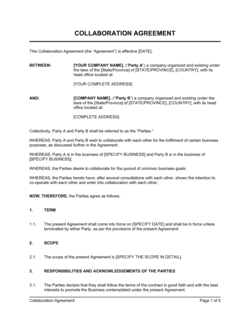
Team Work Agreement Template

Free Word download β€’ Edit online β€’ Save & share with Drive β€’ Export to PDF

3 pagesβ€’25–30 min to fillβ€’Difficulty: Standardβ€’Signature requiredβ€’Legal review recommended
Learn more ↓
FreeTeam Work Agreement Template

At a glance

What it is
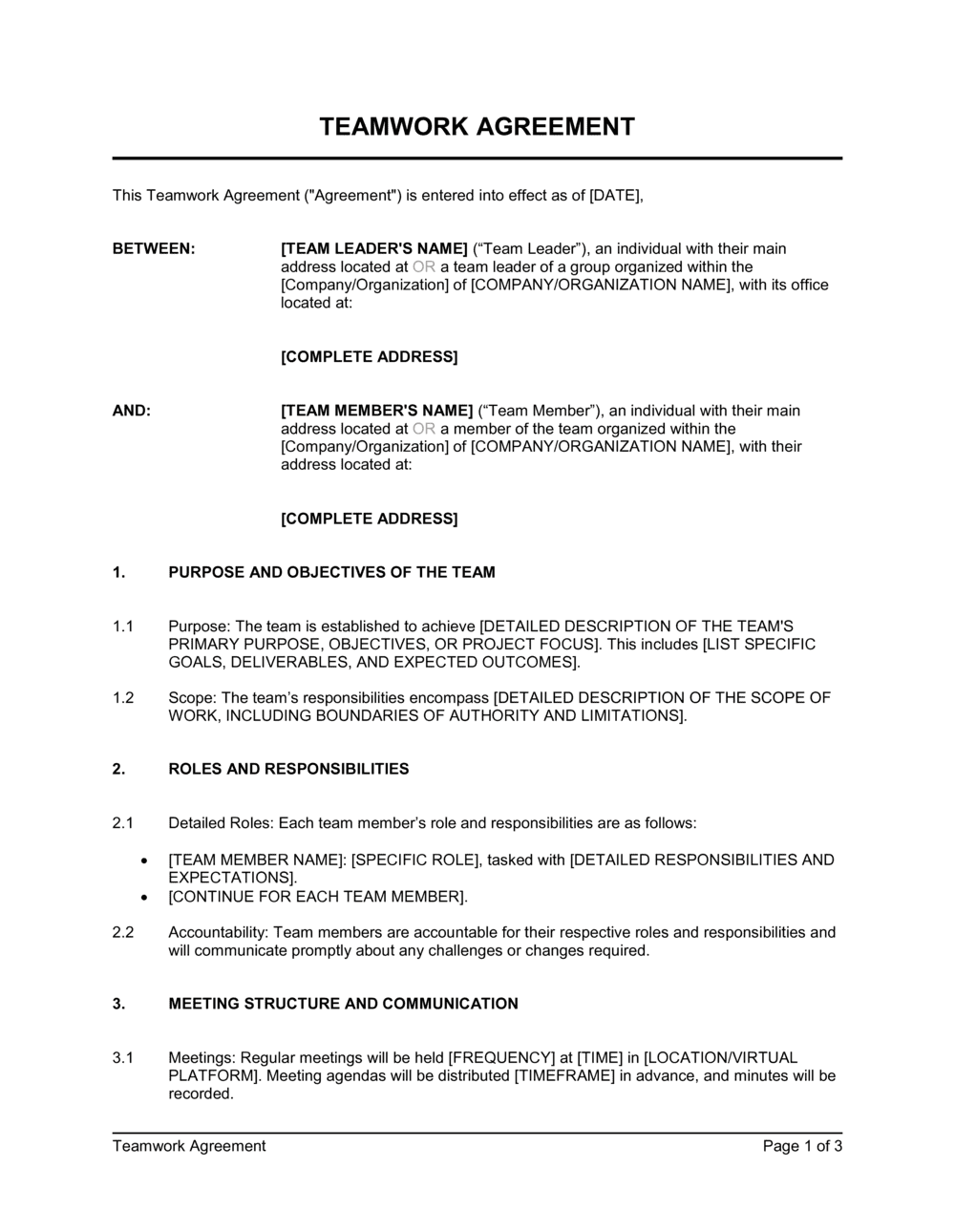
A Team Work Agreement is a binding written document that establishes the rules, roles, responsibilities, decision-making authority, and collaboration norms governing how a team operates together. This free Word download gives you a structured, signable starting point you can edit online and export as PDF for use with project teams, cross-functional units, or joint-venture workgroups.
When you need it
Use it when forming a new team, launching a cross-departmental project, onboarding contributors who span multiple employers, or formalizing how an existing team will resolve disputes, make decisions, and share deliverables.
What's inside
Team purpose and scope, member roles and responsibilities, decision-making authority, communication protocols, conflict resolution procedures, intellectual property ownership, confidentiality obligations, and amendment and termination terms.

What is a Team Work Agreement?

A Team Work Agreement is a signed, binding document that establishes the operating rules for a group of people working toward a shared goal. It defines each member's role and deliverables, specifies who holds decision-making authority and under what circumstances, sets communication and meeting norms, assigns ownership of jointly produced intellectual property, and provides a structured process for resolving conflicts before they escalate. Unlike an informal team charter or a set of unwritten norms, a properly executed team work agreement creates enforceable obligations on every signatory β€” making it the legal backbone of how a team functions, not just an aspirational statement of intent.

Why You Need This Document

Teams that operate without a written agreement routinely encounter the same four problems: unresolved disputes about who owns the IP they produced, members with conflicting understandings of their authority, confidential project information disclosed to the wrong people, and disagreements that escalate to management because there was no agreed first step for working them out peer-to-peer. Each of these problems is preventable and each one costs time, money, and team cohesion to fix after the fact. For cross-company teams β€” where members are employed by different organizations with their own IP policies and NDAs β€” the absence of a team work agreement can trigger competing ownership claims over deliverables that may be worth far more than the cost of a one-hour legal review. This template gives any team lead, project manager, or HR professional a structured, signable starting point that closes those gaps before the first task is assigned.

Which variant fits your situation?

If your situation is…Use this template
Forming a two-person co-founder working relationshipCo-Founder Agreement
Establishing norms for an agile development squadAgile Team Working Agreement
Documenting a joint project between two separate companiesJoint Venture Agreement
Defining collaboration rules for a committee or advisory boardCommittee Charter
Setting expectations for a remote-first or hybrid teamRemote Work Agreement
Formalizing a short-term project team with a fixed end dateProject Agreement
Governing a team that produces shared intellectual propertyCollaboration Agreement

Common mistakes to avoid

❌ Treating the document as a non-binding 'team charter'

Why it matters: Without signatures and governing-law language, courts may treat the agreement as aspirational rather than contractual β€” leaving IP assignment and confidentiality clauses unenforceable.

Fix: Include a signature block, an entire-agreement clause, and a governing-law clause, and ensure all members sign before work begins.

❌ Omitting IP ownership language in cross-company teams

Why it matters: When members are employed by different organizations, each employer's standard IP policy may claim ownership of what the employee produces β€” creating competing claims over the team's output.

Fix: Include an explicit IP assignment clause confirming who owns jointly produced work product, and have each employer's counsel review before execution.

❌ Leaving decision-making authority undefined

Why it matters: Teams without clear decision rights spend disproportionate time seeking consensus on decisions that one person should own β€” stalling projects and creating resentment.

Fix: Categorize decisions by type and assign authority level (Team Lead, majority, unanimous) for each category; name a tiebreaker for deadlocked votes.

❌ Signing after the team has already started working

Why it matters: In common-law jurisdictions, retroactive agreements may face consideration challenges, and IP or confidentiality protections may not apply to work already produced.

Fix: Execute the agreement on or before the team's first working session; for work already done, include a ratification clause covering prior contributions.

❌ No amendment process specified

Why it matters: Teams evolve β€” members join and leave, scope changes, and norms need updating. Without a defined amendment process, informal changes go undocumented and override the written agreement by practice.

Fix: Require all amendments to be in writing and signed by all current members; specify that oral changes carry no contractual weight.

❌ Relying on a single employer's NDA to cover all team members

Why it matters: An NDA between one employer and its employees does not bind members employed by other organizations or external contributors β€” leaving significant confidentiality gaps in cross-functional or cross-company teams.

Fix: Include a standalone confidentiality clause in the team work agreement binding all signatories regardless of employer, and confirm the survival period explicitly.

The 10 key clauses, explained

Parties and team composition

In plain language: Identifies every member of the team by name and role, the employing or sponsoring entities where applicable, and the effective date of the agreement.

Sample language
This Team Work Agreement is entered into as of [DATE] by and among the following individuals: [MEMBER NAME], [ROLE], employed by [EMPLOYER ENTITY]; [MEMBER NAME], [ROLE], employed by [EMPLOYER ENTITY] (collectively, the 'Team').

Common mistake: Listing only job titles without legal names and employing entities β€” if a dispute arises, the agreement becomes difficult to enforce against the right individual or organization.

Purpose and scope

In plain language: Defines what the team is formed to accomplish, the specific project or function it governs, and the boundaries of its authority.

Sample language
The Team is formed to [PURPOSE / PROJECT NAME] and shall operate within the scope of [DEPARTMENT / PROJECT BOUNDARIES]. This Agreement does not supersede the employment agreements of individual members.

Common mistake: Writing a vague purpose statement like 'improve collaboration.' Without a defined scope, the agreement cannot be used to resolve disputes about whether a given task falls within the team's mandate.

Roles and responsibilities

In plain language: Assigns specific duties to each member and designates a team lead or facilitator with defined authority over day-to-day coordination.

Sample language
[MEMBER NAME] shall serve as Team Lead and is responsible for [DUTIES]. [MEMBER NAME] shall serve as [ROLE] and is responsible for [SPECIFIC DELIVERABLES]. A full RACI matrix is attached as Schedule A.

Common mistake: Describing responsibilities in broad outcome language without specifying deliverables or deadlines β€” creating accountability gaps that make performance disputes unresolvable.

Decision-making authority and voting

In plain language: Specifies which decisions require full consensus, which can be made by the team lead unilaterally, and what quorum and voting thresholds apply to group decisions.

Sample language
Routine operational decisions may be made by the Team Lead. Decisions affecting [BUDGET / SCOPE / TIMELINE] require approval by [majority / unanimous] vote of active members. Quorum is defined as [X] of [Y] members.

Common mistake: Leaving all decisions to consensus without a tiebreaker or escalation mechanism β€” teams with an even number of members can deadlock indefinitely on contested decisions.

Communication and meeting protocols

In plain language: Sets the expected cadence for meetings, the primary communication channels, response-time standards, and documentation requirements for decisions.

Sample language
The Team shall hold [weekly / bi-weekly] standups on [DAY] at [TIME]. Primary communication channel: [TOOL]. Team members shall respond to messages within [X] business hours. Meeting notes shall be recorded and distributed within [24] hours.

Common mistake: Omitting response-time expectations for asynchronous communication β€” a common source of friction in remote and hybrid teams that this clause is specifically designed to prevent.

Intellectual property ownership

In plain language: Determines who owns work product, inventions, and materials produced through the team's collaboration, and whether individual employer IP policies take precedence.

Sample language
All work product created by Team members within the scope of this Agreement shall be owned by [EMPLOYER / PROJECT SPONSOR / JOINT PARTIES] and is hereby assigned accordingly. Each member warrants that their contributions do not infringe any third-party IP rights.

Common mistake: Omitting an IP clause entirely in cross-company teams β€” leaving ownership ambiguous when the team produces a valuable deliverable and each party's employer asserts a claim.

Confidentiality

In plain language: Prohibits members from disclosing team discussions, data, strategy, or outputs to unauthorized parties inside or outside the organization.

Sample language
Each Team member agrees to hold all non-public information shared within the Team in strict confidence. 'Confidential Information' includes [meeting notes / financial data / product roadmaps / customer data]. This obligation survives termination of this Agreement for [X] years.

Common mistake: Relying on existing employment NDAs to cover team-specific confidentiality β€” employer NDAs may not extend to cross-company team members and leave intra-team disclosures unprotected.

Conflict resolution

In plain language: Establishes a step-by-step process for resolving disagreements between members, from direct discussion to escalation to a neutral manager or mediator.

Sample language
Disputes shall first be addressed directly between the parties within [5] business days. If unresolved, the Team Lead shall mediate within [10] business days. If still unresolved, the matter shall be escalated to [DESIGNATED MANAGER / STEERING COMMITTEE].

Common mistake: Skipping directly to formal escalation with no peer-resolution step β€” pushing routine disagreements into management chains unnecessarily and damaging team cohesion.

Amendment and termination

In plain language: States how the agreement may be modified, what triggers its termination (project completion, member departure, mutual agreement), and what obligations survive after termination.

Sample language
This Agreement may be amended by written consent of all active members. It terminates upon [PROJECT COMPLETION DATE / mutual written agreement]. Confidentiality and IP assignment obligations survive termination.

Common mistake: No termination trigger tied to project milestones β€” leaving the agreement technically active after the team has disbanded, creating ambiguity about surviving obligations.

Governing law and acknowledgment

In plain language: Specifies which jurisdiction's law governs the agreement and contains the signature block where all members acknowledge they have read and agreed to the terms.

Sample language
This Agreement shall be governed by the laws of [STATE / PROVINCE / COUNTRY]. Each undersigned party acknowledges having read, understood, and agreed to the terms above. Signed: [MEMBER NAME], [DATE].

Common mistake: Choosing a governing jurisdiction with no connection to where members are located β€” courts in the members' actual jurisdiction may apply local law regardless of the clause.

How to fill it out

  1. 1

    List all team members and their employing entities

    Enter each member's full legal name, role title, and the legal name of their employer or sponsoring organization. For single-employer teams, list the employer once in the recitals and reference it throughout.

    πŸ’‘ For cross-company teams, confirm each member's employer name against a company registry before inserting β€” informal trade names create enforcement gaps.

  2. 2

    Write a specific team purpose and scope statement

    Define the project or function the team governs in one to three sentences. Include a boundary statement clarifying what decisions are out of scope for the team.

    πŸ’‘ If the team is formed under a larger project charter, reference that charter by name and date so the two documents are formally linked.

  3. 3

    Assign roles with specific deliverables

    List each member's primary responsibilities with enough specificity to assess performance β€” 'drafts weekly status report by Friday 3 PM' rather than 'handles communications.' Attach a RACI matrix as Schedule A if the team has more than four members.

    πŸ’‘ Identify the Team Lead role explicitly and grant that person a defined tiebreaker authority to prevent decision deadlocks.

  4. 4

    Define decision-making thresholds and quorum

    Categorize decisions into routine (Team Lead only), significant (majority vote), and exceptional (unanimous or escalated). Set a quorum number so decisions cannot be blocked by absences.

    πŸ’‘ For teams of four or fewer, a simple majority with a named tiebreaker is more practical than unanimous consent β€” which gives any one member effective veto power.

  5. 5

    Set communication norms and response-time standards

    Choose the primary communication channel, set a meeting cadence, and specify maximum response times for urgent and routine messages. Document where decisions will be recorded.

    πŸ’‘ Synchronous-first norms work for co-located teams; asynchronous-first with defined response windows is more effective for distributed or cross-timezone teams.

  6. 6

    Complete the IP and confidentiality clauses

    Identify who owns work product β€” the project sponsor, the employer of the member who created it, or all parties jointly β€” and confirm that all members warrant their contributions are free of third-party IP claims. Set the confidentiality survival period.

    πŸ’‘ For cross-company teams, have each employer's legal counsel confirm that the IP assignment clause does not conflict with individual employment agreements before signing.

  7. 7

    Document the conflict resolution path

    Name the escalation contact (manager, sponsor, or steering committee) and set the time limits at each step. Make the first step a direct peer conversation with a specific deadline.

    πŸ’‘ If a neutral party is not available internally, name a professional mediator or HR business partner as the third-stage escalation point.

  8. 8

    Execute before the team begins work

    Circulate the final draft to all members for review, collect signatures from every member before the first substantive task, and distribute fully executed copies to each signatory.

    πŸ’‘ Use a timestamped e-signature platform so you have a dated, authenticated record of when each member signed β€” critical if a dispute arises about when the agreement took effect.

Frequently asked questions

What is a team work agreement?

A team work agreement is a signed document that defines how a group of people will collaborate β€” covering roles, responsibilities, decision-making authority, communication norms, IP ownership, confidentiality, and conflict resolution. Unlike an informal team charter, a properly executed team work agreement creates binding obligations on each member and their employing organizations, making it enforceable if a dispute arises.

Is a team work agreement legally binding?

A team work agreement is generally enforceable as a contract when it identifies the parties, states a clear purpose, includes consideration (the mutual promises made by each member), and is signed by all parties. Clauses covering IP assignment and confidentiality are the most frequently litigated sections. An agreement that lacks signatures or is labeled "non-binding" may be treated as aspirational by courts rather than as an enforceable contract. Consider having legal counsel review the document before execution for cross-company or high-stakes teams.

Who should sign a team work agreement?

Every member who will participate in the team's work should sign, including part-time contributors, seconded employees, and external collaborators. For cross-company teams, it is also advisable to have a representative from each employing organization sign to confirm that individual employment agreements do not conflict with the team agreement's IP and confidentiality terms. New members joining after execution should sign an acknowledgment addendum before contributing.

What is the difference between a team work agreement and a team charter?

A team charter is a planning document that articulates the team's goals, stakeholder context, success metrics, and strategic rationale β€” it answers why the team exists and what it must achieve. A team work agreement governs how the team operates: roles, decision rights, communication norms, IP ownership, and legal obligations. The two documents complement each other; the charter sets direction, the agreement sets rules.

Can a team work agreement cover intellectual property?

Yes, and for cross-company teams it is essential that it does. Without an explicit IP clause, work product created collaboratively may be claimed by each contributor's employer under their employment contracts β€” creating competing ownership claims. The team work agreement should clearly state who owns jointly produced deliverables, how that ownership is allocated, and that each member's contributions are free of third-party IP encumbrances.

How long should a team work agreement remain in effect?

The agreement should remain in effect for as long as the team is active, and it should terminate on a defined trigger β€” project completion, a specific end date, or mutual written consent. Confidentiality and IP assignment obligations typically survive termination for one to three years, or indefinitely for trade secrets. Including a clear termination clause prevents the agreement from remaining technically active after the team has disbanded.

Do remote or hybrid teams need a team work agreement?

Remote and hybrid teams arguably need one more than co-located teams. Physical proximity creates informal communication and accountability norms that do not transfer to distributed settings. A team work agreement makes response-time expectations, meeting cadence, asynchronous communication channels, and decision escalation paths explicit β€” the same shared understanding that co-located teams often develop organically over time.

What happens when a team member leaves β€” does the agreement still apply?

When a member departs, their active obligations under the agreement end, but surviving clauses β€” particularly confidentiality and IP assignment β€” continue to bind them for the duration stated in the agreement. The remaining members should execute an amendment acknowledging the departure and, if a replacement joins, a new acknowledgment addendum signed by the incoming member. Failing to document membership changes creates ambiguity about which version of the agreement governs.

Should a lawyer review a team work agreement?

For internal single-employer teams working on routine projects, a high-quality template is typically sufficient. Legal review is advisable when the team spans multiple employers or organizations, when it will produce commercially valuable IP, when members are located in different jurisdictions, or when the agreement needs to interact with existing employment contracts, NDAs, or joint-venture agreements. A focused one-hour review typically costs $200–$400 and is worthwhile for any cross-company arrangement.

How this compares to alternatives

vs Collaboration Agreement

A collaboration agreement governs a formal relationship between two or more separate organizations working toward a shared commercial goal β€” covering revenue sharing, IP licensing, and liability allocation between entities. A team work agreement governs how individual people within a workgroup operate together on a day-to-day basis. Use a collaboration agreement at the organization level and a team work agreement at the people level; complex cross-company projects often need both.

vs Joint Venture Agreement

A joint venture agreement creates a formal legal entity or structured commercial arrangement between two or more businesses, addressing capital contributions, profit sharing, and governance at the corporate level. A team work agreement operates below that level, governing how the people assigned to the joint venture's working group collaborate and make decisions. Joint ventures typically require both documents.

vs Remote Work Agreement

A remote work agreement is a bilateral document between an employer and an individual employee setting the terms of remote work β€” equipment, availability, expense reimbursement, and data security. A team work agreement is multi-party and governs how a group operates collectively, regardless of where members work. Remote teams benefit from both: the remote work agreement covers the individual's employment terms; the team work agreement covers the group's operating norms.

vs Non-Disclosure Agreement

An NDA is a standalone confidentiality contract protecting specific information shared between defined parties. A team work agreement includes a confidentiality clause as one component of a broader governance framework that also covers roles, decisions, and IP. For teams producing highly sensitive IP or involving multiple employers, a separate mutual NDA executed alongside the team work agreement provides an additional, dedicated layer of confidentiality protection.

Industry-specific considerations

Technology / SaaS

IP assignment clauses are critical for software development teams where multiple engineers from different employers contribute to a shared codebase or product feature.

Professional Services

Cross-functional client delivery teams benefit from explicit decision-making authority and communication protocols that prevent conflicting guidance reaching the client.

Healthcare

Multidisciplinary care teams and research groups require confidentiality clauses aligned with HIPAA obligations and clear role boundaries to meet regulatory standards.

Construction and Engineering

Joint project teams spanning multiple contractors and subcontractors need explicit IP and deliverable-ownership clauses tied to project milestones and handover requirements.

Financial Services

Cross-department or cross-firm project teams handling non-public information require confidentiality survival periods and escalation paths aligned with compliance obligations.

Manufacturing

Product development teams combining engineering, procurement, and quality functions need RACI matrices and decision-authority thresholds to prevent production delays from unresolved ownership disputes.

Jurisdictional notes

United States

US team work agreements are governed by state contract law; there is no federal statute specific to intra-team agreements. IP assignment clauses must comply with state-specific employee invention statutes β€” California, Delaware, Illinois, Minnesota, North Carolina, and Washington limit what employers can require employees to assign. Non-disclosure obligations may also be subject to state restrictions on post-employment enforcement.

Canada

Canadian team work agreements are governed by provincial contract law. Quebec civil law applies different principles to agreement interpretation than common-law provinces. Employers in Ontario and British Columbia must ensure that IP assignment clauses do not conflict with Employment Standards Act minimums. Confidentiality obligations must be reasonable in scope to be enforceable; indefinite survival periods are often narrowed by courts.

United Kingdom

UK team work agreements are governed by English contract law in England and Wales, with separate considerations in Scotland. IP ownership is subject to the Patents Act 1977 and Copyright, Designs and Patents Act 1988 β€” employees generally vest IP in their employer by default, but contractor and seconded-employee contributions require explicit assignment. Confidentiality clauses are enforceable if reasonable and must not conflict with whistleblowing protections under the Public Interest Disclosure Act 1998.

European Union

EU team work agreements must comply with the member state's employment and contract law governing each member's location β€” there is no single EU-wide framework. GDPR applies wherever the team processes personal data, including meeting notes containing member or client information. IP assignment rules vary significantly: Germany and France impose strong statutory rights for employee inventors that override contractual assignment clauses unless the employer pays additional compensation.

Template vs lawyer β€” what fits your deal?

PathBest forCostTime
Use the templateSingle-employer internal project teams or agile squads with straightforward roles and no cross-company IP exposureFree30–60 minutes
Template + legal reviewCross-functional teams spanning two or more employers, or teams producing commercially valuable deliverables$200–$5002–5 business days
Custom draftedMulti-organization joint project teams with complex IP allocation, regulated industry requirements, or members in multiple jurisdictions$800–$3,000+1–3 weeks

Glossary

Working Agreement
A shared commitment document that defines how team members will collaborate, communicate, and make decisions together.
Decision-Making Authority
The defined scope of choices each team member or role is empowered to make without requiring group consensus or escalation.
RACI Matrix
A responsibility-assignment framework identifying who is Responsible, Accountable, Consulted, and Informed for each task or decision.
Escalation Path
The documented sequence of steps and people involved when a conflict or unresolved issue moves above the team level for resolution.
Quorum
The minimum number of team members required to be present for a meeting or vote to be considered valid and binding.
Intellectual Property (IP) Ownership
The clause establishing which party β€” the team, the employer, or individual members β€” holds rights to work product created through the team's collaboration.
Confidentiality Obligation
A binding duty preventing team members from disclosing non-public information shared within the team to outside parties.
Conflict Resolution
The agreed process β€” negotiation, mediation, or escalation to a designated authority β€” for addressing disagreements between team members.
Amendment Clause
The provision specifying how the team work agreement may be updated, including who must consent and whether changes must be in writing.
Team Charter
A broader planning document covering team goals, stakeholder context, and success metrics β€” the team work agreement governs the behavioral and legal operating rules within it.

Part of your Business Operating System

This document is one of 3,000+ business & legal templates included in Business in a Box.

  • Fill-in-the-blanks β€” ready in minutes
  • 100% customizable Word document
  • Compatible with all office suites
  • Export to PDF and share electronically

Create your document in 3 simple steps.

From template to signed document β€” all inside one Business Operating System.
1
Download or open template

Access over 3,000+ business and legal templates for any business task, project or initiative.

2
Edit and fill in the blanks with AI

Customize your ready-made business document template and save it in the cloud.

3
Save, Share, Send, Sign

Share your files and folders with your team. Create a space of seamless collaboration.

Save time, save money, and create top-quality documents.

β˜…β˜…β˜…β˜…β˜…

"Fantastic value! I'm not sure how I'd do without it. It's worth its weight in gold and paid back for itself many times."

Managing Director Β· Mall Farm
Robert Whalley
Managing Director, Mall Farm Proprietary Limited
β˜…β˜…β˜…β˜…β˜…

"I have been using Business in a Box for years. It has been the most useful source of templates I have encountered. I recommend it to anyone."

Business Owner Β· 4+ years
Dr Michael John Freestone
Business Owner
β˜…β˜…β˜…β˜…β˜…

"It has been a life saver so many times I have lost count. Business in a Box has saved me so much time and as you know, time is money."

Owner Β· Upstate Web
David G. Moore Jr.
Owner, Upstate Web

Run your business with a system β€” not scattered tools

Stop downloading documents. Start operating with clarity. Business in a Box gives you the Business Operating System used by over 250,000 companies worldwide to structure, run, and grow their business.

Free Forever PlanΒ Β·Β No credit card required