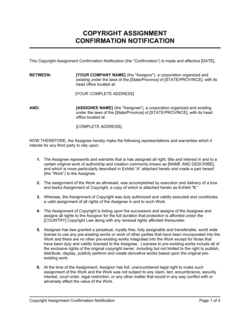
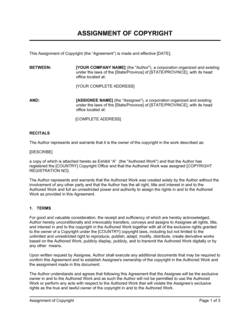
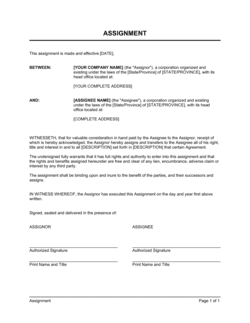
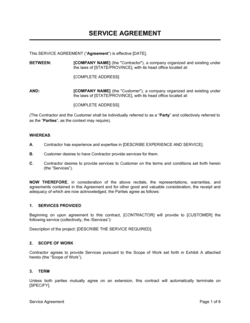
Copyright Assignment Template

Free Word download β€’ Edit online β€’ Save & share with Drive β€’ Export to PDF

4 pagesβ€’25–30 min to fillβ€’Difficulty: Standardβ€’Signature requiredβ€’Legal review recommended
Learn more ↓
FreeCopyright Assignment Template

At a glance

What it is
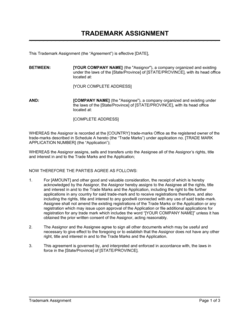
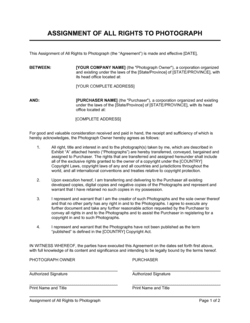
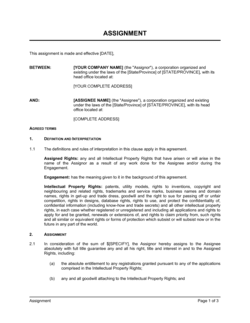
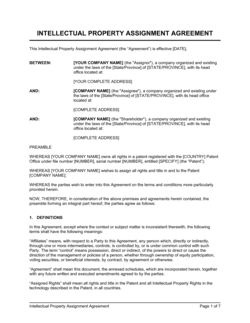
A Copyright Assignment is a legally binding agreement in which the current owner of a copyrighted work β€” the assignor β€” permanently transfers all ownership rights in that work to another party β€” the assignee. This free Word download covers the full scope of rights transferred, the consideration paid, representations and warranties, and moral rights waivers, and can be edited online and exported as a PDF-ready document in minutes.
When you need it
Use it whenever a business purchases creative work outright from a freelancer, contractor, or employee β€” including software code, written content, artwork, music, photographs, or marketing materials β€” and needs documented, enforceable proof that all copyright has moved to the buyer permanently.
What's inside
Identification of the parties and the assigned work, a full scope-of-rights transfer clause, consideration and payment terms, representations and warranties from the assignor, a moral rights waiver, a further-assurances obligation, and governing law. The template is structured for both simple one-work assignments and broader portfolio transfers.

What is a Copyright Assignment?

A Copyright Assignment is a legally binding agreement in which the current owner of a copyrighted work β€” the assignor β€” permanently transfers all ownership rights in that work to another party β€” the assignee. Unlike a license, which merely permits use while leaving title with the creator, an assignment extinguishes the assignor's interest entirely: once signed, the assignee becomes the copyright owner with full authority to reproduce, modify, distribute, and commercialize the work in any medium, territory, and format. Copyright assignments are used for written content, software code, graphic design, photography, music, video, and any other original work of authorship fixed in a tangible medium.

Why You Need This Document

Without a signed copyright assignment, your company does not own the creative work it paid to have made. Under copyright law in the US, Canada, the UK, and the EU, copyright vests automatically in the creator at the moment of fixation β€” not in the business that commissioned or paid for the work. A purchase order, a bank transfer, or an informal email agreement does not transfer that ownership. The consequences are concrete: investors and acquirers conducting due diligence will flag missing assignments as title defects that must be cured before closing; a departing freelancer or contractor retains the legal right to resell, publish, or license the same work to your competitors; and without registration and recordation, you have no standing to pursue statutory damages in an infringement action. A properly executed copyright assignment, signed before or at delivery and recorded with the relevant copyright office, closes all of these gaps and converts the work into a company asset you actually own.

Which variant fits your situation?

If your situation is…Use this template
Work was created by an employee during the course of employmentWork for Hire Agreement
Transferring rights to software code specificallySoftware Assignment Agreement
Licensing rights to use a work without transferring ownershipCopyright License Agreement
Transferring a broad portfolio of IP including patents and trademarksIntellectual Property Assignment Agreement
Assigning copyright as part of a business sale or acquisitionAsset Purchase Agreement
Granting a publisher limited rights while retaining ownershipPublishing Agreement
Freelancer assignment bundled with service delivery termsFreelance Services Agreement with IP Assignment

Common mistakes to avoid

❌ Vague description of the assigned work

Why it matters: Courts apply the principle that ambiguous copyright transfers are construed narrowly β€” a vague description may leave significant rights with the assignor, undermining the purpose of the agreement.

Fix: Attach a Schedule A listing every file, version, and component by name and format. If the work has a copyright registration number, include it in both the body and the schedule.

❌ Omitting a worldwide scope in the rights clause

Why it matters: A territorial restriction β€” even an accidental one β€” leaves the assignor free to license or sell the same work in every country not named. This is especially damaging for digital content distributed internationally.

Fix: Draft the assignment clause to cover 'throughout the universe, in perpetuity, in all media now known or hereafter developed' and avoid naming specific countries or platforms.

❌ No moral rights waiver

Why it matters: Without a waiver, the original creator can object to how the assignee modifies, credits, or commercializes the work β€” particularly in Canada, the UK, and EU jurisdictions where moral rights are statutory.

Fix: Include an explicit moral rights waiver covering both the right of attribution and the right of integrity, qualified by 'to the fullest extent permitted by applicable law.'

❌ Signing after the work has already been put into commercial use

Why it matters: Using a copyrighted work before the assignment is executed means the assignee was infringing during that period β€” exposure to damages claims even if the assignor never intended to pursue them.

Fix: Execute the assignment before or at the point of delivery. If commercial use has already started, include a retroactive effective date and obtain a release covering the prior use period.

❌ Relying on 'work for hire' language without meeting the legal criteria

Why it matters: Under US law, a commissioned work is only work for hire if it falls within one of nine enumerated categories and a written agreement says so. Incorrectly labeling an assignment as work for hire does not make it one β€” the creator may retain copyright.

Fix: Use a copyright assignment clause that operates independently of work-for-hire status. Include both: 'If the Work qualifies as a work made for hire, it is one; if not, Assignor hereby assigns all rights to Assignee.'

❌ No further-assurances clause

Why it matters: Without it, the assignee has no contractual basis to compel the assignor to sign Copyright Office recordation forms, DMCA takedown declarations, or chain-of-title documents required by a future acquirer or licensor.

Fix: Include a further-assurances clause obligating the assignor to execute any documents reasonably requested to perfect or record the transfer within a specified number of days of request.

The 10 key clauses, explained

Parties and recitals

In plain language: Identifies the assignor and assignee by full legal name, describes the context of the assignment, and sets out the purpose of the agreement.

Sample language
This Copyright Assignment Agreement is entered into as of [DATE] by and between [ASSIGNOR FULL LEGAL NAME] ('Assignor') and [ASSIGNEE FULL LEGAL NAME] ('Assignee'). Assignor has created or owns the work described herein and desires to assign all copyright to Assignee on the terms below.

Common mistake: Using trade names or first names only instead of full legal entity names β€” creating ambiguity about who holds title when the assignment is later recorded or enforced.

Description of the assigned work

In plain language: Precisely identifies the copyrighted work or works being transferred β€” title, format, creation date, and any registration numbers.

Sample language
The 'Work' means: [TITLE OF WORK], a [TYPE β€” written article / software application / musical composition / photograph], created by Assignor on or around [DATE], including all component files, source materials, and derivative versions.

Common mistake: Using vague descriptions like 'all creative materials produced.' Lack of specificity allows a court to construe the assignment narrowly, leaving some rights with the assignor.

Assignment of rights

In plain language: The operative clause that transfers the full bundle of exclusive copyright rights β€” reproduction, distribution, display, derivative works, and digital transmission β€” from assignor to assignee permanently and globally.

Sample language
Assignor hereby irrevocably assigns to Assignee all right, title, and interest in and to the Work, including all copyrights and renewals thereof, throughout the universe, in perpetuity, in all media now known or hereafter developed, including the exclusive right to reproduce, distribute, display, perform, and create derivative works.

Common mistake: Assigning 'all rights in [COUNTRY]' without including worldwide scope β€” leaving the assignor free to exploit the same work in other territories.

Consideration

In plain language: States what the assignee pays the assignor in exchange for the transfer. Even a nominal amount like $1 is sufficient if the parties intend it as the sole consideration.

Sample language
In consideration of [USD $AMOUNT], receipt of which Assignor hereby acknowledges, and other good and valuable consideration, Assignor agrees to the terms of this Agreement.

Common mistake: Omitting consideration entirely β€” resulting in a gratuitous transfer that may be challenged as an unenforceable gift in jurisdictions requiring bargained-for exchange.

Representations and warranties

In plain language: The assignor confirms they are the sole owner of the work, that no other party has rights in it, that it does not infringe any third-party copyright, and that they have full authority to make this transfer.

Sample language
Assignor represents and warrants that: (a) Assignor is the sole legal and beneficial owner of all rights in the Work; (b) the Work is original and does not infringe any third-party intellectual property rights; (c) no liens, encumbrances, or licenses affecting the Work are outstanding; and (d) Assignor has full power and authority to enter into this Agreement.

Common mistake: Omitting the 'no prior licenses' warranty. If the assignor has already licensed the work to a third party, the assignee may receive encumbered title β€” invalidating the business purpose of the acquisition.

Moral rights waiver

In plain language: The assignor waives any moral rights β€” including the right of attribution and integrity β€” to the extent permitted by applicable law, allowing the assignee to modify or republish the work without crediting the original creator.

Sample language
To the fullest extent permitted by applicable law, Assignor hereby irrevocably waives all moral rights in and to the Work, including any right to be identified as its author and any right to object to modifications, adaptations, or uses of the Work.

Common mistake: Omitting the moral rights waiver entirely, then discovering the assignor can object to the assignee's rebranding or modification of the work β€” a common issue in jurisdictions where moral rights cannot be fully waived.

Indemnification

In plain language: Requires the assignor to compensate the assignee for any losses, claims, or legal costs arising from a breach of the assignor's representations and warranties β€” primarily, a third party claiming rights in the work.

Sample language
Assignor shall defend, indemnify, and hold harmless Assignee from and against any claims, damages, liabilities, costs, and expenses (including reasonable attorneys' fees) arising from or related to any breach of Assignor's representations and warranties in this Agreement.

Common mistake: Capping indemnification at the purchase price when the work's commercial value to the assignee far exceeds that amount β€” leaving the assignee underprotected in a significant infringement claim.

Further assurances

In plain language: Obligates the assignor to sign copyright registration forms, recordation documents, or any other papers the assignee reasonably needs to perfect or record the assignment in any jurisdiction.

Sample language
Assignor agrees to execute and deliver all documents, instruments, and agreements and to take all actions as Assignee may reasonably request to record, perfect, enforce, or otherwise confirm the assignment of rights under this Agreement.

Common mistake: Skipping this clause and then being unable to register the copyright or record the transfer with the US Copyright Office because the assignor is no longer reachable or cooperative.

Governing law and dispute resolution

In plain language: Specifies which jurisdiction's law governs the agreement and how disputes will be resolved β€” arbitration, mediation, or courts in a named venue.

Sample language
This Agreement shall be governed by and construed in accordance with the laws of [STATE / PROVINCE / COUNTRY], without regard to conflict-of-law principles. Any dispute shall be resolved by [binding arbitration in [CITY] / the courts of [JURISDICTION]].

Common mistake: Choosing a governing law that differs from where the assignor resides or created the work, inadvertently triggering mandatory local copyright law provisions that override the contract's terms.

Entire agreement and severability

In plain language: Confirms the written agreement supersedes all prior discussions and that if any clause is found unenforceable, the remainder of the agreement stays valid.

Sample language
This Agreement constitutes the entire agreement between the parties with respect to its subject matter and supersedes all prior representations, negotiations, and understandings. If any provision is found unenforceable, it shall be severed, and the remaining provisions shall remain in full force.

Common mistake: No entire-agreement clause β€” leaving prior email negotiations, drafts, and verbal promises open to introduction as binding terms in a dispute over what was actually assigned.

How to fill it out

  1. 1

    Enter full legal names for both parties

    Use the registered legal entity name for any company β€” LLC, Inc., Ltd. β€” and the full legal name for any individual. Include the state or country of organization for business entities.

    πŸ’‘ Cross-reference the assignor's name against any prior contracts or invoices to ensure it matches exactly β€” mismatched names complicate copyright recordation filings.

  2. 2

    Describe the assigned work with specificity

    Name the work, identify its type (software, article, photograph, logo, musical composition), provide the creation date, and attach or reference any files, registration numbers, or draft versions as an exhibit.

    πŸ’‘ Attach a Schedule A listing all files by filename and format β€” especially for software projects with multiple components. Courts interpret ambiguous descriptions against the assignee.

  3. 3

    State the scope of rights as worldwide and perpetual

    Ensure the assignment clause covers all exclusive rights under copyright law β€” reproduction, distribution, public display, performance, and derivative works β€” across all territories and all media formats, including those not yet invented.

    πŸ’‘ Avoid limiting the assignment to named countries or named formats. Any gap in geographic or media scope is a right the assignor retains.

  4. 4

    Fill in the consideration amount

    Enter the agreed purchase price or state that the assignment is made in consideration of services already rendered. If the assignment is included in a broader services contract, reference that contract by name and date.

    πŸ’‘ Even if the real payment was made under a separate services agreement, include a nominal recital of consideration ($1 or 'services rendered') in this agreement to support enforceability as a standalone contract.

  5. 5

    Review and confirm the representations and warranties

    Ensure the assignor can truthfully make every warranty β€” sole ownership, no prior licenses, no infringement. If third-party stock assets or open-source components are embedded in the work, note them as exceptions.

    πŸ’‘ Ask the assignor directly whether any part of the work incorporates licensed third-party material before execution. Undisclosed licenses survive the assignment and bind the assignee.

  6. 6

    Include the moral rights waiver

    Confirm the waiver clause is present and covers both the right of attribution and the right of integrity. In Canada and the EU, moral rights are statutory and cannot always be assigned β€” only waived.

    πŸ’‘ In France and Germany, moral rights are perpetual and inalienable. The waiver clause still belongs in the contract, but local law limits its practical effect β€” flag this if the assignor is based in either country.

  7. 7

    Set the governing law and dispute resolution mechanism

    Choose the jurisdiction closest to the assignee's principal place of business for practical enforceability. Specify arbitration for cross-border assignments to avoid parallel court proceedings in multiple countries.

    πŸ’‘ For assignments involving EU-based assignors, name a specific member state β€” 'European Union' is not a jurisdiction for contract law purposes.

  8. 8

    Execute before delivery and record the assignment

    Both parties must sign before or at the moment the assignee takes delivery of the work files. After execution, file the assignment with the relevant copyright office β€” the US Copyright Office charges $105 for recordation and creates a public chain of title.

    πŸ’‘ Recording the assignment with the US Copyright Office within one month of execution protects the assignee against a subsequent conflicting transfer by the same assignor.

Frequently asked questions

How this compares to alternatives

vs Copyright License Agreement

A copyright license grants permission to use a work in defined ways while the creator retains ownership. A copyright assignment permanently transfers ownership β€” the assignor retains nothing. Businesses that need to prevent competitors from using the work, include it as a company asset on a balance sheet, or present clean title in due diligence require an assignment, not a license.

vs Intellectual Property Assignment Agreement

An IP assignment agreement covers a broader bundle of rights β€” patents, trademarks, trade secrets, and copyright together. A copyright assignment addresses only copyright. Use the broader IP assignment when acquiring a complete creative or technology portfolio; use the copyright assignment when the transfer is limited to one or more specific authored works.

vs Independent Contractor Agreement

An independent contractor agreement governs the services relationship β€” scope, payment, and timeline. Copyright in work produced under that agreement does not automatically transfer to the hiring party; a separate IP assignment clause or standalone copyright assignment is required. Many contractors combine both in one document, but a standalone assignment provides cleaner evidence of transfer.

vs Work for Hire Agreement

A work-for-hire agreement relies on a US statutory doctrine to vest copyright in the commissioning party from creation. A copyright assignment transfers rights contractually, regardless of whether work-for-hire criteria are met. Practitioners typically include both mechanisms in a single clause β€” 'if this qualifies as work for hire, it is; if not, rights are hereby assigned' β€” to eliminate any gap between the two theories.

Industry-specific considerations

Technology / Software

Assigning source code, algorithms, and UI designs from freelance developers to the company is standard practice at incorporation and during each development sprint β€” gaps create title defects that block M&A due diligence.

Marketing and Creative Agencies

Agencies acquire full rights to campaign assets, photography, video, and copy from subcontractors before delivering to clients β€” client contracts typically require the agency to warrant clean title.

Publishing and Media

Publishers require written assignments from authors and contributors to sublicense works across territories and formats; without one, the right to publish an e-book or audiobook edition is legally unclear.

Entertainment and Music

Music publishers, film studios, and game developers routinely acquire rights from composers, writers, and artists via assignment agreements, including specific provisions covering synchronization, streaming, and derivative work rights.

Professional Services

Consulting and design firms assign deliverable copyrights to clients as part of engagement close-out β€” without it, the firm retains copyright in the strategy documents, financial models, or brand guidelines it produced.

E-commerce and Retail

Product photography, packaging design, and website copy need clear copyright ownership for platform compliance, brand protection, and trademark coexistence filings.

Jurisdictional notes

United States

Under 17 U.S.C. Β§ 204, any transfer of copyright ownership must be in a written and signed instrument to be valid. Copyright registration is not required for an assignment to be effective, but recording the assignment with the US Copyright Office protects the assignee against subsequent conflicting transfers. Moral rights under the Visual Artists Rights Act apply only to works of visual art and can be waived in writing. Work-for-hire doctrine applies to employees and nine categories of commissioned works.

Canada

Under the Canadian Copyright Act, assignments must be in writing signed by the copyright owner to be enforceable. Moral rights vest in the author and cannot be assigned β€” only waived β€” and an explicit written waiver is required to give the assignee freedom to modify the work. Quebec civil law adds requirements around contracts of adhesion that may affect how assignment clauses are interpreted for consumer-facing transactions.

United Kingdom

The Copyright, Designs and Patents Act 1988 requires assignments to be in writing signed by or on behalf of the assignor. Moral rights β€” including the right to be identified as author and the right to object to derogatory treatment β€” are statutory and must be waived in writing; they cannot be assigned. Future copyright can be assigned by agreement in equity before the work is created. The UK Intellectual Property Office provides a voluntary assignment recordation service.

European Union

Copyright law is not fully harmonized across EU member states; assignments must comply with the domestic law of the country where the assignor is based. France and Germany treat moral rights as perpetual and inalienable β€” a waiver clause has limited practical force there. The EU Directive on Copyright in the Digital Single Market (2019/790) introduced new obligations for platforms and content-sharing services that may affect how assigned rights are exercised commercially. Specify a member state, not 'the EU,' as the governing jurisdiction.

Template vs lawyer β€” what fits your deal?

PathBest forCostTime
Use the templateSingle-work assignments between domestic parties where the work's value is under $10,000Free15–30 minutes
Template + legal reviewCross-border assignments, works with significant commercial value, or assignments bundled with an M&A transaction$200–$500 for a one-hour attorney review1–3 days
Custom draftedPortfolio acquisitions, entertainment industry rights deals, or assignments involving third-party licensed components requiring clearance$800–$3,000+1–2 weeks

Glossary

Assignor
The party who currently owns the copyright and is transferring it to another party under the agreement.
Assignee
The party receiving ownership of the copyright as a result of the assignment.
Consideration
The payment or other value exchanged in return for the copyright transfer β€” required for the assignment to be legally enforceable as a contract.
Moral Rights
Rights recognized in many jurisdictions that allow creators to claim authorship and object to distortion or misuse of their work, independent of economic ownership.
Work for Hire
A legal doctrine under which copyright vests in the employer or commissioning party from creation, without needing a separate assignment β€” applicable in defined circumstances under US law.
Scope of Rights
The specific bundle of exclusive rights being transferred, including reproduction, distribution, derivative works, public display, and digital transmission.
Further Assurances
A clause obligating the assignor to sign any additional documents required to perfect or record the copyright transfer with registration authorities.
Representations and Warranties
Contractual promises by the assignor confirming they own the copyright, have the right to transfer it, and that the work does not infringe third-party rights.
Copyright Registration
The formal filing of a copyright with a national registry β€” such as the US Copyright Office β€” which creates a public record of ownership and enables statutory damages in infringement suits.
Derivative Work
A creative work based on or incorporating an existing copyrighted work β€” such as a translation, adaptation, or modified version β€” which requires rights from the original copyright holder.
Indemnification
A contractual obligation requiring one party to compensate the other for losses arising from a breach β€” here, typically from the assignor's warranties about clear title.

Part of your Business Operating System

This document is one of 3,000+ business & legal templates included in Business in a Box.

  • Fill-in-the-blanks β€” ready in minutes
  • 100% customizable Word document
  • Compatible with all office suites
  • Export to PDF and share electronically

Create your document in 3 simple steps.

From template to signed document β€” all inside one Business Operating System.
1
Download or open template

Access over 3,000+ business and legal templates for any business task, project or initiative.

2
Edit and fill in the blanks with AI

Customize your ready-made business document template and save it in the cloud.

3
Save, Share, Send, Sign

Share your files and folders with your team. Create a space of seamless collaboration.

Save time, save money, and create top-quality documents.

β˜…β˜…β˜…β˜…β˜…

"Fantastic value! I'm not sure how I'd do without it. It's worth its weight in gold and paid back for itself many times."

Managing Director Β· Mall Farm
Robert Whalley
Managing Director, Mall Farm Proprietary Limited
β˜…β˜…β˜…β˜…β˜…

"I have been using Business in a Box for years. It has been the most useful source of templates I have encountered. I recommend it to anyone."

Business Owner Β· 4+ years
Dr Michael John Freestone
Business Owner
β˜…β˜…β˜…β˜…β˜…

"It has been a life saver so many times I have lost count. Business in a Box has saved me so much time and as you know, time is money."

Owner Β· Upstate Web
David G. Moore Jr.
Owner, Upstate Web

Run your business with a system β€” not scattered tools

Stop downloading documents. Start operating with clarity. Business in a Box gives you the Business Operating System used by over 250,000 companies worldwide to structure, run, and grow their business.

Start freeΒ Β·Β No credit card required