Certificate Of Recognition Template

Free Word download • Edit online • Save & share with Drive • Export to PDF

1 page20–30 min to fillDifficulty: StandardSignature requiredLegal review recommended
Learn more ↓
FreeCertificate Of Recognition Template

At a glance

What it is
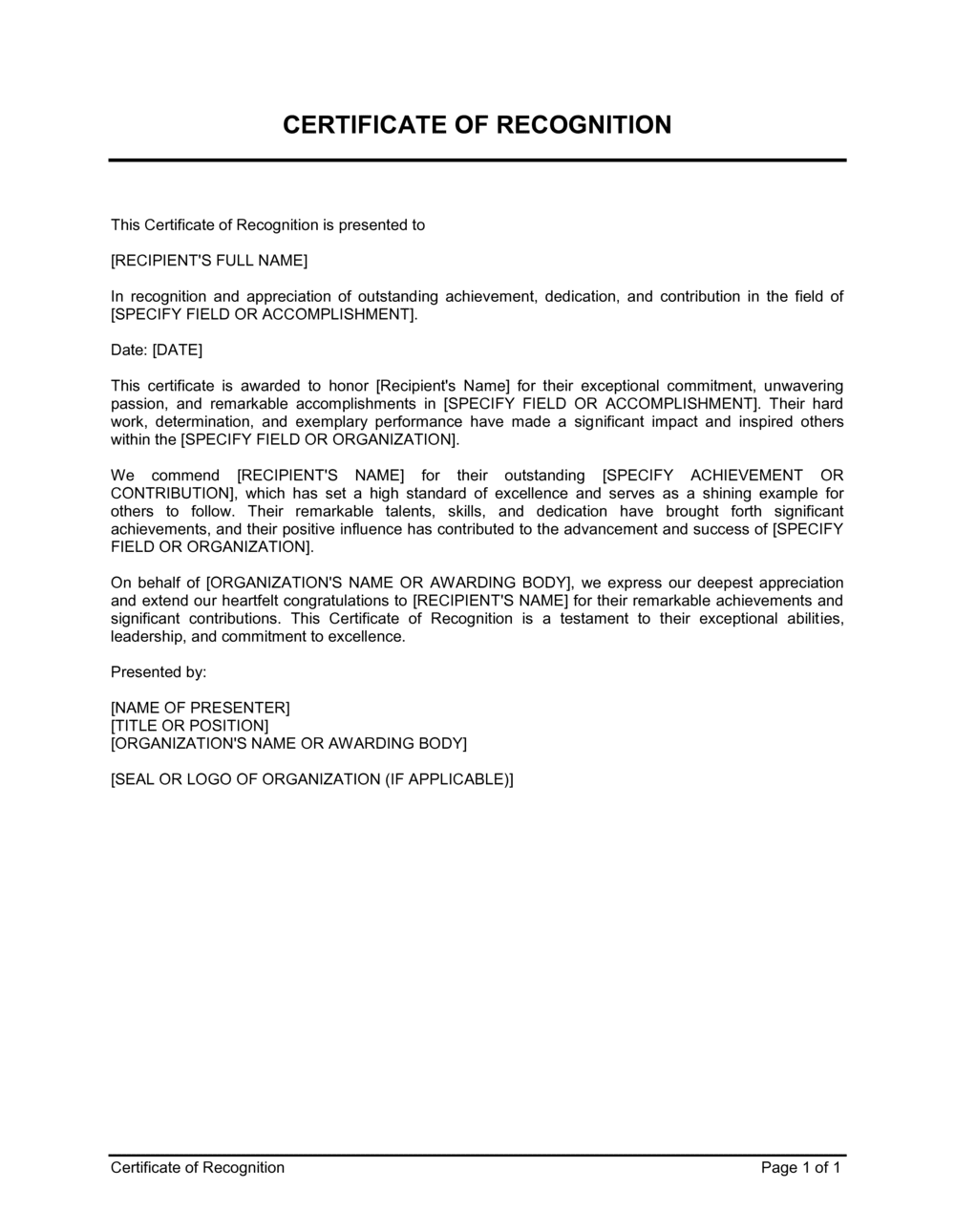
A Certificate of Recognition is a formal document issued by an organization to officially acknowledge an individual's, team's, or entity's achievement, service, or contribution. This template is a free Word download you can edit online — insert recipient details, describe the accomplishment, add authorizing signatures, and export as a print-ready PDF in minutes.
When you need it
Use it when formally acknowledging employee performance milestones, volunteer contributions, academic achievements, partnership excellence, or community service — any situation where a written, signed record of recognition carries organizational or legal weight.
What's inside
Issuing organization details, recipient identification, specific description of the achievement or service being recognized, effective date, governing authority clause, and authorized signatory blocks including titles and dates.

What is a Certificate of Recognition?

A Certificate of Recognition is a formal document issued by an organization to officially acknowledge an individual's, team's, or entity's specific achievement, contribution, or period of service. Unlike a casual letter of thanks, a properly drafted Certificate of Recognition identifies the issuing organization by its full legal name, names the recipient with precision, describes the recognized accomplishment in concrete terms, and is executed by an authorized signatory — creating a written record that can be relied upon in HR files, professional credentialing submissions, immigration applications, and, where a monetary benefit is attached, tax compliance documentation. This template is a free Word download you can customize, sign digitally, and export as a print-ready PDF in under twenty minutes.

Why You Need This Document

Without a formally executed Certificate of Recognition, organizations expose themselves to three avoidable problems. First, a vague or unsigned acknowledgment has no evidentiary value when an employee later references it in a credentialing, immigration, or legal proceeding — courts and licensing boards require specificity and proper execution. Second, when recognition accompanies a monetary award or benefit, an undocumented payment creates payroll tax exposure: the IRS, CRA, HMRC, and EU member state tax authorities all require that benefit-linked recognition be recorded and reported correctly. Third, inconsistent recognition practices — certificates issued for some employees but not others, or using different authority levels — create discrimination and equity risks under employment law in every major jurisdiction. A standardized, properly authorized Certificate of Recognition closes all three gaps at the cost of a single template and twenty minutes of your time.

Which variant fits your situation?

If your situation is…Use this template
Recognizing a specific employee performance achievementEmployee Recognition Certificate
Acknowledging years of continuous service to the organizationCertificate of Service
Certifying successful completion of a training programCertificate of Completion
Formally acknowledging a business partner or vendor contributionCertificate of Appreciation
Recognizing academic or professional achievement at a ceremonyAward Certificate
Certifying a volunteer's contribution to a nonprofit programVolunteer Recognition Certificate
Documenting excellence within a professional association or boardCertificate of Merit

Common mistakes to avoid

❌ Using a trade name instead of the registered legal entity name

Why it matters: A certificate issued under a brand name rather than the legal entity name may be unrecognizable in official HR, regulatory, or audit records — and can be challenged as lacking organizational standing.

Fix: Always verify the issuing entity's exact registered legal name before drafting. Include the trade name in parentheses only if the registered name differs materially from the recognizable brand.
❌ Vague achievement descriptions with no specifics

Why it matters: A recital that says only 'outstanding contributions' or 'excellent service' provides no evidentiary value if the recognition is later referenced in a performance review, legal proceeding, or benefits claim.

Fix: Include at least one measurable or date-specific detail — project name, period of service, percentage improvement, or specific deliverable — that distinguishes this recognition from a generic honorific.

❌ Omitting associated benefit tax language

Why it matters: Monetary awards, gift cards, and certain non-cash benefits attached to recognition certificates are taxable compensation in most jurisdictions. Omitting this language creates unplanned payroll tax liabilities.

Fix: Add a one-sentence clause noting that any associated benefit is subject to applicable tax withholding and referencing your organization's compensation policy.

❌ Issuing the certificate without an authorized signature

Why it matters: An unsigned or purely printed certificate has limited legal weight and may be rejected by external parties — such as immigration authorities, licensing boards, or benefits administrators — who require evidence of formal organizational endorsement.

Fix: Ensure at least one authorized signatory — confirmed by internal policy — signs the certificate before it is presented. Retain a countersigned copy in the recipient's HR file.

❌ Printing the document date as the effective date

Why it matters: When a certificate is printed weeks after a recognition event, using the print date creates discrepancies with related HR, payroll, or event records that document the actual recognition date.

Fix: Always enter the effective date of the recognition — the ceremony date, award decision date, or service period end date — rather than the date the document was created or printed.

❌ No governing law clause on the assumption the certificate is non-legal

Why it matters: If an associated monetary benefit is disputed, or the certificate is relied on in an immigration or licensing context, the absence of a governing law clause can create costly jurisdictional uncertainty.

Fix: Include a standard one-sentence governing law clause naming the organization's home jurisdiction. It takes ten seconds to add and eliminates a significant ambiguity.

The 9 key clauses, explained

Issuing organization identification

In plain language: States the full legal name, registered address, and organizational type of the entity granting the certificate.

Sample language
This Certificate of Recognition is issued by [ORGANIZATION LEGAL NAME], a [ENTITY TYPE] organized under the laws of [STATE / PROVINCE / COUNTRY], with its principal office at [ADDRESS] ('Organization').

Common mistake: Using a trade name or brand name instead of the full registered legal entity name — creating ambiguity about which organization is formally standing behind the recognition.

Recipient identification

In plain language: Identifies the individual, team, or entity receiving recognition by their full legal name and role or affiliation.

Sample language
This certificate is awarded to [RECIPIENT FULL NAME], [TITLE / ROLE], of [DEPARTMENT / ORGANIZATION / CITY, STATE] ('Recipient').

Common mistake: Using a nickname or informal name rather than the recipient's full legal name, which can cause the document to be rejected for official HR records or regulatory filings.

Recital of achievement or service

In plain language: Describes in specific, concrete terms the accomplishment, contribution, or service that is being formally recognized.

Sample language
In recognition of [RECIPIENT'S] outstanding [ACHIEVEMENT / SERVICE], specifically [DESCRIPTION OF CONTRIBUTION], demonstrated during the period of [START DATE] to [END DATE].

Common mistake: Writing a vague recital such as 'excellent performance' with no specifics — reducing the document's credibility and limiting its usefulness as a formal HR or compliance record.

Effective date and duration

In plain language: States the precise date the recognition is conferred and, where applicable, any period to which the recognition applies.

Sample language
This recognition is conferred as of [EFFECTIVE DATE] and pertains to the [ANNUAL / PROJECT / PROGRAM] period ending [DATE].

Common mistake: Omitting the effective date entirely and relying on a print date, which creates discrepancies when the certificate is issued weeks after the recognized event.

Organizational authority clause

In plain language: Confirms that the certificate is issued under the proper authority of the organization and that the signatories have the standing to grant it.

Sample language
This certificate is issued pursuant to the authority of the [BOARD OF DIRECTORS / EXECUTIVE COMMITTEE / HR DEPARTMENT] of [ORGANIZATION NAME] as recorded in its [MEETING MINUTES / POLICY DOCUMENT] dated [DATE].

Common mistake: Issuing a recognition certificate without referencing the authorizing policy or resolution — leaving the document open to challenge if disputed by the recipient or a third party.

Terms and conditions of recognition

In plain language: Sets out any conditions attached to the recognition — such as confidentiality, use restrictions, or the non-transferability of any associated benefit.

Sample language
This recognition is personal to the Recipient and is non-transferable. Any associated benefit — including [MONETARY AWARD / PRIZE / BENEFIT IN KIND] — is subject to applicable tax withholding requirements and the Organization's [POLICY NAME] dated [DATE].

Common mistake: Failing to include tax or benefit language when a monetary award accompanies the certificate, creating unexpected payroll tax obligations for the organization.

Governing law and jurisdiction

In plain language: Specifies which jurisdiction's law governs the certificate and where any dispute would be resolved.

Sample language
This Certificate of Recognition shall be governed by and construed in accordance with the laws of [STATE / PROVINCE / COUNTRY], without regard to its conflict-of-law principles.

Common mistake: Omitting a governing law clause entirely on the assumption that recognition certificates are non-legal documents — any associated monetary benefit or dispute over entitlement then defaults to unpredictable jurisdictional rules.

Authorized signatory block

In plain language: Provides signature lines for the authorized representative(s) of the issuing organization, including name, title, and date of signing.

Sample language
Issued and authorized by: [AUTHORIZED SIGNATORY FULL NAME] [TITLE] [ORGANIZATION NAME] Date: [DATE]

Common mistake: Including only a printed name without an original signature, which reduces the document's evidentiary value if the recognition is later disputed or relied upon in legal or HR proceedings.

Attestation and witness clause

In plain language: Provides an optional secondary signature confirming that the certificate was properly executed, commonly required in regulated industries or public-sector settings.

Sample language
Attested by: [WITNESS FULL NAME] [TITLE] Date: [DATE] I confirm that this Certificate of Recognition was duly authorized and executed in accordance with [ORGANIZATION NAME]'s recognition policies.

Common mistake: Skipping the attestation clause in regulated or government contexts where a single-signatory document may not satisfy internal audit or procurement requirements.

How to fill it out

  1. 1

    Enter the issuing organization's legal details

    Fill in the organization's full registered legal name, entity type, and principal address. Do not use a brand or trade name alone — the legal entity name must appear on the certificate.

    💡 Cross-reference your articles of incorporation or business registration to confirm the exact legal name before printing.

  2. 2

    Identify the recipient precisely

    Enter the recipient's full legal name and their title or role within the organization or program being recognized. For team awards, list the team name and lead contact.

    💡 Confirm the spelling of the recipient's name with HR or the individual directly — a misspelled name on a formal certificate creates an awkward correction process.

  3. 3

    Write a specific recital of the achievement

    Describe the accomplishment in concrete, factual terms — include dates, metrics, or project names where applicable. Avoid generic phrases like 'outstanding performance.'

    💡 Pull language from the nomination form or performance review to ensure the recital matches internal documentation and reduces the risk of inconsistency in HR records.

  4. 4

    Set the effective date

    Enter the precise date the recognition is formally conferred. If the recognized achievement occurred over a period, also include the start and end dates of that period.

    💡 Set the effective date to match the ceremony or award date — not the document creation date — to ensure the certificate aligns with any related payroll, benefit, or HR event records.

  5. 5

    Add any associated benefit terms

    If the recognition includes a monetary award, gift, or benefit in kind, state the amount or description and note any applicable tax treatment or conditions on use.

    💡 Consult your payroll team before issuing — cash awards and gift cards above de minimis thresholds are taxable in most jurisdictions and must appear on payroll records.

  6. 6

    Select and confirm the governing law

    Enter the jurisdiction whose law governs the certificate — typically the state, province, or country where the organization is registered or where the recipient is located.

    💡 For multinational organizations recognizing employees in multiple countries, issue jurisdiction-specific versions rather than a single document with a mismatched governing law clause.

  7. 7

    Obtain authorized signatures before issuance

    Have the appropriate authorized signatory — a senior officer, department head, or board designate — sign the certificate before it is presented to the recipient. Add an attestation signature if required by your internal policy.

    💡 Use Business in a Box eSign to capture and timestamp digital signatures, creating a permanent execution record even for ceremonial documents.

Frequently asked questions

What is a Certificate of Recognition?

A Certificate of Recognition is a formal document issued by an organization to officially acknowledge an individual's or entity's achievement, service, or contribution. It identifies the issuing organization, names the recipient, describes the accomplishment in specific terms, and is signed by an authorized representative. Beyond its ceremonial function, a properly drafted certificate creates a written record that can be referenced in HR files, regulatory submissions, or legal proceedings.

Is a Certificate of Recognition a legally binding document?

A Certificate of Recognition is generally not a contract in the traditional sense, but it can carry legal weight in specific contexts. When it references an associated monetary award, benefit, or entitlement, the certificate may be enforceable as evidence of a promised benefit. In immigration, licensing, and professional credentialing contexts, a formally executed recognition certificate is routinely relied upon as official proof of achievement or service. Consulting a lawyer is advisable when the certificate accompanies a material benefit.

Who should sign a Certificate of Recognition?

The certificate should be signed by the most senior officer with authority over the recognition program — typically a CEO, executive director, department head, or board chairperson, depending on the organization's internal policy. For regulatory or government contexts, a second attestation signature may be required. The signer's full name and title should always appear in print beneath the signature line.

Does a Certificate of Recognition need to be notarized?

Notarization is not typically required for standard employee or volunteer recognition certificates. However, if the certificate will be used in immigration applications, foreign credential recognition, or court proceedings, notarization or apostille authentication may be required by the receiving authority. Check the specific requirements of the institution or jurisdiction where the certificate will be submitted before finalizing.

What is the difference between a Certificate of Recognition and a Certificate of Achievement?

A Certificate of Recognition acknowledges a specific contribution, service, or value demonstrated by the recipient — it focuses on who the person is and what they gave. A Certificate of Achievement certifies that the recipient successfully completed a defined task, program, or set of performance criteria. Recognition is often discretionary and relational; achievement certification is typically criteria-based and verifiable.

Can a Certificate of Recognition include a monetary award?

Yes, and when it does, the certificate should explicitly reference the associated benefit, state any conditions on payment, and note that the award is subject to applicable tax withholding. In most jurisdictions, cash awards and gift cards above de minimis thresholds — $600 per year in the US, for example — are treated as taxable compensation and must be reported on the recipient's tax forms. Failing to document this in the certificate creates payroll compliance risk for the issuing organization.

How should I store issued Certificates of Recognition?

Retain a countersigned copy of every issued certificate in the recipient's personnel or program file, alongside any supporting documentation such as nomination forms, board resolutions, or award program policies. For digital certificates, store the signed PDF with a timestamp in your HRIS or document management system. Retention periods follow your jurisdiction's employment records requirements — typically 3–7 years in most jurisdictions after the employee's departure.

Can I issue a Certificate of Recognition to a business or organization rather than an individual?

Yes. Certificates of Recognition are regularly issued to companies, nonprofit organizations, community groups, or partner entities. When the recipient is an organization rather than an individual, name the organization's legal entity and identify the authorized representative accepting on their behalf. The accepting representative should counter-sign the certificate to confirm receipt on behalf of the entity.

What details make a Certificate of Recognition defensible in an HR or legal context?

Four elements make a certificate defensible: a specific, factual description of the achievement tied to dates or measurable outcomes; the issuing organization's full legal name rather than a trade name; an original signature from a named, titled authorized signatory; and a governing law clause if the certificate accompanies any benefit or entitlement. Certificates lacking these elements are routinely challenged in HR disputes, immigration filings, and professional licensing reviews.

How this compares to alternatives

vs Certificate of Appreciation

A Certificate of Appreciation is a broader, more informal acknowledgment of thanks — it does not require specific achievement criteria and is typically issued for general goodwill. A Certificate of Recognition formally documents a defined accomplishment or service period and carries more evidentiary weight in HR, regulatory, and legal contexts. Use appreciation for relationship-building; use recognition when a formal record matters.

vs Certificate of Completion

A Certificate of Completion certifies that the recipient finished a specific program, course, or training with defined requirements. A Certificate of Recognition acknowledges a broader contribution, achievement, or period of service that may not follow a structured curriculum. Completion certificates are criteria-based and verifiable; recognition certificates are discretionary and relationship-driven.

vs Certificate of Service

A Certificate of Service specifically documents a defined duration of continuous employment or volunteer service — typically measured in years. A Certificate of Recognition can acknowledge any type of contribution regardless of tenure, including a single project or event. Service certificates are milestone-based; recognition certificates are achievement-based.

vs Employee Award Letter

An Employee Award Letter is a written communication from management conveying recognition in letter format, typically addressed personally and filed in HR records. A Certificate of Recognition is a formal standalone document designed for display or official submission, with structured clauses, signatory blocks, and governing terms. Award letters are conversational and private; recognition certificates are formal and portable.

Industry-specific considerations

Corporate and Professional Services

Employee of the quarter awards, partner recognition programs, and long-service acknowledgments must align with HR policy and compensation documentation to avoid unintended benefit obligations.

Nonprofit and Government

Volunteer and donor recognition certificates often serve as official acknowledgment for tax deduction purposes and must accurately reflect the nature and value of the service contributed.

Education and Training

Recognition certificates for academic achievement, faculty service, or institutional partnership are frequently submitted to credentialing bodies and must meet precise naming and signatory standards.

Healthcare

Staff recognition in regulated healthcare settings requires documentation that aligns with accreditation standards; certificates referencing clinical achievements may be reviewed during licensing or privileging processes.

Manufacturing and Trades

Safety milestone recognition certificates and apprenticeship completion acknowledgments are often retained as part of compliance records and may be reviewed in the event of a workplace incident investigation.

Technology / SaaS

Innovation awards and hackathon recognition certificates in tech organizations should include IP assignment language if the recognized work involved protectable inventions or proprietary code.

Jurisdictional notes

United States

In the US, recognition certificates that accompany cash awards above $25 per recipient per year may trigger IRS reporting obligations under the de minimis fringe benefit rules. Certificates used in immigration petitions — such as O-1 or EB-1 applications — must be signed by an officer with clear organizational authority and should reference the specific achievement criteria. Some states, including California, have additional documentation requirements for recognition-linked bonus payments.

Canada

The Canada Revenue Agency treats most non-cash awards under $500 CAD as non-taxable if they are not cash or cash equivalents; recognition certificates accompanying gifts above this threshold must be documented as taxable employment benefits. Quebec employers issuing certificates must ensure any associated documentation is available in French for provincially regulated workplaces. Certificates referenced in immigration applications under IRCC programs require notarization or official organizational letterhead to be accepted.

United Kingdom

In the UK, recognition certificates accompanying long-service awards of up to £50 per year of service (minimum 20 years) may qualify for tax exemption under HMRC's long-service award rules. Certificates used in skilled worker visa applications or professional body submissions must be signed by a senior officer and may require company seal or Companies House confirmation of signatory authority. The Equality Act 2010 requires that recognition programs be applied consistently to avoid discrimination claims.

European Union

EU member states vary significantly on the tax treatment of recognition awards — France requires social contribution declarations on non-cash awards above €183 per employee per year, while Germany treats most employer recognition gifts below €60 as non-taxable. GDPR compliance requires that any personal data included on a recognition certificate — such as employment tenure or role-specific performance data — be processed in accordance with the organization's data retention and privacy policies. Certificates submitted for professional credentialing in the EU may require an apostille under the Hague Convention if issued outside the destination member state.

Template vs lawyer — what fits your deal?

PathBest forCostTime
Use the templateStandard employee, volunteer, or partner recognition without associated monetary awards or regulatory submission requirementsFree10–20 minutes
Template + legal reviewCertificates accompanying cash awards, benefits, or tax-reportable recognition; certificates for regulated industries such as healthcare or financial services$150–$400 for a brief HR or employment counsel review1–2 days
Custom draftedRecognition programs with contractual benefit obligations, immigration or credentialing submissions, or cross-border multi-entity recognition programs$500–$2,000+3–7 days

Glossary

Issuing Authority
The organization or individual with the standing to formally grant the certificate and bind themselves to the recognition it represents.
Recipient
The individual, team, or entity named in the certificate as the subject of the recognition.
Authorized Signatory
The person whose signature makes the certificate official — typically a senior officer, director, or board representative of the issuing organization.
Effective Date
The specific calendar date on which the recognition is formally conferred, which may differ from the date the certificate is printed or delivered.
Recital Clause
The introductory language in a formal document that explains the background facts and purpose — in a recognition certificate, this describes the achievement being acknowledged.
Governing Law
The jurisdiction whose laws govern the interpretation and any legal effect of the certificate.
Seal or Embossment
A formal organizational stamp or embossed imprint applied to the certificate to authenticate its official status.
Attestation
A formal declaration by a witness or second signatory confirming that the certificate was properly executed.
Consideration
In contract law, something of value exchanged between parties; in recognition certificates, the achievement or service provided by the recipient is the underlying consideration for the issuing organization's formal acknowledgment.
Preamble
Introductory text — often beginning with 'This certifies that' — that establishes the document's purpose before the operative clauses.

Part of your Business Operating System

This document is one of 3,000+ business & legal templates included in Business in a Box.

  • Fill-in-the-blanks — ready in minutes
  • 100% customizable Word document
  • Compatible with all office suites
  • Export to PDF and share electronically

Create your document in 3 simple steps.

From template to signed document — all inside one Business Operating System.
1
Download or open template

Access over 3,000+ business and legal templates for any business task, project or initiative.

2
Edit and fill in the blanks with AI

Customize your ready-made business document template and save it in the cloud.

3
Save, Share, Send, Sign

Share your files and folders with your team. Create a space of seamless collaboration.

Save time, save money, and create top-quality documents.

★★★★★

"Fantastic value! I'm not sure how I'd do without it. It's worth its weight in gold and paid back for itself many times."

Managing Director · Mall Farm
Robert Whalley
Managing Director, Mall Farm Proprietary Limited
★★★★★

"I have been using Business in a Box for years. It has been the most useful source of templates I have encountered. I recommend it to anyone."

Business Owner · 4+ years
Dr Michael John Freestone
Business Owner
★★★★★

"It has been a life saver so many times I have lost count. Business in a Box has saved me so much time and as you know, time is money."

Owner · Upstate Web
David G. Moore Jr.
Owner, Upstate Web

Run your business with a system — not scattered tools

Stop downloading documents. Start operating with clarity. Business in a Box gives you the Business Operating System used by over 250,000 companies worldwide to structure, run, and grow their business.

Start free · No credit card required