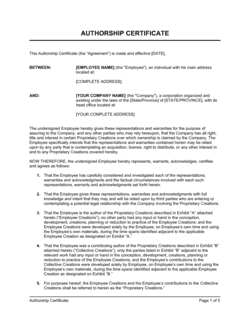
Employee Authorship Certificate Template

Free Word download • Edit online • Save & share with Drive • Export to PDF

5 pages25–30 min to fillDifficulty: ComplexSignature requiredLegal review recommended
Learn more ↓
FreeEmployee Authorship Certificate Template

At a glance

What it is
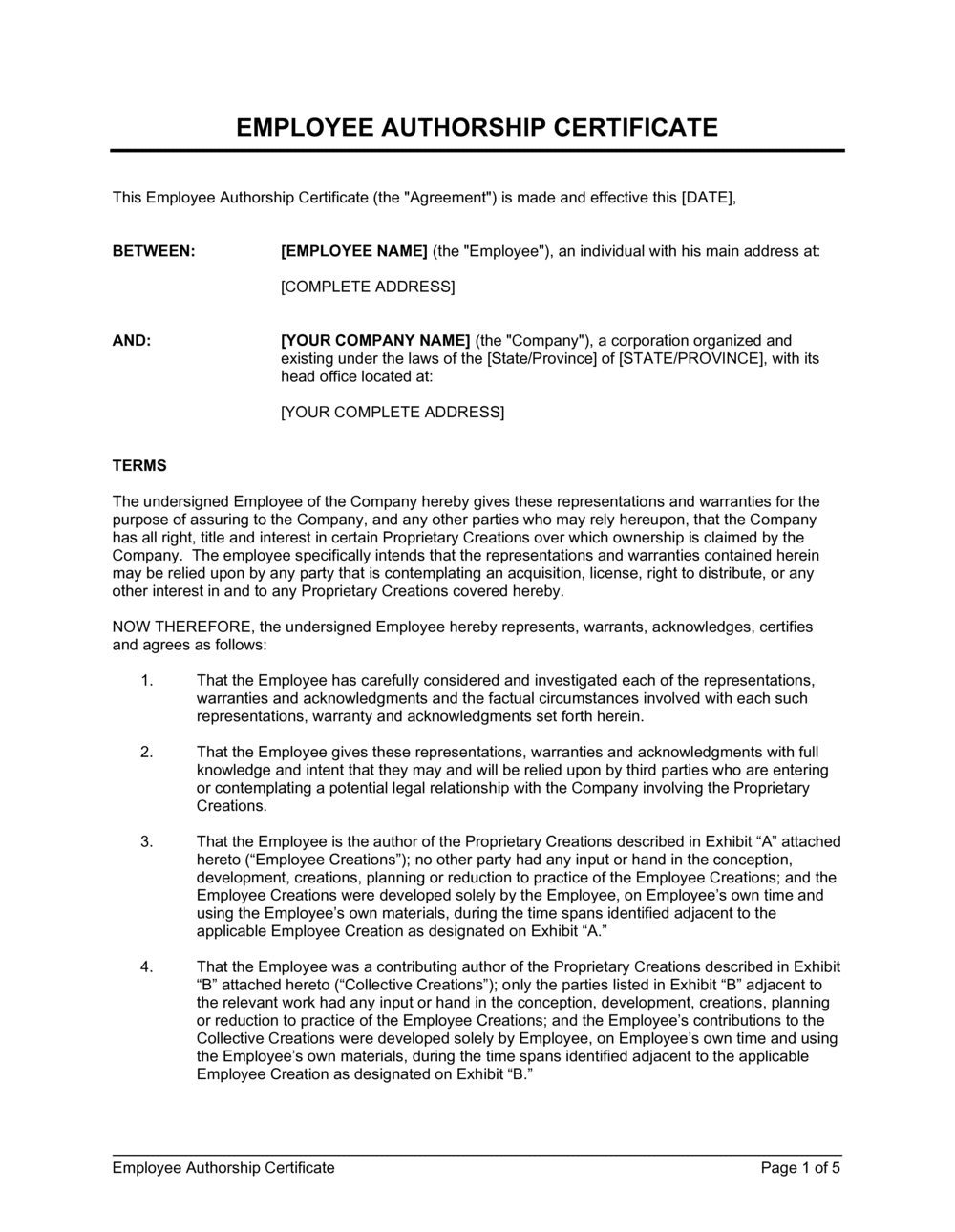
An Employee Authorship Certificate is a legally binding document in which an employee formally acknowledges and certifies that specific work product — code, written content, designs, or other creative output — was created within the scope of their employment and is owned by the employer. This free Word download lets you capture the key facts of authorship, the nature of the work, and the employee's assignment of any residual rights, all in a single signed record you can export as PDF and store in your HR or IP files.
When you need it
Use it whenever an employee delivers a significant work product — a software module, a proprietary report, a creative asset — and you need a documented, signed record that the employer owns the output. It is especially important when an employment contract lacks a specific IP assignment clause, when work was created under ambiguous circumstances, or before licensing, selling, or transferring the work to a third party.
What's inside
Parties and work identification, a statement of authorship and scope of employment, an IP assignment and work-made-for-hire declaration, a representation that no third-party rights are embedded, a moral rights waiver where applicable, and signatures from the employee and an authorized employer representative.

What is an Employee Authorship Certificate?

An Employee Authorship Certificate is a legally binding document in which an employee certifies that a specific piece of work product — software, written content, a design, a technical drawing, or any other creative output — was created within the scope of their employment, and formally assigns or confirms the employer's ownership of all intellectual property rights in that work. It combines a factual statement of authorship with a work-made-for-hire declaration, a fallback IP assignment, third-party representations, and a moral rights waiver into a single signed record. Unlike a general IP assignment clause buried in an employment agreement, an authorship certificate is tied to a particular deliverable identified by name, date, and description — giving the employer specific, auditable evidence of a clean chain of title for each significant work product.

Why You Need This Document

Without a signed authorship certificate, your employer's ownership of an employee's creative output rests entirely on the work-made-for-hire doctrine and any general IP clause in the employment contract — neither of which provides the deliverable-specific evidence that investors, acquirers, and licensees require during due diligence. A missing or ambiguous IP paper trail is one of the most common reasons technology acquisitions are delayed, repriced, or unwound: if ownership of a core software module cannot be cleanly traced back to a signed document, the buyer's legal team will flag it as an unacceptable risk. Beyond transactions, a departing employee who has not signed an authorship certificate for key work can threaten to assert residual copyright or moral rights claims — demanding attribution, objecting to modifications, or asserting partial co-ownership. Executing a certificate for each significant deliverable, at the moment of completion, closes these gaps for the cost of 20 minutes per document and a legal review where the work has material commercial value.

Which variant fits your situation?

If your situation is…Use this template
Capturing IP from a full-time salaried employee for a single deliverableEmployee Authorship Certificate
Assigning all IP rights from an independent contractor engagementIndependent Contractor IP Assignment Agreement
Broadly assigning all present and future IP created by an employeeEmployee IP Assignment Agreement
Protecting confidential information alongside IP ownershipNon-Disclosure Agreement (Employee)
Embedding IP assignment and authorship obligations into the hiring contractEmployment Contract with IP Assignment
Documenting IP ownership for a jointly authored work involving multiple employeesJoint Authorship and IP Assignment Agreement
Recording IP assignment for a software product prior to a sale or M&A transactionIP Assignment and Transfer Agreement

Common mistakes to avoid

❌ Relying on work-made-for-hire doctrine without a fallback assignment

Why it matters: Not every creative output qualifies as a work made for hire under every jurisdiction's statute. Without a fallback assignment clause, a court finding that the doctrine does not apply leaves the employer with no ownership rights.

Fix: Always include both a work-made-for-hire declaration and an irrevocable IP assignment clause covering all categories of IP. This dual approach ensures coverage regardless of how a court characterizes the work.

❌ Omitting the open-source and third-party representations

Why it matters: Copyleft open-source components embedded in employee-authored code can obligate the employer to release proprietary source code publicly, destroying trade secret protection and product value.

Fix: Include an explicit representation that the work is free of third-party copyleft materials, and conduct a license audit of any software deliverable before executing the certificate.

❌ Skipping the prior inventions schedule

Why it matters: Without a documented carve-out, an employee can later claim that pre-employment work was swept into the assignment, creating disputes that cloud IP title during due diligence.

Fix: Always attach Schedule A. If the employee has no prior inventions, require a signed blank schedule explicitly stating 'None' — this acknowledgment is more valuable than a blank page.

❌ Using a US moral rights waiver for employees in Canada or the EU

Why it matters: Moral rights in Canada and most EU member states cannot be assigned, only waived, and some jurisdictions treat broad waivers as unenforceable. Using a US-style clause may leave moral rights intact, allowing the employee to object to modifications or demand attribution.

Fix: Tailor the moral rights provision to the employee's work location. Use jurisdiction-specific waiver language for Canada and EU employees, and obtain legal review for any high-value work created in these regions.

❌ Executing the certificate after the work has already been licensed or transferred

Why it matters: An assignment executed after a third-party license or transfer has been granted may not reach back to cure the ownership gap — the assignee takes subject to prior encumbrances.

Fix: Make execution of an authorship certificate a mandatory step in your work-delivery workflow, completed before any external sharing, licensing, or incorporation into a product.

❌ Using a vague work description that could sweep in personal or prior-employer materials

Why it matters: A description like 'all software written by Employee during 2025' may inadvertently capture personal projects or code from a previous employer, creating third-party claims against your IP portfolio.

Fix: Describe the work by specific project name, deliverable type, date range, and version or file identifier. Attach a copy or reference the precise repository and commit range for software.

The 10 key clauses, explained

Parties and recitals

In plain language: Identifies the employer and the employee by their full legal names and establishes the employment relationship as the basis for the certificate.

Sample language
This Employee Authorship Certificate ('Certificate') is entered into as of [DATE] between [EMPLOYER LEGAL NAME], a [STATE/PROVINCE] [ENTITY TYPE] ('Company'), and [EMPLOYEE FULL NAME] ('Employee'), currently employed as [JOB TITLE].

Common mistake: Using a trade name or DBA for the employer instead of the registered legal entity name — this can create a gap in chain of title that surfaces during M&A due diligence.

Description of the work

In plain language: Precisely identifies the specific work product covered by the certificate — its name, nature, date of creation, and the project or context in which it was produced.

Sample language
Employee authored the following work product: [TITLE OR DESCRIPTION OF WORK], a [TYPE — e.g., software module / written report / graphic design], created between [START DATE] and [COMPLETION DATE] in connection with [PROJECT NAME / CLIENT ENGAGEMENT].

Common mistake: Describing the work so broadly that it inadvertently captures pre-existing materials or personal projects the employee created before or outside of employment.

Statement of authorship and scope of employment

In plain language: The employee certifies that the work was created by them, solely or jointly, within the scope of their employment duties and using employer resources, time, or direction.

Sample language
Employee certifies that the Work was created by Employee during the course of Employee's employment with Company, within the scope of Employee's duties as [JOB TITLE], and using Company resources and direction.

Common mistake: Omitting the resource and direction element. Courts in several jurisdictions weigh whether employer resources and control were involved when determining whether work-made-for-hire doctrine applies.

Work-made-for-hire declaration

In plain language: Confirms that the work is a 'work made for hire' under applicable copyright law, vesting initial ownership in the employer, to the maximum extent permitted.

Sample language
The Work is a 'work made for hire' as defined under [applicable copyright law], and all copyright in the Work vests exclusively in Company from the moment of creation. To the extent any Work does not qualify as a work made for hire, Employee hereby irrevocably assigns all rights to Company.

Common mistake: Relying solely on the work-made-for-hire declaration without including a fallback assignment clause. Not all works qualify as works made for hire under every jurisdiction's copyright statute.

IP assignment and transfer

In plain language: The employee irrevocably transfers to the employer all intellectual property rights in the work — including copyright, patents, trade secrets, and any moral rights that can be waived or assigned — to the fullest extent permitted by law.

Sample language
To the extent the Work or any element thereof is not a work made for hire, Employee hereby irrevocably assigns, transfers, and conveys to Company all right, title, and interest in and to the Work, including all copyright, patent rights, trade secret rights, and other intellectual property rights, throughout the world.

Common mistake: Limiting the assignment to copyright and forgetting patent rights. Code and technical designs may be patentable — an assignment clause that omits patent rights leaves a significant gap.

Representations regarding third-party rights

In plain language: The employee confirms that the work does not incorporate any third-party materials, open-source code, or prior employer IP that would encumber the employer's title, and that no other person has a claim to the work.

Sample language
Employee represents and warrants that: (a) the Work is original to Employee; (b) the Work does not incorporate any third-party copyrighted material, open-source software, or proprietary information of any prior employer; and (c) no other person or entity has any claim to or interest in the Work.

Common mistake: Omitting a specific representation about open-source components. Copyleft licenses embedded in employee-authored code can obligate the employer to release proprietary source code.

Prior inventions carve-out

In plain language: Expressly excludes from the assignment any pre-existing work or inventions the employee created before employment began, which should be listed in an attached schedule to avoid disputes.

Sample language
The assignment in this Certificate does not include any work, invention, or development listed in Schedule A ('Prior Inventions'), which Employee created prior to the commencement of employment with Company.

Common mistake: Skipping Schedule A entirely because the employee says they have no prior inventions. A blank schedule still serves as a documented acknowledgment that none exist, eliminating future 'I forgot to mention it' claims.

Moral rights waiver

In plain language: Where legally permitted, the employee waives any moral rights — including the right of attribution and the right to object to modification — so the employer may freely edit, license, or sublicense the work.

Sample language
To the fullest extent permitted by applicable law, Employee irrevocably waives all moral rights in the Work, including any right of attribution or right to object to any modification, combination, or use of the Work by Company or its successors and assigns.

Common mistake: Using a US-style waiver in Canada or the EU without adjusting language. Moral rights cannot be assigned (only waived) under Canadian copyright law, and some EU jurisdictions treat waivers of moral rights as unenforceable.

Further assurances

In plain language: Obligates the employee to sign any additional documents and take any further steps the employer reasonably needs to perfect, record, or enforce its IP rights in the work.

Sample language
Employee agrees to execute any additional documents, assignments, or instruments and take any further actions that Company may reasonably request to evidence, perfect, or enforce Company's rights in the Work, including patent applications and copyright registrations.

Common mistake: Omitting a power of attorney backstop. If the employee becomes unavailable or uncooperative, this clause alone may not be sufficient — a limited power of attorney provision enables the employer to execute filings without the employee's participation.

Governing law and entire agreement

In plain language: Specifies which jurisdiction's law governs the certificate and confirms that it supersedes any prior oral or written understandings about ownership of the specific work identified.

Sample language
This Certificate is governed by the laws of [STATE / PROVINCE / COUNTRY]. It constitutes the entire agreement between the parties with respect to ownership of the Work and supersedes all prior representations and understandings relating thereto.

Common mistake: Choosing a governing law that diverges from where the employee actually works. Several jurisdictions apply local employment and copyright law regardless of a contractual choice-of-law clause.

How to fill it out

  1. 1

    Identify the parties with precise legal names

    Enter the employer's full registered legal entity name — not a brand name — and the employee's legal name as it appears on their employment record. Include the employee's job title and department.

    💡 Cross-check the employer name against your corporate registry filing before signing. A mismatch creates a gap in chain of title that complicates future transactions.

  2. 2

    Describe the work product specifically

    Name the work, state its type (software module, report, design, etc.), and record the creation date range and the project or client engagement it relates to. Attach a copy of the work or a unique identifier such as a version number or file hash.

    💡 For software, include the repository name and commit range or release version — this makes the certificate searchable and linkable in your IP records.

  3. 3

    Confirm the scope-of-employment basis

    Review whether the work was performed during business hours, with employer resources, and under employer direction. If any element is ambiguous, note it in a brief recital and include the IP assignment fallback clause regardless.

    💡 If the employee used personal equipment or worked outside normal hours, the work-made-for-hire doctrine may not apply automatically — the assignment clause becomes even more critical.

  4. 4

    Complete the prior inventions schedule

    Ask the employee to list any pre-existing work or inventions they want excluded from the assignment. If there are none, have them sign a blank Schedule A explicitly stating 'None.'

    💡 A signed blank schedule is better than no schedule. It prevents a departing employee from later claiming a pre-existing codebase or design was not covered.

  5. 5

    Verify there are no embedded third-party materials

    Before signing, confirm with the employee that the work does not incorporate open-source code under a copyleft license, licensed stock assets, or proprietary materials from a previous employer.

    💡 Run an open-source license scan (e.g., FOSSA, Black Duck) on any software deliverable before executing the certificate — this surfaces GPL or AGPL components that could trigger public disclosure obligations.

  6. 6

    Tailor the moral rights waiver to jurisdiction

    For employees in the US, a standard waiver clause is sufficient. For Canada, use waiver language (not assignment) for moral rights. For EU employees, check whether the specific member state recognizes moral rights waivers before including the clause.

    💡 When in doubt, include both a waiver and an assignment of moral rights with a severability note — courts will apply whichever formulation is valid in the governing jurisdiction.

  7. 7

    Execute before the work is distributed or licensed

    Both the employee and an authorized employer representative must sign and date the certificate. Execute it as soon as the work is completed — before it is shared externally, licensed, or incorporated into a product.

    💡 Use a timestamped eSignature platform to create an immutable execution record. Store the fully executed PDF alongside the work product in your IP register.

  8. 8

    File the certificate in your IP register

    Add the executed certificate to your IP register with the work description, execution date, and a link to the work product. For high-value software or patentable inventions, consider recording the assignment with the relevant IP office.

    💡 Recording an IP assignment with the US Copyright Office or USPTO costs $85–$105 and provides constructive notice to third parties, which matters in M&A and licensing transactions.

Frequently asked questions

What is an employee authorship certificate?

An employee authorship certificate is a signed legal document in which an employee certifies that specific work product was created within the scope of their employment and formally assigns or confirms the employer's ownership of all intellectual property rights in that work. It documents the factual basis for the employer's title — authorship, scope of employment, and absence of third-party encumbrances — and serves as evidence of a clean chain of title for IP due diligence, licensing, or sale transactions.

Is an employee authorship certificate the same as a work-made-for-hire agreement?

They overlap but are not identical. A work-made-for-hire agreement or clause states that work created by an employee in the scope of employment belongs to the employer under applicable copyright law. An employee authorship certificate is a document-specific record that identifies a particular piece of work, confirms the authorship facts, and includes both a work-made-for-hire declaration and a fallback IP assignment — plus representations about third-party rights and a moral rights waiver. The certificate provides stronger, more specific evidence of ownership than a general employment clause alone.

Do I need an employee authorship certificate if my employment contracts already include an IP assignment clause?

A general IP assignment clause in an employment contract is a good baseline, but it operates prospectively and broadly. An employee authorship certificate documents a specific piece of work with particularity — date, description, authorship facts, and third-party representations. This specificity is what due diligence reviewers, patent offices, and copyright registries require when verifying chain of title. For high-value software, creative works, or patentable inventions, the certificate supplements the employment contract and provides the granular evidence a transaction demands.

When should an employee authorship certificate be executed?

Execute it as soon as the work is complete and before it is licensed, distributed, incorporated into a product, or transferred to any third party. Many companies build execution into their delivery or sprint-close workflow, requiring a signed certificate for every major release, report, or creative asset. Executing retroactively — after a licensing deal or M&A transaction has been announced — may not cure an existing ownership gap.

Can an employee refuse to sign an employee authorship certificate?

In most jurisdictions, work created within the scope of employment is owned by the employer as a matter of law, so the certificate is largely a documentation exercise. That said, an employee can refuse to sign. If no authorship certificate exists and the employment contract's IP clause is narrow or absent, the employer may need to pursue a court declaration of ownership — a costly and time-consuming process. To reduce this risk, make execution of authorship certificates a standard, non-negotiable step in the employment agreement and onboarding process.

What happens if the employee used open-source code or third-party materials?

Third-party materials embedded in an employee-authored work can encumber the employer's IP rights. Copyleft open-source licenses such as the GPL or AGPL require derivative works to be released under the same license — potentially forcing disclosure of proprietary source code. The certificate's third-party representations clause requires the employee to disclose any such components before signing. Employers should also run a software composition analysis tool on any code deliverable to independently verify compliance.

Are employee authorship certificates enforceable in all countries?

The core IP assignment provisions are generally enforceable in most commercial jurisdictions, but specific elements — particularly moral rights waivers — vary significantly. In the United States, moral rights are narrow and largely waivable. In Canada, moral rights exist but can only be waived, not assigned. In EU member states, enforceability of moral rights waivers depends on national law, and some countries treat them as void. Always tailor the certificate's moral rights language to the employee's jurisdiction and obtain local legal review for high-value creative works.

Should the certificate include a prior inventions carve-out?

Yes, always. Without a prior inventions carve-out and a signed Schedule A, an employee can argue that pre-employment work — personal projects, prior employer code, or side ventures — was swept into the assignment. A completed Schedule A, even if blank, creates a documented record that the parties agreed on the scope of exclusions at the time of signing. This prevents retroactive claims that cloud IP title and can derail acquisition or licensing transactions.

Does recording an employee authorship certificate with a government IP office provide additional protection?

Recording an IP assignment with the US Copyright Office or USPTO is optional but provides constructive notice to third parties — meaning any subsequent claimant is deemed to have known about the assignment even if they did not conduct a search. This is particularly valuable before a sale, licensing deal, or patent application. Recording costs $85–$105 per document at the USPTO and is generally recommended for software products, patentable inventions, or high-value creative works that will be commercialized.

How this compares to alternatives

vs IP Assignment Agreement

A standalone IP assignment agreement transfers all present and future intellectual property rights from one party to another in broad terms. An employee authorship certificate is document-specific — it identifies a particular piece of work, records the authorship facts, and includes both an assignment and a work-made-for-hire declaration. Use the certificate for individual deliverables where you need granular evidence of ownership; use a broad IP assignment agreement as a baseline clause in the employment contract.

vs Independent Contractor Agreement

An independent contractor agreement governs a self-employed individual's engagement and typically includes an IP assignment clause. Work made for hire doctrine does not automatically apply to contractors the way it does to employees, so the IP assignment provisions are even more critical. An employee authorship certificate is specific to the employer-employee relationship and relies partly on the work-made-for-hire doctrine — it is not appropriate for contractor engagements.

vs Non-Disclosure Agreement (Employee)

An NDA restricts an employee from disclosing confidential information belonging to the employer. It does not transfer IP ownership. An employee authorship certificate confirms and transfers ownership of specific work product. The two documents serve complementary purposes — the NDA protects against disclosure; the certificate secures ownership — and are often used together when an employee has created sensitive proprietary work.

vs Employment Contract with IP Assignment Clause

An employment contract with an IP assignment clause broadly assigns future work product to the employer at the outset of the relationship. An employee authorship certificate is a transaction-specific record executed when a particular work is completed. The employment contract creates the framework; the certificate provides the specific evidence. For high-value IP, both documents are needed — the contract as the foundation and the certificate as the proof for each significant deliverable.

Industry-specific considerations

Technology / SaaS

Used to document ownership of every software module, algorithm, and dataset produced by engineering staff, providing the clean IP chain required for venture funding, patent applications, and acquisition due diligence.

Creative and Marketing Agencies

Confirms employer ownership of client-facing designs, copy, campaigns, and brand assets created by staff, ensuring the agency can license deliverables to clients without residual employee claims.

Pharmaceutical and Biotech

Supports patent prosecution by documenting inventorship and assignment for each compound, formulation, or research method developed by in-house scientists, satisfying USPTO and EPO recordation requirements.

Financial Services

Covers proprietary trading algorithms, risk models, and analytical tools developed by quant and technology staff, providing the IP documentation required by regulators and acquirers in fintech transactions.

Publishing and Media

Captures authorship and copyright assignment for articles, scripts, photographs, and multimedia content produced by editorial staff, enabling the publisher to license, syndicate, or sell content without employee consent.

Manufacturing and Engineering

Documents ownership of technical drawings, process innovations, and product designs created by engineering employees, forming the evidential foundation for patent filings and trade secret protection.

Jurisdictional notes

United States

Under the US Copyright Act (17 U.S.C. § 101), works created by employees within the scope of employment are works made for hire owned by the employer from creation. However, certain categories of commissioned works require a written agreement to qualify. California Labor Code § 2870 limits IP assignment clauses — they cannot reach work created entirely on an employee's own time, without employer resources, and unrelated to the employer's business. Include a fallback assignment clause alongside the work-made-for-hire declaration to cover any works that fall outside the statutory definition.

Canada

The Canadian Copyright Act (s. 13(3)) provides that an employer owns the copyright in a work created by an employee in the course of employment unless there is a contrary agreement. Moral rights, however, cannot be assigned — only waived — under Canadian law (s. 14.1). Use explicit waiver language rather than assignment language for moral rights provisions. Quebec's civil law framework may impose additional formality requirements; consider notarized execution for significant IP assets in Quebec.

United Kingdom

Under the UK Copyright, Designs and Patents Act 1988 (s. 11(2)), works created by an employee in the course of employment are owned by the employer. Moral rights under the CDPA can be waived in writing. The certificate should specify that the waiver is irrevocable and covers all forms of the work. For employees who may also hold design rights or database rights in their output, ensure the assignment clause expressly covers these additional IP categories, which are treated separately under UK law.

European Union

EU copyright law does not harmonize work-made-for-hire rules — ownership of employee-created works is governed by national law, which varies significantly across member states. Germany, France, and the Netherlands each have distinct statutory provisions on employer ownership. Moral rights are strongly protected in most EU member states (particularly France under droit moral) and waivers may be unenforceable. For employees in EU jurisdictions, obtain country-specific legal review before executing the certificate, and consider a bilateral IP assignment clause rather than relying solely on a work-made-for-hire declaration.

Template vs lawyer — what fits your deal?

PathBest forCostTime
Use the templateStandard domestic employees creating routine deliverables where an employment contract already includes a general IP assignment clauseFree15–20 minutes per certificate
Template + legal reviewEmployees in Canada, the UK, or the EU; high-value software or patentable inventions; situations where the employment contract lacks an IP clause$300–$800 for a one-time legal review of the template and jurisdiction-specific tailoring1–3 days
Custom draftedPre-acquisition IP cleanup, patent prosecution support, multi-jurisdiction teams, or situations involving disputed authorship or embedded third-party materials$1,000–$4,000+1–2 weeks

Glossary

Work Made for Hire
A legal doctrine under which a work created by an employee within the scope of employment is automatically owned by the employer, not the individual author.
IP Assignment
A written transfer of intellectual property rights — copyright, patent rights, or trade secret rights — from one party (the assignor) to another (the assignee).
Authorship
Legal recognition of the person or entity that created an original work, which determines initial ownership of copyright unless otherwise assigned.
Scope of Employment
The range of duties and activities an employee is expected to perform as part of their job, which determines whether work-made-for-hire doctrine applies to a given creation.
Copyright
An exclusive legal right protecting original creative works — software, written content, designs, and more — from reproduction, distribution, or adaptation without the rights holder's permission.
Moral Rights
Rights of attribution and integrity held by an author in many jurisdictions, separate from economic copyright, that allow them to object to derogatory treatment of their work or demand credit.
Residual Rights
Any intellectual property rights not clearly transferred by an employment agreement that remain with the individual creator unless separately assigned.
Prior Inventions
Work, code, or inventions created by an employee before their employment began, which must be explicitly carved out to avoid inadvertent assignment to the employer.
Due Diligence
The process by which a buyer, investor, or licensee investigates IP ownership, validity, and encumbrances before completing a transaction.
Waiver
A voluntary, documented relinquishment of a known right — such as the right to attribution — which in IP contexts is often required for the employer to freely modify or sublicense work.
Chain of Title
The documented sequence of ownership transfers for a piece of intellectual property, establishing that the current rights holder has clean, unencumbered title.

Part of your Business Operating System

This document is one of 3,000+ business & legal templates included in Business in a Box.

  • Fill-in-the-blanks — ready in minutes
  • 100% customizable Word document
  • Compatible with all office suites
  • Export to PDF and share electronically

Create your document in 3 simple steps.

From template to signed document — all inside one Business Operating System.
1
Download or open template

Access over 3,000+ business and legal templates for any business task, project or initiative.

2
Edit and fill in the blanks with AI

Customize your ready-made business document template and save it in the cloud.

3
Save, Share, Send, Sign

Share your files and folders with your team. Create a space of seamless collaboration.

Save time, save money, and create top-quality documents.

★★★★★

"Fantastic value! I'm not sure how I'd do without it. It's worth its weight in gold and paid back for itself many times."

Managing Director · Mall Farm
Robert Whalley
Managing Director, Mall Farm Proprietary Limited
★★★★★

"I have been using Business in a Box for years. It has been the most useful source of templates I have encountered. I recommend it to anyone."

Business Owner · 4+ years
Dr Michael John Freestone
Business Owner
★★★★★

"It has been a life saver so many times I have lost count. Business in a Box has saved me so much time and as you know, time is money."

Owner · Upstate Web
David G. Moore Jr.
Owner, Upstate Web

Run your business with a system — not scattered tools

Stop downloading documents. Start operating with clarity. Business in a Box gives you the Business Operating System used by over 250,000 companies worldwide to structure, run, and grow their business.

Free Forever Plan · No credit card required