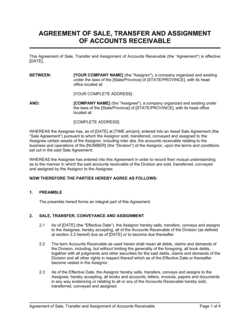
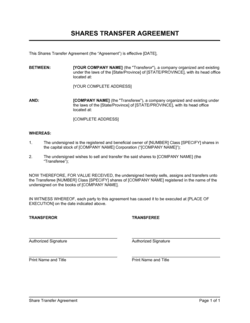
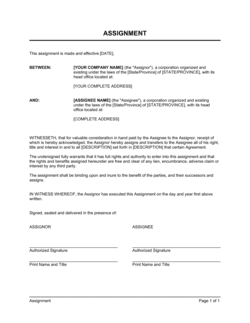
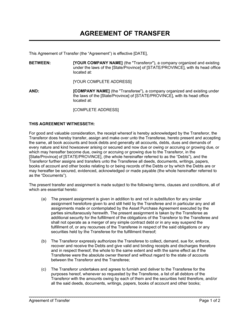
Assignment and Transfer of Stock Certificate Template

Free Word download • Edit online • Save & share with Drive • Export to PDF

1 page20–30 min to fillDifficulty: StandardSignature requiredLegal review recommended
Learn more ↓
FreeAssignment and Transfer of Stock Certificate Template

At a glance

What it is
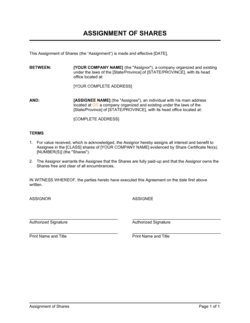
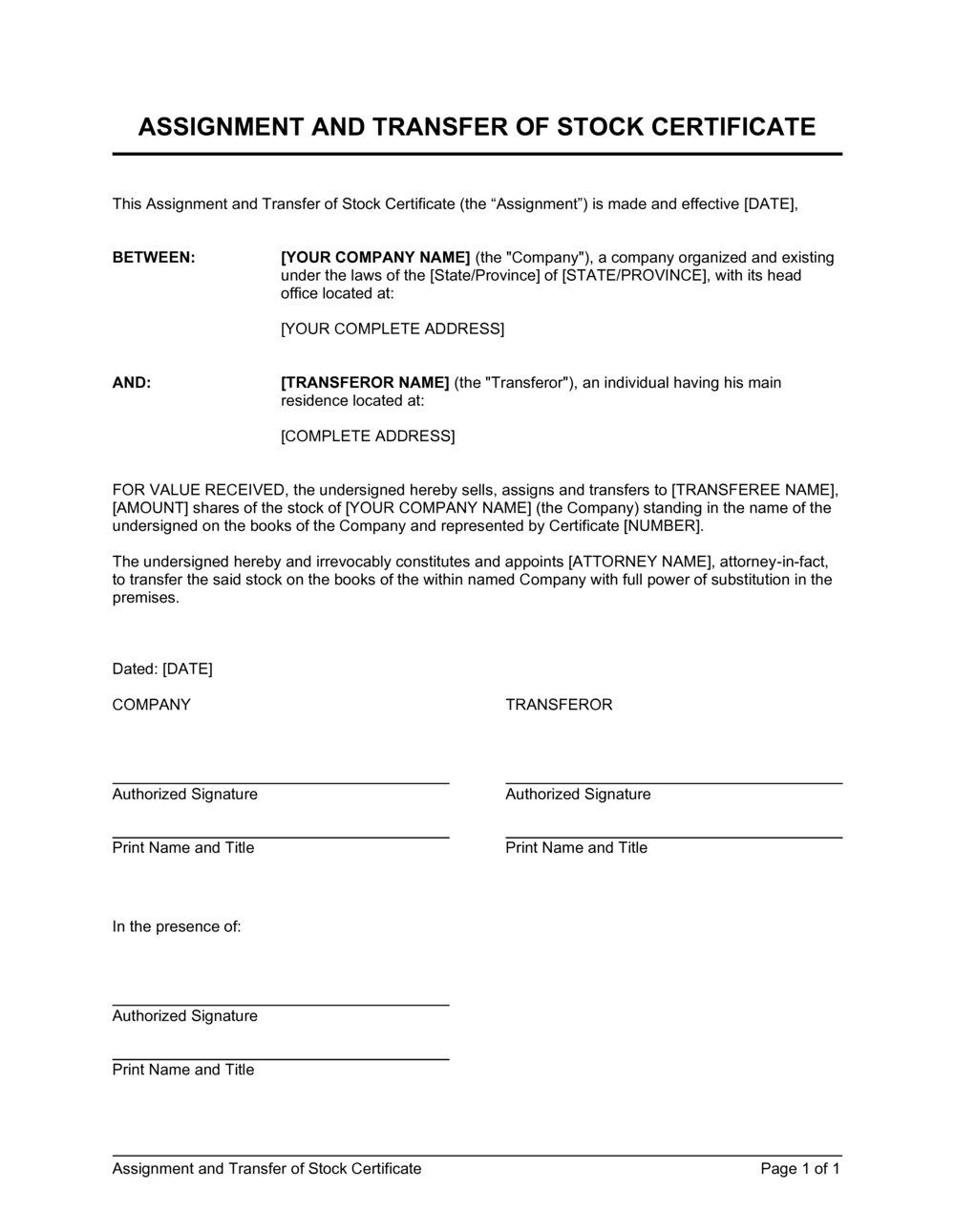
An Assignment and Transfer of Stock Certificate is a legally binding document through which a shareholder (the assignor) formally transfers ownership of a specified number of shares to another party (the assignee). This free Word download provides a structured, attorney-reviewed starting point covering parties, share details, purchase price, representations, and governing law — ready to edit online and export as PDF for execution and corporate recordkeeping.
When you need it
Use it whenever shares in a private company change hands — whether through a sale, gift, estate transfer, or restructuring transaction. It is required any time you need an auditable, enforceable record of the transfer that can be registered in the company's stock ledger and presented to counsel or regulators.
What's inside
Identification of assignor and assignee, a precise description of the shares being transferred including certificate numbers and class, the agreed consideration, representations and warranties from both parties, indemnification, consent and notice requirements, and governing law and signature blocks.

What is an Assignment and Transfer of Stock Certificate?

An Assignment and Transfer of Stock Certificate is a legally binding instrument through which a shareholder formally conveys ownership of a specified number of shares in a corporation to another party. The document identifies both the assignor (the current owner) and the assignee (the recipient), precisely describes the shares being transferred by class and certificate number, records the agreed consideration, and captures representations from each party confirming the transfer is free of undisclosed encumbrances and complies with all governing documents. Once executed and filed with the company secretary, it authorizes the cancellation of the original certificate and the issuance of a new one in the assignee's name — creating a clean, auditable link in the chain of title.

Why You Need This Document

Without a properly executed assignment, a share transfer simply does not exist on the company's records — the assignee has no recognized ownership, no voting rights, and no standing to receive dividends or sale proceeds. Informal agreements, handshake deals, and email confirmations are routinely rejected by corporate counsel, investors conducting due diligence, and courts adjudicating shareholder disputes. The consequences are severe: a future acquirer may require the transfer to be re-executed years later under unfavorable conditions, a departing founder may retain legal ownership of shares they believed they had relinquished, or an estate may face protracted litigation over who actually owned the shares at the time of death. This template provides the structural foundation — parties, shares, consideration, ROFR compliance, board consent, and governing law — that turns an informal understanding into an enforceable, ledger-ready record of ownership change.

Which variant fits your situation?

If your situation is…Use this template
Transferring shares as part of a full company acquisitionShare Purchase Agreement
Gifting shares to a family member with no monetary considerationGift of Shares Agreement
Transferring shares from a deceased estate to beneficiariesTransmission of Shares (Probate Transfer)
Moving shares into or out of a holding trustStock Assignment with Trust Transfer Addendum
Issuing new shares to a founding team memberStock Subscription Agreement
Documenting a pledge of shares as collateral for a loanStock Pledge Agreement
Transferring membership interests in an LLC rather than sharesAssignment of LLC Membership Interest

Common mistakes to avoid

❌ Executing the transfer without checking the shareholders' agreement for ROFR

Why it matters: Existing shareholders whose right of first refusal was bypassed can sue to void the transfer or force a sale to them at the same price. The assignee ends up with legally contested shares.

Fix: Pull the shareholders' agreement before any transfer discussion begins. Identify every ROFR, co-sale, and drag-along right, send notices to all entitled parties, and wait for written waivers before execution.

❌ Using informal share counts rather than certificate numbers

Why it matters: Describing transferred shares as '500 shares' without referencing certificate numbers creates ambiguity when a shareholder holds multiple certificates — and makes the transfer unregistrable in some states.

Fix: List every certificate number being transferred, confirm the counts match the ledger, and note any partial-certificate splits requiring new certificate issuance.

❌ Leaving the consideration field vague or blank

Why it matters: Unstated consideration can trigger gift-tax characterization, cause the transfer to fail for lack of consideration, or create disputes about what was actually agreed.

Fix: Always state a specific dollar amount or explicitly note the gift character with nominal consideration. Attach a promissory note if payment is deferred.

❌ Failing to carry forward legends from the original certificate

Why it matters: Securities law legends on the original certificate — restricting resale under Rule 144 or citing the shareholders' agreement — run with the shares. A new certificate issued without them exposes the company to securities law liability.

Fix: Instruct the company secretary to reproduce all existing legends on any replacement certificate issued to the assignee.

❌ No board consent resolution in the corporate records

Why it matters: Without a formal board resolution, future investors, acquirers, or courts may question whether the transfer was properly authorized — clouding title to the shares.

Fix: Pass a written board resolution at the time of transfer, reference it as an exhibit in the assignment agreement, and file it in the corporate minute book.

❌ Backdating the transfer to a prior tax year

Why it matters: Backdating a stock transfer is a securities law violation and can trigger IRS penalties for incorrect tax reporting in the year of transfer. It also invalidates the agreement itself in many jurisdictions.

Fix: Always use the actual execution date. If timing is tax-sensitive, consult a tax attorney before execution — not after.

The 10 key clauses, explained

Parties and recitals

In plain language: Identifies the assignor and assignee by full legal name, address, and capacity, and briefly states the background — that the assignor owns the shares and wishes to transfer them on the agreed terms.

Sample language
This Assignment and Transfer of Stock Certificate ('Agreement') is entered into as of [DATE] by and between [ASSIGNOR FULL NAME], a [STATE] [INDIVIDUAL/ENTITY TYPE] ('Assignor'), and [ASSIGNEE FULL NAME], a [STATE] [INDIVIDUAL/ENTITY TYPE] ('Assignee').

Common mistake: Using a nickname or trade name instead of the exact legal name on the corporate stock ledger. A name mismatch voids the transfer at the ledger level and requires a corrective affidavit.

Description of shares being transferred

In plain language: Specifies the company name, share class (common, preferred, Series A, etc.), number of shares, and the certificate number(s) being assigned — creating an unambiguous record of exactly what is changing hands.

Sample language
[NUMBER] shares of [CLASS] stock of [COMPANY LEGAL NAME], a [STATE] corporation, represented by Stock Certificate No(s). [CERTIFICATE NUMBERS], registered in the name of Assignor on the books of the Company.

Common mistake: Omitting the certificate number or share class. Ambiguous share descriptions cause disputes when a shareholder holds multiple certificate classes, and some state filings require exact certificate numbers.

Consideration

In plain language: States the purchase price or other value being exchanged for the shares, confirms receipt of that consideration, and specifies the payment method and timing.

Sample language
In consideration of the sum of $[AMOUNT] USD ('Purchase Price'), receipt and sufficiency of which are hereby acknowledged, Assignor hereby assigns, transfers, and conveys to Assignee all right, title, and interest in and to the Shares.

Common mistake: Leaving consideration blank or writing 'for good and valuable consideration' without specifying the amount. Courts in several jurisdictions have found inadequately stated consideration to be evidence of a disguised gift, triggering gift-tax treatment.

Representations and warranties of assignor

In plain language: The assignor confirms that they legally own the shares, that the shares are free of liens or encumbrances, that no third-party consent is required (or has been obtained), and that transferring them does not violate any agreement.

Sample language
Assignor represents and warrants that: (a) Assignor is the sole legal and beneficial owner of the Shares; (b) the Shares are free and clear of all liens, pledges, and encumbrances; (c) Assignor has full right and authority to transfer the Shares; and (d) the transfer does not violate any shareholders' agreement, right of first refusal, or applicable law.

Common mistake: Omitting the 'no liens' warranty. If the shares were previously pledged as collateral and that pledge is not released before the transfer, the assignee acquires encumbered shares — often without knowing it.

Representations and warranties of assignee

In plain language: The assignee confirms they have the legal capacity to receive the shares, understand any applicable securities law restrictions on resale, and accept the shares subject to the terms of the company's shareholders' agreement.

Sample language
Assignee represents and warrants that: (a) Assignee has full legal capacity and authority to enter into this Agreement; (b) Assignee is acquiring the Shares for Assignee's own account and not with a view to distribution; and (c) Assignee has received and reviewed the Company's Shareholders' Agreement and agrees to be bound by its terms.

Common mistake: Skipping the assignee's investment intent representation. Without it, the transfer may trigger securities registration requirements if the assignee is deemed a statutory underwriter under Rule 144.

Consent of the company

In plain language: Records the company's formal approval of the transfer — required under most shareholders' agreements and corporate bylaws — and confirms that the company's board has authorized updating the stock ledger.

Sample language
[COMPANY LEGAL NAME] hereby consents to the transfer of the Shares from Assignor to Assignee as set forth herein, and the Secretary of the Company is hereby authorized and directed to record such transfer in the Company's stock ledger and to issue a new stock certificate to Assignee.

Common mistake: Executing the transfer without the company's consent when the bylaws or a shareholders' agreement requires it. The transfer may be treated as void or voidable, leaving the assignee without recognized ownership on the company's records.

Right of first refusal and transfer restrictions

In plain language: Confirms that any applicable ROFR or co-sale rights have been properly waived or exercised, and that the transfer complies with all transfer restrictions in the company's governing documents.

Sample language
Assignor represents that the right of first refusal set out in Section [X] of the Shareholders' Agreement dated [DATE] has been properly waived by all holders thereof, and that no other transfer restrictions apply to the Shares that have not been complied with or waived in writing.

Common mistake: Failing to circulate the ROFR notice to all entitled parties before executing the transfer. Existing shareholders who were not notified can void the transfer or seek damages even after the certificate has been reissued.

Indemnification

In plain language: Each party agrees to indemnify the other for losses arising from a breach of their respective representations and warranties, typically capped at the purchase price of the shares.

Sample language
Each party ('Indemnifying Party') shall indemnify, defend, and hold harmless the other party ('Indemnified Party') from and against any losses, claims, or liabilities arising from any breach by the Indemnifying Party of the representations and warranties set forth herein.

Common mistake: No indemnification cap. An unlimited indemnity on a low-value share transfer can expose a party to liability disproportionate to the deal size if an undisclosed lien or encumbrance surfaces later.

Governing law and dispute resolution

In plain language: Specifies which jurisdiction's law governs the agreement and how disputes are resolved — litigation, arbitration, or mediation — and the venue.

Sample language
This Agreement shall be governed by and construed in accordance with the laws of the State of [STATE], without regard to conflicts of law principles. Any dispute arising hereunder shall be resolved by binding arbitration in [CITY, STATE] under the rules of [AAA/JAMS], except claims for injunctive relief.

Common mistake: Choosing a governing law that conflicts with the state of incorporation. Most jurisdictions apply the internal affairs doctrine — corporate governance disputes follow the law of the state of incorporation, not the governing law clause.

Entire agreement and counterparts

In plain language: Confirms that this document supersedes all prior discussions and agreements about the transfer, and that the agreement may be signed in counterparts — including electronically — each of which is an original.

Sample language
This Agreement constitutes the entire agreement between the parties with respect to the subject matter hereof and supersedes all prior negotiations, representations, and understandings. This Agreement may be executed in counterparts, including by electronic signature, each of which shall constitute an original.

Common mistake: Omitting an entire-agreement clause when prior term sheets or emails contain different price or share-count terms. Without it, those prior communications can be introduced as evidence of the 'real' deal.

How to fill it out

  1. 1

    Identify parties using their exact legal names

    Enter the assignor's and assignee's full legal names exactly as they appear on government ID or corporate formation documents. For entities, use the registered legal name, not a DBA or brand name.

    💡 Cross-reference the assignor's name against the current stock ledger entry — a single character difference triggers a correction affidavit before the ledger can be updated.

  2. 2

    Describe the shares with full precision

    Record the company's full legal name, state of incorporation, share class (e.g., Common Stock, Series A Preferred), exact number of shares, and every certificate number being transferred.

    💡 If a single physical certificate covers more shares than are being transferred, the company must cancel the old certificate and issue two new ones — note this in the document.

  3. 3

    State the consideration clearly

    Enter the exact dollar amount (or other agreed consideration) being paid for the shares. Confirm the payment method — wire transfer, check, or promissory note — and the date by which payment is due.

    💡 For gift transfers to family members, use a nominal consideration of $1 and note the gift character explicitly to support consistent tax treatment.

  4. 4

    Verify and document ROFR compliance

    Review the company's shareholders' agreement and bylaws for any right of first refusal, co-sale right, or board consent requirement. Attach written waivers or evidence of compliance before execution.

    💡 Send ROFR notices by the method specified in the shareholders' agreement — email may not be valid if the agreement requires written notice by mail.

  5. 5

    Obtain the company's written consent

    Have the company's board pass a written resolution approving the transfer and authorizing the secretary to update the stock ledger and issue a new certificate. Attach the resolution as an exhibit.

    💡 Even in single-owner companies, a formal board resolution creates a clean paper trail that protects against future disputes about when the transfer was approved.

  6. 6

    Complete the signature blocks

    Both the assignor and assignee must sign and date the agreement. If either party is an entity, ensure the signatory has authority — a corporate officer or authorized manager. Include the company's countersignature for the consent block.

    💡 Date the agreement on or before the date the consideration is exchanged — backdating a share transfer creates securities law and tax problems in every jurisdiction.

  7. 7

    Cancel the old certificate and issue a new one

    Surrender the original stock certificate(s) to the company secretary for cancellation. The company then issues a new certificate in the assignee's name reflecting the transferred shares, with any required legends carried forward.

    💡 Mark the original certificate 'CANCELLED' in ink with the date and keep it in the corporate minute book — do not destroy it, as it may be required as evidence in future disputes.

  8. 8

    Update the stock ledger and cap table

    Record the transfer in the company's official stock ledger and update the cap table to reflect the new ownership percentages. Distribute an updated cap table to all shareholders if required by the shareholders' agreement.

    💡 Use the execution date of this agreement — not the payment date or certificate issue date — as the transfer date in the ledger for legal and tax consistency.

Frequently asked questions

What is an assignment and transfer of stock certificate?

An assignment and transfer of stock certificate is a legal document through which a shareholder formally conveys ownership of a specified number of shares to another party. It identifies both parties, describes the shares being transferred by class and certificate number, states the agreed consideration, records representations from each side, and authorizes the company to update its stock ledger accordingly. The document creates an enforceable, auditable record that protects both buyer and seller.

When do I need to use this document?

You need this document any time shares in a private company change hands — whether through a sale between shareholders, a gift to a family member, an estate transfer following a shareholder's death, a buyout of a departing co-founder, or a restructuring in which shares move between entities. Oral or informal transfers are generally not recognized on corporate books and create serious title disputes at future funding rounds or sales.

Is board approval required to transfer shares?

In most private companies, yes. Shareholder agreements and corporate bylaws commonly require board consent before any share transfer is registered. Even when not explicitly required, documenting board approval in a written resolution protects the validity of the transfer against later challenge. Always review the company's governing documents before initiating a transfer.

What happens to the original stock certificate after a transfer?

The original certificate must be surrendered to the company for cancellation. The company secretary marks it cancelled, retains it in the corporate minute book, and issues a new certificate in the assignee's name. Destroying the original or failing to cancel it properly leaves the company with two conflicting certificates outstanding — a title defect that can derail future transactions.

Do I need to notify the other shareholders before transferring my shares?

If the shareholders' agreement contains a right of first refusal, you must send formal notice to all entitled parties and give them the required response period — typically 30 to 60 days — before transferring to an outside party. Transferring without this notice can make the transfer voidable at the election of the shareholders whose ROFR was bypassed. Check the notice method specified in the agreement — email alone may not suffice.

Are there tax implications when transferring shares?

Yes. The assignor typically recognizes a capital gain or loss equal to the difference between the consideration received and their adjusted cost basis in the shares. Gift transfers may trigger gift-tax reporting obligations. Estate transfers involve step-up-in-basis rules. In the UK and Canada, stamp duty or land transfer equivalents may apply to share transfers. Consult a tax advisor before executing any transfer — particularly those involving non-cash consideration or related parties.

Can this document be signed electronically?

In most jurisdictions, electronic signatures are legally valid for private share transfer agreements under statutes such as the US ESIGN Act, UETA, Canada's PIPEDA, and the EU's eIDAS Regulation. However, some transfer agents for publicly traded companies require a Medallion Signature Guarantee rather than an e-signature. For private companies, confirm that the shareholders' agreement does not require wet-ink signatures before relying on electronic execution.

What is the difference between this document and a share purchase agreement?

An assignment and transfer of stock certificate is the formal instrument that effects the actual conveyance of shares — it is the deed of transfer. A share purchase agreement is the broader commercial contract governing the terms of the deal: price, conditions precedent, representations, indemnities, and post-closing covenants. For simple transfers between known parties, this assignment document may suffice on its own. For complex transactions with conditions and ongoing obligations, a full share purchase agreement is typically required, with this assignment executed at closing.

Does this document need to be notarized?

Notarization is generally not required for private share transfer documents in the US, Canada, or the UK. However, some jurisdictions require notarized or apostilled signatures when shares are transferred across borders or when the assignee is a foreign entity. Estate and probate transfers often require court-issued letters testamentary rather than notarization. When in doubt, consult the company's transfer agent or corporate counsel.

How this compares to alternatives

vs Share Purchase Agreement

A share purchase agreement is a comprehensive commercial contract covering the full economics of a share deal — price adjustments, conditions precedent, representations and indemnities, and post-closing covenants. The assignment and transfer of stock certificate is the short-form instrument that effects the actual conveyance at closing. Simple transfers between known parties may need only this assignment; complex or high-value deals require both documents.

vs Stock Subscription Agreement

A stock subscription agreement governs the issuance of new shares by a company to an investor — the company creates new equity and the investor pays for it. An assignment and transfer moves existing shares from one holder to another without creating new equity. These are fundamentally different transactions: subscription increases the share count; assignment does not.

vs Assignment of LLC Membership Interest

An assignment of LLC membership interest transfers an economic or governance interest in a limited liability company, which is governed by the LLC's operating agreement and state LLC statutes. An assignment of stock certificates transfers shares in a corporation, governed by corporate bylaws and corporate statutes. The underlying legal frameworks, tax treatments, and transferability restrictions differ materially between the two entity types.

vs Stock Pledge Agreement

A stock pledge agreement grants a lender a security interest in shares as collateral — the pledgor retains ownership unless they default. An assignment and transfer document permanently conveys ownership to the assignee. Pledging shares and transferring shares are legally distinct acts; executing the wrong document can inadvertently trigger a full ownership transfer when only a security interest was intended.

Industry-specific considerations

Technology / SaaS

Co-founder buyouts, vesting cliff departures, and secondary share sales to new investors all require a documented transfer that passes due diligence in the next funding round.

Professional Services

Partner retirement and equity succession in law firms, accounting practices, and consulting partnerships frequently involve share transfers governed by detailed shareholders' agreements with ROFR and consent provisions.

Family Business / Private Equity

Generational wealth transfers and estate planning require share assignments that comply with gift-tax annual exclusions and step-up-in-basis rules, often requiring a qualified business valuation at the time of transfer.

Manufacturing

Joint venture restructurings and partial divestitures in capital-intensive manufacturing companies involve share transfers that must comply with secured lender consent requirements tied to pledge agreements over the shares.

Healthcare

Physician practice ownership transfers must comply with state corporate practice of medicine laws, which restrict who may own shares in a medical professional corporation — a transfer to an unlicensed party may be void as a matter of law.

Real Estate

Shares in real estate holding corporations change hands regularly during property portfolio sales or investor exits, requiring transfer documents that dovetail with any underlying mortgage lender consent-to-transfer covenants.

Jurisdictional notes

United States

Share transfers in US corporations are governed by the Uniform Commercial Code Article 8 and the corporate statutes of the state of incorporation — Delaware General Corporation Law being the most common. Securities legend compliance under Rule 144 of the Securities Act is critical for restricted shares. Several states impose documentary stamp taxes on share transfers. California courts apply equitable considerations that can override transfer restrictions deemed unconscionable.

Canada

Federal corporations under the Canada Business Corporations Act and provincial corporations each have specific requirements for share transfer registration. Stamp duty does not apply to share transfers at the federal level, but Ontario and Quebec have historically imposed or periodically revisited securities transfer taxes. Quebec-registered corporations and transfers involving Quebec residents may require documentation in French under the Charter of the French Language.

United Kingdom

Share transfers in UK private limited companies are executed on a stock transfer form (J30 form) and typically require board approval under the company's articles of association. HMRC imposes Stamp Duty of 0.5% on transfers of shares with consideration above £1,000, payable within 30 days of execution. The UK Companies Act 2006 requires the company to register the transfer and update its register of members within two months.

European Union

Share transfer requirements vary significantly by member state. Germany requires notarization for GmbH share transfers; France imposes a 0.1% share transfer tax (droits d'enregistrement) on SAS and SA transfers; Spain requires a public deed for S.L. transfers. GDPR is relevant when the transfer involves disclosure of personal data about shareholders or beneficial owners to counterparties. Cross-border transfers within the EU may also trigger beneficial ownership reporting under the Fifth Anti-Money Laundering Directive.

Template vs lawyer — what fits your deal?

PathBest forCostTime
Use the templateSimple transfers between existing shareholders in a privately held company with a straightforward shareholders' agreementFree30–60 minutes
Template + legal reviewTransfers involving a departing founder, non-family third party, or any company with investor-held preferred stock and ROFR provisions$300–$750 for a corporate attorney review2–5 business days
Custom draftedComplex transactions — cross-border transfers, estate or probate situations, transfers in regulated industries, or partial transfers that require new certificate issuance and ledger reconciliation$1,000–$3,500+1–3 weeks

Glossary

Assignor
The current shareholder who is transferring ownership of the shares to another party.
Assignee
The individual or entity receiving ownership of the shares being transferred.
Stock Certificate
A physical or electronic document issued by a corporation certifying that a named person owns a specified number of shares in that company.
Consideration
The price or other value exchanged for the shares — cash, promissory note, services rendered, or nominal value such as $1 in gift transfers.
Cap Table (Capitalization Table)
A spreadsheet or record maintained by the company listing every shareholder, their share class, number of shares held, and ownership percentage.
Right of First Refusal (ROFR)
A contractual right giving existing shareholders or the company the option to purchase shares before they are offered to an outside third party.
Share Legends
Restrictive notices printed on a stock certificate — typically citing securities law restrictions or shareholder agreement transfer limitations — that must be carried over to any new certificate.
Stock Ledger
The company's official register recording all share issuances, transfers, and cancellations — updated every time a transfer is executed.
Medallion Signature Guarantee
A specialized stamp issued by an eligible financial institution that authenticates a shareholder's signature on a transfer document, required by many transfer agents for public company shares.
Representations and Warranties
Factual statements each party certifies as true at the time of signing — for example, that the assignor owns the shares free of liens and has authority to transfer them.
Indemnification
A contractual obligation by one party to compensate the other for losses arising from a breach of the representations and warranties made in the agreement.

Part of your Business Operating System

This document is one of 3,000+ business & legal templates included in Business in a Box.

  • Fill-in-the-blanks — ready in minutes
  • 100% customizable Word document
  • Compatible with all office suites
  • Export to PDF and share electronically

Create your document in 3 simple steps.

From template to signed document — all inside one Business Operating System.
1
Download or open template

Access over 3,000+ business and legal templates for any business task, project or initiative.

2
Edit and fill in the blanks with AI

Customize your ready-made business document template and save it in the cloud.

3
Save, Share, Send, Sign

Share your files and folders with your team. Create a space of seamless collaboration.

Save time, save money, and create top-quality documents.

★★★★★

"Fantastic value! I'm not sure how I'd do without it. It's worth its weight in gold and paid back for itself many times."

Managing Director · Mall Farm
Robert Whalley
Managing Director, Mall Farm Proprietary Limited
★★★★★

"I have been using Business in a Box for years. It has been the most useful source of templates I have encountered. I recommend it to anyone."

Business Owner · 4+ years
Dr Michael John Freestone
Business Owner
★★★★★

"It has been a life saver so many times I have lost count. Business in a Box has saved me so much time and as you know, time is money."

Owner · Upstate Web
David G. Moore Jr.
Owner, Upstate Web

Run your business with a system — not scattered tools

Stop downloading documents. Start operating with clarity. Business in a Box gives you the Business Operating System used by over 250,000 companies worldwide to structure, run, and grow their business.

Start free · No credit card required