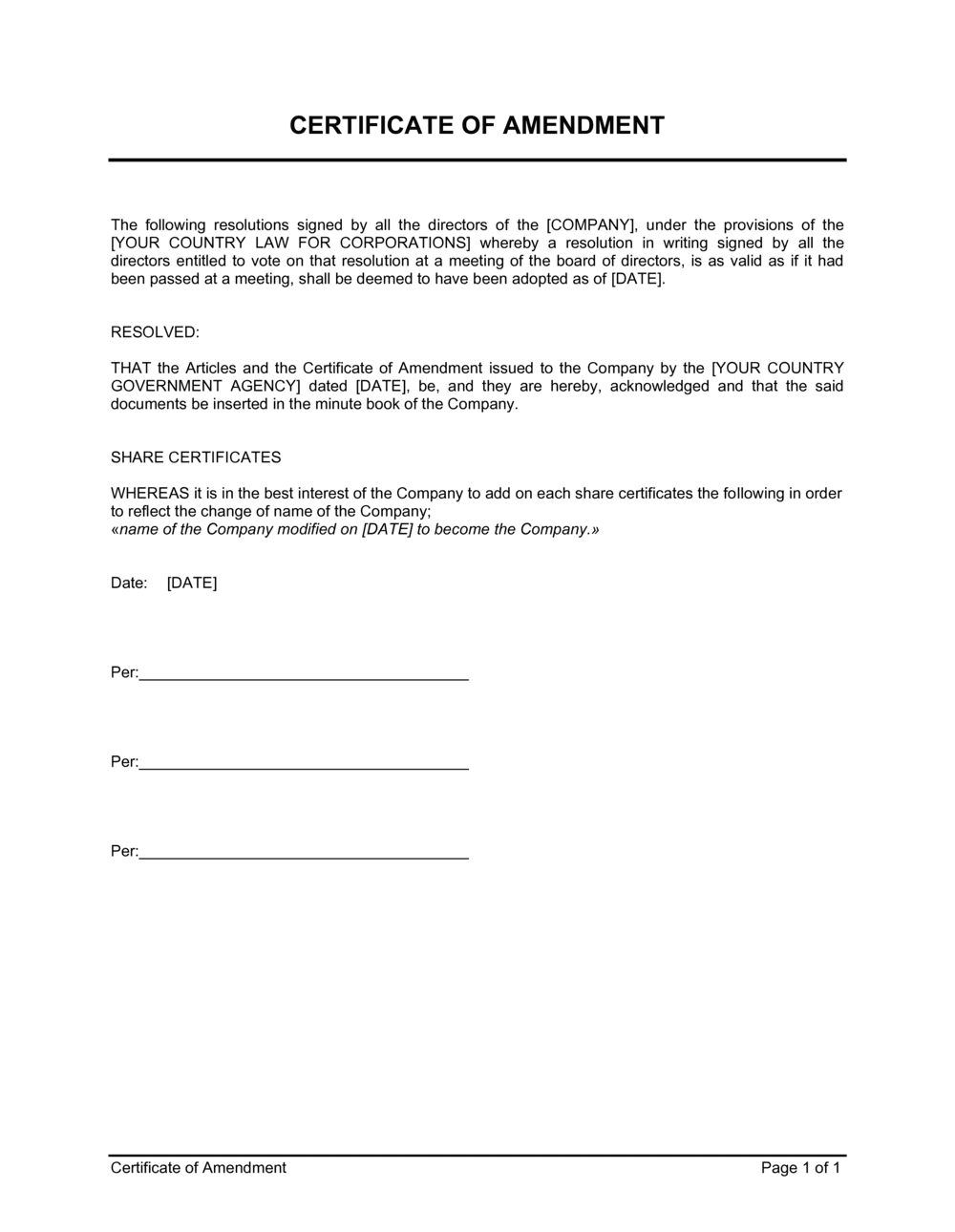
Certificate of Amendment Template

Free Word download • Edit online • Save & share with Drive • Export to PDF

1 page20–30 min to fillDifficulty: StandardSignature requiredLegal review recommended
Learn more ↓
FreeCertificate of Amendment Template

At a glance

What it is
A Certificate of Amendment is a formal legal document filed with the state or provincial authority to update the original articles of incorporation or articles of organization on record for a corporation or LLC. This free Word download gives you a professionally structured template you can edit online, adapt to your jurisdiction, and export as PDF for filing with the relevant government agency.
When you need it
Use it whenever a material term in your formation documents needs to change — a new legal name, an expanded or reduced authorized share count, a revised registered agent, or a changed purpose clause. Filing is typically required before the change takes legal effect.
What's inside
Entity identification details, the specific article being amended, the full text of the amended provision, the authorization record showing board and shareholder approval, the effective date, and the authorized officer's signature block with any required notarization reference.

What is a Certificate of Amendment?

A Certificate of Amendment is a formal legal document filed with a state or provincial authority — typically the Secretary of State or equivalent agency — to officially update one or more provisions in a corporation's articles of incorporation or an LLC's articles of organization. It is the mechanism by which a business entity changes its legal name, adjusts its authorized share capital, updates its registered agent, revises its stated purpose, or modifies any other term that was established in the original formation filing. Unlike internal governance changes made through bylaws or operating agreement amendments, a Certificate of Amendment becomes legally effective only when the government authority accepts and processes the filing — making it a binding public record.

Why You Need This Document

Operating a business entity under terms that no longer reflect its current legal name, share structure, or registered agent creates compounding compliance risk. Banks, investors, counterparties, and licensing authorities match entity details against state records — a mismatch delays closings, voids signatures, and triggers regulatory citations. A name that exists in your branding but not in the state database means contracts signed under that name may be unenforceable against the entity. An authorized share count that is below what a funding round requires cannot be remedied retroactively — the certificate must be on file before shares can be lawfully issued. Filing a Certificate of Amendment promptly when material terms change keeps your entity's public record accurate, protects the validity of every agreement and transaction that references it, and ensures you remain in good standing in every jurisdiction where you operate. This template gives you a professionally structured starting point that covers every required element, reducing the risk of a rejected filing and the delays that come with it.

Which variant fits your situation?

If your situation is…Use this template
Changing the corporation's legal nameCertificate of Amendment — Name Change
Increasing or decreasing authorized sharesCertificate of Amendment — Share Capital
Amending articles of organization for an LLCArticles of Amendment (LLC)
Changing the registered agent or registered officeStatement of Change of Registered Agent
Restating all articles in a single amended and restated documentAmended and Restated Articles of Incorporation
Domesticating or converting the entity to a different structureArticles of Conversion
Changing the corporation's purpose clauseCertificate of Amendment — Purpose Clause

Common mistakes to avoid

❌ Using a name that doesn't match state records exactly

Why it matters: The state matches the certificate against its database by exact legal name. Even a missing comma or 'Inc.' vs. 'Incorporated' will cause an automatic rejection and require a corrected refiling.

Fix: Copy the entity name character-for-character from the state agency's online business search or the most recently accepted filing before entering it in the certificate.

❌ Providing partial amendment language instead of the full restated article

Why it matters: A certificate that says 'Article 4 is amended by replacing the words X with Y' creates ambiguity about the current state of the article, especially after multiple prior amendments.

Fix: Always restate the entire amended article in full — every sentence, not just the changed portion — so the certificate is self-contained and unambiguous.

❌ Skipping or improperly documenting shareholder approval

Why it matters: An amendment filed without the required shareholder authorization is voidable and can be challenged by dissenting shareholders, creditors, or state regulators, unwinding transactions that relied on the amendment.

Fix: Before filing, confirm the required approval threshold in both the state statute and the existing articles, hold or document the proper vote or consent, and retain the signed consent or meeting minutes in your corporate book.

❌ Specifying a retroactive or improperly dated effective date

Why it matters: Most states prohibit amendments from taking effect before the filing date. A retroactive date causes rejection and can create legal confusion about the entity's status during the gap period.

Fix: Set the effective date as the filing date (the default in most states) unless you have a specific future date in mind that falls within the state's permitted window, typically 30–90 days forward.

❌ Filing with an outdated or incorrect fee

Why it matters: State agencies return unfiled certificates when the fee is wrong — checks for the wrong amount are not processed, causing the amendment to remain unfiled and the change to have no legal effect.

Fix: Check the fee schedule on the state agency's official website on the day of submission. Filing fees for certificates of amendment typically range from $25 to $200 depending on the state.

❌ Failing to update downstream records after filing

Why it matters: A name change or share structure amendment that is not reflected in bank accounts, contracts, licenses, and tax registrations creates regulatory compliance gaps and can void agreements that reference the old entity name.

Fix: Create a post-filing checklist covering the IRS (EIN update if needed), state tax authority, banking relationships, active contracts, business licenses, and registered trademarks, and work through it within 30 days of receiving the stamped acceptance.

The 10 key clauses, explained

Entity identification

In plain language: States the full legal name of the entity as it currently appears on file with the state, the entity type, the state of formation, and the original date of filing.

Sample language
[CURRENT LEGAL NAME OF ENTITY], a [CORPORATION / LIMITED LIABILITY COMPANY] formed under the laws of the State of [STATE], originally filed on [DATE OF ORIGINAL FILING] (File No. [STATE FILE NUMBER]).

Common mistake: Using a trade name or DBA instead of the exact name on the state's records — the filing will be rejected if the name does not match the state database precisely.

Statement of amendment authority

In plain language: Identifies the legal authority under which the amendment is made — typically the relevant state business corporation act or LLC statute — confirming the entity has the right to file.

Sample language
Pursuant to [SECTION X] of the [STATE] [Business Corporation Act / Limited Liability Company Act], the undersigned entity hereby submits this Certificate of Amendment.

Common mistake: Citing the wrong statutory provision for the entity type — corporations and LLCs are governed by separate statutes in every state, and cross-citing voids the filing.

Article being amended

In plain language: Identifies by number or heading the specific article or provision in the original formation document that is being changed.

Sample language
Article [NUMBER] of the Articles of Incorporation, entitled '[ARTICLE TITLE],' is hereby amended as set forth below.

Common mistake: Referencing a section number that does not match the original filed document. Always pull the exact article numbering from the currently filed version, not from an internal draft.

Full text of the amended provision

In plain language: Sets out the complete new language replacing the original provision — not just the changed words, but the full restated text of the article as it will read after filing.

Sample language
Article [NUMBER] is hereby amended to read in its entirety as follows: '[COMPLETE RESTATED TEXT OF THE AMENDED ARTICLE, INCLUDING ALL UNCHANGED LANGUAGE WITHIN THAT ARTICLE].'

Common mistake: Providing only the changed words without restating the full article text. Partial amendments create ambiguity about what the article now says and can require a corrective filing.

Board of directors approval

In plain language: Recites that the board of directors adopted the amendment by resolution on a specific date, establishing the first required layer of corporate authorization.

Sample language
The foregoing amendment was duly adopted by the Board of Directors of [ENTITY NAME] on [DATE], by a vote of [NUMBER] directors in favor, [NUMBER] against, and [NUMBER] abstaining, constituting the requisite approval under the governing documents.

Common mistake: Omitting the vote count or the meeting date. Many states require the approval record to appear on the face of the certificate; omitting it triggers a rejection or a request for supplemental documentation.

Shareholder or member approval

In plain language: Recites that the required percentage of shareholders (for corporations) or members (for LLCs) approved the amendment, satisfying the second authorization layer required by most state statutes.

Sample language
The amendment was approved by the shareholders of [ENTITY NAME] on [DATE] at a [special / annual] meeting at which a quorum was present. Shares voting in favor: [NUMBER] ([PERCENTAGE]%), which constitutes the required [MAJORITY / SUPERMAJORITY] under [STATE LAW / GOVERNING DOCUMENTS].

Common mistake: Failing to verify whether the amendment type (e.g., name change vs. authorized share increase) requires a simple majority or a supermajority. Using the wrong threshold invalidates the authorization and exposes the amendment to challenge.

Effective date

In plain language: States when the amendment takes effect — either upon filing and acceptance by the state or on a specified future date, if permitted by the jurisdiction.

Sample language
This Certificate of Amendment shall be effective [upon filing with the Secretary of State / on [FUTURE DATE], which is no more than [90] days from the date of filing].

Common mistake: Specifying a retroactive effective date — most states do not permit amendments to take effect before the filing date, and a retroactive date will cause rejection.

Authorized officer signature block

In plain language: Identifies the name and title of the individual authorized to sign the certificate on behalf of the entity, and includes the signature line, date, and any required printed name.

Sample language
IN WITNESS WHEREOF, the undersigned officer of [ENTITY NAME], being duly authorized, has executed this Certificate of Amendment as of [DATE]. Signature: _________________________ Name: [OFFICER NAME] Title: [PRESIDENT / SECRETARY / AUTHORIZED MANAGER]

Common mistake: Having the certificate signed by a non-officer or a person whose authority is not established in the board resolution. States verify signatory authority and will reject certificates signed by unauthorized individuals.

Filing fee and submission instructions

In plain language: References the applicable state filing fee and submission method — mail, in-person, or online — ensuring the document is accompanied by the correct payment and cover sheet.

Sample language
This Certificate of Amendment is submitted with the applicable filing fee of $[AMOUNT] payable to the [STATE AGENCY NAME]. Filing method: [MAIL / ONLINE PORTAL / IN-PERSON] to [AGENCY ADDRESS / PORTAL URL].

Common mistake: Submitting with an outdated fee amount. State filing fees change without widely publicized notice — verify the current fee on the state agency's website the day you file.

Consent or waiver of notice (if applicable)

In plain language: If shareholder or member approval was obtained by written consent rather than at a meeting, this clause documents that the required number of owners signed the consent in lieu of a formal meeting.

Sample language
In lieu of a meeting, the holders of [NUMBER] shares, representing [PERCENTAGE]% of the outstanding shares entitled to vote, have executed a written consent to the foregoing amendment dated [DATE], a copy of which is attached hereto as Exhibit A.

Common mistake: Relying on informal email approvals rather than a signed written consent document. Written consents must meet the same formality requirements as meeting votes — undated or unsigned emails do not qualify.

How to fill it out

  1. 1

    Pull the current filed formation document from the state records

    Access the state agency's online database (Secretary of State or equivalent) and download the most recently filed version of your articles. You need the exact current text — including article numbers — before drafting any amendment.

    💡 Never draft from an internal copy. Internal versions often diverge from the filed version after prior informal revisions, leading to citation errors that reject the filing.

  2. 2

    Identify the specific article and provision to be changed

    Locate the article number and heading in the filed document that contains the language you need to update. Write down the exact article number and title as they appear on file.

    💡 If more than two articles need amending, consider filing amended and restated articles instead — it creates a single, clean governing document rather than a patchwork of amendments.

  3. 3

    Draft the full restated text of the amended article

    Write out the complete new text of the article as it should read after the amendment, not just the changed words. Every word of that article — changed and unchanged — should appear in the amendment.

    💡 Have a colleague read the restated text against the original to confirm no unintended language was dropped or altered in the process of redrafting.

  4. 4

    Obtain board of directors approval by resolution

    Convene a board meeting or prepare a unanimous written consent authorizing the amendment. Record the date, vote count, and the exact text of the resolution. Attach the resolution as an exhibit if your state requires it.

    💡 Refer to your bylaws for the required quorum and vote threshold before the meeting — some amendment types require a supermajority of the full board, not just those present.

  5. 5

    Obtain shareholder or member approval

    Call a shareholder meeting or circulate a written consent. Record the number of shares voting in favor, the percentage that represents, and whether it meets the statutory or governing-document threshold for the amendment type.

    💡 Check both the state statute and your existing articles — some articles include a higher-than-statutory approval threshold that can only be lowered by a supermajority vote itself.

  6. 6

    Complete the entity identification and signature block

    Enter the entity's exact legal name as it appears on file, the state file number, the state of formation, and the name and title of the authorized officer who will sign. Sign and date the certificate.

    💡 Confirm the signer's authority in the board resolution itself — naming the specific officer authorized to execute and file the certificate avoids any signatory challenge.

  7. 7

    Verify the current filing fee and submission requirements

    Visit the state agency's official website on the day of filing to confirm the current fee, accepted payment methods, and any required cover sheet or form number. Fees and procedures change without broad notice.

    💡 Many states offer expedited processing for an additional fee — worth considering when the amendment must take effect before a closing, lender deadline, or name-change rebrand launch.

  8. 8

    File the certificate and store the confirmed acceptance

    Submit the signed certificate, payment, and any required exhibits to the state agency. Once accepted, download or request the state-stamped copy and store it with your corporate records alongside the original formation documents.

    💡 Update your registered agent, bank accounts, contracts, and business licenses to reflect the amendment immediately after receiving the stamped acceptance — delays create compliance gaps.

Frequently asked questions

What is a Certificate of Amendment?

A Certificate of Amendment is a formal document filed with the state agency — typically the Secretary of State — to officially change one or more provisions in a corporation's articles of incorporation or an LLC's articles of organization. Common amendments include name changes, authorized share increases, registered agent updates, and purpose clause revisions. The amendment has no legal effect until the state accepts and stamps the filing.

When do I need to file a Certificate of Amendment?

You need one any time you want to change a material term recorded in your original formation documents — a new legal name, a change to authorized share capital, a new registered agent, a revised business purpose, or an update to the principal office address if that information is in your articles. Changes that affect only your bylaws or operating agreement typically do not require a state filing.

What is the difference between a Certificate of Amendment and Amended and Restated Articles?

A Certificate of Amendment changes specific provisions while leaving the rest of the original document intact. Amended and Restated Articles replace the original formation document and all prior amendments with a single, consolidated, fully updated document. If your entity has accumulated multiple amendments over time, restating the articles is generally cleaner and easier to administer going forward than adding another layer of amendment.

Does a Certificate of Amendment require shareholder approval?

In most jurisdictions, yes — amendments to a corporation's articles of incorporation require both board approval and shareholder approval, typically by a simple majority of shares entitled to vote, though some amendments (such as increasing authorized shares beyond a certain threshold) require a supermajority. LLC amendments may require only member approval without a separate manager vote, depending on the operating agreement and state statute. Always confirm the threshold in both the applicable statute and your existing governing documents.

How long does it take for a Certificate of Amendment to take effect?

The timeline depends on the state and the filing method. Standard processing in most US states takes 5–15 business days. Many states offer expedited options (1–3 business days) for an additional fee ranging from $50 to $500. Same-day or 24-hour processing is available in Delaware, Nevada, and a few other states. The amendment takes legal effect on the date the state stamps and accepts the filing, or on the future effective date specified in the certificate if the state permits forward-dating.

Can I file a Certificate of Amendment myself without a lawyer?

For straightforward amendments — a name change or registered agent update for a simple domestic entity — many business owners complete the filing themselves using the state's standard form or a high-quality template. Legal review is strongly recommended when the amendment involves share capital restructuring, changes that affect investor rights, cross-border entities, or situations where the amendment is tied to a transaction closing. Errors in a corporate amendment can create downstream legal and tax complications that cost far more to correct than a preventive review would have.

Does changing the company name require anything else beyond the Certificate of Amendment?

Yes — a name change requires updating a range of downstream records and registrations. You will typically need to notify the IRS if the name appears on your EIN registration, update state and local business licenses, notify your bank to update account names, update any contracts that reference the old name, file a DBA cancellation if applicable, and update trademark registrations with the USPTO. Many states also require that you update your registered agent filing and any foreign qualification registrations in other states where the entity is qualified to do business.

What happens if I operate under a new name before the Certificate of Amendment is accepted?

Operating under a name not yet on file with the state creates legal and commercial risk. Third parties contracting with an entity under an unregistered name may have grounds to challenge the enforceability of those agreements. Banks may refuse to process checks or payments made to the new name. In some jurisdictions, operating under an unregistered assumed name without a proper DBA filing constitutes a statutory violation. Wait for the stamped acceptance before rolling out the new name publicly.

Is a Certificate of Amendment the same in every US state?

No. Each state has its own form, statutory requirements, filing fee, and processing procedure. Delaware, Nevada, and Wyoming have particularly streamlined processes and are popular incorporation states for this reason. California imposes additional disclosure requirements for certain amendments. Some states require the certificate to be filed alongside a certified copy of the authorizing board or shareholder resolution. Always check the specific requirements of the state of formation before filing.

How this compares to alternatives

vs Amended and Restated Articles of Incorporation

A Certificate of Amendment changes specific provisions while leaving the rest of the original formation document intact. Amended and Restated Articles replace the entire formation document with one consolidated version incorporating all changes. Use a certificate for isolated, one-off changes; use amended and restated articles when multiple provisions need updating or when prior amendments have made the document difficult to read.

vs Corporate Bylaws Amendment

A bylaws amendment changes the internal governance rules of a corporation — meeting procedures, officer roles, voting thresholds — without requiring a state filing. A Certificate of Amendment changes provisions in the publicly filed articles and must be filed with and accepted by the state to take effect. Bylaws govern internal operations; articles govern the entity's legal existence and external-facing characteristics.

vs LLC Operating Agreement Amendment

An operating agreement amendment updates the internal governance terms among LLC members — profit sharing, management structure, capital contributions — and typically does not require a state filing. A Certificate of Amendment updates the publicly filed articles of organization and must be filed with the state. Both documents may need to be amended simultaneously when an LLC undergoes a name change or ownership restructuring.

vs Articles of Dissolution

Articles of Dissolution terminate a corporation's or LLC's legal existence by filing with the state. A Certificate of Amendment modifies the entity's formation documents while keeping it active. Dissolution ends the entity; amendment updates it. Entities sometimes amend their articles as part of a wind-down process, but the two filings serve opposite purposes.

Industry-specific considerations

Technology / SaaS

Authorized share increases ahead of funding rounds and name changes during rebrands are the most common amendment triggers for tech entities, often tied to closing conditions in investment agreements.

Professional Services

Firms undergoing mergers, acquisitions, or partner restructurings frequently need to amend purpose clauses, registered agent details, or entity names to reflect the new operating structure.

Healthcare

Healthcare entities amend formation documents to add or modify purpose clauses to comply with licensing requirements, or to restructure ownership when adding or removing physician-owners.

Retail / E-commerce

Growing retail businesses filing in multiple states frequently need to amend their principal office address and registered agent in each state of qualification, requiring coordinated multi-state filings.

Financial Services

Regulatory and licensing requirements in financial services often mandate specific language in formation documents, making amendments necessary when licensing conditions change or new regulatory frameworks apply.

Manufacturing

Capital-intensive manufacturers frequently amend authorized share counts to facilitate equipment financing, private placements, or ESOP structures that require additional equity capacity.

Jurisdictional notes

United States

Each state has its own statute, standard form, filing fee, and processing timeline for certificates of amendment. Delaware, Nevada, and Wyoming offer streamlined online filing and same-day or next-day processing at premium fees. California imposes additional disclosure requirements and charges higher fees. For foreign-qualified entities operating in multiple states, a name change requires coordinated amendment filings in every state of qualification — not just the state of formation.

Canada

Federally incorporated corporations under the Canada Business Corporations Act file Articles of Amendment with Corporations Canada. Provincially incorporated entities file with the relevant provincial registry (e.g., Ontario Business Registry, Registre des entreprises in Quebec). Quebec corporations must ensure all publicly filed documents comply with French language requirements under the Charter of the French Language. Processing times range from same-day for online filings in some provinces to 10–15 business days for paper submissions.

United Kingdom

UK companies amend their constitutional documents — the articles of association — by passing a special resolution (75% shareholder vote) and filing the updated articles at Companies House within 15 days. There is no separate 'certificate of amendment' concept; the restated articles themselves are the filed document. A company name change also requires a change of name resolution and a new certificate of incorporation issued by Companies House. The filing fee is nominal (£8–£30 for online submissions).

European Union

Amendment procedures vary significantly by member state. In Germany, amendments to the GmbH articles (Gesellschaftsvertrag) require notarization and registration with the Handelsregister. In France, modifications to statuts must be recorded with the Registre du commerce et des sociétés (RCS) following shareholder approval by the required majority. Under the EU Digitalisation Directive (2019/1151), member states are progressively required to offer online registration and amendment filing, but implementation timelines and local formalities continue to differ. Cross-border mergers and conversions within the EU are governed by the Cross-Border Conversions Directive.

Template vs lawyer — what fits your deal?

PathBest forCostTime
Use the templateSimple domestic amendments — name changes, registered agent updates, or address changes — for straightforward corporations or LLCs in a single stateFree (plus state filing fee of $25–$200)1–2 hours to prepare; 5–15 business days for state processing
Template + legal reviewAmendments affecting share capital, investor rights, or entities with multiple classes of stock or complex operating agreements$300–$800 for attorney review and filing coordination2–5 business days for preparation; standard or expedited state processing
Custom draftedMulti-state entities, amendments tied to a transaction closing, regulated industries, or changes that require simultaneous updates to investment agreements or shareholder agreements$1,000–$5,000+ depending on complexity and jurisdiction1–3 weeks for drafting, negotiation, and coordinated multi-state filing

Glossary

Articles of Incorporation
The foundational formation document filed with a state agency that legally creates a corporation and records its core governance terms.
Articles of Organization
The equivalent formation document for a limited liability company, filed with the state to create the LLC as a legal entity.
Certificate of Amendment
A document filed with the state to officially change one or more provisions in a corporation's or LLC's original formation documents.
Authorized Shares
The maximum number of shares a corporation is permitted to issue, as stated in its articles of incorporation and subject to amendment.
Registered Agent
The designated individual or entity authorized to receive official legal and government correspondence on behalf of the business entity.
Effective Date
The date on which the amendment legally takes effect, which may be the filing date or a future date specified in the document.
Quorum
The minimum number or percentage of shareholders or directors that must be present or voting to make a corporate resolution legally valid.
Shareholder Resolution
A formal decision passed by shareholders, required in most jurisdictions before a certificate of amendment can be filed.
Par Value
The nominal minimum price per share stated in the articles of incorporation; many modern corporations issue shares at no par value.
Amended and Restated Articles
A single consolidated document that replaces the original articles and all prior amendments with an updated, complete version.
Ultra Vires
Latin for 'beyond the powers' — actions taken by a corporation that fall outside the authority granted by its formation documents are ultra vires and may be void.

Part of your Business Operating System

This document is one of 3,000+ business & legal templates included in Business in a Box.

  • Fill-in-the-blanks — ready in minutes
  • 100% customizable Word document
  • Compatible with all office suites
  • Export to PDF and share electronically

Create your document in 3 simple steps.

From template to signed document — all inside one Business Operating System.
1
Download or open template

Access over 3,000+ business and legal templates for any business task, project or initiative.

2
Edit and fill in the blanks with AI

Customize your ready-made business document template and save it in the cloud.

3
Save, Share, Send, Sign

Share your files and folders with your team. Create a space of seamless collaboration.

Save time, save money, and create top-quality documents.

★★★★★

"Fantastic value! I'm not sure how I'd do without it. It's worth its weight in gold and paid back for itself many times."

Managing Director · Mall Farm
Robert Whalley
Managing Director, Mall Farm Proprietary Limited
★★★★★

"I have been using Business in a Box for years. It has been the most useful source of templates I have encountered. I recommend it to anyone."

Business Owner · 4+ years
Dr Michael John Freestone
Business Owner
★★★★★

"It has been a life saver so many times I have lost count. Business in a Box has saved me so much time and as you know, time is money."

Owner · Upstate Web
David G. Moore Jr.
Owner, Upstate Web

Run your business with a system — not scattered tools

Stop downloading documents. Start operating with clarity. Business in a Box gives you the Business Operating System used by over 250,000 companies worldwide to structure, run, and grow their business.

Start free · No credit card required