Accounts Payable Policy Template

Free Word download β€’ Edit online β€’ Save & share with Drive β€’ Export to PDF

2 pagesβ€’20–25 min to fillβ€’Difficulty: Standard
Learn more ↓
FreeAccounts Payable Policy Template

At a glance

What it is
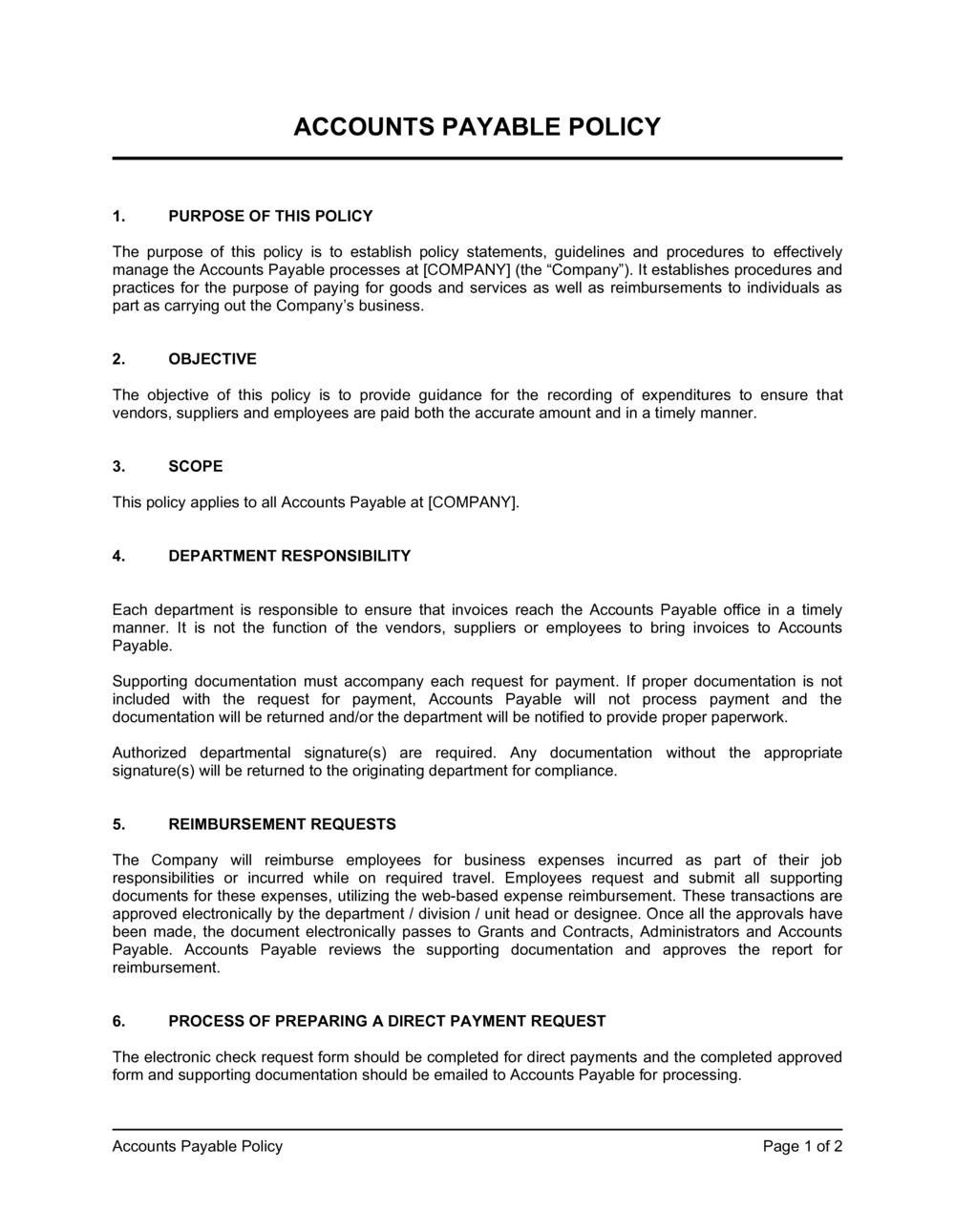
An Accounts Payable Policy is a formal internal document that defines how a company receives, reviews, approves, and pays vendor invoices. This free Word download gives you a structured, editable template you can adapt to your approval thresholds, payment terms, and internal controls, then export as PDF for staff distribution or auditor review.
When you need it
Use it when onboarding your first AP staff member, preparing for a financial audit, tightening internal controls after a payment error, or standardizing how multiple departments submit and approve vendor invoices.
What's inside
Policy scope and objectives, vendor onboarding and master data requirements, invoice receipt and three-way matching procedures, approval authority levels, payment scheduling and terms, expense reimbursement rules, internal controls and segregation of duties, and policy compliance and exceptions handling.

What is an Accounts Payable Policy?

An Accounts Payable Policy is a formal internal document that defines the rules, controls, and responsibilities governing how a company receives, validates, approves, and pays vendor invoices. It specifies who is authorized to approve payments at each dollar threshold, how invoices are matched against purchase orders and receiving records, which payment methods are permitted, and how duties are separated to prevent fraud and error. Unlike an informal practice or unwritten convention, a written AP policy creates a consistent, auditable framework that every employee and department must follow β€” regardless of whether the company processes 20 invoices a month or 2,000.

Why You Need This Document

Without a written accounts payable policy, the same invoice can arrive through three different channels, get approved by whoever happens to see it first, and be paid twice without anyone noticing until a vendor reconciliation surfaces the error months later. Duplicate payments, unauthorized vendor additions, and business email compromise attacks all exploit the absence of documented controls. Finance auditors β€” internal and external β€” specifically look for a written AP policy as evidence that management has designed and implemented controls over disbursements; its absence is a common audit finding that triggers expanded testing and remediation requirements. This template gives you a complete, customizable policy framework in hours rather than weeks, covering every control point from vendor onboarding through payment reconciliation.

Which variant fits your situation?

If your situation is…Use this template
Documenting end-to-end AP procedures with step-by-step instructionsAccounts Payable Procedures Manual
Tracking outstanding vendor invoices and payment due datesAccounts Payable Aging Report
Setting rules for how employees submit and get reimbursed for expensesExpense Reimbursement Policy
Governing how vendors are selected, onboarded, and managedVendor Management Policy
Defining spending authority limits across departmentsDelegation of Authority Policy
Establishing overall financial controls and reporting governanceFinance Policy and Procedures Manual
Documenting how goods and services are purchased before invoicingProcurement Policy

Common mistakes to avoid

❌ Allowing invoices to bypass the AP inbox

Why it matters: When vendors send invoices directly to department contacts, payments are initiated outside the approval workflow. This is the most common source of duplicate payments and unauthorized vendor additions.

Fix: Communicate a single AP submission channel to all vendors in writing and train all staff to redirect misdirected invoices immediately.
❌ Omitting system-level access controls

Why it matters: A written segregation-of-duties policy is unenforceable if the accounting system allows the same user to create vendors, approve invoices, and release payments.

Fix: Audit user permissions in your accounting system against the policy before it goes live and restrict access to match the documented roles.

❌ Publishing approval thresholds by person instead of role

Why it matters: When an approver leaves or changes roles, invoices stall because the next person doesn't know their authority level β€” and the policy is immediately outdated.

Fix: Write all approval thresholds against job titles or roles. Update the matrix when org structure changes, not when a payment gets stuck.

❌ Skipping three-way matching on small invoices

Why it matters: Fraudulent invoices are routinely structured just below de minimis thresholds knowing they will be paid without scrutiny. Accumulated small errors and fraud can exceed the cost of full validation.

Fix: Apply three-way matching to all PO-backed invoices regardless of dollar amount. Use a simplified two-way match (invoice vs. PO only) for non-PO invoices below your threshold.

The 9 key sections, explained

Policy scope and objectives

Vendor onboarding and master data

Invoice receipt and logging

Three-way matching and invoice validation

Approval authority matrix

Payment scheduling and terms

Expense reimbursement integration

Internal controls and segregation of duties

Policy compliance, exceptions, and review

How to fill it out

  1. 1

    Define the policy scope and effective date

    State which legal entities, subsidiaries, and departments are covered. Include the effective date and the name of the policy owner responsible for maintaining it.

    πŸ’‘ Name a specific role β€” not a person β€” as policy owner so the document remains accurate through staff changes.

  2. 2

    Document vendor onboarding requirements

    List every piece of information required before a vendor is activated in your accounting system: legal name, tax ID, bank details, and any required certifications or insurance certificates.

    πŸ’‘ Require dual verification of bank account details β€” one from the vendor's official domain email and one by callback to a number on file β€” to reduce business email compromise fraud.

  3. 3

    Set invoice receipt rules and routing

    Designate a single AP inbox or portal as the only valid submission channel. State the SLA for logging invoices (typically 1 business day) and the naming or numbering convention used for tracking.

    πŸ’‘ Communicate the AP inbox address to all active vendors in writing when the policy launches β€” not just internally.

  4. 4

    Define three-way match tolerances

    Specify the acceptable dollar and percentage variance between invoice, PO, and receipt. Document the workflow for invoices that fail matching, including who investigates and the vendor communication process.

    πŸ’‘ A tolerance of 1–2% or $50 (whichever is lower) balances administrative efficiency with financial accuracy for most mid-market companies.

  5. 5

    Complete the approval authority matrix

    Fill in the dollar thresholds and the specific roles β€” not names β€” authorized to approve at each level. Confirm the matrix is consistent with your delegation of authority policy if one exists.

    πŸ’‘ Build in an escalation path for urgent invoices when an approver is absent β€” a missing approver should not stall a critical vendor payment.

  6. 6

    Set payment terms and run frequency

    Enter your standard payment terms by vendor tier, the days of the week payment runs are processed, and the authorized payment methods. Note any vendor agreements with non-standard terms.

    πŸ’‘ Scheduling two payment runs per week (e.g., Tuesday and Thursday) captures most early-payment discount windows while maintaining cash flow discipline.

  7. 7

    Document segregation of duties controls

    Map each AP task β€” vendor creation, invoice approval, payment initiation, bank reconciliation β€” to distinct roles. Confirm that your accounting system's user permissions enforce these restrictions at the system level.

    πŸ’‘ Run a user access report from your accounting system and compare it against the policy before publishing. Gaps between policy and system access are the most common internal audit finding.

  8. 8

    Establish the exceptions process and review cycle

    Define how exceptions are requested, who approves them, and where they are logged. Set the annual review date and assign the update responsibility to a named role.

    πŸ’‘ Add a calendar reminder to your accounting system or project management tool on the review date β€” policy reviews that are not calendared almost never happen on schedule.

Frequently asked questions

What is an accounts payable policy?

An accounts payable policy is a formal internal document that defines how a company receives, validates, approves, and pays vendor invoices. It establishes the rules for vendor onboarding, three-way matching, approval authority levels, payment scheduling, and internal controls. Its primary purposes are to ensure accurate and timely payments, prevent fraud and duplicate payments, and provide an auditable process for every dollar the company pays out.

Why do small businesses need a formal AP policy?

Small businesses are disproportionately targeted by invoice fraud and business email compromise because they typically have fewer controls than larger organizations. A written AP policy β€” even a simple one β€” establishes a consistent approval process that makes unauthorized payments harder to execute. It also simplifies onboarding when the business hires its first bookkeeper or AP clerk and reduces errors when the founder is no longer personally reviewing every invoice.

What is three-way matching in accounts payable?

Three-way matching is the process of verifying that a vendor invoice aligns with the purchase order that authorized the purchase and the goods receipt that confirmed delivery before the invoice is approved for payment. All three documents must match on vendor identity, line items, quantities, and price within an acceptable tolerance. It is one of the most effective controls against overpayment, duplicate payment, and vendor invoice fraud.

What should an approval authority matrix include?

An approval authority matrix should list dollar thresholds β€” for example, up to $2,500, $2,501 to $10,000, $10,001 to $50,000, and above $50,000 β€” and assign a specific role (not a person's name) to each tier. It should also address emergency approvals when the primary approver is unavailable, and reference any separate delegation of authority policy that governs capital expenditures or contract commitments above standard AP thresholds.

How often should an accounts payable policy be updated?

Annual review is the standard minimum for most organizations. Updates should also be triggered by system changes (new accounting software), organizational changes (new roles or approval thresholds), audit findings that identify control gaps, or regulatory changes affecting tax reporting or payment processing. Assign a named role β€” typically the Controller or VP Finance β€” as policy owner to ensure reviews happen on schedule.

What is segregation of duties in AP and why does it matter?

Segregation of duties means that no single employee can control all steps of a financial transaction β€” vendor creation, invoice approval, payment release, and bank reconciliation must be performed by different people. Without this separation, a single dishonest or careless employee can create a fictitious vendor, approve an invoice to that vendor, release payment, and reconcile the bank statement without anyone else reviewing the transaction. It is the foundational fraud-prevention control in any AP function.

What payment terms should the AP policy specify?

The policy should define your standard terms (commonly Net 30 from invoice date), how non-standard vendor terms are handled and who approves exceptions, the frequency of scheduled payment runs (typically weekly or bi-weekly), and a process for evaluating early payment discounts against the company's cost of capital. Authorized payment methods β€” ACH, wire, check, and credit card β€” and any restrictions on each should also be documented.

How does an AP policy support financial audit preparation?

Auditors examining accounts payable look for evidence of consistent controls: documented approval workflows, three-way match completion, vendor verification records, and segregation of duties. A written AP policy that matches actual practice gives auditors the control framework they need to reduce their testing scope. Without a policy, auditors must reconstruct your process through interviews and transaction samples, which extends audit duration and increases the risk of findings.

What is the difference between an AP policy and AP procedures?

An AP policy defines the rules β€” approval thresholds, segregation of duties, payment terms, and compliance requirements. AP procedures define the step-by-step instructions for executing those rules β€” how to log an invoice in the accounting system, how to run the three-way match checklist, and how to initiate a payment run. The policy is stable and reviewed annually; procedures are updated more frequently as systems and workflows change. Both documents are needed for a complete AP control framework.

How this compares to alternatives

vs Expense Reimbursement Policy

An expense reimbursement policy governs how individual employees submit personal spending for repayment β€” receipts, approval, and eligible expense categories. An AP policy governs direct vendor invoices. The two overlap when employee reimbursements are processed through the AP function, but they address different transaction origins and approval chains. Both documents are needed for a complete disbursement control framework.

vs Procurement Policy

A procurement policy defines how the company selects vendors, issues purchase orders, and negotiates contracts before goods or services are received. An AP policy takes over from the point an invoice arrives. Together they form a complete purchase-to-pay control framework; gaps between the two are where unauthorized spending and off-contract purchases occur most frequently.

vs Accounts Payable Procedures Manual

An AP policy sets the rules β€” approval thresholds, segregation of duties, and compliance requirements β€” that govern the function. An AP procedures manual provides the step-by-step operational instructions for executing those rules inside a specific accounting system. The policy changes infrequently; the procedures manual is updated whenever workflows, systems, or staffing change.

vs Finance Policy and Procedures Manual

A finance policy and procedures manual is a comprehensive document covering all financial functions: AP, accounts receivable, payroll, reporting, and treasury. An AP policy is a focused standalone document covering only the payables function. Large organizations typically maintain both β€” the AP policy as a standalone for departmental use and the finance manual as the governing document for the full function.

Industry-specific considerations

Manufacturing

High-volume PO-backed transactions with multiple suppliers require strict three-way matching and freight-charge reconciliation before payment release.

Professional Services

Subcontractor and freelancer invoice management, project-coded expense allocation, and client reimbursable expense tracking within the AP workflow.

Retail and E-commerce

Inventory supplier payment terms, deduction management for short shipments or damaged goods, and integration between POS receiving records and AP validation.

Healthcare

Vendor credentialing requirements, medical supply and equipment PO matching, and compliance with anti-kickback regulations on vendor relationships and payments.

SaaS and Technology

Subscription and SaaS vendor management, software license renewals, and cloud infrastructure invoices with usage-based variable charges requiring cost-center coding.

Construction

Progress-billing payment schedules tied to project milestones, subcontractor lien waiver collection before payment release, and retention holdback tracking.

Template vs pro β€” what fits your needs?

PathBest forCostTime
Use the templateSmall and mid-size businesses establishing or formalizing their AP function for the first timeFree2–4 hours to customize and finalize
Template + professional reviewCompanies preparing for an external audit, implementing a new accounting system, or operating in a regulated industry$300–$800 for a controller or CPA review3–5 business days
Custom draftedMulti-entity organizations, publicly traded companies, or businesses subject to SOX or government contracting compliance requirements$2,000–$6,000 for a finance consultant or Big 4 advisory engagement2–6 weeks

Glossary

Three-Way Match
A verification process that confirms a vendor invoice matches the corresponding purchase order and goods receipt before payment is approved.
Accounts Payable (AP)
Money a company owes to suppliers and vendors for goods or services received but not yet paid for, recorded as a liability on the balance sheet.
Purchase Order (PO)
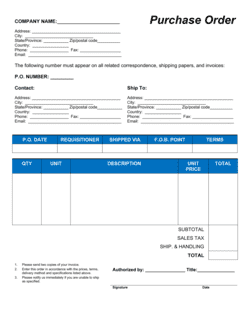
A buyer-issued document authorizing a vendor to supply specified goods or services at an agreed price, which anchors the three-way match process.
Approval Authority Matrix
A table defining which roles can approve invoices or payments up to specific dollar thresholds without requiring additional sign-off.
Segregation of Duties
An internal control principle requiring that no single employee can initiate, approve, and record a financial transaction β€” reducing fraud and error risk.
Accrual
An accounting entry recording an expense that has been incurred but not yet invoiced or paid, ensuring costs appear in the correct reporting period.
Payment Run
A scheduled batch process β€” typically weekly or bi-weekly β€” in which approved invoices are grouped and paid simultaneously to optimize cash flow.
Early Payment Discount
A vendor incentive offering a percentage reduction (e.g., 2% net 10) if the buyer pays within a specified number of days before the standard due date.
Vendor Master Data
The authoritative record of each approved vendor's legal name, tax ID, banking details, and contact information held in the accounting system.
Duplicate Payment
An erroneous second payment on an invoice already settled, typically caused by inconsistent invoice numbering, manual data entry, or weak AP controls.

Part of your Business Operating System

This document is one of 3,000+ business & legal templates included in Business in a Box.

  • Fill-in-the-blanks β€” ready in minutes
  • 100% customizable Word document
  • Compatible with all office suites
  • Export to PDF and share electronically

Create your document in 3 simple steps.

From template to signed document β€” all inside one Business Operating System.
1
Download or open template

Access over 3,000+ business and legal templates for any business task, project or initiative.

2
Edit and fill in the blanks with AI

Customize your ready-made business document template and save it in the cloud.

3
Save, Share, Send, Sign

Share your files and folders with your team. Create a space of seamless collaboration.

Save time, save money, and create top-quality documents.

β˜…β˜…β˜…β˜…β˜…

"Fantastic value! I'm not sure how I'd do without it. It's worth its weight in gold and paid back for itself many times."

Managing Director Β· Mall Farm
Robert Whalley
Managing Director, Mall Farm Proprietary Limited
β˜…β˜…β˜…β˜…β˜…

"I have been using Business in a Box for years. It has been the most useful source of templates I have encountered. I recommend it to anyone."

Business Owner Β· 4+ years
Dr Michael John Freestone
Business Owner
β˜…β˜…β˜…β˜…β˜…

"It has been a life saver so many times I have lost count. Business in a Box has saved me so much time and as you know, time is money."

Owner Β· Upstate Web
David G. Moore Jr.
Owner, Upstate Web

Run your business with a system β€” not scattered tools

Stop downloading documents. Start operating with clarity. Business in a Box gives you the Business Operating System used by over 250,000 companies worldwide to structure, run, and grow their business.

Start freeΒ Β·Β No credit card required