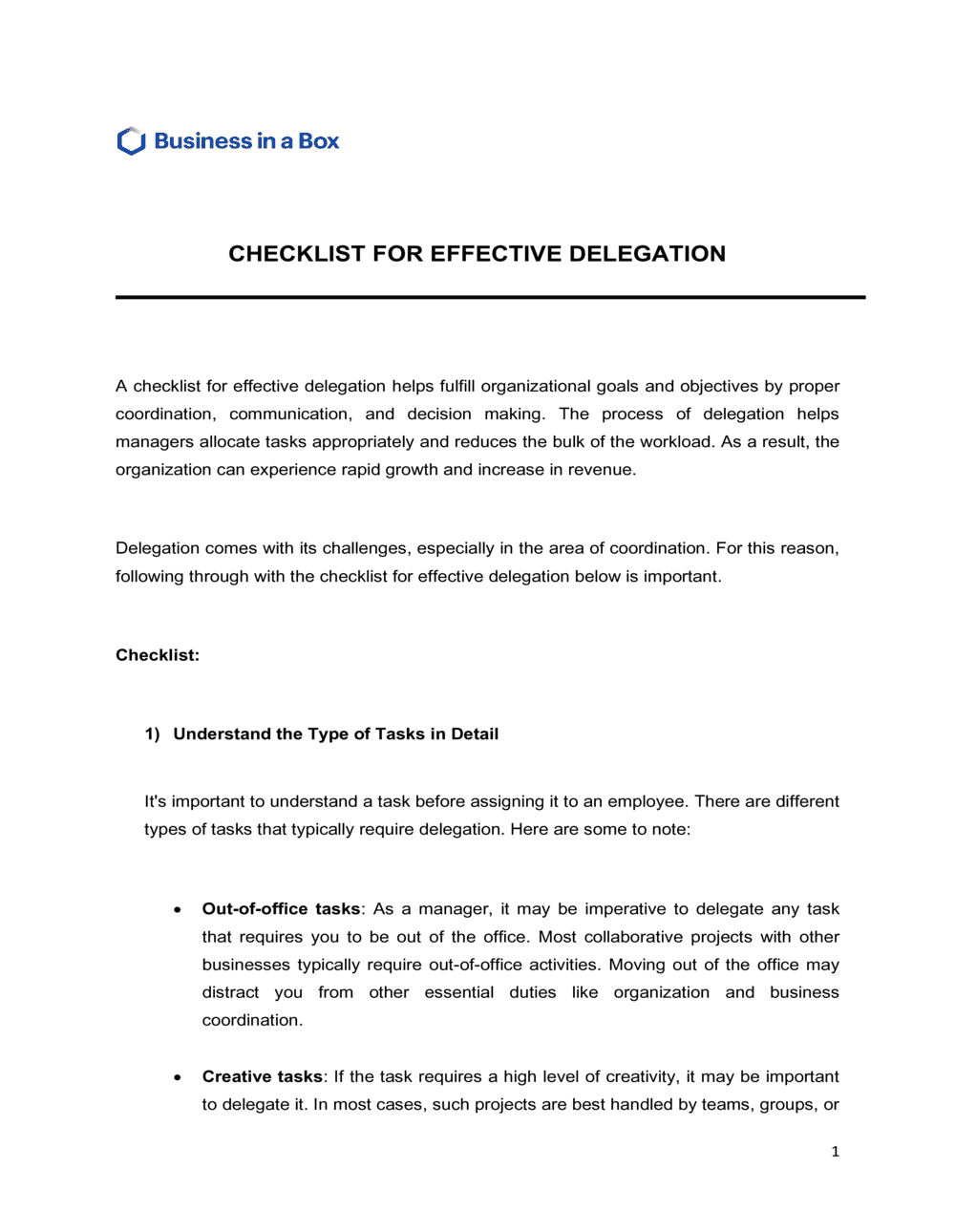
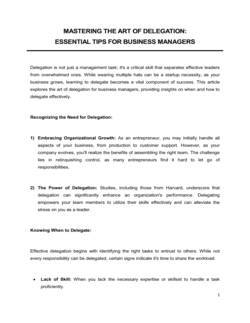
Checklist For Effective Delegation

Free download β€’ Use as a template β€’ Print or share

5 pagesβ€’20–25 min to useβ€’Difficulty: Standard
Learn more ↓
FreeChecklist For Effective Delegation Template

At a glance

What it is
A Checklist For Effective Delegation is a structured one-page form that helps managers and team leaders assign tasks with clarity, set measurable outcomes, confirm the delegate has the authority and resources to act, and schedule follow-up checkpoints. This free Word download is editable online and can be exported as PDF for use in team meetings or stored in project management systems.
When you need it
Use it whenever you assign a meaningful task or responsibility to a direct report, a peer, or a contractor β€” especially when the task spans multiple days, involves a decision-making boundary, or carries a deadline that affects other work streams.
What's inside
Task description and objective, delegate name and role, authority level, required resources, success criteria, deadline, check-in schedule, and completion confirmation fields.

What is a Checklist For Effective Delegation?

A Checklist For Effective Delegation is a structured one-page form that guides managers through every component of a clear, accountable task hand-off. It captures the task description, the named delegate, the authority and resources they are granted, measurable success criteria, a firm deadline, scheduled check-in points, escalation triggers, and a completion sign-off β€” converting what is often a brief verbal conversation into a documented agreement both parties can refer back to throughout execution. By making each element of delegation explicit, the checklist reduces miscommunication, prevents tasks from stalling mid-execution, and creates a record that supports performance management and continuous improvement.

Why You Need This Document

Unclear delegation is one of the most common causes of missed deadlines, duplicated effort, and team frustration β€” and most of it stems from hand-offs that skip one or two critical elements. When a delegate does not know their authority limits, they either stop to ask permission at every step or exceed their mandate without realizing it. When success criteria are vague, the finished work rarely matches what the manager expected. When no check-ins are scheduled, the first indication of a problem arrives on the due date. This template eliminates those failure points by turning delegation into a repeatable, five-to-ten-minute process with a documented outcome. For managers building high-performing teams, it also functions as a training tool β€” showing direct reports exactly what a well-structured assignment looks like so they can apply the same discipline when they delegate in turn.

Which variant fits your situation?

If your situation is…Use this template
Delegating a one-off task with a short deadlineChecklist For Effective Delegation
Tracking multiple delegated tasks across a team simultaneouslyTask Management Spreadsheet
Assigning responsibilities for an entire projectProject Plan Template
Distributing recurring duties to a new employeeEmployee Responsibilities Template
Documenting who is accountable for each business processRACI Matrix Template
Delegating approval authority during an absenceDelegation of Authority Letter
Reviewing an employee's ability to handle delegated workEmployee Performance Review Template

Common mistakes to avoid

❌ Delegating the task without defining authority

Why it matters: The delegate either makes decisions they weren't supposed to β€” creating rework or compliance issues β€” or stops at every decision point to ask, defeating the purpose of delegation.

Fix: Add a one-line authority statement to every delegation: what the delegate can decide, approve, or commit to without checking back.

❌ Setting a deadline with no milestones

Why it matters: A single deadline on a multi-day task means the first sign of a problem appears on the due date, when there is no time to fix it.

Fix: Add at least one interim milestone per three business days of task duration and schedule a brief check-in around it.

❌ Assigning to a role instead of a named person

Why it matters: Tasks assigned to 'the finance team' or 'the ops department' with no named owner fall through the cracks β€” everyone assumes someone else is handling it.

Fix: Always enter a single named delegate. If a team needs to collaborate, one person is still accountable for the final deliverable.

❌ Skipping the completion sign-off

Why it matters: Without formal acceptance, disputes arise weeks later about whether the work was done correctly, and there is no documented record of the outcome.

Fix: Treat the sign-off as non-optional. A 2-minute review and signature closes the loop and creates an auditable record for performance discussions.

The 9 key fields, explained

Task Title and Description

Delegate Name and Role

Authority Level

Required Resources and Support

Success Criteria and Expected Output

Deadline

Check-in Schedule

Escalation Triggers

Completion Confirmation

How to fill it out

  1. 1

    Identify the task and write a specific description

    Name the task precisely and write 2–3 sentences covering what needs to be done, the expected output, and why it matters to the business or project.

    πŸ’‘ Read your description aloud and ask whether someone unfamiliar with the project could start work from it alone. If not, add detail.

  2. 2

    Name the delegate and confirm fit

    Enter the delegate's full name, title, and department. Before filling in the rest of the form, verify they have the skills and current capacity to take on the task.

    πŸ’‘ Check the delegate's existing workload before assigning. Overburdened delegates miss deadlines even when they understand the task perfectly.

  3. 3

    Define the authority level explicitly

    State clearly what decisions the delegate can make independently β€” spending limits, external contact authority, and approval scope. Write dollar thresholds and conditions in specific terms.

    πŸ’‘ Err on the side of narrower authority for first-time delegates on a task type, then expand it after a successful completion.

  4. 4

    List required resources and confirm availability

    Identify every tool, system access, budget line, or person the delegate needs. Confirm each is available before the task begins β€” not after.

    πŸ’‘ A quick pre-start confirmation call of 5 minutes eliminates the most common cause of early-task delays.

  5. 5

    Write measurable success criteria

    Describe the deliverable in specific, observable terms β€” format, quantity, quality standard, and how it will be evaluated. Avoid subjective language like 'good quality' or 'reasonable detail.'

    πŸ’‘ Attach a sample output or previous example if one exists. A concrete reference reduces ambiguity more than any written description.

  6. 6

    Set the deadline and interim milestones

    Enter the final due date and at least one intermediate milestone for tasks longer than three business days. Milestones give both parties early warning of problems.

    πŸ’‘ Build in a 10–15% time buffer before the real deadline so late-stage issues can be corrected without affecting downstream commitments.

  7. 7

    Schedule check-ins and define escalation triggers

    Book check-in dates on the calendar at the time of delegation β€” not after. Write out the specific conditions that require immediate escalation outside the check-in schedule.

    πŸ’‘ Send a calendar invite for each check-in immediately after the delegation conversation so it cannot be overlooked.

  8. 8

    Complete the sign-off at task close

    Have the delegate confirm completion against the success criteria, then review and sign off as manager. Note any items that remain open or require follow-up.

    πŸ’‘ Archive the completed checklist in the relevant project folder β€” it becomes a useful reference for future delegation of similar tasks.

Frequently asked questions

What is a delegation checklist?

A delegation checklist is a structured form that guides a manager through every element of a successful task hand-off: what needs to be done, who is doing it, what authority they have, what resources they need, what success looks like, when it is due, and when progress will be reviewed. It replaces informal verbal instructions with a documented agreement that both parties can refer back to.

Why do managers need a checklist for delegation?

Most delegation failures trace back to incomplete hand-offs β€” missing authority limits, unclear deliverables, or no follow-up schedule. A checklist forces the manager to think through each element before assigning the work, so the delegate starts with everything they need and the manager retains the right level of visibility without micromanaging.

What is the difference between responsibility and accountability in delegation?

Responsibility is the obligation to do the work β€” it can be shared across multiple people. Accountability is the obligation to answer for the outcome β€” it belongs to one person. When delegating, the delegate takes on responsibility for execution, but the manager typically retains accountability for the result to the broader organization.

How much authority should I give a delegate?

Authority should match the task. For routine operational tasks, allow the delegate to make all day-to-day decisions within a defined budget or scope. For higher-stakes tasks, limit authority to execution decisions and require manager sign-off on commitments above a specific dollar or risk threshold. State the exact limits in the authority field of the checklist β€” vague authority is the same as no authority.

How often should I check in on a delegated task?

A single check-in per three business days is a reasonable default for most tasks. For high-stakes or time-sensitive work, daily 10-minute stand-ups may be appropriate. Schedule check-ins at the time of delegation β€” not reactively β€” so neither party has to initiate an awkward status request.

Can this checklist be used for delegating to contractors or freelancers?

Yes. The checklist applies to any delegation relationship β€” employees, contractors, or freelancers. For external parties, the authority and resources fields are especially important: contractors may need explicit permission to contact clients or vendors on your behalf, and their access to internal systems should be confirmed and scoped before work begins.

What should I do if a delegate misses a milestone or deadline?

Treat the first missed milestone as an early-warning signal, not a failure. Use the scheduled check-in β€” or trigger an unscheduled one β€” to identify the blocker and adjust resources, scope, or deadline as needed. Document the change in the checklist notes field. If the issue is a pattern, address it in the next performance conversation rather than at the task level.

Should I keep completed delegation checklists on file?

Yes. Completed checklists serve three purposes: they provide a reference for delegating similar tasks in the future, they create a record of completed work useful in performance reviews, and they document the scope and authority granted at the time β€” which matters if a dispute arises about what the delegate was authorized to do.

How this compares to alternatives

vs RACI Matrix Template

A RACI matrix maps responsibility across an entire project or process, identifying who is Responsible, Accountable, Consulted, and Informed for each activity. A delegation checklist focuses on a single task hand-off with specific authority, resources, and follow-up schedule. Use a RACI for project planning; use this checklist for the individual act of delegating each task within that plan.

vs Task Management Spreadsheet

A task management spreadsheet tracks the status of many tasks across a team at a portfolio level. A delegation checklist documents the details of one specific delegation β€” including authority, resources, and success criteria β€” that a spreadsheet row cannot capture. They complement each other: the checklist feeds structured data into the tracker.

vs Project Plan Template

A project plan covers the full scope, timeline, and resource allocation for a multi-phase initiative. A delegation checklist operates at the individual task level within that plan, ensuring each assigned work item is handed off with clarity and tracked to completion. Both are needed when running a project with a team.

vs Employee Performance Review Template

A performance review evaluates an employee's work over a review period. A delegation checklist is a real-time operational tool used during task execution. Completed delegation checklists provide concrete, documented evidence of what an employee was asked to do and whether they delivered β€” making them useful inputs into a performance review.

Industry-specific considerations

Professional Services

Delegating client deliverables to junior staff with clear quality standards and escalation points prevents scope errors that affect billable relationships.

Construction and Trades

Site managers use delegation checklists to assign safety-critical tasks with explicit authority limits and mandatory check-in points tied to project phases.

Retail and E-commerce

Store and operations managers delegate inventory, vendor, and staffing tasks with defined approval thresholds to maintain control across multiple locations.

Healthcare

Clinical team leads delegate administrative and non-clinical tasks with strict escalation triggers to ensure patient-facing responsibilities are never inadvertently transferred.

Template vs pro β€” what fits your needs?

PathBest forCostTime
Use the templateManagers and business owners delegating tasks to individuals or small teamsFree5–10 minutes per delegation
Template + professional reviewOrganizations standardizing delegation practices across departments or building a management training program$100–$500 for an HR or operations consultant to adapt the template to company standards1–3 days
Custom draftedEnterprises integrating delegation workflows into project management or HR software systems$500–$2,000+ for custom form development and system integration1–3 weeks

Glossary

Delegation
The act of assigning responsibility and authority for a specific task or decision to another person while retaining accountability for the outcome.
Authority Level
The defined scope of decisions a delegate may make independently without returning to the manager for approval.
Success Criteria
Specific, measurable conditions that define when a delegated task has been completed satisfactorily.
Check-in Point
A pre-scheduled moment during a task's timeline when the manager and delegate review progress, resolve blockers, and confirm the task is on track.
Accountability
The obligation of the delegate to report on progress and deliver the agreed outcome β€” distinct from responsibility, which can be shared.
Scope Creep
The gradual expansion of a task beyond its original boundaries, often caused by unclear initial instructions or unchecked assumptions.
Escalation Trigger
A pre-defined condition β€” such as a budget overrun, missed milestone, or decision outside the delegate's authority β€” that requires the delegate to notify the manager immediately.
RACI Matrix
A responsibility-assignment framework that classifies each task participant as Responsible, Accountable, Consulted, or Informed.
Delegation Creep
The pattern where a manager gradually reassigns so many tasks that the delegate becomes overloaded and the original intent of the delegation breaks down.

Part of your Business Operating System

This document is one of 3,000+ business & legal templates included in Business in a Box.

  • Fill-in-the-blanks β€” ready in minutes
  • 100% customizable Word document
  • Compatible with all office suites
  • Export to PDF and share electronically

Create your document in 3 simple steps.

From template to signed document β€” all inside one Business Operating System.
1
Download or open template

Access over 3,000+ business and legal templates for any business task, project or initiative.

2
Edit and fill in the blanks with AI

Customize your ready-made business document template and save it in the cloud.

3
Save, Share, Send, Sign

Share your files and folders with your team. Create a space of seamless collaboration.

Save time, save money, and create top-quality documents.

β˜…β˜…β˜…β˜…β˜…

"Fantastic value! I'm not sure how I'd do without it. It's worth its weight in gold and paid back for itself many times."

Managing Director Β· Mall Farm
Robert Whalley
Managing Director, Mall Farm Proprietary Limited
β˜…β˜…β˜…β˜…β˜…

"I have been using Business in a Box for years. It has been the most useful source of templates I have encountered. I recommend it to anyone."

Business Owner Β· 4+ years
Dr Michael John Freestone
Business Owner
β˜…β˜…β˜…β˜…β˜…

"It has been a life saver so many times I have lost count. Business in a Box has saved me so much time and as you know, time is money."

Owner Β· Upstate Web
David G. Moore Jr.
Owner, Upstate Web

Run your business with a system β€” not scattered tools

Stop downloading documents. Start operating with clarity. Business in a Box gives you the Business Operating System used by over 250,000 companies worldwide to structure, run, and grow their business.

Start freeΒ Β·Β No credit card required