10 Reasons Why You Quit Template

Free Word download β€’ Edit online β€’ Save & share with Drive β€’ Export to PDF

2 pagesβ€’20–30 min to fillβ€’Difficulty: Standard
Learn more ↓
Free10 Reasons Why You Quit Template

At a glance

What it is
The "10 Reasons Why You Quit" document is a structured operational form that captures the ten most common categories of reasons employees resign from a company. This free Word download gives HR managers and business owners a ready-to-use framework for recording, analyzing, and acting on employee departure data β€” editable online and exportable as PDF in minutes.
When you need it
Use it when an employee submits a resignation, during an offboarding conversation, or when conducting retrospective analysis of recent voluntary turnover across a team or department.
What's inside
A concise cover section identifying the departing employee and role, followed by ten clearly labeled departure-reason categories, each with a rating scale and a free-text comment field, plus a summary section for HR notes and recommended follow-up actions.

What is a 10 Reasons Why You Quit Document?

A 10 Reasons Why You Quit document is a structured operational form used during employee offboarding to record and rate the ten most common categories of reasons behind a voluntary resignation β€” including compensation, career growth, management quality, work-life balance, culture, and personal factors. Each category carries a numerical rating field and a free-text comment space, giving HR teams both quantitative data for trend analysis and qualitative context for root-cause investigation. Unlike an informal exit conversation, this template produces consistent, comparable records that can be aggregated across multiple departures to reveal patterns no single resignation makes visible on its own.

Why You Need This Document

Every voluntary departure that goes undocumented costs more than the replacement fee β€” it takes with it the organizational intelligence needed to prevent the next one. Without a standardized form, exit conversations produce anecdotes that differ in scope and depth depending on who conducts them, making it impossible to identify whether a spike in turnover reflects a compensation problem, a management failure, or a cultural shift. A missing career-path program, a consistently overloading manager, or a compensation band that fell below market two years ago will each generate resignations for months before anyone connects the dots β€” if the data is never collected in a consistent format. This template gives any business the structured instrument needed to move from individual exit stories to actionable workforce patterns, with no specialized HR analytics capability required.

Which variant fits your situation?

If your situation is…Use this template
Conducting a live conversation with the departing employeeExit Interview Questionnaire
Collecting anonymous departure feedback via a written formEmployee Exit Survey
Formally documenting the employee's resignation in writingResignation Letter
Acknowledging and accepting an employee's resignationResignation Acceptance Letter
Completing full offboarding steps and checklistsEmployee Offboarding Checklist
Analyzing turnover trends across the whole organizationEmployee Turnover Report
Presenting retention findings and recommendations to leadershipHR Report

Common mistakes to avoid

❌ Waiting until the last day to complete the form

Why it matters: Employees completing an exit form on their last day are focused on logistics β€” returning equipment, final pay, goodbyes. Response quality drops sharply and the most candid feedback is withheld.

Fix: Schedule the offboarding conversation and form completion 5–10 days before the last day when the employee is still engaged and candid.

❌ Accepting 'personal reasons' without any follow-up

Why it matters: A significant proportion of departures logged as personal reasons contain a preventable workplace component the employee chose not to disclose when asked a direct question.

Fix: Add a single neutral follow-up: 'Is there anything about your role or the work environment that also contributed?' This surfaces mixed-motive departures without pressuring the employee.

❌ Collecting exit data but never aggregating it

Why it matters: Individual forms generate anecdotes; aggregated data generates insight. If the forms are filed and never analyzed, the cost of collecting them produces zero organizational learning.

Fix: Assign one person to compile reason ratings into a quarterly summary and present it to department heads within 30 days of quarter close.

❌ Sharing identified individual responses with the departing employee's manager

Why it matters: If employees learn their specific comments were shared with the manager they criticized, future employees will provide sanitized responses β€” permanently degrading the quality of your exit data.

Fix: Establish and communicate a clear policy: individual responses are seen only by HR. Only aggregated, anonymized trends are shared with managers and leadership.

❌ Skipping the recommended-actions section because the issues seem structural

Why it matters: Labeling a problem 'structural' without assigning an owner and a date is the organizational equivalent of acknowledging a leak and putting a bucket under it.

Fix: For every structural issue identified, assign the smallest concrete next step β€” even 'HR director to raise compensation benchmarking with CFO by [DATE]' β€” so the conversation has a documented starting point.

❌ Using the form only for voluntary departures and ignoring early-tenure exits

Why it matters: Employees who leave within the first six months carry disproportionately high signal about onboarding gaps, job-description accuracy, and manager effectiveness during the critical ramp period.

Fix: Apply the form to all voluntary exits regardless of tenure, and flag any departure under 12 months for a separate root-cause conversation with the hiring manager.

The 10 key sections, explained

Employee and role identification

Compensation and benefits

Career growth and advancement

Management and leadership

Work environment and culture

Work-life balance and workload

Job role and responsibilities

Recognition and appreciation

Personal or external factors

HR notes and recommended actions

How to fill it out

  1. 1

    Schedule the conversation before the last day

    Book a 30-minute offboarding session with the departing employee at least three days before their final day. Earlier scheduling gives HR time to act on any time-sensitive issues, such as counter-offer decisions.

    πŸ’‘ Employees are most candid 5–10 days before departure β€” close enough to still care, far enough from the emotional trigger of the resignation itself.

  2. 2

    Complete the employee and role identification section

    Fill in the employee's full name, job title, department, direct manager, start date, and last working day before the meeting. Confirm tenure in years and months.

    πŸ’‘ Pull the data from your HRIS rather than asking the employee β€” you want them focused on reasons, not correcting administrative details.

  3. 3

    Walk through each of the ten reason categories

    For each category, ask the employee to rate its contribution to their decision on a 1–5 scale, then invite a short verbal comment. Record the rating and summarize the comment in the free-text field.

    πŸ’‘ Ask 'how much did this factor into your decision?' rather than 'was this a factor?' β€” the framing reduces yes/no answers and surfaces degree of impact.

  4. 4

    Probe the top two or three rated categories

    For any category rated 4 or 5, ask one follow-up question to move from symptom to root cause. Note the specific example or situation the employee references.

    πŸ’‘ The most actionable exit data comes from specific incidents or policies, not general impressions β€” 'the Q3 project crunch' is more useful than 'too much work.'

  5. 5

    Classify the departure as preventable or not

    In the HR notes section, mark whether the departure was preventable given reasonable company action. Personal relocations and life events are generally not preventable; compensation gaps, poor management, and lack of career path typically are.

    πŸ’‘ If you are unsure, default to 'preventable' β€” it keeps the organization honest about its retention levers.

  6. 6

    Assign follow-up actions with owners and dates

    For every actionable theme identified, write a specific action item, name the responsible party, and set a target completion date. Do not leave the recommended-actions field blank.

    πŸ’‘ Limit follow-up items to three per exit β€” more than three rarely get completed, and the most impactful items get lost.

  7. 7

    File the completed form and log the data

    Save the signed or completed form to the employee's HR file. Enter the reason ratings into your tracking spreadsheet or HRIS so patterns can be analyzed across multiple exits over time.

    πŸ’‘ A minimum of five completed forms is needed before reason patterns become statistically meaningful β€” resist drawing conclusions from one or two exits.

  8. 8

    Review aggregated data quarterly

    Pull all completed forms for the quarter and calculate the average rating per reason category. Identify the top two rated categories and check whether they are concentrated in a specific department or under a specific manager.

    πŸ’‘ Present aggregated findings, not individual responses, to leadership β€” anonymized data drives organizational change without exposing individual employees to potential blowback.

Frequently asked questions

What is a '10 Reasons Why You Quit' document?

It is a structured operational form that lists the ten most common categories of reasons employees voluntarily leave an organization β€” such as compensation, career growth, management, and work-life balance β€” and asks the departing employee to rate and comment on each. HR teams use it to collect consistent, comparable exit data that can be analyzed over time to identify preventable turnover patterns.

When should this document be used?

Use it whenever a permanent or long-term employee submits a voluntary resignation, ideally 5–10 days before their last day while they are still engaged enough to provide candid responses. It can also be used retrospectively when analyzing a spike in turnover or preparing a workforce retention report for leadership.

How is this different from an exit interview?

An exit interview is a live conversation β€” typically unstructured or semi-structured β€” between HR and the departing employee. This document provides the structured framework that makes exit data comparable across multiple departures. The two work together: the form captures standardized ratings, and the conversation provides the qualitative context behind them. Using only a conversation without a form produces rich anecdotes but no trackable data.

Should the form be completed by the employee or by HR?

Both approaches work, and the best practice is to have the employee complete the rating fields independently first, then review their responses together in a brief HR conversation. Self-completion before the meeting reduces social desirability bias β€” employees rate more honestly when they are not responding in real time to an HR representative.

How do you ensure employees are honest on the form?

Communicate clearly that individual responses are confidential, will not be shared with the departing employee's manager, and will only be reviewed by HR in aggregated, anonymized form. Employees who trust the confidentiality of exit data provide significantly more accurate responses. For departures that involve a difficult management relationship, offer the option of a written submission rather than a face-to-face review.

What should you do with the completed forms?

File each completed form in the employee's HR record, enter the reason ratings into a tracking spreadsheet or HRIS, and compile aggregated findings quarterly. Share only anonymized, aggregated trends with department heads and leadership β€” never individual responses. Use the quarterly summary to prioritize retention initiatives, compensation benchmarking reviews, or management development programs.

How many exits do you need before the data is meaningful?

A minimum of five completed forms in a comparable time period or team context is needed before reason patterns carry statistical weight. For small businesses with fewer than 20 employees, a 12-month rolling view is more useful than a quarterly snapshot. Organizations with high turnover should analyze data monthly once they have 10 or more forms on file.

Can this template be adapted for specific industries or roles?

Yes. The ten standard reason categories cover the most universal departure drivers, but organizations in high-turnover industries such as retail, hospitality, or healthcare may want to add sector-specific categories β€” such as physical working conditions, licensing and credentialing support, or shift scheduling β€” as additional rows. Retain the core ten to preserve comparability across departments and time periods.

Is this document the same as a resignation letter?

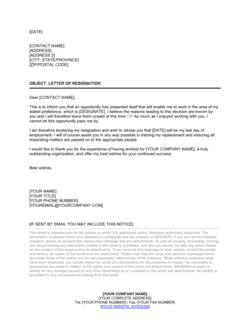
No. A resignation letter is written by the employee to formally notify the employer of their intent to leave on a specific date. This document is completed during the offboarding process to capture the reasons behind that decision. A resignation letter triggers the departure; this form explains it. Both should be retained in the employee's HR file.

How this compares to alternatives

vs Exit Interview Questionnaire

An exit interview questionnaire is a broad, open-ended document covering overall employment experience, company strengths, and suggestions for improvement. This template is narrower and more structured β€” focused specifically on rating the weight of ten defined departure reasons. The two complement each other: use the exit interview for qualitative depth and this form for quantitative tracking across multiple exits.

vs Employee Satisfaction Survey

An employee satisfaction survey is administered to current employees on a periodic basis to measure engagement and flag retention risks before resignations occur. This document is completed after a resignation has been submitted. The satisfaction survey is preventive; this form is diagnostic. Together they form a complete retention intelligence loop.

vs Resignation Letter

A resignation letter is written by the employee to formally notify the employer of their departure date and intent. It rarely explains the real reasons for leaving in actionable detail. This form goes deeper β€” it systematically captures the weighted reasons behind the resignation in a format HR can analyze and act on.

vs Employee Turnover Report

An employee turnover report aggregates headcount, attrition rates, and workforce trends at the organizational level for leadership review. This template is the individual data-collection instrument that feeds that report. The turnover report answers 'how much are we losing?'; this form answers 'why are we losing them?'

Industry-specific considerations

Technology / SaaS

Equity compensation gaps, technical career ladder clarity, and remote-work policy changes are the most frequently rated departure drivers in tech companies.

Retail and Hospitality

High voluntary turnover rates make systematic exit data collection especially valuable; shift scheduling flexibility and hourly wage competitiveness are top-rated categories.

Healthcare

Workload and burnout ratings dominate healthcare exit forms; the data feeds directly into staffing ratio decisions and well-being program investments.

Professional Services

Career advancement pace and client-facing workload are the leading departure categories; aggregated exit data informs promotion timelines and billable-hour targets.

Template vs pro β€” what fits your needs?

PathBest forCostTime
Use the templateSmall and mid-size businesses collecting voluntary exit data without a dedicated HR analytics functionFree30 minutes per exit conversation plus 1–2 hours quarterly to aggregate
Template + professional reviewOrganizations with turnover above 20% annually that need a custom reason taxonomy and a linked tracking spreadsheet$200–$800 for an HR consultant review and spreadsheet setup1–2 days
Custom draftedEnterprises integrating exit reason data into an HRIS or people analytics platform with automated reporting$2,000–$8,000 for HRIS configuration and dashboard build2–6 weeks

Glossary

Voluntary Turnover
Employee departures initiated by the employee rather than the employer, including resignations and retirements.
Involuntary Turnover
Departures initiated by the employer, such as layoffs, terminations for cause, or end of contract β€” not captured by this document.
Exit Interview
A structured conversation between HR and a departing employee to understand their reasons for leaving and gather feedback on the work environment.
Attrition Rate
The percentage of employees who leave an organization over a defined period, calculated as departures divided by average headcount.
Retention Risk
The likelihood that a current employee will voluntarily leave, often assessed using engagement scores, tenure, and compensation benchmarks.
Onboarding-to-Exit Cycle
The full employment lifecycle from hire date to separation, used to identify whether departure patterns concentrate at particular tenure milestones.
Stay Interview
A proactive conversation with a current employee aimed at identifying what would cause them to leave β€” the preventive counterpart to an exit interview.
Turnover Cost
The total direct and indirect cost of replacing a departed employee, typically estimated at 50–200% of the role's annual salary when factoring in recruiting, training, and lost productivity.
Root Cause Analysis
A structured method of tracing a recurring problem β€” such as high turnover in a specific team β€” back to its underlying cause rather than its surface symptoms.
Engagement Survey
A periodic questionnaire measuring how motivated, committed, and satisfied employees are with their roles and workplace β€” often used alongside exit data to identify retention risks before resignation.

Part of your Business Operating System

This document is one of 3,000+ business & legal templates included in Business in a Box.

  • Fill-in-the-blanks β€” ready in minutes
  • 100% customizable Word document
  • Compatible with all office suites
  • Export to PDF and share electronically

Create your document in 3 simple steps.

From template to signed document β€” all inside one Business Operating System.
1
Download or open template

Access over 3,000+ business and legal templates for any business task, project or initiative.

2
Edit and fill in the blanks with AI

Customize your ready-made business document template and save it in the cloud.

3
Save, Share, Send, Sign

Share your files and folders with your team. Create a space of seamless collaboration.

Save time, save money, and create top-quality documents.

β˜…β˜…β˜…β˜…β˜…

"Fantastic value! I'm not sure how I'd do without it. It's worth its weight in gold and paid back for itself many times."

Managing Director Β· Mall Farm
Robert Whalley
Managing Director, Mall Farm Proprietary Limited
β˜…β˜…β˜…β˜…β˜…

"I have been using Business in a Box for years. It has been the most useful source of templates I have encountered. I recommend it to anyone."

Business Owner Β· 4+ years
Dr Michael John Freestone
Business Owner
β˜…β˜…β˜…β˜…β˜…

"It has been a life saver so many times I have lost count. Business in a Box has saved me so much time and as you know, time is money."

Owner Β· Upstate Web
David G. Moore Jr.
Owner, Upstate Web

Run your business with a system β€” not scattered tools

Stop downloading documents. Start operating with clarity. Business in a Box gives you the Business Operating System used by over 250,000 companies worldwide to structure, run, and grow their business.

Free Forever PlanΒ Β·Β No credit card required