Exit Interview Questionnaire Template

Free Word download β€’ Edit online β€’ Save & share with Drive β€’ Export to PDF

3 pagesβ€’20–25 min to fillβ€’Difficulty: Standard
Learn more ↓
FreeExit Interview Questionnaire Template

At a glance

What it is
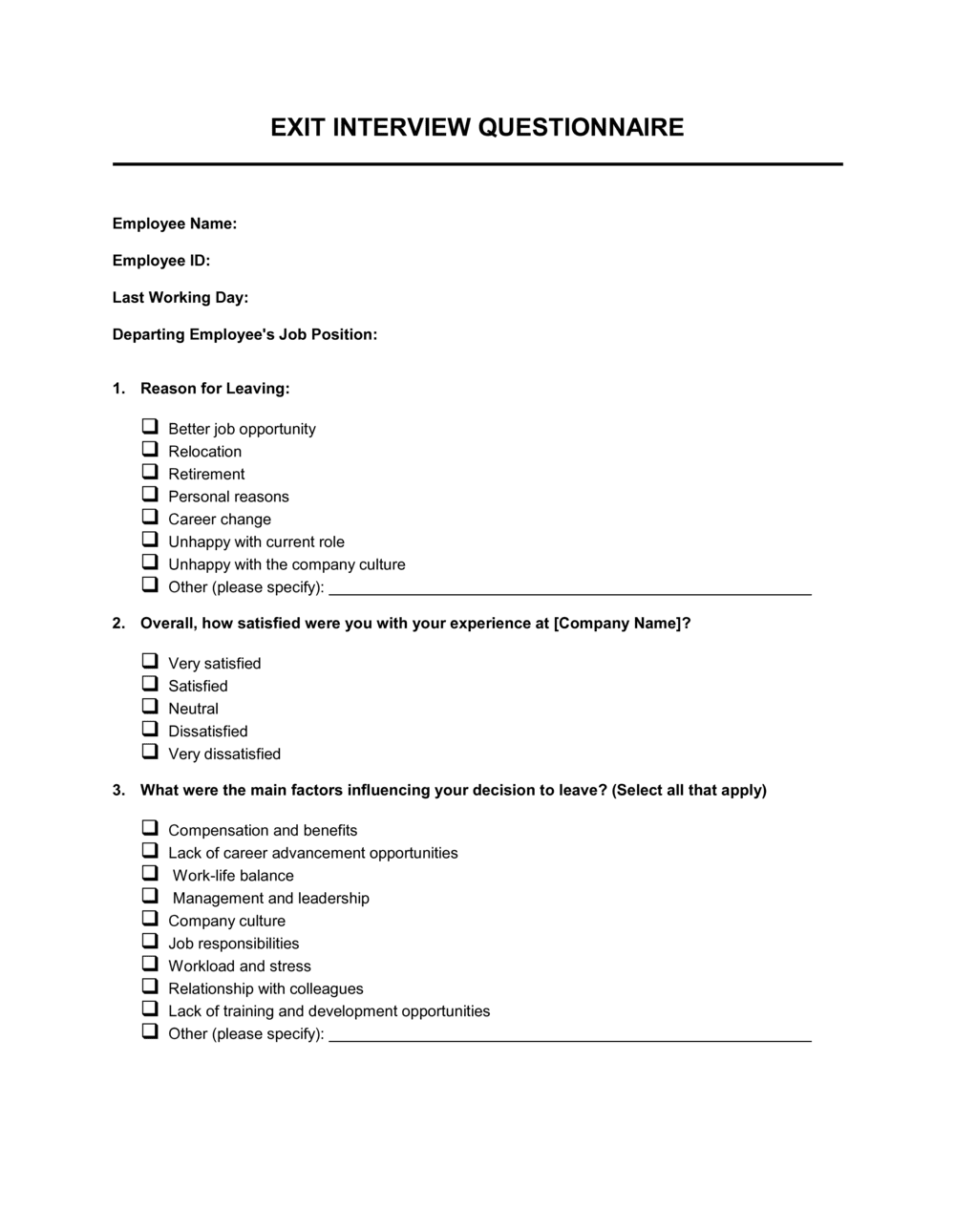
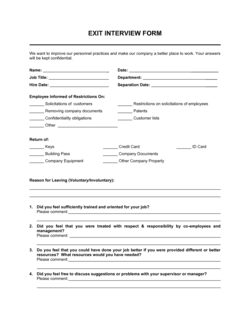
An Exit Interview Questionnaire is a structured form completed by an employee who is voluntarily leaving the organization. This free Word download gives HR teams a consistent set of questions covering role satisfaction, management, compensation, culture, and reasons for departure β€” ready to edit online and export as PDF in minutes.
When you need it
Use it during the offboarding process, typically in the final one to two weeks of employment, to gather candid feedback before the employee leaves. It is most valuable when turnover is rising, when a team or department loses multiple people in a short period, or when leadership wants structured data to improve retention.
What's inside
Employee and role details, primary reason for leaving, job satisfaction ratings, feedback on management and team, compensation and benefits assessment, culture and work environment questions, and an open-ended section for suggestions and final comments.

What is an Exit Interview Questionnaire?

An Exit Interview Questionnaire is a structured feedback form completed by an employee who is voluntarily leaving an organization. It captures standardized responses on job satisfaction, management effectiveness, compensation competitiveness, workplace culture, and the primary reasons for departure. Unlike an informal conversation, a written questionnaire ensures that every departure generates comparable, aggregable data β€” giving HR teams and leadership a reliable picture of why people leave rather than a collection of one-off impressions.

Why You Need This Document

Without a consistent exit questionnaire, the real reasons employees leave go unrecorded. Managers summarize departures in their own words, critical feedback about leadership never reaches HR, and the same problem triggers the same turnover six months later. The cost is concrete: replacing a mid-level employee typically runs 50–100% of their annual salary when recruitment, onboarding, and lost productivity are factored in. A structured questionnaire converts individual departures into trend data β€” and trend data into decisions. When three exits in one quarter all cite the same manager or the same compensation gap, leadership has specific evidence to act on. This template gives you a ready-to-use form you can send to the next departing employee today.

Which variant fits your situation?

If your situation is…Use this template
Employee is leaving voluntarily and has time for a full interviewExit Interview Questionnaire
Employee is being laid off or terminated involuntarilyEmployee Termination Checklist
Gathering quick pulse feedback from a large departing cohortEmployee Satisfaction Survey
Documenting the complete offboarding process end to endEmployee Offboarding Checklist
Capturing 360-degree performance feedback before departureEmployee Performance Review
Tracking recurring exit themes across multiple departuresHR Report Template

Common mistakes to avoid

❌ Conducting exit interviews only for senior roles

Why it matters: Front-line and mid-level turnover drives the highest aggregate cost and often signals problems that senior exits do not surface. Skipping them creates a blind spot in retention data.

Fix: Apply the same questionnaire to all voluntary departures regardless of seniority. Segment the data by level when analyzing, but collect it universally.

❌ Having the direct manager conduct the exit interview

Why it matters: Employees rarely give honest feedback about their manager to that same manager. Responses become vague or positive, making the data useless for identifying management issues.

Fix: Assign exit interviews to HR or a neutral party β€” ideally someone the employee has not reported to. For small companies, an anonymous written form is more reliable than a manager-led conversation.

❌ Collecting responses without a system to aggregate them

Why it matters: Individual exit forms sitting in email inboxes provide no actionable insight. Without aggregation, the same problem can appear in ten consecutive exits and never trigger a response.

Fix: Store completed forms in a shared HR folder and tag each response with at least one primary theme. Review aggregated themes monthly or quarterly, not exit by exit.

❌ Asking leading or emotionally loaded questions

Why it matters: Questions like 'Was your manager unfair to you?' prime a specific answer and produce biased data that HR cannot reliably act on.

Fix: Use neutral phrasing: 'How would you describe the feedback you received from your manager?' Pilot the form with two or three current employees to catch loaded language before it goes live.

The 9 key fields, explained

Employee and role information

Primary reason for leaving

Job satisfaction rating

Management and leadership feedback

Compensation and benefits assessment

Culture and work environment

What would have made you stay

Would you recommend the company as an employer

Additional comments and suggestions

How to fill it out

  1. 1

    Customize the header with your company details

    Replace the placeholder company name, logo, and HR contact information at the top of the form. Confirm the form version date so HR knows which version of the questionnaire each response came from.

    πŸ’‘ Add a form version number (e.g., EIQ-v2) to the header β€” when you update questions over time, you will be able to segment historical data accurately.

  2. 2

    Fill in the employee and role information block

    Enter the employee's name, title, department, direct manager, hire date, and final day before distributing. Pre-filling this saves the departing employee time and ensures data completeness.

    πŸ’‘ Pre-populate these fields from your HRIS before sending β€” blank administrative fields are the most common source of incomplete exit records.

  3. 3

    Send the form at least five business days before the last day

    Distribute the questionnaire early enough that the employee can complete it thoughtfully, not in the final hour of their last day. Attach a brief note explaining how responses will be used and who will review them.

    πŸ’‘ Employees give more candid responses when they know their feedback goes to HR leadership rather than directly to their manager β€” state this explicitly in your cover note.

  4. 4

    Offer both written and verbal completion options

    Some employees are more comfortable discussing their reasons in a conversation than writing them down. Offer the form as a baseline and an optional 20-minute call with HR to go deeper on any section.

    πŸ’‘ Employees who choose the verbal option often reveal root causes that the written form would not capture β€” especially for sensitive management or culture issues.

  5. 5

    Review responses within 48 hours of the last day

    Read each completed form while the context is fresh. Flag any responses that indicate a systemic issue β€” repeated mentions of the same manager, compensation gap, or workload concern.

    πŸ’‘ Create a simple tagging system (e.g., 'compensation,' 'management,' 'growth') and apply tags to each form as you review. After ten exits, patterns become immediately visible.

  6. 6

    Aggregate themes quarterly and share with leadership

    Compile exit responses into a quarterly summary showing top departure reasons, satisfaction score averages, and eNPS trend. Present this to department heads with recommended actions.

    πŸ’‘ A simple heat map of satisfaction scores by department β€” not just overall averages β€” makes it immediately obvious which teams need attention.

Frequently asked questions

What is an exit interview questionnaire?

An exit interview questionnaire is a structured form completed by an employee who is voluntarily leaving an organization. It collects standardized feedback on job satisfaction, management, compensation, culture, and the primary reasons for departure. HR teams use the responses to identify retention risks, improve workplace conditions, and reduce future turnover.

When should an exit interview questionnaire be given to a departing employee?

Distribute the questionnaire within the first two days after an employee gives notice, and ask them to complete it at least three to five business days before their last day. This gives the employee time to reflect and respond thoughtfully, rather than rushing through it in their final hours. Waiting until the last day results in incomplete or superficial responses.

Are exit interview responses confidential?

Responses are typically treated as confidential within HR and shared with leadership only in aggregated, anonymized form. Individual responses should not be shared with the departing employee's direct manager unless the employee explicitly consents. Communicating this policy upfront significantly increases candor and response quality.

Should exit interviews be written or verbal?

Both formats have merit. A written questionnaire provides consistent, comparable data across all departures and is less intimidating for employees with sensitive feedback. A verbal interview allows follow-up questions and captures nuance the form may miss. Many HR teams use a written form as the baseline and offer an optional verbal follow-up for employees who want to expand on their responses.

What is the most important question on an exit interview questionnaire?

The single most actionable question is typically: 'What could the company have done differently to keep you?' This open-ended prompt cuts through satisfaction ratings and surfaces specific, addressable causes. Place it early in the form β€” immediately after the primary reason for leaving β€” before response fatigue sets in.

Can exit interview data be used to improve retention?

Yes, but only if responses are aggregated and reviewed systematically. Individual exit forms rarely reveal patterns; quarterly trend analysis does. When the same themes β€” a specific manager, a compensation gap, a lack of growth opportunities β€” appear across multiple exits, leadership has concrete evidence to act on. Companies that review exit data quarterly and close the loop with department heads typically see measurable reductions in voluntary turnover within 12 months.

What is the difference between an exit interview and a stay interview?

An exit interview collects feedback from an employee who has already decided to leave β€” it is retrospective. A stay interview is a proactive conversation with a current employee to understand what keeps them engaged and what might cause them to leave. Stay interviews are preventive; exit interviews are diagnostic. High-performing retention programs use both.

Does an exit interview questionnaire need to be signed by the employee?

No signature is required for a standard exit questionnaire β€” it is a feedback tool, not a legal document. However, if your offboarding process includes a separation agreement, final pay acknowledgment, or reminder of ongoing confidentiality obligations, those documents should be signed separately and are not part of the exit interview form itself.

How this compares to alternatives

vs Employee satisfaction survey

An employee satisfaction survey is administered to the full workforce at regular intervals to measure current engagement. An exit interview questionnaire targets only departing employees and captures retrospective, candid feedback that current employees are unlikely to share. The two tools complement each other β€” satisfaction surveys detect risk early; exit questionnaires diagnose it after the fact.

vs Employee offboarding checklist

An offboarding checklist is a task-tracking tool covering access revocation, equipment return, knowledge transfer, and final pay. An exit interview questionnaire is a feedback instrument focused on the employee's experience. Both are used during offboarding, but they serve different purposes β€” the checklist ensures process compliance; the questionnaire captures strategic insight.

vs Performance review form

A performance review evaluates an employee's contributions against defined goals during their tenure. An exit interview questionnaire captures the employee's assessment of the organization, not the other way around. The two documents are occasionally combined for departing employees but serve opposite perspectives.

vs Employee warning letter

An employee warning letter documents performance or conduct issues during employment as part of a corrective action process. An exit interview questionnaire is used only when an employee is voluntarily leaving and has no disciplinary function. Using an exit questionnaire in an involuntary termination context is inappropriate and can create legal exposure.

Industry-specific considerations

Technology / SaaS

High voluntary turnover driven by competing offers makes structured exit data essential for understanding whether compensation benchmarking or role growth is the primary driver.

Healthcare

Clinical staff shortages make every departure costly; exit questionnaires help distinguish burnout and workload issues from compensation gaps that can be directly addressed.

Retail / Hospitality

High turnover volumes require a short, efficient form that front-line employees can complete in under ten minutes, with questions focused on scheduling, management, and culture.

Professional Services

Client relationship and knowledge transfer risks make departure data especially valuable; exit forms flag which accounts need immediate coverage reassignment.

Template vs pro β€” what fits your needs?

PathBest forCostTime
Use the templateHR teams and small business owners conducting standard voluntary exit interviewsFree10 minutes to set up, 10–15 minutes per employee to complete
Template + professional reviewCompanies wanting to add custom rating scales, branded design, or integration with an HRIS$50–$200 (HR consultant or designer)1–2 days
Custom draftedEnterprise HR teams building automated exit survey workflows with analytics dashboards$500–$2,000+ (HR tech setup or people analytics consultant)1–3 weeks

Glossary

Exit Interview
A structured conversation or written survey conducted with a departing employee to understand their reasons for leaving and gather feedback on the organization.
Voluntary Turnover
Employee separations initiated by the employee rather than the employer β€” resignations, retirements, or departures for other opportunities.
Retention Risk
The likelihood that an employee or group of employees will leave, often identified through engagement surveys, performance data, or exit patterns.
Offboarding
The formal process of transitioning a departing employee out of the organization, covering knowledge transfer, access revocation, final pay, and feedback collection.
Stay Interview
A proactive conversation with a current employee to understand what keeps them engaged and what might cause them to leave β€” the preventive counterpart to the exit interview.
eNPS (Employee Net Promoter Score)
A single-question metric asking employees how likely they are to recommend the company as a place to work, scored on a 0–10 scale.
Turnover Rate
The percentage of employees who leave an organization over a given period, calculated as separations divided by average headcount.
Knowledge Transfer
The process of documenting and passing on a departing employee's responsibilities, contacts, and institutional knowledge to a successor or team.
Confidentiality Agreement (Exit)
A reminder clause sometimes included at the end of an exit form confirming the employee's ongoing obligations under their original NDA or confidentiality agreement.
Root Cause Analysis
A structured method for identifying the underlying reasons behind a pattern β€” such as repeated turnover in one team β€” rather than treating each departure in isolation.

Part of your Business Operating System

This document is one of 3,000+ business & legal templates included in Business in a Box.

  • Fill-in-the-blanks β€” ready in minutes
  • 100% customizable Word document
  • Compatible with all office suites
  • Export to PDF and share electronically

Create your document in 3 simple steps.

From template to signed document β€” all inside one Business Operating System.
1
Download or open template

Access over 3,000+ business and legal templates for any business task, project or initiative.

2
Edit and fill in the blanks with AI

Customize your ready-made business document template and save it in the cloud.

3
Save, Share, Send, Sign

Share your files and folders with your team. Create a space of seamless collaboration.

Save time, save money, and create top-quality documents.

β˜…β˜…β˜…β˜…β˜…

"Fantastic value! I'm not sure how I'd do without it. It's worth its weight in gold and paid back for itself many times."

Managing Director Β· Mall Farm
Robert Whalley
Managing Director, Mall Farm Proprietary Limited
β˜…β˜…β˜…β˜…β˜…

"I have been using Business in a Box for years. It has been the most useful source of templates I have encountered. I recommend it to anyone."

Business Owner Β· 4+ years
Dr Michael John Freestone
Business Owner
β˜…β˜…β˜…β˜…β˜…

"It has been a life saver so many times I have lost count. Business in a Box has saved me so much time and as you know, time is money."

Owner Β· Upstate Web
David G. Moore Jr.
Owner, Upstate Web

Run your business with a system β€” not scattered tools

Stop downloading documents. Start operating with clarity. Business in a Box gives you the Business Operating System used by over 250,000 companies worldwide to structure, run, and grow their business.

Start freeΒ Β·Β No credit card required