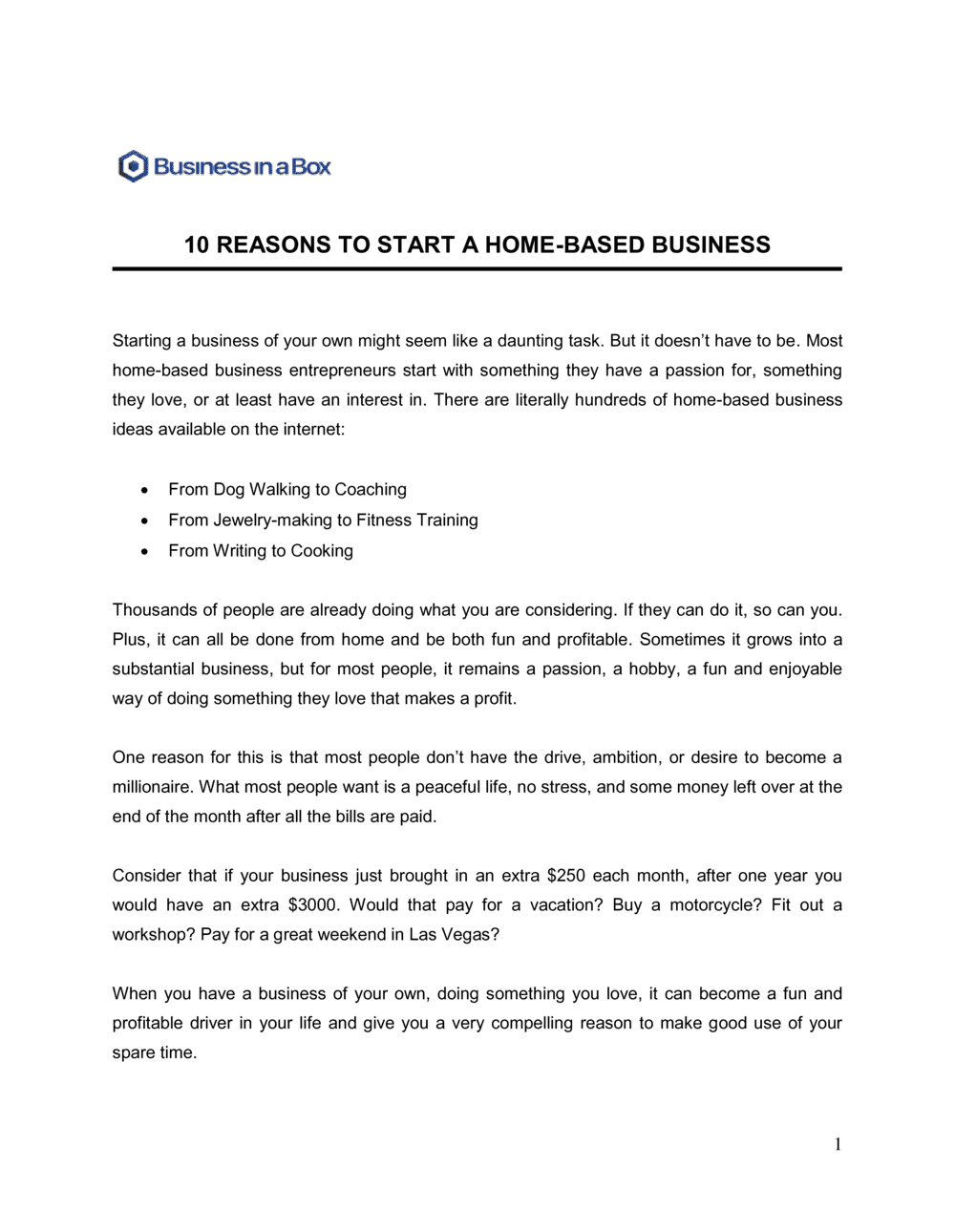
10 Reasons To Start A Home Based Business Template

Free to read β€’ Save or share with one click

Free10 Reasons To Start A Home Based Business Template

At a glance

What it is
10 Reasons To Start A Home Based Business is a structured persuasive and planning document that outlines the core advantages of launching a business from home β€” covering financial benefits, lifestyle flexibility, tax advantages, low startup costs, and long-term growth potential. This free Word download gives aspiring entrepreneurs, coaches, and advisors a ready-to-edit framework they can customize and export as PDF to inform, motivate, and guide home business decisions.
When you need it
Use it when you are evaluating whether to launch a home based business, presenting the case to a partner or family member, advising a client on entrepreneurship options, or creating educational content for a workshop or seminar on self-employment.
What's inside
A structured list of ten evidence-backed reasons covering cost savings, tax deductions, schedule flexibility, commute elimination, work-life balance, scalability, low overhead, increased productivity, personal fulfillment, and growing market demand for remote and home-based ventures.

What is a 10 Reasons To Start A Home Based Business document?

A 10 Reasons To Start A Home Based Business document is a structured persuasive and planning resource that presents the core financial, lifestyle, and strategic advantages of launching a business from a personal residence rather than a commercial premises. It covers benefits ranging from lower startup costs and tax deductions to schedule flexibility, commute elimination, and access to global digital markets β€” each supported by specific data points and real-world examples. Coaches, advisors, and aspiring entrepreneurs use it to evaluate the home based business model systematically, rather than acting on vague enthusiasm or incomplete information.

Why You Need This Document

Deciding to start a home based business without a structured framework means weighing major life and financial changes based on assumptions that may be incomplete or simply wrong. Most people underestimate available tax deductions, overestimate the social isolation risk, and fail to account for the compounding value of reclaimed commute time β€” errors that lead either to premature hesitation or underprepared launches. This document surfaces every material advantage in one place, with the context needed to evaluate each one honestly. For advisors and coaches, it serves as a credibility-building client handout that replaces informal conversation with a documented, repeatable process. Used before a business plan, it answers the foundational question β€” "is this the right model for me?" β€” so that subsequent planning work is built on a clear, informed commitment rather than lingering doubt.

Which variant fits your situation?

If your situation is…Use this template
Planning an actual home based business from scratchHome Based Business Plan
Presenting a full business case to investors or a bankBusiness Plan
Outlining a freelance or consulting service offeringConsulting Proposal
Mapping out startup costs and initial financial requirementsStartup Budget Template
Setting goals and milestones for a new home ventureAction Plan Template
Formalizing a side business into a legal entityBusiness Registration Checklist
Identifying a niche or market for a home based serviceMarket Analysis Template

Common mistakes to avoid

❌ Using generic statistics without sources

Why it matters: Uncited statistics erode trust immediately with any reader who has seen similar documents. Skeptical audiences dismiss the entire argument when data cannot be verified.

Fix: Cite every statistic with a specific source and year β€” US Census Bureau, Gallup, IRS Publication numbers, or Statistics Canada. Update figures annually.
❌ Presenting only upside without acknowledging real challenges

Why it matters: A one-sided document reads as promotional rather than advisory, which undermines the credibility of the presenter and the document's usefulness for genuine decision-making.

Fix: Add a brief 'considerations' note under each reason acknowledging the relevant challenge β€” isolation, self-discipline, zoning rules β€” and how it is typically managed.

❌ Ignoring zoning and local business licensing requirements

Why it matters: Many residential zones restrict or prohibit certain business activities, client visits to the home, and signage. Overlooking this exposes the reader to fines or forced business closure.

Fix: Include a reminder in the document that readers should verify local zoning bylaws and obtain any required home occupation permit before launching.

❌ Treating the document as a finished product without personalization

Why it matters: A template with placeholder text and generic examples fails to resonate with the specific reader and signals a lack of preparation when used in a client or workshop context.

Fix: Spend at least 30 minutes replacing every generic example and statistic with content specific to the reader's industry, location, and business type before presenting or distributing.

The 10 key sections, explained

Reason 1 β€” Significantly lower startup costs

Reason 2 β€” Tax advantages and home office deductions

Reason 3 β€” Flexible schedule and autonomy

Reason 4 β€” Elimination of commute time and cost

Reason 5 β€” Improved work-life balance and wellbeing

Reason 6 β€” Low ongoing overhead and operating costs

Reason 7 β€” Access to growing remote and digital markets

Reason 8 β€” Scalability without proportional cost increases

Reason 9 β€” Greater personal fulfillment and ownership

Reason 10 β€” Favorable market trends and timing

How to fill it out

  1. 1

    Identify your primary audience and purpose

    Decide whether this document is for personal decision-making, client advising, educational use, or a presentation. The audience determines how much supporting data and personalization each section needs.

    πŸ’‘ A document used in a workshop needs more context and supporting statistics than one used for personal planning. Add footnotes with data sources when presenting to a skeptical audience.

  2. 2

    Customize each reason with specific supporting data

    Replace placeholder statistics and generic statements with current, sourced figures β€” IRS deduction limits, average commute costs for your city, or local business formation rates from the US Census Bureau.

    πŸ’‘ Citing a specific, dated source for each financial claim (e.g., 'IRS Publication 587, 2025') adds credibility that generic statements cannot.

  3. 3

    Add personal or client-specific examples

    Where the template uses a general example, substitute a real scenario relevant to your business type, industry, or personal situation. Specific examples are more persuasive than abstractions.

    πŸ’‘ A sentence like 'A freelance copywriter in Denver recovered 240 hours per year by eliminating her commute' lands harder than 'commute time is significant.'

  4. 4

    Tailor the tax section to your jurisdiction

    Update the home office deduction section to reflect the tax rules in your country or province. US, Canadian, UK, and Australian rules differ meaningfully on what qualifies and how to calculate the deduction.

    πŸ’‘ Add a disclaimer recommending the reader consult a tax professional. Tax rules change annually and the document should not be read as tax advice.

  5. 5

    Sequence the reasons to match your reader's priorities

    Reorder the ten reasons so the two or three most relevant to your audience appear first. A stay-at-home parent prioritizes flexibility and wellbeing; a career changer prioritizes financial viability and market access.

    πŸ’‘ Leading with the reason your reader already suspects is true β€” then backing it up with data β€” builds credibility faster than starting with an argument they haven't considered.

  6. 6

    Add a call to action or next-step section

    Append a brief section listing the three to five concrete next steps a reader should take after reviewing the document β€” registering a business name, opening a business bank account, or booking an advisor consultation.

    πŸ’‘ A next-step section transforms a persuasive document into an action plan and significantly increases the chance the reader does something with the information.

Frequently asked questions

What is a home based business?

A home based business is any commercial venture operated primarily from the owner's personal residence rather than a separate commercial premises. It can take many forms β€” freelance services, e-commerce, coaching, consulting, tutoring, or product manufacturing at a small scale. The defining characteristic is that the home serves as the principal place of business for tax, operational, and administrative purposes.

What are the main advantages of starting a home based business?

The primary advantages are lower startup and operating costs, access to home office tax deductions, schedule flexibility, elimination of commute time and expense, improved work-life balance, and the ability to scale digitally without proportional increases in fixed costs. Together these factors make home based businesses one of the lowest-risk entry points into entrepreneurship for most individuals.

Can I deduct home office expenses for a home based business?

In the United States, home office expenses are deductible if you use a portion of your home exclusively and regularly for business. The IRS offers a simplified method ($5 per square foot, up to 300 sq ft) or an actual expense method based on the percentage of your home used for business. Canada, the UK, and Australia have equivalent provisions with different calculation methods. Always consult a tax professional to confirm eligibility for your specific situation.

What types of businesses work best as home based businesses?

Service-based businesses tend to be the strongest fit β€” consulting, copywriting, graphic design, bookkeeping, coaching, tutoring, and virtual assistance all require minimal physical infrastructure. Digital product businesses (online courses, software, templates), e-commerce operations run from a home warehouse or via dropshipping, and small-scale manufacturing or craft businesses also operate effectively from home. Businesses requiring significant foot traffic, heavy equipment, or regulated commercial facilities are less suitable.

How much does it cost to start a home based business?

Startup costs vary widely by business type, but many home based service businesses launch for under $1,000 β€” covering a business registration fee ($50–$200), a dedicated business bank account, basic software subscriptions, and business insurance ($300–$600 per year). Product-based businesses may require inventory investment. The absence of commercial rent is the primary cost advantage over a traditional brick-and-mortar launch.

What is the difference between a home based business and a remote job?

A remote job is employment with a company β€” you receive a salary, your employer withholds taxes, and you have no ownership in the business. A home based business means you are self-employed or operate your own entity: you bear the financial risk, pay self-employment taxes, own the revenue and assets, and build equity in something you control. The financial, legal, and tax implications are fundamentally different.

How do I stay productive when working from home?

The most consistently effective practices are: a dedicated workspace used only for business, defined start and end times adhered to daily, a morning routine that signals the transition into work mode, time-blocked schedules for deep work versus meetings and admin, and deliberate social connection to offset isolation. Productivity in a home business is a designed system, not a default outcome.

Is a home based business right for everyone?

No. Home based business ownership suits people who are self-directed, comfortable with income variability, able to maintain discipline without external structure, and who have a home environment that can accommodate a dedicated workspace. People who depend on the social energy of a workplace, have significant domestic distractions, or need the financial predictability of a salary may find the transition more challenging than anticipated. The decision should be evaluated against personal working style as rigorously as financial opportunity.

How this compares to alternatives

vs Business Plan

A business plan is a comprehensive operational and financial document designed to guide execution and secure capital. The 10 Reasons document is a motivational and decision-support tool aimed at helping someone evaluate whether to start a home based business at all. Use this document first to build conviction, then a business plan to structure execution.

vs One-Page Business Plan

A one-page business plan captures the core strategic elements of a specific venture β€” market, offer, channels, and financials. The 10 Reasons document is broader and more general, designed to advocate for home based entrepreneurship as a model rather than plan a specific business. They serve sequential rather than competing purposes.

vs Home Based Business Plan

A home based business plan is a tailored operational document for a specific home business, covering market analysis, services, pricing, and financial projections. The 10 Reasons document precedes that work β€” it addresses the 'should I do this?' question, while a home based business plan addresses the 'how will I do this?' question.

vs Action Plan Template

An action plan translates a decision into sequenced tasks with owners, deadlines, and success metrics. The 10 Reasons document informs and motivates the decision; an action plan operationalizes it. Pair the two: use the 10 Reasons to build commitment, then an action plan to define the first 90 days of execution.

Industry-specific considerations

Professional Services

Consultants, accountants, and lawyers operating solo practices frequently use home offices as their registered principal place of business to maximize the home office deduction and minimize overhead.

Creative and Marketing

Freelance designers, copywriters, videographers, and social media managers are among the most common home based business operators, with client relationships managed entirely through digital channels.

E-commerce and Retail

Home based e-commerce sellers using dropshipping, print-on-demand, or small-batch inventory models operate product businesses with no commercial premises, relying on third-party fulfillment to handle logistics.

Education and Coaching

Tutors, online course creators, life coaches, and business coaches built the largest cohort of new home based businesses post-2020, leveraging video platforms and learning management systems to serve students globally.

Template vs pro β€” what fits your needs?

PathBest forCostTime
Use the templateIndividuals evaluating a home business launch, advisors preparing client materials, and workshop facilitatorsFree30–60 minutes to customize
Template + professional reviewBusiness coaches or career counselors creating branded client-facing content from this framework$100–$300 for a professional editor or content designer1–2 days
Custom draftedOrganizations producing a proprietary home business guide as a lead magnet, course module, or published resource$500–$2,000 for a professional writer and designer1–2 weeks

Glossary

Home Based Business
A business operated primarily from the owner's residence, with minimal or no separate commercial premises.
Home Office Deduction
A tax deduction available to business owners who use a dedicated, exclusive portion of their home for business purposes β€” calculated either by the simplified method or actual expense method.
Overhead Costs
Ongoing operating expenses not directly tied to producing a product or delivering a service, such as rent, utilities, and insurance.
Sole Proprietorship
The simplest business structure where one person owns and operates the business with no legal separation between the owner and the entity.
Work-Life Balance
The degree to which a person distributes time and energy between professional responsibilities and personal or family life in a sustainable way.
Scalability
The capacity of a business to grow revenue without a proportional increase in costs or resources required to operate.
Self-Employment Tax
The US Social Security and Medicare tax paid by sole proprietors and independent contractors, currently 15.3% on net self-employment income.
Startup Costs
One-time expenses incurred to establish a new business before it begins generating revenue, including equipment, licenses, and initial marketing.
Zoning Regulations
Local government rules that govern how residential and commercial properties may be used β€” some restrict or prohibit business activities in residential areas.
Digital Nomad
A self-employed professional who works remotely and is not tied to a fixed office location, often working from home, co-working spaces, or while traveling.

Part of your Business Operating System

This document is one of 3,000+ business & legal templates included in Business in a Box.

  • Fill-in-the-blanks β€” ready in minutes
  • Compatible with all office suites
  • Export to PDF and share electronically

Create your document in 3 simple steps.

From template to signed document β€” all inside one Business Operating System.
1
Download or open template

Access over 3,000+ business and legal templates for any business task, project or initiative.

2
Edit and fill in the blanks with AI

Customize your ready-made business document template and save it in the cloud.

3
Save, Share, Send, Sign

Share your files and folders with your team. Create a space of seamless collaboration.

Save time, save money, and create top-quality documents.

β˜…β˜…β˜…β˜…β˜…

"Fantastic value! I'm not sure how I'd do without it. It's worth its weight in gold and paid back for itself many times."

Managing Director Β· Mall Farm
Robert Whalley
Managing Director, Mall Farm Proprietary Limited
β˜…β˜…β˜…β˜…β˜…

"I have been using Business in a Box for years. It has been the most useful source of templates I have encountered. I recommend it to anyone."

Business Owner Β· 4+ years
Dr Michael John Freestone
Business Owner
β˜…β˜…β˜…β˜…β˜…

"It has been a life saver so many times I have lost count. Business in a Box has saved me so much time and as you know, time is money."

Owner Β· Upstate Web
David G. Moore Jr.
Owner, Upstate Web

Run your business with a system β€” not scattered tools

Stop downloading documents. Start operating with clarity. Business in a Box gives you the Business Operating System used by over 250,000 companies worldwide to structure, run, and grow their business.

Free Forever PlanΒ Β·Β No credit card required