4 Reasons Great Leaders Rise Early Template

Free to read β€’ Save or share with one click

Free4 Reasons Great Leaders Rise Early Template

At a glance

What it is
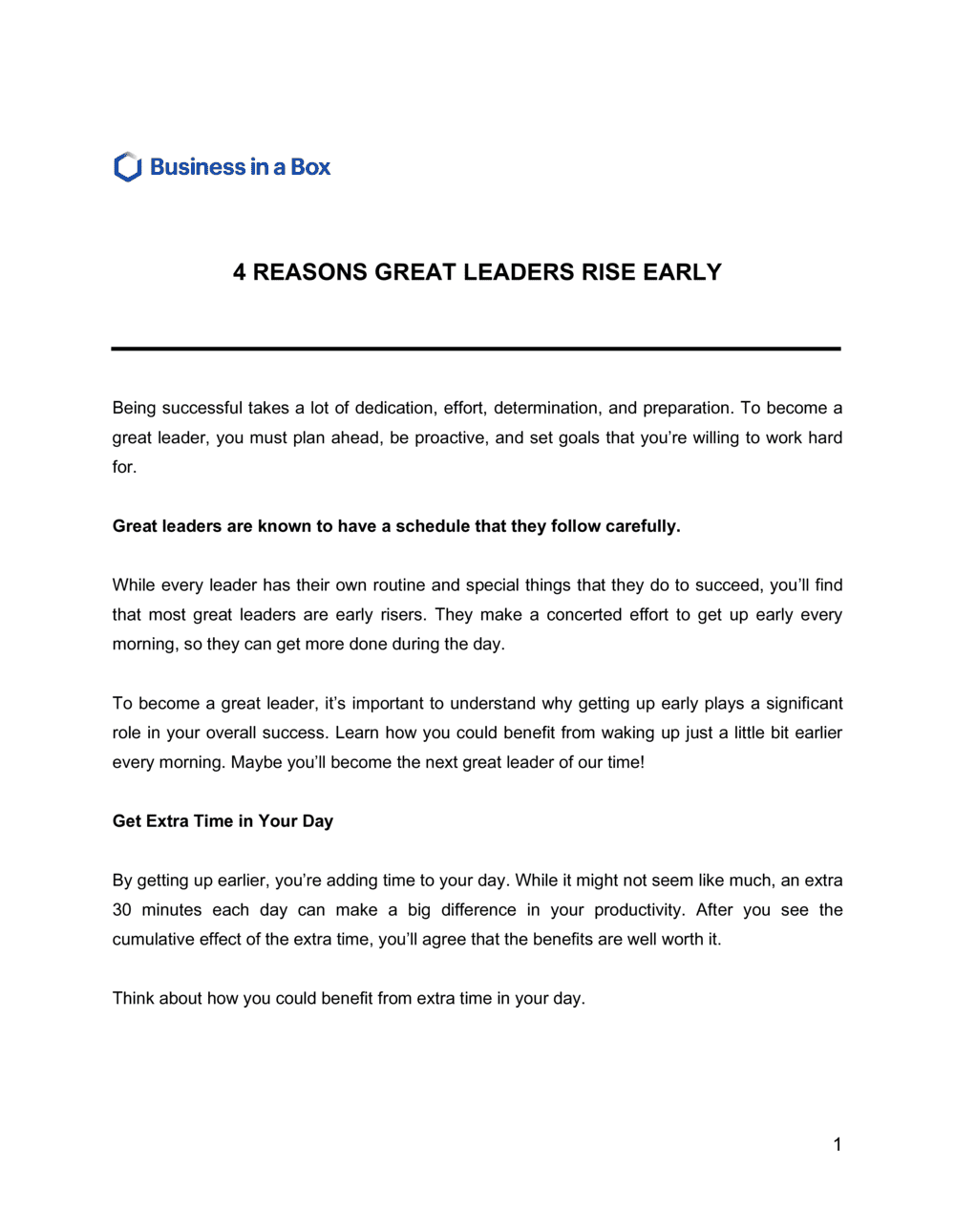
The 4 Reasons Great Leaders Rise Early template is a structured Word document that frames the case for early-rising habits as a deliberate leadership practice. It presents four evidence-based rationales β€” covering focus time, proactive planning, physical wellbeing, and competitive advantage β€” in a format ready for use in leadership training, coaching sessions, or personal development programs. Download it free, edit it online, and export as PDF to share with your team or use as a coaching aid.
When you need it
Use it when onboarding new managers, delivering leadership development workshops, or coaching executives who want a structured framework for building high-performance morning routines. It is also well suited for team newsletters, internal communications, or leadership curriculum guides.
What's inside
An opening rationale, four structured argument sections with supporting evidence and actionable takeaways, a reflection prompt, and a call to action β€” all formatted for professional presentation in a leadership development context.

What is 4 Reasons Great Leaders Rise Early?

4 Reasons Great Leaders Rise Early is a structured leadership development document that presents four evidence-based arguments for why early rising is a deliberate, high-impact leadership practice rather than a generic productivity trend. It covers uninterrupted focus time, proactive planning before reactive demands take over, physical and mental wellbeing investment, and the compounding competitive advantage that consistent early preparation builds over a career. Available as a free Word download, it is formatted for use in coaching sessions, management training programs, and internal leadership communications, and can be edited online and exported as PDF in under an hour.

Why You Need This Document

Leaders who rely solely on informal advice or motivational anecdotes to build team habits rarely produce lasting behavior change. Without a structured, evidence-grounded document that makes the case for early rising and provides a concrete implementation path, early-hour habit initiatives stall after the first week β€” the argument resonated, but no mechanism existed to translate inspiration into a committed routine. This template closes that gap by combining the persuasive case with reflection prompts, a graduated ramp-up schedule, and a specific call to action that includes a named duration and accountability structure. For coaches and L&D managers, it saves hours of content development while delivering a professionally formatted artifact participants can reference long after the session ends. For individual leaders, it provides the rationale and the roadmap in a single document β€” the why and the how, not just one or the other.

Which variant fits your situation?

If your situation is…Use this template
Formal leadership development curriculum for a team of managersLeadership Development Plan
One-on-one executive coaching session on personal effectivenessExecutive Coaching Action Plan
Company-wide internal communication on leadership valuesInternal Memo Template
Onboarding new managers into the organization's leadership standardsManager Onboarding Plan
Tracking individual progress on leadership habit adoptionPersonal Development Plan
Broader team alignment around productivity and performance cultureEmployee Performance Improvement Plan
Presenting leadership principles in a visual workshop formatLeadership Workshop Presentation

Common mistakes to avoid

❌ Using the document as a one-time handout with no follow-up

Why it matters: Leadership habit documents read without a structured follow-up have near-zero behavior change impact. The insight registers, but no mechanism exists to translate it into action.

Fix: Pair the document with a 21-day habit tracker and schedule a follow-up check-in on Day 22 to review what changed and what didn't.

❌ Presenting the document without customizing evidence for the audience

Why it matters: Generic statistics about unnamed executives feel abstract and easy to dismiss. Your audience will not change behavior based on evidence they cannot connect to their own context.

Fix: Add at least one internal example and one industry-specific data point before distributing. Personalized evidence increases adoption rates significantly.

❌ Recommending a single rigid wake time (e.g., 5 a.m.) for all readers

Why it matters: Chronotype research shows that forcing a late chronotype to a 5 a.m. rise produces sleep deprivation, not leadership performance. Prescriptive timing undermines the document's credibility with evidence-aware readers.

Fix: Frame early rising as rising earlier than your current norm by a consistent increment, and acknowledge that the optimal time varies by individual.

❌ Omitting the implementation guide and stopping at the argument

Why it matters: A persuasive case for early rising that provides no practical adoption path leaves readers convinced but stuck. Persuasion without a pathway does not change behavior.

Fix: Always include the step-by-step ramp-up schedule and reflection prompts β€” the argument sections are the why, but the implementation section is the how that produces actual change.

The 9 key sections, explained

Opening rationale

Reason 1 β€” Uninterrupted focus time

Reason 2 β€” Proactive planning before reactive demands

Reason 3 β€” Physical and mental wellbeing investment

Reason 4 β€” Competitive advantage through consistent preparation

Evidence and supporting examples

Practical implementation guide

Reflection prompts

Call to action and next steps

How to fill it out

  1. 1

    Customize the opening rationale with your organization's context

    Replace the placeholder examples and statistics with data or stories relevant to your industry or company culture. Reference leadership figures your audience already respects to increase immediate credibility.

    πŸ’‘ One specific, named internal example (e.g., a senior leader on your own team who practices early rising) is more persuasive than three famous external CEOs.

  2. 2

    Populate each of the four reason sections with supporting evidence

    For each reason, add at least one cited research finding and one practical example. Use the sample language as a structural guide, replacing bracketed placeholders with real figures.

    πŸ’‘ Keep each reason section to one page or fewer β€” concise sections get read; dense pages get skimmed.

  3. 3

    Tailor the implementation guide to your audience's schedule

    Adjust the weekly ramp-up schedule to reflect the realistic constraints of your audience β€” parents, cross-timezone managers, and shift workers need modified timelines. A one-size ramp-up plan creates drop-off.

    πŸ’‘ Add a note acknowledging that the ideal wake time varies by individual chronotype β€” early rising means earlier than your current norm, not a universal 5 a.m. target.

  4. 4

    Select three to four focused reflection prompts

    Choose prompts that tie directly to the leadership challenges most relevant to your audience. Swap out generic prompts for ones specific to your team's current strategic priorities or performance gaps.

    πŸ’‘ If using this document in a group workshop, assign reflection prompts as pre-work so participants arrive ready to discuss rather than writing for the first time in the session.

  5. 5

    Set a specific call to action with a date and accountability structure

    Replace the generic call to action with a specific habit challenge β€” a named start date, a defined duration (21 days is the research-backed minimum for habit formation), and a concrete accountability mechanism such as a peer check-in or tracking template.

    πŸ’‘ A shared accountability partner doubles habit retention rates β€” prompt readers to name one specific person they will share their commitment with.

  6. 6

    Export as PDF and distribute through your preferred channel

    Save the completed document as PDF for clean presentation. Distribute via your LMS, team communication platform, or include in a leadership development kit alongside a companion tracking template.

    πŸ’‘ A one-page visual summary of the four reasons β€” pulled from the full document β€” makes an effective standalone poster, screensaver, or slide for team meetings.

Frequently asked questions

What is the '4 Reasons Great Leaders Rise Early' document?

It is a structured leadership development document that presents four evidence-based rationales for why early rising is a deliberate leadership practice: uninterrupted focus time, proactive planning, physical and mental wellbeing, and compounding competitive preparation. It is designed for use in coaching sessions, management training programs, and internal leadership communications, and comes as a free Word download you can edit and export as PDF.

Who should use this template?

Leadership coaches, HR and L&D managers, founders, and CEOs who want a structured, ready-to-use framework for communicating the value of early-rising habits to their teams or clients. It is also useful for individual managers who want to formalize their own leadership development philosophy and share it with direct reports.

Is early rising actually supported by research?

Yes, within important caveats. Studies on deep work, cognitive performance, and executive habits consistently show that protected early-morning time correlates with higher strategic output and lower decision fatigue. However, research also shows that chronotype β€” your natural biological sleep-wake tendency β€” varies significantly. The document's argument is that rising earlier than your current norm produces benefit, not that a universal 5 a.m. target applies to everyone.

How should I use this document in a leadership workshop?

Distribute it as pre-reading at least 48 hours before the workshop. Ask participants to complete the reflection prompts before arrival. Use the four reasons as the agenda structure for a 60-minute discussion session, spending 10–15 minutes per reason. Close the session by having each participant commit to one specific habit change with a named accountability partner.

How is this different from a general productivity guide?

This document frames early rising specifically as a leadership practice with organizational consequences β€” not just a personal efficiency hack. It connects the habit to strategic decision quality, team culture, and compounding career advantage, making it relevant to managers who must model behavior for their teams, not just optimize their own output.

Can I customize the four reasons for my industry or company?

Yes, and you should. The template is structured so each reason section has editable evidence blocks and example placeholders. Replace generic statistics with industry-specific data, add internal leadership examples, and adjust the implementation guide's timeline to fit your audience's real-world constraints such as shift work, parenting responsibilities, or cross-timezone demands.

How long does it take to customize and deploy this document?

A basic customization β€” replacing placeholders with real names, dates, and one or two supporting data points β€” takes 30 to 45 minutes. A thorough customization including original research, internal examples, and a tailored implementation guide takes 2 to 3 hours. Deploying it as part of a structured program with a tracking template and follow-up session adds another hour of coordination.

What companion documents work well alongside this template?

A personal development plan lets individuals track habit goals beyond early rising. A daily time-blocking template operationalizes the focus window the document advocates. A 21-day habit tracker provides the accountability structure the call-to-action section recommends. Together, these four documents form a lightweight but complete leadership habit development kit.

How this compares to alternatives

vs Leadership Development Plan

A leadership development plan is a comprehensive, multi-month roadmap covering competency gaps, training activities, and measurable milestones across the full scope of a leader's role. This document focuses specifically on one high-leverage habit β€” early rising β€” and makes the case for it in depth. Use this document to introduce or anchor the habit, and a full development plan to embed it within a broader growth program.

vs Personal Development Plan

A personal development plan is an individual's structured commitment to growth goals across multiple life and career dimensions. This document is a persuasive and instructional piece focused on one specific practice. The two work well together β€” this document provides the rationale, and the personal development plan provides the goal-setting and tracking structure.

vs Employee Performance Improvement Plan

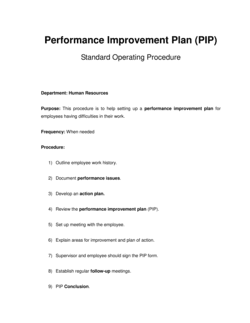
A performance improvement plan addresses a documented performance shortfall and sets corrective targets with timelines. This document is proactive and aspirational β€” it builds habits in high-performing leaders rather than correcting deficiencies. The two address different audiences and serve different purposes within an HR or L&D program.

vs Strategic Planning Template

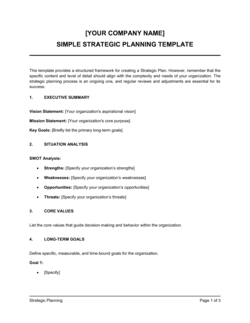
A strategic planning template maps organizational goals, initiatives, and KPIs across a multi-year horizon. This document operates at the individual leadership behavior level β€” the daily habits that enable a leader to execute strategic plans effectively. Both are relevant to senior leaders, but they operate at different scales and timeframes.

Industry-specific considerations

Professional Services

Consultants and advisors use early-hour client preparation as a billable-quality differentiator, making the focus-time argument directly relevant to revenue outcomes.

Technology / SaaS

Engineering and product leaders in always-on distributed teams rely on early uninterrupted hours to do architectural thinking before standups and Slack fragments attention.

Financial Services

Market-facing professionals routinely start before opening bell, making early rising a baseline expectation β€” this document frames the habit's strategic rationale beyond market hours alone.

Healthcare

Clinical and administrative leaders managing shift handovers and high-stakes morning rounds have concrete operational incentives for early proactive planning that this document explicitly supports.

Template vs pro β€” what fits your needs?

PathBest forCostTime
Use the templateCoaches, HR managers, and leaders who want a ready-to-customize framework for a workshop or team distributionFree30–45 minutes to customize and deploy
Template + professional reviewOrganizations embedding this into a formal leadership curriculum with original research and branded design$200–$600 for a facilitator or instructional designer review2–5 days
Custom draftedExecutive coaching firms or L&D teams building proprietary leadership IP with full original content and multi-session program design$1,500–$5,000+2–4 weeks

Glossary

Deep Work
Focused, uninterrupted cognitive effort on high-value tasks, typically performed before the day's distractions begin.
Proactive Planning
The practice of setting priorities and identifying obstacles before reactive demands take over the workday.
Leadership Habit
A consistent, intentional behavior that reinforces a leader's effectiveness over time, such as early rising, journaling, or structured reflection.
Morning Routine
A defined sequence of activities performed early in the day to establish mental clarity, physical readiness, and strategic focus before external demands arise.
Competitive Advantage (personal)
An edge gained by a leader through habits that compound over time β€” hours of focused work, consistent preparation, or health practices others do not maintain.
Reflective Practice
The deliberate act of reviewing decisions, outcomes, and behaviors to extract lessons that improve future leadership performance.
Time Blocking
Scheduling specific blocks of time for defined tasks, preventing reactive work from crowding out strategic priorities.
Circadian Rhythm
The body's natural 24-hour biological cycle that influences sleep, alertness, and cognitive performance β€” a key factor in the case for consistent early rising.
Leadership Development
A structured process of building skills, habits, and self-awareness that increases a person's effectiveness as a leader over time.
Accountability Framework
A structured system β€” individual or team-based β€” for tracking commitments and following through on stated behavioral changes.

Part of your Business Operating System

This document is one of 3,000+ business & legal templates included in Business in a Box.

  • Fill-in-the-blanks β€” ready in minutes
  • Compatible with all office suites
  • Export to PDF and share electronically

Create your document in 3 simple steps.

From template to signed document β€” all inside one Business Operating System.
1
Download or open template

Access over 3,000+ business and legal templates for any business task, project or initiative.

2
Edit and fill in the blanks with AI

Customize your ready-made business document template and save it in the cloud.

3
Save, Share, Send, Sign

Share your files and folders with your team. Create a space of seamless collaboration.

Save time, save money, and create top-quality documents.

β˜…β˜…β˜…β˜…β˜…

"Fantastic value! I'm not sure how I'd do without it. It's worth its weight in gold and paid back for itself many times."

Managing Director Β· Mall Farm
Robert Whalley
Managing Director, Mall Farm Proprietary Limited
β˜…β˜…β˜…β˜…β˜…

"I have been using Business in a Box for years. It has been the most useful source of templates I have encountered. I recommend it to anyone."

Business Owner Β· 4+ years
Dr Michael John Freestone
Business Owner
β˜…β˜…β˜…β˜…β˜…

"It has been a life saver so many times I have lost count. Business in a Box has saved me so much time and as you know, time is money."

Owner Β· Upstate Web
David G. Moore Jr.
Owner, Upstate Web

Run your business with a system β€” not scattered tools

Stop downloading documents. Start operating with clarity. Business in a Box gives you the Business Operating System used by over 250,000 companies worldwide to structure, run, and grow their business.

Start freeΒ Β·Β No credit card required