1
Confirm the governing jurisdiction and legal baseline
Identify every state, province, or country where employees work. Research the minimum statutory requirements for leave, overtime, and termination notice in each location before writing a single policy line.
💡 Build a one-row-per-jurisdiction table of statutory minimums before you open the template — this becomes the floor every policy section must meet or exceed.
2
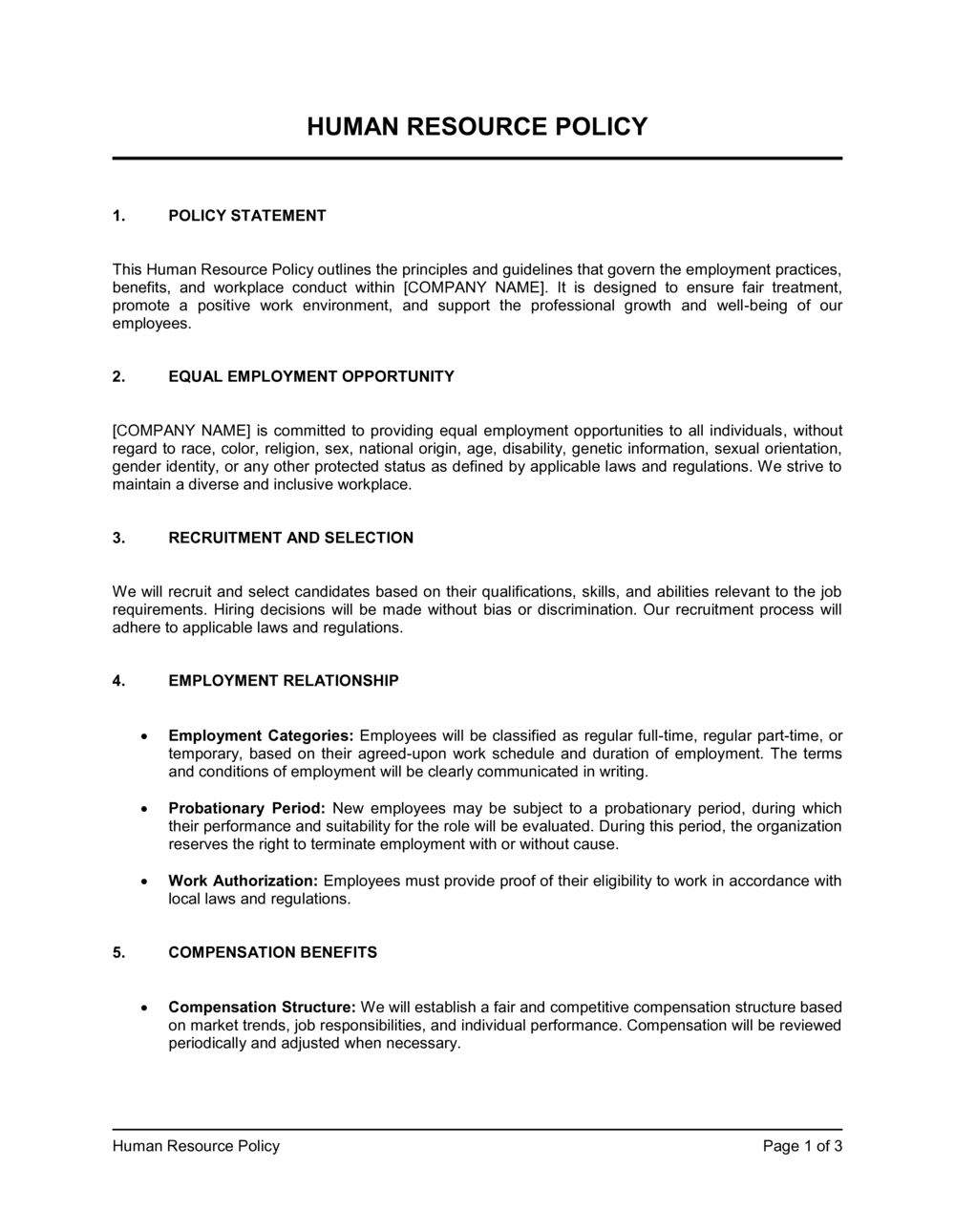
Complete the purpose and scope section
Name the company, list covered employee categories (full-time, part-time, fixed-term), identify excluded categories (contractors, volunteers), and state the effective date.
💡 If you have multiple business entities, name the specific legal entity — not a brand name — so the policy binds the right employer.
3
Define employment classifications and probationary terms
Confirm your FLSA exempt/non-exempt classifications for each role family, set the probationary period length, and document the review milestones at 30, 60, and 90 days.
💡 Have your payroll provider confirm exempt/non-exempt status before publishing — misclassification is the leading FLSA violation and carries three years of back-pay exposure.
4
Set leave entitlements above statutory minimums
Enter annual leave accrual rates, sick leave rules, parental leave, and bereavement leave. Cross-check each against the statutory floor in every jurisdiction where you have employees.
💡 State leave balances in days per year rather than hours per pay period — employees find days-based language far easier to understand and act on.
5
Write the code of conduct with a named reporting contact
List prohibited behaviors, confidentiality obligations, and conflict-of-interest rules. Name a specific role (e.g., HR Manager or CEO) as the reporting contact and provide a confidential reporting channel.
💡 Add a sentence explicitly prohibiting retaliation against anyone who reports a concern in good faith — this is legally required in many jurisdictions and materially reduces report suppression.
6
Draft the disciplinary procedure with gross-misconduct carve-outs
Describe each progressive discipline step, the documentation required at each stage, and the list of gross-misconduct offenses that bypass progressive steps and allow immediate termination.
💡 Use the phrase 'may result in' rather than 'will result in' at each disciplinary step — this preserves management discretion and avoids contractual obligations to follow every step in every case.
7
Specify final pay timing and off-boarding steps
State the final pay deadline for both voluntary and involuntary terminations, list the company property to be returned, and describe the exit interview and reference-provision process.
💡 Map your final-pay deadline to the strictest state you operate in — if you employ anyone in California, same-day payment on involuntary termination is required, and using a single standard protects you everywhere.
8
Distribute, acknowledge, and version-control the document
Share the completed policy with all employees and collect signed acknowledgment forms confirming receipt and understanding. Date the document, assign a version number, and store the master copy centrally.
💡 Set a calendar reminder to review the policy annually — employment law changes year to year, and an outdated policy is often worse than none because it creates a false sense of compliance.