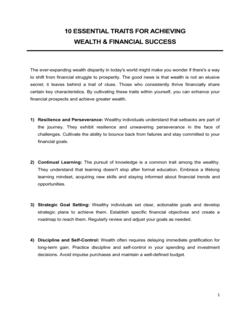
10 Essential Elements Of Success Template

Free download β€’ Use as a template β€’ Print or share

3 pagesβ€’20–30 min to useβ€’Difficulty: Standard
Learn more ↓
Free10 Essential Elements Of Success Template

At a glance

What it is
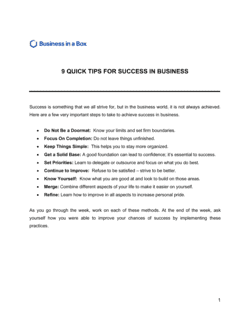
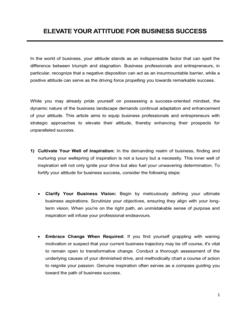
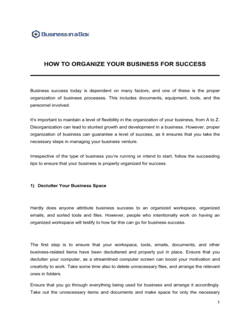
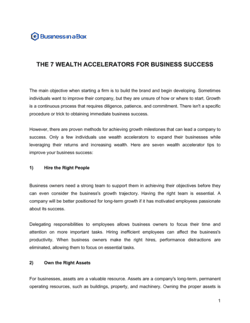
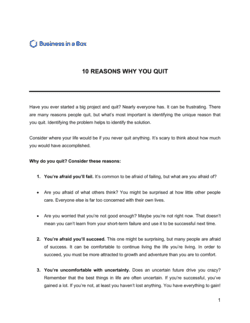
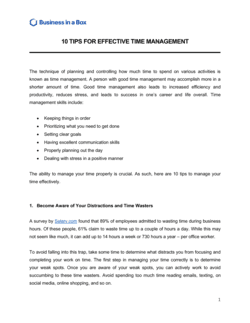
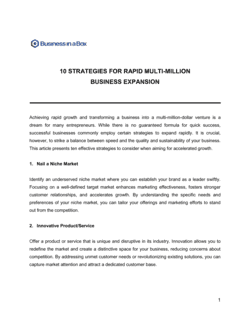
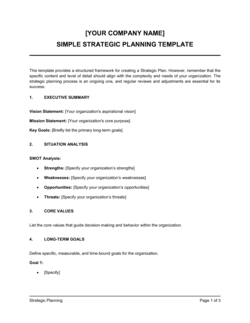
The 10 Essential Elements of Success is a structured operational document that guides individuals, teams, and organizations through ten proven pillars β€” from vision and goal-setting to accountability and continuous improvement β€” needed to achieve sustainable results. This free Word download gives you a ready-to-complete framework you can edit online and export as PDF for team workshops, leadership planning sessions, or personal development reviews.
When you need it
Use it when launching a new business initiative, onboarding a leadership team, conducting an annual strategy review, or coaching employees who need a structured path from aspiration to measurable outcome. It is equally effective for individual contributors mapping their professional development as for executives aligning an entire organization.
What's inside
Ten clearly defined sections covering vision, goal-setting, mindset, planning, execution, accountability, communication, resilience, continuous learning, and performance measurement β€” each with prompts, self-assessment questions, and space for concrete action items and target dates.

What is the 10 Essential Elements of Success?

The 10 Essential Elements of Success is a structured operational framework that guides individuals, teams, and organizations through ten proven pillars β€” vision, goal-setting, mindset, strategic planning, execution, accountability, communication, resilience, continuous learning, and performance measurement β€” needed to achieve sustainable, repeatable results. Unlike a project plan that tracks tasks or a business plan that targets external audiences, this document focuses on the behavioral and operational foundations that determine whether any strategy actually gets executed. It functions as both a self-assessment tool and a forward-looking action plan, giving users a single document that connects purpose to daily habits and measurable outcomes.

Why You Need This Document

Most plans fail not because the strategy was wrong but because the human operating system running it was never addressed. Without a documented success framework, teams default to reactive execution β€” responding to the loudest priority rather than the most important one β€” and accountability conversations happen only when something goes wrong. The absence of defined resilience responses means a single setback derails months of progress. Without scheduled performance reviews, small deviations compound unnoticed until they become structural problems. The 10 Essential Elements of Success closes these gaps by creating a written contract between intention and action: it names who is accountable for what, pre-plans responses to predictable obstacles, and builds the review cadences that keep progress visible. This template gives you a professionally structured, immediately usable version of that framework β€” ready to customize for your team, your goals, and your planning cycle in under an afternoon.

Which variant fits your situation?

If your situation is…Use this template
Applying the framework to an entire organization's annual strategyStrategic Planning Template
Focusing specifically on individual employee growth and career goalsEmployee Development Plan
Driving a specific project to successful completionProject Plan Template
Establishing company-wide values and behavioral standardsCompany Mission and Values Statement
Measuring team performance against key resultsOKR Planning Template
Coaching a new manager through their first leadership transitionManagement Development Plan
Running a structured workshop on success principles with a groupWorkshop Facilitation Guide

Common mistakes to avoid

❌ Setting more than five concurrent goals

Why it matters: Cognitive and resource capacity has hard limits. Teams that pursue more than five goals simultaneously show measurably lower completion rates on every goal, not just the lowest-priority ones.

Fix: Rank all candidate goals by expected impact and resource cost. Commit to the top three to five and place the rest in a 'next cycle' backlog.

❌ Skipping the mindset and resilience sections

Why it matters: These sections are routinely omitted as 'soft,' but they are the failure points most commonly cited in post-mortem reviews when execution breaks down under pressure.

Fix: Complete both sections with specific, behaviorally defined commitments β€” not generic affirmations. Specificity is what makes them actionable.

❌ Assigning accountability to a team rather than an individual

Why it matters: When a goal belongs to everyone, no one treats it as their personal responsibility. Milestones slip without anyone feeling obligated to escalate.

Fix: Name one person as the single accountable owner for each goal. Others can support β€” but only one person is on the hook for the outcome.

❌ Treating the document as complete once drafted

Why it matters: A success framework that is not reviewed against actuals at a defined cadence degrades into a motivational poster β€” it stops influencing behavior within weeks.

Fix: Schedule monthly reviews and a full retrospective at the end of each planning cycle before you close the document. Put the review dates in the calendar now.

❌ Measuring activity instead of outcomes

Why it matters: Tracking tasks completed rather than results achieved creates the illusion of progress while masking underperformance on the metrics that actually matter.

Fix: For each goal, define the outcome metric β€” revenue, customer count, error rate, time saved β€” and track it alongside activity metrics so both are visible.

❌ Leaving the communication plan undefined

Why it matters: Without a structured update cadence, stakeholders fill information gaps with assumptions β€” typically pessimistic ones β€” and confidence in the plan erodes before results appear.

Fix: Define the audience, format, and frequency for progress updates in the communication section before sharing the plan with anyone outside the core team.

The 10 key sections, explained

Vision and purpose

Goal-setting

Mindset and belief system

Strategic planning

Execution and discipline

Accountability systems

Communication and collaboration

Resilience and adaptability

Continuous learning and improvement

Performance measurement and celebration

How to fill it out

  1. 1

    Define your vision and core purpose

    Write a one-to-three sentence vision that describes the future state you are working toward and the reason it matters. Be specific about who benefits and what changes.

    πŸ’‘ If you cannot explain your vision in plain language to someone outside your industry, it is still too abstract to be useful as a planning anchor.

  2. 2

    Set three to five SMART goals

    Convert your vision into specific, measurable goals with clear deadlines. Each goal should have a named KPI and a target value so progress can be tracked objectively.

    πŸ’‘ Run each goal through the 'so what' test β€” if achieving it would not materially move your vision forward, remove it and free up execution capacity.

  3. 3

    Identify and document your mindset commitments

    List the two or three core beliefs or behavioral commitments that will sustain effort when progress stalls. Write the specific thought or action you will default to when facing each predictable obstacle.

    πŸ’‘ Pair each belief with a concrete trigger β€” 'when X happens, I will do Y' β€” to make mindset commitments actionable rather than aspirational.

  4. 4

    Build the strategic plan with owners and budgets

    Break each goal into three to five initiatives. For each initiative, assign a named owner, a budget range, and a completion date. Sequence initiatives so dependencies are visible.

    πŸ’‘ If an initiative has no named owner and no budget, it is a wish β€” not a plan. Remove it or resource it before sharing the document.

  5. 5

    Schedule execution routines and non-negotiables

    Translate each initiative into recurring calendar commitments β€” daily habits, weekly check-ins, and monthly reviews. Identify the two or three non-negotiable behaviors that must happen regardless of competing priorities.

    πŸ’‘ Block execution time on calendars at the moment of planning, not later. Time blocked now is protected; time 'planned' but not scheduled rarely materializes.

  6. 6

    Assign accountability partners and check-in cadences

    For each goal, name a single accountable owner and a reviewer they report to. Set the check-in frequency and format β€” a 15-minute weekly written update outperforms a monthly meeting for most goals.

    πŸ’‘ The accountability partner should be someone who will ask hard questions, not just offer encouragement. Comfort and accountability rarely coexist.

  7. 7

    Populate the resilience and contingency section

    List three to five predictable obstacles and write a pre-planned response for each. Identify the signal that will trigger a pivot and the fallback option if the primary approach fails.

    πŸ’‘ Run a pre-mortem: assume the plan failed β€” write down the most likely reason. That reason is your highest-priority risk to address before you start.

  8. 8

    Set KPIs and schedule performance reviews

    Enter the two to four KPIs that will determine whether each goal was achieved. Schedule monthly performance reviews and a full retrospective at the end of each planning cycle.

    πŸ’‘ Review actuals against plan in writing, not just in conversation. Written reviews create a record that makes the next planning cycle significantly faster and more accurate.

Frequently asked questions

What are the 10 essential elements of success in business?

The 10 essential elements of success in a business context are: vision and purpose, goal-setting, mindset, strategic planning, execution discipline, accountability, communication, resilience, continuous learning, and performance measurement. Each element addresses a distinct failure mode β€” organizations that excel at execution but lack accountability, for example, tend to repeat the same mistakes across cycles.

Who should use the 10 Essential Elements of Success template?

The template is designed for small business owners, team leaders, executive coaches, HR professionals, startup founders, and individual contributors who want a structured framework for moving from aspiration to measurable outcome. It works equally well as a personal development tool, a team alignment exercise, or the foundation for an annual strategic planning session.

How is this template different from a standard business plan?

A business plan is primarily an external-facing document for investors and lenders, focused on market analysis, financial projections, and capital requirements. The 10 Essential Elements of Success is an internal operational framework focused on the human and behavioral factors β€” mindset, accountability, resilience β€” that determine whether any plan actually gets executed. Both are useful; they address different layers of performance.

How long does it take to complete this template?

A focused individual can complete a personal version in two to three hours. A leadership team working through it collaboratively in a workshop setting typically needs a half-day to a full day to complete all ten sections with sufficient depth and team alignment. The investment pays back quickly β€” teams that complete a structured success framework before starting a major initiative report significantly fewer mid-project pivots and scope disputes.

How often should the 10 Essential Elements framework be reviewed?

Monthly check-ins against the KPIs and accountability commitments are the minimum recommended cadence. A full review and update of all ten sections should happen quarterly or at the start of each new planning cycle. Any major change in market conditions, team structure, or strategic direction also warrants an unscheduled full review.

Can this template be used for personal development, not just business?

Yes. The framework applies directly to individual career development, personal goal achievement, and professional coaching engagements. The sections on mindset, resilience, and continuous learning are particularly relevant for individuals navigating career transitions, new roles, or major skill-building initiatives. The template prompts can be answered from a personal perspective without modification.

What is the difference between a success framework and a strategic plan?

A strategic plan defines what the organization will do β€” initiatives, resource allocation, and market positioning. A success framework defines how the organization will operate to ensure those plans get executed β€” the behavioral habits, accountability structures, and learning systems that separate organizations that achieve their strategies from those that merely document them. Both are necessary for sustained high performance.

Do I need a facilitator to run a team workshop using this template?

A facilitator helps but is not required. The template is designed to be self-guided, with prompts and sample language in each section. For teams larger than eight people, or where significant disagreement on goals or priorities is expected, an external facilitator keeps the session on track and prevents dominant voices from short-circuiting the process. For teams of two to five, a nominated internal lead works well.

How this compares to alternatives

vs Strategic planning template

A strategic planning template focuses on market positioning, competitive analysis, and multi-year initiative roadmaps for an organization. The 10 Essential Elements of Success focuses on the behavioral and operational foundations β€” mindset, accountability, resilience β€” that determine whether any strategic plan gets executed. Use the strategic plan to decide what to do and the success elements framework to ensure it actually happens.

vs Business plan template

A business plan is built for external audiences β€” investors, lenders, and partners β€” and centers on market analysis, financial projections, and competitive positioning. The 10 Essential Elements of Success is an internal operational document built for the team executing the strategy. The two documents address different audiences and different questions.

vs Employee development plan

An employee development plan focuses on a single individual's skills, career trajectory, and training milestones within an organizational context. The 10 Essential Elements of Success is a broader framework applicable to individuals, teams, and entire organizations. Use an employee development plan for structured HR conversations and the success elements framework for broader goal alignment and performance culture.

vs OKR planning template

An OKR template structures objectives and key results into a measurable tracking format, typically on a quarterly cadence. The 10 Essential Elements of Success is a fuller operational framework that includes OKR-style goal-setting but also addresses mindset, resilience, communication, and learning β€” the contextual factors that determine whether OKRs are achieved or simply reported.

Industry-specific considerations

Professional services

Used in client onboarding and coaching programs to give clients a structured framework for achieving the outcomes they hired the firm to deliver.

SaaS / Technology

Applied in quarterly planning cycles to align cross-functional teams on product, sales, and customer success goals with shared accountability metrics.

Retail / E-commerce

Used by store managers and regional directors to translate company OKRs into team-level success commitments tied to conversion, retention, and revenue targets.

Manufacturing

Embedded in operational excellence programs to reinforce continuous improvement culture alongside Lean or Six Sigma initiatives at the team level.

Template vs pro β€” what fits your needs?

PathBest forCostTime
Use the templateIndividuals, small teams, and business owners building or refreshing their success framework without external supportFree2–4 hours for an individual; half-day for a team workshop
Template + professional reviewLeadership teams preparing for a high-stakes planning cycle or organizations embedding the framework into a formal coaching or L&D program$500–$2,000 for a facilitator or business coach session1–2 days including preparation and follow-up
Custom draftedEnterprise organizations integrating the framework into a multi-team performance system with custom KPIs, reporting dashboards, and facilitated rollout$3,000–$10,000+ for a consulting or organizational development engagement2–6 weeks

Glossary

Vision Statement
A concise description of the desired future state an individual or organization is working toward, used to anchor all planning decisions.
SMART Goals
Goals that are Specific, Measurable, Achievable, Relevant, and Time-bound β€” a standard format for converting aspirations into actionable targets.
Growth Mindset
The belief that abilities and intelligence can be developed through effort, learning, and persistence, as opposed to being fixed traits.
Action Plan
A sequenced list of specific tasks, owners, and deadlines that translates a goal or strategy into day-to-day execution steps.
Accountability
A formal or informal commitment to report progress against agreed goals to another person or group, increasing follow-through rates.
Key Performance Indicator (KPI)
A measurable value that tracks progress toward a specific goal, enabling objective evaluation of whether performance is on track.
Resilience
The capacity to recover from setbacks, adapt to changing conditions, and continue progressing toward goals despite obstacles.
Continuous Improvement
An ongoing practice of reviewing processes, identifying inefficiencies, and making incremental adjustments to raise performance over time.
Stakeholder Alignment
The process of ensuring that all parties with an interest in an outcome share a common understanding of goals, priorities, and progress.
Success Metric
A specific, agreed-upon measure used to determine whether a goal or initiative has been achieved at the expected level.

Part of your Business Operating System

This document is one of 3,000+ business & legal templates included in Business in a Box.

  • Fill-in-the-blanks β€” ready in minutes
  • 100% customizable Word document
  • Compatible with all office suites
  • Export to PDF and share electronically

Create your document in 3 simple steps.

From template to signed document β€” all inside one Business Operating System.
1
Download or open template

Access over 3,000+ business and legal templates for any business task, project or initiative.

2
Edit and fill in the blanks with AI

Customize your ready-made business document template and save it in the cloud.

3
Save, Share, Send, Sign

Share your files and folders with your team. Create a space of seamless collaboration.

Save time, save money, and create top-quality documents.

β˜…β˜…β˜…β˜…β˜…

"Fantastic value! I'm not sure how I'd do without it. It's worth its weight in gold and paid back for itself many times."

Managing Director Β· Mall Farm
Robert Whalley
Managing Director, Mall Farm Proprietary Limited
β˜…β˜…β˜…β˜…β˜…

"I have been using Business in a Box for years. It has been the most useful source of templates I have encountered. I recommend it to anyone."

Business Owner Β· 4+ years
Dr Michael John Freestone
Business Owner
β˜…β˜…β˜…β˜…β˜…

"It has been a life saver so many times I have lost count. Business in a Box has saved me so much time and as you know, time is money."

Owner Β· Upstate Web
David G. Moore Jr.
Owner, Upstate Web

Run your business with a system β€” not scattered tools

Stop downloading documents. Start operating with clarity. Business in a Box gives you the Business Operating System used by over 250,000 companies worldwide to structure, run, and grow their business.

Free Forever PlanΒ Β·Β No credit card required