Why You Proscrastinate and How To Overcome It

Free to read β€’ Save or share with one click

FreeWhy You Proscrastinate and How To Overcome It Template

At a glance

What it is
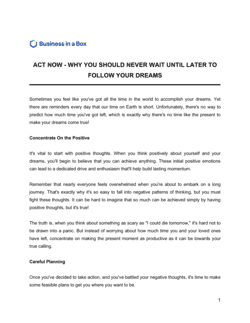
Why You Procrastinate and How to Overcome It is a structured self-improvement guide grounded in behavioral psychology that explains the real reasons people delay important tasks and provides a practical, step-by-step system for breaking the cycle. This free Word download is fully editable β€” fill in your own triggers, goals, and action plans β€” and export as PDF to keep as a personal reference or share with a team.
When you need it
Use it when chronic task avoidance is blocking progress on projects, goals, or daily work responsibilities. It is especially useful when you suspect perfectionism, fear of failure, or a poorly-defined task list is the root cause rather than a simple lack of motivation.
What's inside
The guide covers the cognitive and neurological drivers of procrastination, a self-diagnosis framework for identifying your personal pattern, and five evidence-backed intervention techniques including implementation intentions, environment redesign, and accountability structures. It closes with a personal action plan template you fill in directly.

What is Why You Procrastinate and How to Overcome It?

Why You Procrastinate and How to Overcome It is a structured self-improvement guide that draws on behavioral psychology research to explain the real mechanisms behind task avoidance β€” temporal discounting, dopamine misalignment, perfectionism paralysis, and fear-of-failure β€” and then delivers a practical, evidence-backed system for breaking the pattern. Unlike generic productivity advice, this guide begins with self-diagnosis: identifying which specific root cause is driving your particular avoidance before introducing a matched technique. It covers implementation intentions, the 5-minute rule, environment redesign, task decomposition, and accountability structures, and closes with a personal action plan you fill in directly to commit to a first application.

Why You Need This Document

Understanding procrastination intellectually does not stop it β€” most chronic procrastinators already know they are delaying and why it is costly. What stalls progress is the absence of a structured diagnosis-to-action pathway. Without one, people apply generic motivation tactics to specific psychological barriers, get no result, and reinforce the belief that the problem is unfixable. The compounding cost is significant: a single avoided deliverable can block a project for days; a pattern of avoidance across a team can erode months of productive capacity. This guide gives individuals and managers a reusable framework for diagnosing the specific trigger, selecting the right intervention, and committing to a concrete first action β€” turning a vague intention to do better into a dated, accountable plan.

Which variant fits your situation?

If your situation is…Use this template
Procrastination driven by unclear priorities across multiple projectsAction Plan
Avoiding a single large project with no defined milestonesProject Plan
Struggling to maintain daily habits and routines consistentlyDaily Planner
Team members repeatedly missing self-imposed deadlinesPerformance Improvement Plan
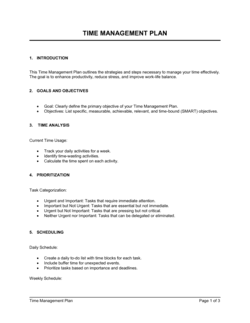
Time lost to low-value tasks crowding out deep workTime Management Plan
Wanting a structured weekly planning ritual to anchor progressWeekly Planner
Procrastination linked to broader goal-setting failurePersonal Development Plan

Common mistakes to avoid

❌ Applying techniques without diagnosing the root cause

Why it matters: The 5-minute rule is highly effective for task-aversion procrastination but produces almost no improvement for perfectionism-driven avoidance. Using the wrong tool wastes effort and reinforces the belief that 'nothing works.'

Fix: Complete the self-diagnosis section for each major avoided task before selecting a technique. One accurate diagnosis is worth more than applying every technique simultaneously.

❌ Writing vague implementation intentions

Why it matters: Research shows that 'I will work on it this week' produces roughly the same follow-through as no plan at all. Vague intentions fail because they require an in-the-moment decision about when and how to act.

Fix: Specify the exact cue, time, location, and first physical action β€” 'When I sit down at my desk at 9 a.m. on Thursday, I will open the document and write for 25 minutes before doing anything else.'

❌ Trying to redesign the entire environment at once

Why it matters: Attempting to change your phone habits, office setup, browser configuration, and daily schedule simultaneously creates a new overwhelming task β€” which itself becomes a source of avoidance.

Fix: Pick the single highest-leverage change first β€” usually phone distance or site-blocking β€” implement it for one week, then add one more. Stack changes gradually rather than all at once.

❌ Treating the guide as reading material rather than a working document

Why it matters: Reading about procrastination without completing the action plan produces no behavioral change. Understanding why you procrastinate does not, on its own, stop it.

Fix: Set a 20-minute timer before finishing the guide and complete the personal action plan in full before closing the document. The plan is the deliverable.

The 9 key sections, explained

Understanding why you procrastinate

Self-diagnosis: identifying your procrastination pattern

Fear of failure and perfectionism

Poorly defined tasks and unclear first steps

Implementation intentions

Environment redesign

The 5-minute rule and momentum

Accountability structures

Personal action plan

How to fill it out

  1. 1

    Read the psychology overview before touching the tools

    Work through the first two sections on procrastination's roots and self-diagnosis before skipping ahead to techniques. Applying the wrong technique to the wrong trigger is the most common reason these guides produce no lasting change.

    πŸ’‘ If you find yourself wanting to skip the diagnosis section, that is itself a procrastination behavior worth noting.

  2. 2

    Complete the self-diagnosis for one specific avoided task

    Pick the single task you have been postponing the longest. Answer the diagnosis prompts honestly, selecting the root cause that fits most closely β€” fear of failure, perfectionism, unclear first step, overwhelm, or environment.

    πŸ’‘ Most people have a dominant pattern that applies to 70–80% of their avoided tasks. Identifying it once gives you a reusable framework.

  3. 3

    Rewrite the task as a concrete first action

    Take your avoided task and rewrite it as a single physical action requiring no further planning β€” something you could start within 60 seconds of reading it.

    πŸ’‘ A well-formed task starts with a verb and takes under 20 minutes. 'Draft the opening two sentences of the introduction' beats 'write the report' every time.

  4. 4

    Write one implementation intention for the task

    Fill in the if-then template: 'When [specific cue], I will immediately [specific action].' Make the cue something that happens at a fixed time or place, not something contingent on how you feel.

    πŸ’‘ The more specific the cue β€” 'when I close my laptop after lunch on Wednesday' rather than 'when I have a free moment' β€” the more reliably it fires.

  5. 5

    Redesign one environmental friction point

    Identify the single biggest environmental distractor pulling you away from the task. Remove it or add one barrier to accessing it before your next work session.

    πŸ’‘ Phone in another room reduces usage by an average of 26% compared to face-down on the desk β€” distance matters more than willpower.

  6. 6

    Set up an accountability check-in

    Tell one specific person what you will have completed and by when. Ask them to request evidence of completion β€” the actual output, not just your word that you did it.

    πŸ’‘ Thirty-second voice messages or a shared task tracker work just as well as formal meetings β€” the social stake is what drives behavior, not the medium.

  7. 7

    Complete the personal action plan section

    Fill in every field in the action plan β€” task, root cause, chosen technique, implementation intention, and accountability arrangement. Export or print it and put it where you will see it before the session you planned.

    πŸ’‘ Review the plan the night before your scheduled work session, not the morning of. Pre-commitment made 12 hours earlier holds stronger than one made 5 minutes before.

Frequently asked questions

What causes procrastination?

Procrastination is primarily an emotion-regulation behavior, not a time-management failure. When a task triggers a negative emotion β€” anxiety about the outcome, boredom, frustration, or self-doubt β€” the brain resolves the discomfort by switching to something immediately rewarding. Temporal discounting amplifies this: future consequences feel abstract compared to the immediate relief of avoidance. Common specific drivers include fear of failure, perfectionism, vague or overwhelming task definitions, and environmental distractors with lower activation energy than the target task.

What is the most effective technique for overcoming procrastination?

Implementation intentions β€” if-then plans specifying exactly when, where, and how you will start β€” consistently show the strongest effect in controlled research, roughly doubling follow-through rates compared to vague goal-setting alone. The 5-minute rule is highly effective for task-aversion procrastination because it lowers the perceived cost of starting. Environment redesign addresses the structural causes that willpower-based approaches cannot sustain. The most effective single intervention depends on your specific root cause, which is why self-diagnosis comes first.

Is procrastination a sign of laziness?

No. Procrastination and laziness are distinct. Laziness is indifference to outcome; procrastination occurs precisely because the person cares about the outcome β€” the stakes are what generate the anxiety or perfectionism that drives avoidance. Reframing procrastination as a character flaw is counterproductive because it blocks accurate diagnosis and makes self-compassion β€” itself an evidence-backed intervention β€” harder to access.

How is procrastination different from prioritization?

Rational reprioritization means deliberately choosing a more urgent or higher-value task over another. Procrastination means delaying an intended task despite knowing the delay will make things worse. The diagnostic test is simple: if you feel relief at avoiding the task, it is likely procrastination. If you feel clarity, it is likely reprioritization. Most people can accurately tell the difference when they examine it honestly.

Does the 5-minute rule actually work?

Yes, for specific types of procrastination. It works best when the barrier to starting is the anticipated unpleasantness of the task β€” once underway, most tasks feel less aversive than anticipated and momentum carries the session forward. It is less effective when the barrier is a poorly defined task (you do not know what to do for the five minutes) or perfectionism (five minutes of imperfect work feels worse than not starting). Pair it with a clearly written first action for best results.

How do I stop procrastinating when I am overwhelmed?

Overwhelm is almost always a task-definition problem. A task that feels too large to make visible progress on generates avoidance because the brain cannot identify a completable unit of work. The fix is decomposition: rewrite the task as the single smallest physical action you could take in the next 20 minutes that moves it forward. 'Outline three key points for the introduction' is completable; 'write the report' is not. Repeat the decomposition each time you sit down until the project is done.

What role does perfectionism play in procrastination?

Perfectionism drives procrastination by raising the perceived cost of starting β€” if the output must be excellent, producing a draft feels like risking proof of inadequacy. The most effective intervention is not lowering standards but redefining them: specify the minimum criteria the work must meet to serve its actual purpose, then commit to those criteria rather than an undefined 'perfect' standard. Research on self-compassion also shows that treating errors as information rather than judgment reduces perfectionism-driven avoidance.

Can this guide be used with a team or in a coaching setting?

Yes. Managers and coaches can use the guide to facilitate a structured conversation about a direct report's specific avoidance pattern, then co-complete the action plan section as a coaching output. The self-diagnosis framework makes it easier to move from 'why haven't you done this yet' β€” which generates defensiveness β€” to 'which of these patterns fits best' β€” which generates problem-solving. L&D teams have also incorporated the guide into productivity workshops and onboarding programs.

How long does it take to see results from these techniques?

Implementation intentions and environment redesign can produce measurable behavior change within the first week when applied to a specific, well-defined task. Procrastination patterns that have built up over years β€” particularly perfectionism and fear-of-failure patterns β€” typically require 4–8 weeks of consistent application before new defaults feel automatic. Accountability structures often produce the fastest initial results because the social stake is immediate, but they need to be paired with internal techniques to sustain change when the external check-in ends.

How this compares to alternatives

vs Time Management Plan

A time management plan structures how hours are allocated across tasks and projects β€” it assumes the user is willing to work and focuses on scheduling efficiency. This guide addresses why work does not happen even when time is allocated, targeting the emotional and cognitive barriers that scheduling alone cannot fix. Use the time management plan after completing this guide's action plan.

vs Personal Development Plan

A personal development plan maps long-term skills, career goals, and learning milestones over 6–12 months. This guide is narrower and more immediately actionable β€” it targets a specific behavioral pattern blocking near-term progress. The two work well in sequence: this guide clears the avoidance blocking current goals; the personal development plan structures the longer arc.

vs Action Plan

An action plan breaks a goal into tasks, owners, and deadlines β€” it assumes the tasks are clearly defined and the person is ready to act. This guide specifically addresses situations where tasks are defined but not being executed, diagnosing and resolving the psychological barrier between intention and action. Pair both: use this guide to remove the barrier, then use an action plan to track completion.

vs Performance Improvement Plan

A performance improvement plan is a formal management document addressing underperformance with documented expectations and consequences β€” it is employer-to-employee and typically involves HR. This guide is a self-directed individual tool for understanding and changing personal behavior without external mandate. Use the PIP when management intervention is required; use this guide when the individual wants to solve the problem themselves.

Industry-specific considerations

Professional services

Consultants and lawyers frequently delay billable work in favor of administrative tasks β€” task aversion linked to ambiguous deliverables is the dominant pattern in project-based professional roles.

Technology / SaaS

Engineers and product managers often avoid documentation, code reviews, and strategic planning in favor of immediate-feedback coding tasks β€” a dopamine-loop pattern that environment redesign and time-blocking address directly.

Creative and marketing agencies

Creative professionals disproportionately report perfectionism-driven avoidance on client deliverables; the 'good enough standard' and draft-first techniques are the highest-leverage interventions for this group.

Education

Students and academics delay thesis chapters, grant proposals, and grading through a combination of perfectionism and poorly-defined task scope β€” the guide's decomposition and implementation-intention sections are especially applicable.

Template vs pro β€” what fits your needs?

PathBest forCostTime
Use the templateIndividuals seeking to understand and address their own procrastination patterns independentlyFree2–3 hours to read, diagnose, and complete the action plan
Template + professional reviewManagers using the guide in a coaching conversation with a direct report, or L&D teams building it into a training program$0–$300 for a facilitator or coach sessionHalf-day workshop or 3–5 coaching sessions
Custom draftedOrganizations commissioning a bespoke behavioral change program for a team or department with specific productivity metrics$2,000–$8,000 for a behavioral coach or organizational psychologist4–8 weeks

Glossary

Procrastination
The voluntary delay of an intended task despite knowing it will likely make things worse β€” distinct from rational reprioritization.
Implementation Intention
A specific if-then plan that links a situational cue to a behavior: 'When X happens, I will do Y' β€” shown in research to double follow-through rates.
Temporal Discounting
The tendency to place lower value on future rewards compared to immediate ones, making tomorrow's deadline feel less urgent than today's distraction.
Perfectionism Paralysis
A state where the fear of producing imperfect work prevents starting altogether, often misidentified as laziness.
Dopamine Loop
The neurological reward cycle that makes checking notifications, social media, or email feel immediately satisfying while effortful work does not β€” pulling attention away from difficult tasks.
Task Aversion
Negative emotional response β€” boredom, frustration, anxiety β€” triggered by a specific task, which the brain resolves by switching to something more pleasant.
The 5-Minute Rule
A commitment technique where you agree only to work on an avoided task for five minutes, exploiting the fact that starting is the hardest part and momentum typically carries you past the timer.
Environment Redesign
Deliberately altering the physical or digital workspace to reduce friction for target behaviors and increase friction for distracting ones.
Accountability Partner
A person who agrees to check on your progress toward a commitment at a defined time, increasing follow-through by adding social stakes to the outcome.
Activation Energy
The mental and physical effort required to begin a task β€” reducing it (by preparing materials, clearing space, or pre-deciding the first action) is the most reliable way to reduce avoidance.

Part of your Business Operating System

This document is one of 3,000+ business & legal templates included in Business in a Box.

  • Fill-in-the-blanks β€” ready in minutes
  • Compatible with all office suites
  • Export to PDF and share electronically

Create your document in 3 simple steps.

From template to signed document β€” all inside one Business Operating System.
1
Download or open template

Access over 3,000+ business and legal templates for any business task, project or initiative.

2
Edit and fill in the blanks with AI

Customize your ready-made business document template and save it in the cloud.

3
Save, Share, Send, Sign

Share your files and folders with your team. Create a space of seamless collaboration.

Save time, save money, and create top-quality documents.

β˜…β˜…β˜…β˜…β˜…

"Fantastic value! I'm not sure how I'd do without it. It's worth its weight in gold and paid back for itself many times."

Managing Director Β· Mall Farm
Robert Whalley
Managing Director, Mall Farm Proprietary Limited
β˜…β˜…β˜…β˜…β˜…

"I have been using Business in a Box for years. It has been the most useful source of templates I have encountered. I recommend it to anyone."

Business Owner Β· 4+ years
Dr Michael John Freestone
Business Owner
β˜…β˜…β˜…β˜…β˜…

"It has been a life saver so many times I have lost count. Business in a Box has saved me so much time and as you know, time is money."

Owner Β· Upstate Web
David G. Moore Jr.
Owner, Upstate Web

Run your business with a system β€” not scattered tools

Stop downloading documents. Start operating with clarity. Business in a Box gives you the Business Operating System used by over 250,000 companies worldwide to structure, run, and grow their business.

Free Forever PlanΒ Β·Β No credit card required