5-Day Notice to Quit Template

Free Word download β€’ Edit online β€’ Save & share with Drive β€’ Export to PDF

1 pageβ€’15–25 min to fillβ€’Difficulty: Standard
Learn more ↓
Free5-Day Notice to Quit Template

At a glance

What it is
A 5 Day Notice To Quit is a formal written notice a landlord or property manager delivers to a tenant demanding they pay overdue rent, remedy a lease violation, or vacate the premises within five calendar or business days. This free Word download gives you a ready-to-edit template you can complete in minutes and serve personally, by certified mail, or by posting, depending on your jurisdiction's service requirements.
When you need it
Issue it the day after a rent payment is confirmed late, after a tenant has violated a lease term and the violation remains uncured, or when an unauthorized occupant is discovered on the property. The five-day window is the first formal step required before filing an unlawful detainer or eviction action in most US states that use this notice period.
What's inside
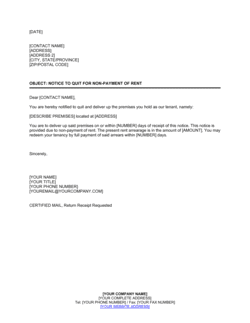
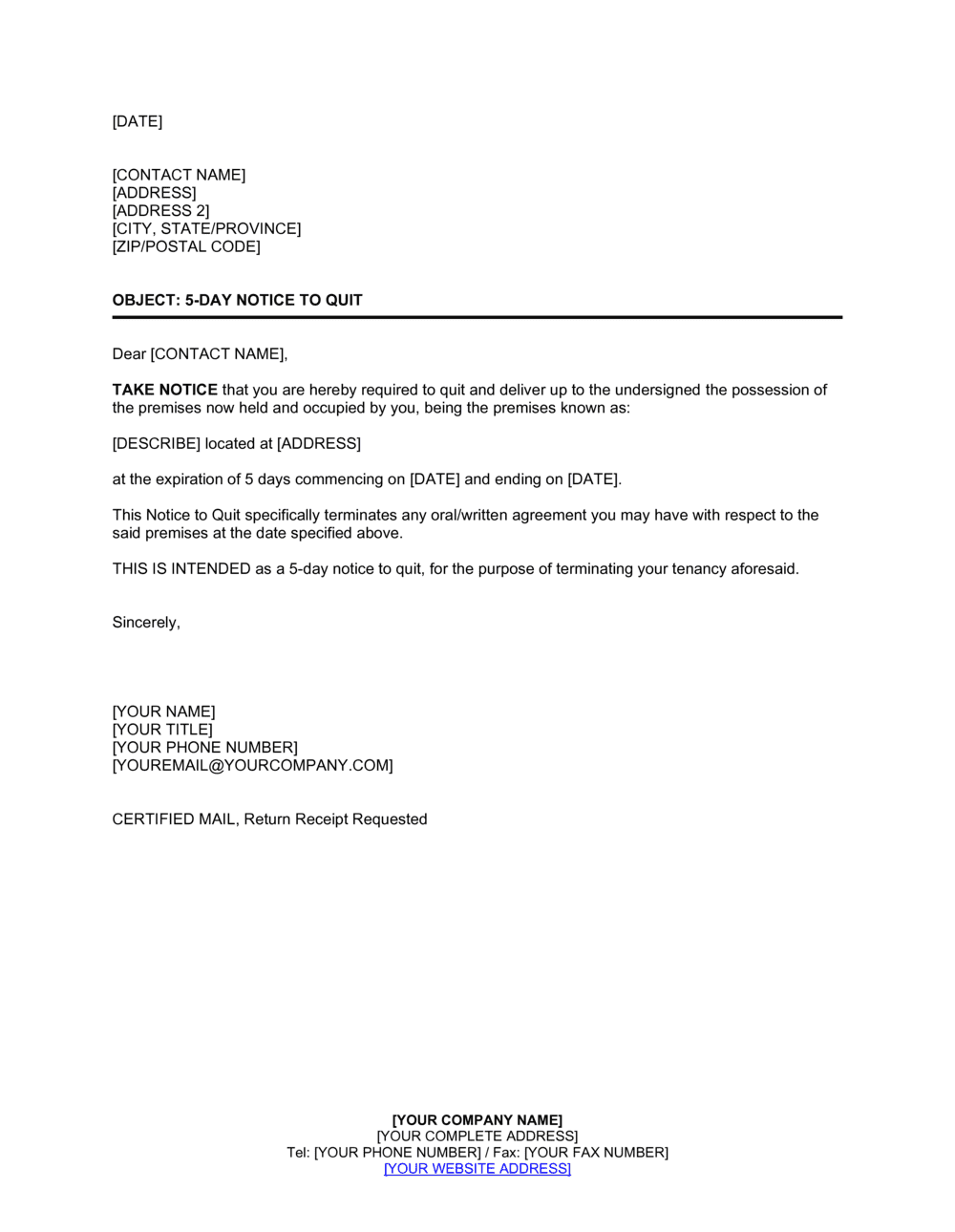
Landlord and tenant identification, property address, the specific breach (overdue rent amount or lease violation), the cure or vacate deadline, service instructions, and a certification of delivery block. Some versions include a payment ledger showing the balance owed broken down by period.

What is a 5 Day Notice To Quit?

A 5 Day Notice To Quit is a formal written demand a landlord or property manager serves on a tenant requiring them to pay all overdue rent, cure a specified lease violation, or vacate the rental unit within five days. It functions as the mandatory pre-litigation step in the eviction process in many US states β€” without a properly served notice, a court will typically dismiss an unlawful detainer filing on procedural grounds regardless of the underlying breach. The notice identifies the parties, the property, the specific breach, the exact dollar amount owed or violation to be cured, the deadline date, and the accepted methods of service.

Why You Need This Document

Skipping or mishandling a 5 day notice does not just delay an eviction β€” it can reset the entire process from day one, costing weeks of additional unpaid rent and additional filing fees. Courts in jurisdictions that require the notice will dismiss an unlawful detainer action filed without one, or filed before the notice period has fully expired. A notice with procedural errors β€” wrong balance, missing tenant names, improper service method, or a miscounted deadline β€” gives a tenant's attorney a straightforward technical defense that can extend the timeline by 30 to 60 days. A properly completed template ensures every required element is present and documented, gives you a clean eviction record if the matter proceeds to court, and in many cases prompts the tenant to pay in full before any court action is necessary.

Which variant fits your situation?

If your situation is…Use this template
Tenant has not paid rent and no prior notice has been issued5 Day Notice To Quit (Nonpayment of Rent)
Tenant has violated a lease term other than nonpaymentNotice To Cure or Quit
Tenant's lease has expired and they remain on the propertyNotice To Vacate (Holdover Tenant)
Tenant must leave with no option to cure the violationUnconditional Quit Notice
State requires a longer notice period (e.g., 14 or 30 days)30 Day Notice To Vacate
Landlord is terminating a month-to-month tenancy without causeNotice To Terminate Month-to-Month Tenancy
Commercial tenant is in default of a commercial leaseCommercial Lease Default Notice

Common mistakes to avoid

❌ Using the wrong notice period for the jurisdiction

Why it matters: A 5-day notice served where state law requires 14 days is void on its face. The landlord must re-serve with the correct period, resetting the clock and delaying any court filing by weeks.

Fix: Verify the statutory notice period on your state's landlord-tenant statute before drafting. If your state requires 14 or 30 days for nonpayment, use the correct notice template instead.

❌ Including non-rent charges in the rent demand amount

Why it matters: Courts in many states will dismiss or void a pay-or-quit notice that bundles late fees, utility charges, or pet fees into the rent balance β€” the tenant cannot 'cure' charges that are legally distinct from rent.

Fix: State the base unpaid rent amount only in the demand section. Reference other charges separately as 'also owed under the lease' without including them in the five-day cure amount.

❌ Serving the notice by text or email without lease authorization

Why it matters: Electronic service is not legally sufficient for notices to quit in most US states unless the lease explicitly permits it and the state statute allows it. A notice served improperly provides no valid start date for the cure period.

Fix: Use personal delivery, certified mail, or the post-and-mail method as prescribed by your state statute. Keep physical or photographic proof of every service attempt.

❌ Miscounting the five-day period

Why it matters: Including the day of service in the count makes the notice expire one day early β€” a procedural defect tenants' attorneys routinely exploit to have unlawful detainer filings dismissed.

Fix: Start counting from the day after service. Enter the resulting calendar date explicitly on the notice so there is no ambiguity about when the period ends.

❌ Naming only the primary leaseholder when multiple adults are on the lease

Why it matters: A co-tenant not named on the notice can argue they received no valid notice, complicating eviction proceedings and potentially requiring you to re-serve.

Fix: Name every adult tenant listed on the lease and add 'and all other occupants' to capture any unauthorized residents who may claim tenancy rights.

❌ Filing for eviction before the notice period fully expires

Why it matters: Filing an unlawful detainer before the fifth day has fully passed gives the tenant grounds to have the case dismissed, wasting filing fees and adding weeks to the process.

Fix: Wait until the morning of the sixth day after service β€” or the next business day if the deadline falls on a weekend or holiday β€” before filing any court action.

The 8 key sections, explained

Landlord and tenant identification

Property address and unit description

Statement of the breach

Demand to pay or vacate

Deadline date

Payment instructions

Service method and proof of delivery

Landlord signature and contact block

How to fill it out

  1. 1

    Confirm the applicable notice period for your state

    Verify that a 5-day notice period applies under your state's landlord-tenant statute before using this template. Some states β€” including New York, Texas, and Florida β€” use different minimum periods for nonpayment notices.

    πŸ’‘ Search '[YOUR STATE] nonpayment of rent notice period' on your state legislature's website to confirm the current statutory requirement before issuing any notice.

  2. 2

    Enter all tenant names exactly as they appear on the lease

    List every adult occupant named on the lease agreement in the tenant identification block. Cross-reference the original lease signature page to ensure no names are missed.

    πŸ’‘ If you are unsure whether a person is an authorized occupant or an unauthorized subtenant, name them as 'and all other occupants' after the primary tenant's name.

  3. 3

    Fill in the complete property address including unit number

    Enter the full civic address, apartment or unit number, city, state, and ZIP code. For single-family homes, confirm the address matches the lease exactly.

    πŸ’‘ If the property has multiple addresses (a corner lot, for example), use the address that appears on the executed lease to avoid ambiguity.

  4. 4

    Document the balance owed with a period-by-period breakdown

    List each month or billing period with the rent charge and any amount paid, then calculate the running balance. Attach the rent ledger as a supporting exhibit if the arrears span more than two months.

    πŸ’‘ Do not include contested late fees or charges in the 'rent owed' total unless your lease explicitly defines them as rent β€” courts in many states will dismiss the notice if non-rent charges are included in the demand amount.

  5. 5

    Calculate and enter the exact deadline date

    Count five days forward from the day after service β€” not from the day of service β€” and enter the resulting calendar date as the deadline. Confirm whether your state counts calendar days or business days.

    πŸ’‘ If the deadline falls on a Sunday or a state-recognized holiday, extend it to the next business day to avoid a procedural defect.

  6. 6

    Add clear payment instructions

    Specify the accepted payment methods, the payee name, the mailing or portal address, and any reference information (e.g., tenant account number) the tenant needs to complete payment.

    πŸ’‘ Listing a payment portal URL is the single most effective way to get rent paid during the notice period β€” tenants can act immediately without waiting for business hours.

  7. 7

    Serve the notice using a legally accepted method

    Choose personal delivery to an adult tenant, certified mail with return receipt, or conspicuous posting plus first-class mail β€” whichever your state statute permits. Document the method, date, and time immediately after service.

    πŸ’‘ Take a timestamped photograph of the posted notice if you use the post-and-mail method β€” photo evidence is routinely accepted by courts to confirm service was completed.

  8. 8

    Retain the completed notice and proof of service

    Keep the original signed notice, the certified mail receipt or posting photo, and any subsequent delivery confirmation in the tenant's file. These documents are the foundation of your unlawful detainer case if the tenant does not comply.

    πŸ’‘ Create a digital copy immediately after serving β€” paper notices get lost, and a court filing deadline during an eviction proceeding is not a forgiving deadline.

Frequently asked questions

What is a 5 day notice to quit?

A 5 day notice to quit is a formal written demand a landlord delivers to a tenant requiring them to pay all overdue rent, cure a lease violation, or vacate the rental property within five days. It is the first mandatory step in the eviction process in many US states and establishes the legal record a landlord needs before filing an unlawful detainer action in court.

When can a landlord serve a 5 day notice to quit?

A landlord can typically serve a 5 day notice the day after rent is confirmed late β€” once any grace period written into the lease has expired. It can also be used for material lease violations such as unauthorized occupants, prohibited pets, or property damage, provided the violation is one the tenant has an opportunity to cure. Some jurisdictions restrict when notices can be issued during a declared emergency or moratorium period.

Does a 5 day notice to quit apply in every US state?

No. Notice periods vary significantly by state. Illinois, Indiana, and several other states use a 5-day period for nonpayment. New York requires 14 days, Florida 3 days, California 3 days (recently extended to 3 days with specific cure provisions), and Texas 3 days for most situations. Always confirm your state's current statutory requirement before issuing any notice to quit.

What happens if the tenant pays within the 5 day period?

If the tenant pays the full amount of overdue rent within the notice period, the notice is satisfied and the tenancy continues. The landlord cannot proceed with an eviction filing once the cure has been completed. Document the payment with a dated receipt and update the rent ledger immediately. Partial payment does not satisfy the notice unless the landlord accepts it in writing as full settlement.

What happens if the tenant does not comply with the notice?

If the tenant neither pays the balance owed nor vacates the premises by the deadline, the landlord may file an unlawful detainer or eviction action with the local court on the following business day. The served notice is filed as evidence of compliance with the pre-filing notice requirement. A hearing is typically scheduled within 5–30 days depending on the jurisdiction and court backlog.

Does a 5 day notice to quit need to be notarized?

No. A 5 day notice to quit does not require notarization to be valid in any US state. It does require proper service using a legally accepted method β€” personal delivery, certified mail, or conspicuous posting plus first-class mail β€” and the landlord should retain a signed proof of service or postal receipt as evidence.

Can a landlord issue a 5 day notice for reasons other than nonpayment?

Yes. A 5 day notice can be issued for lease violations such as unauthorized occupants, pet violations, excessive noise, or property damage β€” any material breach the tenant has the ability to cure within the notice period. For violations that cannot be cured, such as criminal activity on the premises, an unconditional quit notice with no cure period is more appropriate in most jurisdictions.

Can the tenant dispute a 5 day notice to quit?

A tenant can raise defenses if the notice contains procedural errors β€” incorrect balance, wrong notice period, improper service, or missing required disclosures. They can also assert affirmative defenses such as retaliatory eviction, habitability problems, or acceptance of partial rent. These defenses are raised at the unlawful detainer hearing, not during the notice period itself.

Should I use a 5 day notice template or hire a property attorney?

For straightforward nonpayment situations in jurisdictions that use a 5-day period, a properly completed template is sufficient for most independent landlords. Engage a property attorney when the tenant has filed prior complaints, when the property is subject to rent control or just-cause eviction ordinances, when the balance owed exceeds several months, or when the tenant has retained legal counsel.

How this compares to alternatives

vs 30 Day Notice To Vacate

A 30 day notice to vacate is used to terminate a tenancy without cause β€” typically a month-to-month arrangement β€” and does not require the tenant to pay or cure a breach. A 5 day notice is a cure-or-quit demand triggered by a specific breach. Use the 5 day notice when there is unpaid rent or a lease violation; use the 30 day notice when you are simply ending an at-will tenancy.

vs Eviction Notice

An eviction notice is a general term covering all pre-litigation notices to tenants. A 5 day notice to quit is a specific type of eviction notice with a defined cure window. Not all eviction notices offer a cure option β€” unconditional quit notices, for example, demand vacating with no opportunity to remedy the breach. Choose the specific notice type that matches the breach and your state's requirements.

vs Lease Termination Letter

A lease termination letter documents the agreed or scheduled end of a tenancy β€” often at the lease's natural expiration β€” with move-out instructions. A 5 day notice to quit is an adversarial demand triggered by a breach, not a cooperative end-of-tenancy communication. The two serve entirely different purposes and should not be substituted for each other.

vs Late Rent Notice

A late rent notice is an informal reminder that rent is overdue β€” it carries no legal weight and does not start the eviction clock. A 5 day notice to quit is a formal legal document that begins the statutory pre-eviction period. Start with a late rent notice as a courtesy for first-time lateness; escalate to a 5 day notice when the tenant has not paid after a reasonable reminder or has a pattern of late payment.

Industry-specific considerations

Residential Property Management

Multi-unit operators use standardized 5 day notices to maintain consistent pre-eviction documentation across large portfolios and reduce per-unit legal costs.

Commercial Real Estate

Commercial landlords adapt the notice for retail and office tenants in arrears, though commercial lease terms and local statutes may require longer or differently structured cure periods.

Single-Family Rental

Individual investors managing one to four units rely on standardized notices to enforce lease terms without retaining ongoing legal counsel for routine nonpayment situations.

Student and Workforce Housing

High tenant turnover and frequent short-term lease cycles make consistent notice documentation especially important for maintaining an audit trail across successive tenancies.

Template vs pro β€” what fits your needs?

PathBest forCostTime
Use the templateIndependent landlords handling routine nonpayment in standard 5-day-notice jurisdictionsFree15–20 minutes to complete and serve
Template + professional reviewLandlords in rent-controlled markets, properties with prior tenant complaints, or balances exceeding two months$150–$400 for a property attorney review1–2 business days
Custom draftedCommercial landlords, multi-breach situations, tenants who have retained counsel, or portfolios in multiple jurisdictions$400–$1,200+ depending on complexity2–5 business days

Glossary

Notice To Quit
A formal written demand from a landlord requiring a tenant to pay overdue rent, remedy a lease breach, or vacate the rental property within a specified number of days.
Cure Period
The window of time a tenant has to correct a lease violation β€” such as paying overdue rent β€” before the landlord can proceed with a formal eviction filing.
Unlawful Detainer
A court action filed by a landlord to legally remove a tenant who remains on the property after failing to comply with a valid notice to quit.
Service of Notice
The legally prescribed method of delivering a notice to a tenant β€” typically personal delivery, certified mail, or conspicuous posting on the front door.
Holdover Tenant
A tenant who remains in possession of the rental unit after their lease has expired without entering into a new agreement with the landlord.
Pay or Quit
A notice that gives the tenant a choice: pay all rent owed within the notice period or vacate the premises β€” the most common form of a 5 day notice.
Writ of Possession
A court order issued after a successful eviction judgment that authorizes law enforcement to physically remove a non-compliant tenant from the property.
Rent Ledger
A record documenting each rent charge, payment received, and outstanding balance for a tenancy β€” used as supporting evidence when serving a notice or filing in court.
Constructive Notice
Notice that is presumed to have been received by law once properly posted or mailed, even if the tenant claims they did not personally receive the document.
Lease Default
Any breach of a lease agreement's material terms, including nonpayment of rent, unauthorized occupants, or property damage beyond normal wear and tear.

Part of your Business Operating System

This document is one of 3,000+ business & legal templates included in Business in a Box.

  • Fill-in-the-blanks β€” ready in minutes
  • 100% customizable Word document
  • Compatible with all office suites
  • Export to PDF and share electronically

Create your document in 3 simple steps.

From template to signed document β€” all inside one Business Operating System.
1
Download or open template

Access over 3,000+ business and legal templates for any business task, project or initiative.

2
Edit and fill in the blanks with AI

Customize your ready-made business document template and save it in the cloud.

3
Save, Share, Send, Sign

Share your files and folders with your team. Create a space of seamless collaboration.

Save time, save money, and create top-quality documents.

β˜…β˜…β˜…β˜…β˜…

"Fantastic value! I'm not sure how I'd do without it. It's worth its weight in gold and paid back for itself many times."

Managing Director Β· Mall Farm
Robert Whalley
Managing Director, Mall Farm Proprietary Limited
β˜…β˜…β˜…β˜…β˜…

"I have been using Business in a Box for years. It has been the most useful source of templates I have encountered. I recommend it to anyone."

Business Owner Β· 4+ years
Dr Michael John Freestone
Business Owner
β˜…β˜…β˜…β˜…β˜…

"It has been a life saver so many times I have lost count. Business in a Box has saved me so much time and as you know, time is money."

Owner Β· Upstate Web
David G. Moore Jr.
Owner, Upstate Web

Run your business with a system β€” not scattered tools

Stop downloading documents. Start operating with clarity. Business in a Box gives you the Business Operating System used by over 250,000 companies worldwide to structure, run, and grow their business.

Start freeΒ Β·Β No credit card required