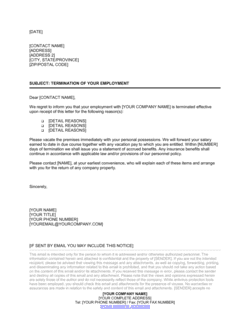
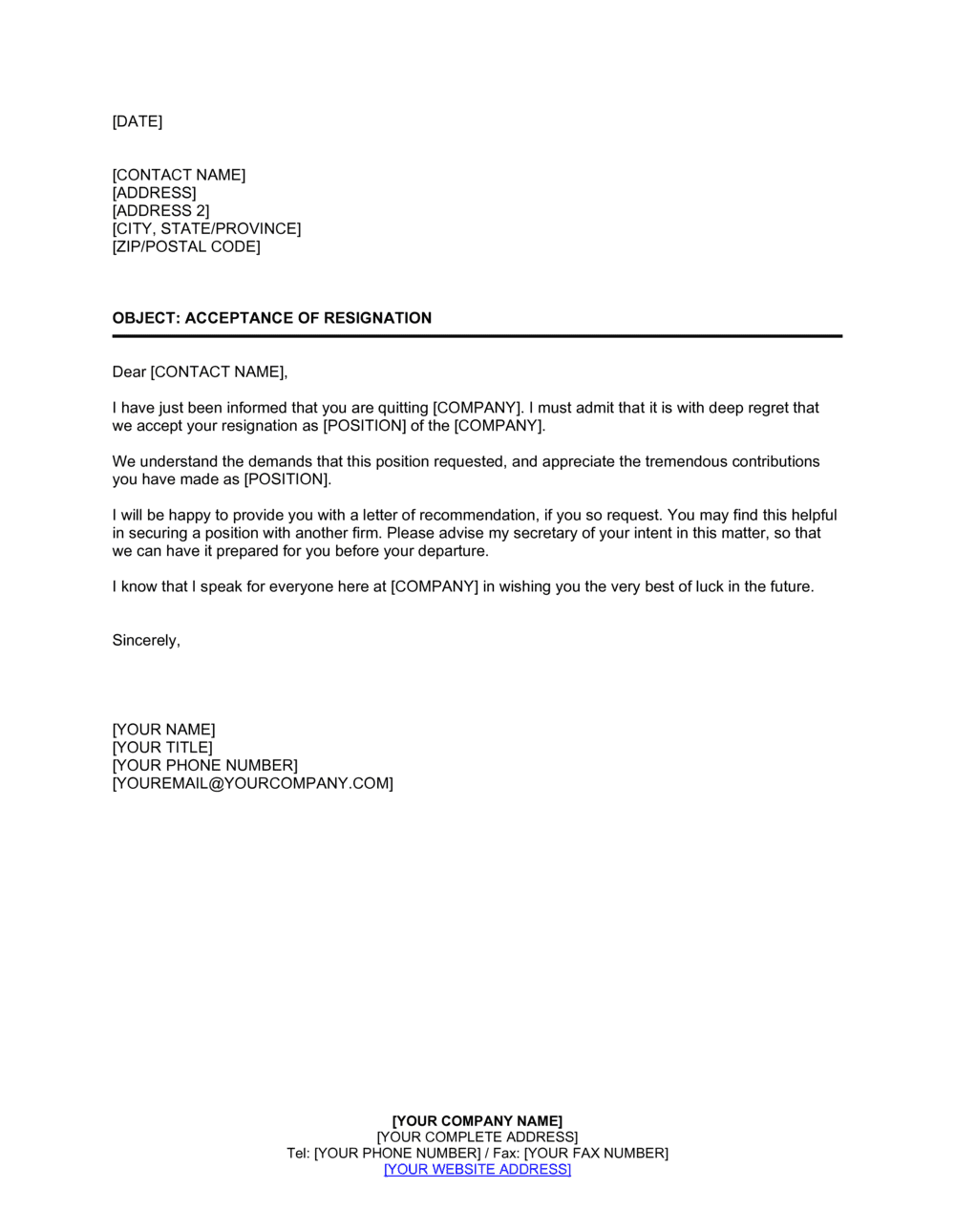
Acceptance of Resignation Template

Free Word download β€’ Edit online β€’ Save & share with Drive β€’ Export to PDF

1 pageβ€’20–30 min to fillβ€’Difficulty: Standardβ€’Signature requiredβ€’Legal review recommended
Learn more ↓
FreeAcceptance of Resignation Template

At a glance

What it is
An Acceptance of Resignation is a formal written document an employer issues to confirm it has received and accepted an employee's resignation notice. This free Word download lets you confirm the last working day, reference applicable notice-period terms, document handover obligations, and close the employment relationship cleanly β€” reducing the risk of disputed separation dates or misunderstood entitlements.
When you need it
Issue it as soon as possible after receiving a resignation β€” ideally within one to three business days β€” for any employee regardless of seniority, role, or length of service. It is especially important when the employee holds access to sensitive systems, confidential information, or client relationships that require a structured handover.
What's inside
The document covers the employee's name and role, the date the resignation was received, the confirmed last working day, notice-period terms, handover requirements, final pay and benefit entitlements, the status of any post-employment obligations such as non-compete or confidentiality, and a professional closing that preserves the working relationship through the departure.

What is an Acceptance of Resignation?

An Acceptance of Resignation is a formal written document issued by an employer to confirm that it has received and accepted an employee's voluntary resignation. It records the agreed last working day, specifies how the notice period will be served β€” whether through working notice, garden leave, or pay in lieu β€” and documents the employee's handover obligations, property-return requirements, and final pay entitlements. Critically, it also reminds the departing employee that any post-employment obligations from their original contract β€” including confidentiality, non-compete, and non-solicitation clauses β€” remain fully in force after their last working day. Unlike a termination letter, which records an employer-initiated separation, an acceptance of resignation responds to a voluntary employee decision and does not ordinarily trigger statutory severance obligations.

Why You Need This Document

Without a written acceptance of resignation, the terms of the separation exist only in conversation β€” and conversations are disputed. The most common and costly gaps are a disagreement over the effective last working day, ambiguity about whether the employee was on garden leave or expected to work through the notice period, and an employee who later claims that the employer's silence about post-employment restrictions amounted to a waiver of the non-compete or confidentiality obligations. Courts and employment tribunals look for contemporaneous written evidence; a properly executed acceptance of resignation provides exactly that. For employers with access to sensitive data, client relationships, or proprietary systems, a signed acceptance letter with explicit digital-asset return and IT offboarding clauses is the first line of defense against data loss at the moment of highest risk. This template gives you a complete, jurisdiction-aware starting point that closes every one of those gaps in under thirty minutes.

Which variant fits your situation?

If your situation is…Use this template
Employee resigns with proper notice per their employment contractAcceptance of Resignation (Standard)
Employee resigns effective immediately with no notice periodAcceptance of Resignation (Immediate)
Employer places the employee on garden leave during the notice periodGarden Leave Letter
Employer and employee agree to waive part of the notice periodMutual Separation Agreement
Employee's departure triggers a formal severance paymentSeverance Agreement and Release
Employer needs to document the full offboarding processEmployee Offboarding Checklist
Resignation is accompanied by a departure from a senior role with equityExecutive Separation Agreement

Common mistakes to avoid

❌ Accepting the resignation verbally without a written follow-up

Why it matters: A verbal acceptance creates no enforceable record of the agreed last working day, handover terms, or surviving obligations. If the employee later claims constructive dismissal or disputes their separation date, the employer has no documentary evidence.

Fix: Issue a written acceptance within one to three business days of receiving any resignation, even if the conversation has already happened verbally.

❌ Failing to specify the exact last working day

Why it matters: Leaving the last working day as 'end of your notice period' rather than a specific date causes disputes about when the employment relationship β€” and associated entitlements β€” actually ended.

Fix: Convert the notice period to a precise calendar date in the letter and confirm it in writing with the employee.

❌ Omitting the return of digital assets and system credentials

Why it matters: Physical equipment gets returned at offboarding; SaaS logins, cloud storage, email accounts, and code repository access often remain active for weeks, creating data security and confidentiality exposure.

Fix: Add a specific clause covering digital assets and coordinate with IT to schedule access revocation on or before the last working day.

❌ Not referencing post-employment obligations from the original contract

Why it matters: Silence in the acceptance letter about non-compete, non-solicitation, and confidentiality clauses can be cited by the departing employee as evidence that the employer waived those restrictions as part of the separation.

Fix: Cite surviving obligations by section number in the acceptance letter and include a statement that they remain in full force and effect.

❌ Promising a positive reference without HR and legal sign-off

Why it matters: An unqualified promise of a positive reference in a signed document creates liability if the reference later omits material negative information β€” particularly in regulated industries where the prospective employer relies on it.

Fix: Limit the reference commitment to a factual reference confirming title, dates, and role description, and route any deviation from that standard through HR and legal review.

❌ Delaying issuance of the acceptance letter for more than a week

Why it matters: A lengthy delay creates a gap in the official record and gives the employee grounds to argue the effective separation date was unclear, potentially extending benefit, equity vesting, or notice-period entitlements.

Fix: Establish an HR policy requiring the acceptance letter to be issued within three business days of receiving written resignation notice.

The 10 key clauses, explained

Opening acknowledgement

In plain language: Formally confirms that the employer received the employee's written resignation on a specific date and accepts it.

Sample language
We write to confirm receipt of your written notice of resignation dated [DATE], submitted on [RECEIPT DATE]. We accept your resignation effective as of [LAST WORKING DAY].

Common mistake: Omitting the date the resignation was received versus the date it was submitted. If the employee hand-delivered notice on Monday and emailed it on Wednesday, the employer's accepted date can be disputed without explicit confirmation.

Confirmed last working day

In plain language: States the precise calendar date on which employment ends, calculated from the resignation receipt date plus the required notice period.

Sample language
In accordance with the [X weeks'/months'] notice period specified in your Employment Agreement dated [DATE], your last working day will be [LAST WORKING DAY DATE].

Common mistake: Stating the notice period in weeks without converting it to a specific date. If there is any ambiguity about when the notice clock started, the last working day becomes a disputed fact.

Notice period terms

In plain language: Describes how the notice period will be served β€” whether the employee will work through it, be placed on garden leave, or receive pay in lieu.

Sample language
During your notice period from [START DATE] to [LAST WORKING DAY DATE], you are expected to [continue in your role as normal / be available on garden leave / receive pay in lieu of notice]. All existing duties and confidentiality obligations remain in full effect.

Common mistake: Leaving the notice-period arrangement implied rather than explicit. An employee who turns up to the office when the employer intended garden leave β€” or vice versa β€” creates operational and legal complications.

Handover obligations

In plain language: Sets out what the employee must do before departure to transfer knowledge, files, client relationships, and system access.

Sample language
You agree to complete a formal handover plan by [DATE], to be agreed with [MANAGER/HR], including transfer of all client files, project documentation, system credentials, and introductions to key contacts as reasonably required by the Company.

Common mistake: No handover clause at all, or language so vague that the employee can argue any minimal effort satisfies the requirement. A specific deliverable list tied to a deadline is enforceable; 'reasonable assistance' alone is not.

Return of company property

In plain language: Requires the employee to return all company property β€” devices, access cards, documents, and data β€” by or on the last working day.

Sample language
On or before your last working day, you must return all Company property in your possession, including [laptop, mobile phone, access cards, keys, confidential documents, and any copies thereof], to [NAME/DEPARTMENT].

Common mistake: Forgetting to list digital property β€” cloud storage, code repositories, email archives, and SaaS account credentials. Physical items get returned; digital access often lingers and creates security exposure.

Final pay and benefits

In plain language: Confirms when and how the employee will receive their final paycheck, accrued vacation payout, and any other entitlements, and when benefits will cease.

Sample language
Your final pay, including salary through [LAST WORKING DAY DATE] and [X] accrued vacation days, will be processed on [DATE] via [PAYMENT METHOD]. Company benefits will cease on [DATE] in accordance with applicable plan rules.

Common mistake: Not stating the exact final pay date. In many US states and Canadian provinces, final pay must be issued within a specific number of days of separation β€” failing to meet the deadline triggers statutory penalties.

Continuing post-employment obligations

In plain language: Reminds the employee that confidentiality, non-compete, and non-solicitation obligations from their original contract remain enforceable after the last working day.

Sample language
Your obligations under Sections [X] (Confidentiality), [Y] (Non-Competition), and [Z] (Non-Solicitation) of your Employment Agreement dated [DATE] remain in full force and effect following your separation from the Company.

Common mistake: Assuming the employment contract already covers this and skipping the reminder. Courts have found that an acceptance of resignation that does not reference surviving obligations can create ambiguity about whether the parties intended to terminate those clauses as well.

Benefit and equity treatment

In plain language: Addresses the treatment of unvested equity, outstanding bonuses, retirement plan contributions, and any other benefits that have specific separation-triggered rules.

Sample language
Any unvested stock options or RSUs will be treated in accordance with the terms of the [EQUITY PLAN NAME]. Outstanding discretionary bonus amounts, if any, will be determined per the Company's standard policy for employees who do not complete the full performance year.

Common mistake: Leaving equity treatment out of the acceptance letter when the employee has outstanding grants. Silence invites the employee to argue the acceptance of resignation constituted a waiver of vesting forfeiture.

Reference and professional conduct

In plain language: States whether the company will provide a reference and sets expectations for the employee's conduct and public communications through to the last working day.

Sample language
The Company is prepared to provide a factual reference confirming your title, dates of employment, and [role description] upon request. We ask that you continue to conduct yourself professionally and in accordance with Company policies through your last working day.

Common mistake: Promising a 'positive reference' in the body of the acceptance letter without HR and legal review. An unqualified promise to provide a positive reference can create liability if the reference later omits negative information relevant to a prospective employer.

Governing law and integration

In plain language: Confirms which jurisdiction's law governs the acceptance letter and that it is read together with the original employment contract, not as a replacement.

Sample language
This letter is governed by the laws of [STATE / PROVINCE / COUNTRY]. It is intended to be read in conjunction with your Employment Agreement dated [DATE] and does not supersede or amend any provision thereof unless expressly stated.

Common mistake: Omitting an integration clause, leaving open the argument that the acceptance letter β€” by being issued later β€” implicitly modified or terminated terms in the original employment contract.

How to fill it out

  1. 1

    Confirm the resignation receipt date and method

    Record the exact date and method by which you received the resignation β€” email, hand-delivered letter, or verbal notice followed by written confirmation. This date starts the notice-period clock.

    πŸ’‘ If the resignation was given verbally first, send a brief email the same day acknowledging it and asking for written confirmation before issuing the formal acceptance.

  2. 2

    Calculate and enter the last working day

    Count the required notice period from the resignation receipt date using the employment contract or applicable statutory minimum, whichever is longer. Convert the result to a specific calendar date.

    πŸ’‘ Check whether the notice period is measured in calendar days or working days β€” employment contracts vary, and the difference can shift the last working day by one to two weeks.

  3. 3

    Choose the notice-period arrangement

    Decide whether the employee will work through the notice period, be placed on garden leave, or receive pay in lieu. Document the decision explicitly in the notice-period terms clause.

    πŸ’‘ For senior employees or those with direct client access, garden leave or an immediate pay-in-lieu arrangement reduces the risk of customer poaching or data extraction during the wind-down period.

  4. 4

    Specify handover deliverables and deadlines

    List the specific files, accounts, client relationships, and system credentials the employee must transfer, and set a deadline for the handover plan to be agreed and completed.

    πŸ’‘ Attach a handover checklist as a separate schedule rather than trying to list everything in the letter body β€” it makes compliance easier to track and verify.

  5. 5

    List all company property to be returned

    Itemize physical and digital property β€” devices, access cards, documents, cloud storage, and software credentials β€” and state the return deadline.

    πŸ’‘ Coordinate with IT to disable system access on the last working day rather than waiting for the employee to self-report return. The acceptance letter should note the IT offboarding date.

  6. 6

    Confirm final pay date and benefit cessation

    Enter the exact final pay date, the method of payment, the accrued-vacation payout amount, and the date on which health, dental, and other benefits will end.

    πŸ’‘ Check your jurisdiction's final-pay deadline before completing this clause β€” US state rules vary from immediately on the last day to within 72 hours to the next regular pay date.

  7. 7

    Reference surviving contract obligations

    Cite the specific sections of the original employment contract that remain in force β€” confidentiality, non-compete, non-solicitation, and IP assignment β€” by section number.

    πŸ’‘ If the employee's non-compete has a geographic or duration scope you want to re-emphasize, quote the operative clause directly in the letter rather than relying on the reference alone.

  8. 8

    Obtain signatures and retain the executed copy

    Have an authorized company representative sign the letter. Ask the employee to countersign confirming receipt and acknowledgement of terms. Retain the fully executed copy in the employee's personnel file.

    πŸ’‘ Use a timestamped e-signature tool so the execution record is indisputable β€” particularly important if the employee later disputes the agreed separation date or surviving obligations.

Frequently asked questions

What is an acceptance of resignation?

An acceptance of resignation is a formal written document an employer issues to confirm it has received and agreed to an employee's resignation. It records the agreed last working day, confirms how the notice period will be served, documents handover and property-return obligations, and reminds the departing employee of any post-employment restrictions that remain in force. It creates a clear, signed record of the separation terms that both parties can rely on.

Is an employer legally required to accept a resignation?

In most jurisdictions, an employer cannot prevent an employee from resigning β€” the employment relationship cannot be forced to continue against an employee's will. However, the employee must still comply with the notice period specified in their contract or required by statute. Issuing a formal acceptance is not typically a legal requirement, but it is standard practice and creates an important evidential record for both parties.

What happens if an employer does not formally accept a resignation?

Without a written acceptance, the separation terms β€” last working day, handover obligations, and surviving post-employment restrictions β€” remain undocumented. This leaves the employer exposed to disputes about the effective separation date, unlocks potential constructive-dismissal claims if the employee perceives the silence as pressure, and weakens the enforceability of non-compete and confidentiality obligations that reference separation as a trigger event.

Can an employer reject a resignation?

An employer cannot generally compel an employee to remain in their role indefinitely. However, if the employee is in breach of contract by not serving the required notice period, the employer may pursue damages for wrongful resignation β€” particularly if the abrupt departure causes demonstrable business loss. The acceptance letter can note that the employer expects the employee to honor the full notice period and reserves the right to enforce the contractual notice requirement.

What should an acceptance of resignation letter include?

At minimum: acknowledgement of the resignation with the date received, the confirmed last working day, how the notice period will be served (working notice, garden leave, or pay in lieu), handover requirements, return of company property obligations, final pay date and benefit cessation, a reminder of post-employment obligations, and an authorized signature. For senior employees or those with equity, also address the treatment of unvested grants and any outstanding bonus entitlements.

Should the employee sign the acceptance of resignation letter?

Yes. Having the employee countersign the acceptance letter confirms they received it, agree to the stated last working day and handover terms, and acknowledge that post-employment obligations remain in force. A countersigned letter is materially stronger evidence than one that was only sent. Use a timestamped e-signature platform to create an indisputable execution record.

Can an employee withdraw a resignation after it has been accepted?

Once the employer has formally accepted the resignation in writing, the resignation is generally binding and the employee cannot unilaterally withdraw it. The employer may choose to allow withdrawal β€” for example, when the employee is a critical team member and the underlying reason for resigning has been resolved β€” but this is entirely at the employer's discretion. The acceptance letter should be issued promptly to establish the binding point clearly.

What is the difference between an acceptance of resignation and a termination letter?

An acceptance of resignation responds to an employee-initiated departure and confirms the terms the employee has already set in motion. A termination letter is employer-initiated, documenting the employer's decision to end the employment relationship β€” with or without cause. The legal consequences differ significantly: a resignation acceptance does not typically trigger statutory severance obligations, while a termination without cause usually does.

How quickly should an employer issue an acceptance of resignation?

Best practice is within one to three business days of receiving the written resignation. Delay beyond one week creates an evidentiary gap, signals disorganization to the departing employee, and can allow the notice-period clock to be disputed. Establish an HR workflow that routes all resignation notices to the HR manager and the relevant department head on the day they are received, with a templated response ready to customize and issue immediately.

How this compares to alternatives

vs Employee Resignation Letter

A resignation letter is the employee-authored document initiating the departure. An acceptance of resignation is the employer's formal written response confirming the terms. Both are needed to create a complete separation record β€” the resignation letter alone does not document the agreed last working day, handover obligations, or the employer's position on surviving post-employment restrictions.

vs Termination Letter

A termination letter is employer-initiated and documents the company's decision to end employment, typically with cause or without cause plus severance. An acceptance of resignation responds to a voluntary employee departure and does not ordinarily trigger statutory severance. Using a termination letter to respond to a resignation creates legal confusion about who initiated the separation.

vs Mutual Separation Agreement

A mutual separation agreement is a negotiated document used when both parties want to agree on custom departure terms β€” including severance, release of claims, and modified notice periods. An acceptance of resignation is simpler and appropriate when the employee's terms are straightforward and no additional negotiation is needed. If the departure involves severance, equity, or a release, a mutual separation agreement is the more appropriate instrument.

vs Severance Agreement

A severance agreement pays the employee additional compensation upon departure in exchange for a release of claims against the employer. An acceptance of resignation alone does not include any release or severance payment. When a resignation is accepted alongside a severance package β€” for example, for a senior executive β€” both documents should be executed together, with the severance agreement taking precedence on financial terms.

Industry-specific considerations

Technology / SaaS

Code repository access, API credentials, and proprietary algorithm documentation require explicit digital-asset return clauses and same-day IT offboarding to protect IP.

Financial Services

Regulatory obligations and client data sensitivity make garden leave and immediate system access revocation standard practice for departing advisors, traders, or compliance officers.

Healthcare

HIPAA data access must be revoked on or before the last working day, and patient non-solicitation clauses require explicit reinstatement in the acceptance letter.

Professional Services

Client relationship continuity is critical; the handover clause must name specific client accounts and require formal introductions to replacement contacts before departure.

Retail / Hospitality

High turnover means the acceptance letter must also trigger an immediate replacement hire request; POS access, cash-handling credentials, and uniform return all require itemization.

Manufacturing

Safety certifications and operational knowledge held by a departing employee must be transferred in the handover plan to maintain regulatory compliance and production continuity.

Jurisdictional notes

United States

At-will employment in most states means employers can accept resignations immediately with no notice period obligation. However, final pay deadlines vary by state β€” California requires final wages on the last day of work, while Texas allows up to six days. Some states require payout of accrued vacation on separation; others do not. Non-compete enforceability varies sharply β€” California, Minnesota, and Oklahoma effectively ban post-employment non-competes.

Canada

At-will employment does not exist in Canada. Provincial Employment Standards Acts set statutory minimum notice periods β€” typically one to eight weeks depending on length of service β€” which represent a floor, not a ceiling. Common-law notice for senior employees can be substantially higher. Quebec requires that employer communications to employees governed by provincial law be available in French. Accrued vacation pay must be included in the final paycheck in all provinces.

United Kingdom

The statutory minimum notice an employee must give is one week after one month of service, but contractual notice is typically longer and governs. Garden leave is a common and fully enforceable arrangement during notice periods. Pay in lieu of notice (PILON) clauses must be explicitly included in the employment contract to be paid tax-free; otherwise PILON may attract income tax and NICs. Post-termination restrictive covenants are enforceable if reasonable in scope and duration.

European Union

Notice periods and final-pay rules vary significantly by member state β€” France, Germany, and Spain impose statutory minimum notice periods that scale with length of service and cannot be contracted below. GDPR applies to personal data handled during the offboarding process, including information in the resignation and acceptance correspondence. Post-employment non-competes in several EU member states require financial compensation to the employee β€” typically 25–50% of base salary β€” to be enforceable.

Template vs lawyer β€” what fits your deal?

PathBest forCostTime
Use the templateStandard employee resignations at any seniority level with straightforward notice periods and no severanceFree15–30 minutes
Template + legal reviewSenior or executive departures, roles with equity, employees in jurisdictions with complex statutory notice requirements$200–$500 for a one-hour employment lawyer review1–2 days
Custom draftedC-suite separations with material severance, ongoing litigation risk, regulated industries, or cross-border employment arrangements$800–$3,000+3–7 days

Glossary

Notice Period
The span of time between an employee's resignation and their last working day, as specified in the employment contract or by applicable statute.
Garden Leave
A notice-period arrangement where the employee is paid but required to stay away from the workplace and not perform duties, preventing access to clients or sensitive information.
Last Working Day
The final calendar date on which the employee is expected to report, perform duties, and complete handover obligations before separation takes effect.
Constructive Dismissal
A legal claim an employee may bring if an employer's conduct effectively forces a resignation β€” treated as employer-initiated termination under employment law.
Wrongful Resignation
Departure by an employee in breach of the notice-period obligation stated in their contract, potentially exposing them to a damages claim.
Post-Employment Obligations
Continuing duties β€” such as non-compete, non-solicitation, and confidentiality β€” that survive the end of employment as agreed in the original employment contract.
Final Pay
All amounts owed to the employee at separation, including earned salary to the last working day, accrued and unused vacation, and any agreed bonus entitlements.
Handover Plan
A documented schedule of tasks, knowledge transfers, and introductions the departing employee must complete before their last working day.
At-Will Employment
A US doctrine under which either party may end employment at any time for any lawful reason β€” resignation accepted immediately without a mandatory notice period.
Separation Date
The legally effective date on which the employment relationship ends, which may differ from the last physical working day if garden leave or pay-in-lieu of notice applies.
Pay in Lieu of Notice (PILON)
A lump-sum payment equal to the salary the employee would have earned during the notice period, used when the employer waives the working notice requirement.

Part of your Business Operating System

This document is one of 3,000+ business & legal templates included in Business in a Box.

  • Fill-in-the-blanks β€” ready in minutes
  • 100% customizable Word document
  • Compatible with all office suites
  • Export to PDF and share electronically

Create your document in 3 simple steps.

From template to signed document β€” all inside one Business Operating System.
1
Download or open template

Access over 3,000+ business and legal templates for any business task, project or initiative.

2
Edit and fill in the blanks with AI

Customize your ready-made business document template and save it in the cloud.

3
Save, Share, Send, Sign

Share your files and folders with your team. Create a space of seamless collaboration.

Save time, save money, and create top-quality documents.

β˜…β˜…β˜…β˜…β˜…

"Fantastic value! I'm not sure how I'd do without it. It's worth its weight in gold and paid back for itself many times."

Managing Director Β· Mall Farm
Robert Whalley
Managing Director, Mall Farm Proprietary Limited
β˜…β˜…β˜…β˜…β˜…

"I have been using Business in a Box for years. It has been the most useful source of templates I have encountered. I recommend it to anyone."

Business Owner Β· 4+ years
Dr Michael John Freestone
Business Owner
β˜…β˜…β˜…β˜…β˜…

"It has been a life saver so many times I have lost count. Business in a Box has saved me so much time and as you know, time is money."

Owner Β· Upstate Web
David G. Moore Jr.
Owner, Upstate Web

Run your business with a system β€” not scattered tools

Stop downloading documents. Start operating with clarity. Business in a Box gives you the Business Operating System used by over 250,000 companies worldwide to structure, run, and grow their business.

Start freeΒ Β·Β No credit card required