Payments and Treasury Templates
★★★★★4.7from 280+ reviews· Trusted by 20M+ businesses
Manage every stage of the payment cycle — from agreements and schedules to dispute letters and collections — with ready-to-use templates.
WordEditable onlinePDF22+ payments and treasury templates
Other Finance & Accounting categories
Most popular payment templates
Payment agreements and schedules
Late payment and collections
Partial payment and creditor communication
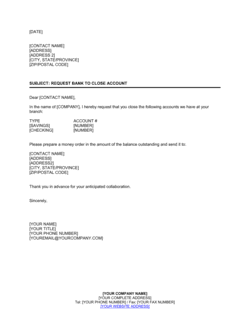
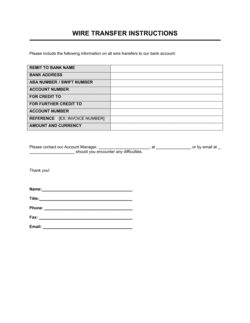
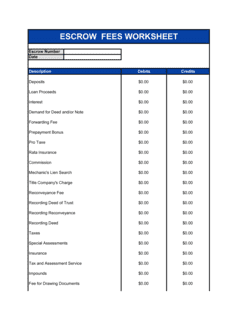
Banking, checks, and account notices
Refunds, guarantees, and specialist documents
250K+Clients
20M+Free users
20+Years
190+Countries
10,000+Law firms
50M+Downloads
Trusted across review platforms
- Capterra★★★★☆4.649 reviews
- G2★★★★☆4.713 reviews
- GetApp★★★★☆4.649 reviews
- Google Play★★★★☆4.6179 ratings
- Google Reviews★★★★☆4.567 reviews
Frequently asked questions
What is a payment agreement?
A payment agreement is a written contract that records one party's obligation to pay another a specified amount, under defined terms. It typically covers the amount owed, the due date or schedule, interest terms, and consequences for non-payment. A signed payment agreement gives both sides a clear record and makes enforcement considerably easier if a dispute arises.
Is a payment plan agreement legally binding?
Yes, in most jurisdictions a payment plan agreement is legally enforceable when it includes the key elements of a contract: offer, acceptance, and consideration (the debt itself). Both parties should sign it, and it should clearly state the amount, schedule, and default consequences. If significant sums are involved, consider having a lawyer review the document before signing.
When should I send a late payment letter rather than a notice of default?
Send a late payment letter as the first step — typically within 7 to 14 days of a missed due date. It signals that you've noticed the overdue balance and gives the debtor a clear opportunity to pay before formal action begins. Reserve a notice of default for situations where the debtor has ignored one or more reminders and the default provisions in the underlying agreement have been triggered.
Can I charge interest on overdue invoices?
Generally yes, provided you disclosed the interest rate in the original agreement, invoice, or terms and conditions before the payment was due. Many jurisdictions also have statutory interest rates for commercial debts that apply automatically when no rate is agreed. Check local law and consult a lawyer if you are uncertain about the rate you can legally charge.
What is a stop payment order and when should I use one?
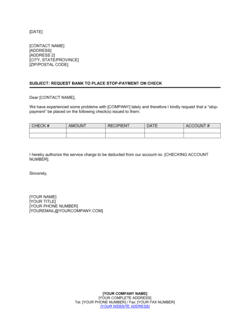
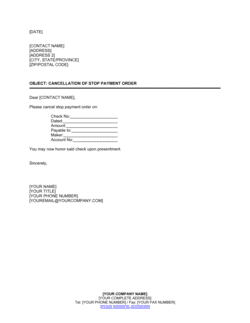
A stop payment order is a formal instruction to your bank to refuse payment on a specific cheque you have already issued. You would use one when you discover the cheque was lost, stolen, issued in error, or when a dispute has arisen with the payee before the cheque is cashed. The Notice to Bank to Stop Payment on Check (D453) provides the written instruction the bank requires; many banks also require a phone call or in-branch visit alongside the written notice.
What is the difference between a payment guaranty and a payment agreement?
A payment agreement records the primary debtor's obligation to pay. A payment guaranty (D404) brings in a third party — the guarantor — who agrees to pay if the primary debtor defaults. Guaranties are commonly required by lenders or suppliers when the debtor's creditworthiness is uncertain.
How do I handle a duplicate payment from a customer?
Send the Request for Refund of Duplicate Payment (D456) to the party who made the duplicate payment, or use the Refund of Duplicate Payment (D274) to initiate the refund from your side. Document the duplicate in your accounts receivable records and issue a corrected receipt or credit note so both parties' books stay reconciled.
What should a payment collections policy include?
A payment collections policy should define the escalation timeline — for example, a reminder at 7 days, a formal letter at 30 days, a final notice at 60 days — as well as the interest rate applied, the threshold for referral to a collections agency or legal counsel, and any incentives offered for early payment. A written policy keeps collection activity consistent and defensible if a customer challenges your process.
Payments and Treasury vs. related documents
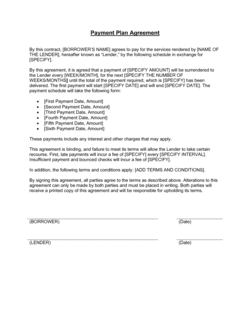
A Payment Agreement (D12662) establishes that money is owed and the overarching obligation to pay it — suitable when the debt and terms are settled in a single document. A Payment Plan Agreement (D12663) is designed specifically for structured repayment over time, with each instalment amount and due date spelled out. Use the Payment Agreement for a straightforward one-off commitment; use the Payment Plan Agreement when a customer needs to pay in recurring portions.
A Late Payment Letter (D448) is an early-stage, relatively informal reminder that an invoice is overdue — typically sent before formal action is considered. A Notice of Default in Payment (D391) is a formal legal notice triggered once a debtor has materially breached agreed payment terms. Use the letter first; escalate to the notice if the debt remains unresolved after your collections policy timeline.
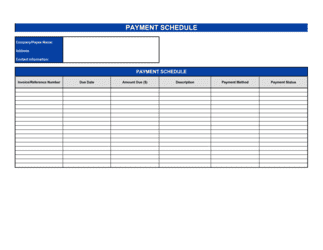
A Payment Schedule (D13745) is a standalone document that lists dates and amounts — useful for recording a repayment timetable on an existing agreement. An Installment Sale Contract (D12709) is a full contract that governs the transfer of goods while the buyer pays over time, with title and risk provisions included. Use the schedule to document timing; use the sale contract when you also need to formalize transfer of ownership.
A Good Faith Partial Payment to Creditor (D447) is a one-time gesture signalling intent to repay — useful when you can't meet the full amount and want to prevent escalation. A Monthly Partial Payment to Creditor (D449) sets up a recurring reduced-payment arrangement for an extended period. Use the good-faith letter for a single bridging payment; use the monthly version once a longer repayment schedule is agreed.
Key clauses every Payments and Treasury contains
Most payment documents — whether a demand letter, a plan agreement, or a collections policy — share a common set of provisions that define the obligation, the timeline, and the consequences of non-payment.
- Identification of parties and debt. Names the creditor and debtor and states the exact amount owed, including any accrued interest or fees.
- Payment terms and schedule. Sets out the amount, due dates, and accepted payment methods — by instalment or in full.
- Interest and late fees. Specifies the rate at which interest accrues on overdue balances and any flat late-payment penalties.
- Default provisions. Defines what constitutes default (e.g., missing a payment by more than X days) and what rights the creditor gains.
- Acceleration clause. Allows the full outstanding balance to become immediately due if a scheduled payment is missed.
- Dispute resolution. Describes the process for raising and resolving disagreements about the amount owed or payment received.
- Governing law. Names the jurisdiction whose laws apply if the parties need to enforce the document in court.
- Signature and date. Confirms both parties have read, agreed, and are bound by the document's terms from the signed date.
How to write a payment agreement or payment letter
Regardless of whether you're drafting a formal repayment plan or a demand letter, every effective payment document follows the same structure.
1
Identify both parties
Use full legal names for companies and individuals — not trading names — and include contact addresses.
2
State the exact amount owed
Include the original debt, any accrued interest, and any fees already applied, with dates.
3
Define the payment structure
Specify whether payment is due in full by a set date, in instalments, or under a partial-payment arrangement.
4
Set interest and late-fee terms
State the annual interest rate and any flat fee that applies for each day or period payment is overdue.
5
Include default and acceleration language
Explain what happens if a payment is missed — typically acceleration of the full balance and right to collections.
6
Add a dispute resolution clause
Describe how disagreements about the amount or terms will be handled before either party escalates to litigation.
7
Specify governing law and sign
Name the applicable jurisdiction and have authorized representatives sign and date the document.
At a glance
- What it is
- Payments and treasury documents are the formal letters, agreements, notices, and policies that govern how money moves between businesses and their customers, creditors, and banking partners.
- When you need one
- Any time you need to set payment terms, chase overdue invoices, formalize an installment arrangement, dispute a charge, or stop a check, you need the right document in writing.
Which Payments and Treasury do I need?
The right template depends on where you are in the payment cycle — setting terms upfront, managing an overdue balance, or resolving a dispute. Match your situation below.
Your situation
Recommended template
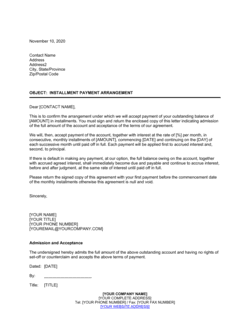
Formalizing a structured repayment schedule with a customer
Sets out amount, frequency, and consequences of missed payments in one document.A customer has missed an invoice due date
Firm but professional first-contact letter that requests immediate payment.Documenting agreed installment terms for a sale
Records the agreed schedule and both parties' obligations in writing.A debtor has defaulted and you need formal notice
Triggers formal default provisions and preserves your legal rights.Setting company-wide rules for chasing unpaid invoices
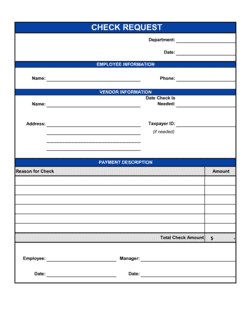
Documents escalation steps and keeps collection activity consistent.Needing to stop a check already issued to a payee
Formal bank instruction that protects funds while a dispute is investigated.A customer wants to pay an overdue balance in monthly portions
Documents partial-payment intent and keeps the creditor relationship intact.Resolving a disputed invoice balance without going to court
Proposes a final settlement figure and records mutual agreement.Glossary
- Creditor
- The party to whom money is owed.
- Debtor
- The party who owes money to the creditor.
- Default
- Failure to meet a payment obligation by the agreed date or under agreed terms.
- Acceleration clause
- A contract provision that makes the entire outstanding balance immediately due if a scheduled payment is missed.
- Instalment
- One of a series of partial payments made at regular intervals until a debt is fully repaid.
- Stop payment order
- A bank instruction to refuse payment on a specific cheque that has already been issued.
- Guarantor
- A third party who agrees to pay a debt if the primary debtor fails to do so.
- NSF (non-sufficient funds)
- A bank's refusal to honour a cheque because the account it is drawn on has insufficient funds.
- Escrow
- Funds held by a neutral third party until specific conditions of a transaction are met.
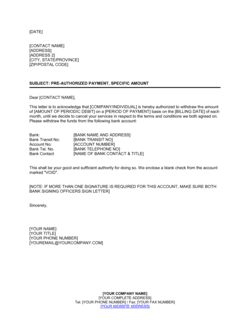
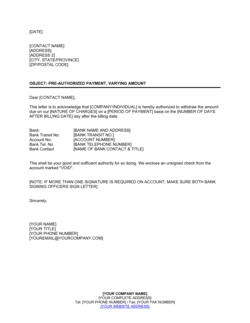
- Pre-authorized payment
- A standing bank instruction that allows a creditor to withdraw agreed amounts from a debtor's account on set dates.
- Promissory note
- A written, signed promise by one party to pay a specific sum to another party at a defined date or on demand.
- Settlement offer
- A proposal to resolve a disputed or outstanding debt for less than the full amount owed, in exchange for full and final release.
What is a payments and treasury document?
A payments and treasury document is any formal letter, agreement, notice, or policy that governs how money moves between a business and its customers, creditors, suppliers, or banking partners. These documents cover the full payment lifecycle: setting terms before a transaction, acknowledging receipt or scheduling repayments during one, and chasing, disputing, or settling balances when something goes wrong. Together they form the paper trail that keeps cash flow predictable and disputes resolvable.
The category spans a wide range of document types. Agreements and schedules — such as payment plan agreements, installment contracts, and payment schedules — establish the rules before a problem occurs. Letters and notices — late payment letters, notices of default, demands for payment — are used when a debtor is overdue or in breach. Banking and account documents — stop payment orders, escrow receipts, bank extension requests — manage specific transactional events. Dispute and settlement documents close out unresolved balances. Every type serves a distinct moment in the payment cycle.
When you need a payments and treasury template
Most businesses need at least one payments and treasury document several times a month — yet many rely on improvised emails or verbal agreements instead of properly structured documents. That creates real risk: without written records, proving what was agreed, when it was due, and what the consequences of non-payment are becomes a matter of "your word against mine."
Common triggers:
- A customer has missed a due date and needs a formal written reminder
- You're setting up a repayment plan for an overdue balance with a long-standing client
- A supplier or lender requires a signed payment agreement before extending credit
- You need to stop a cheque already issued while you investigate a dispute
- A debtor is consistently paying late and you need a company-wide collections policy to enforce consistent escalation
- An instalment sale is being made and ownership transfer depends on completed payments
- You receive a duplicate payment and need to formally request or issue a refund
- A contested invoice needs a written settlement offer to avoid litigation
The cost of an undocumented payment arrangement is not just the risk of non-payment — it is the loss of legal standing to enforce anything. A signed letter, notice, or agreement creates an unambiguous record that can be relied upon in collections, mediation, or court proceedings. Starting with the right template is the fastest way to make sure that record is complete.
Award-winning platform
- Great Place to Work 2025
- BIG Award — Product of the Year 2025
- Smartest Companies 2025
- Global 100 Excellence 2026
- Best of the Best 2025