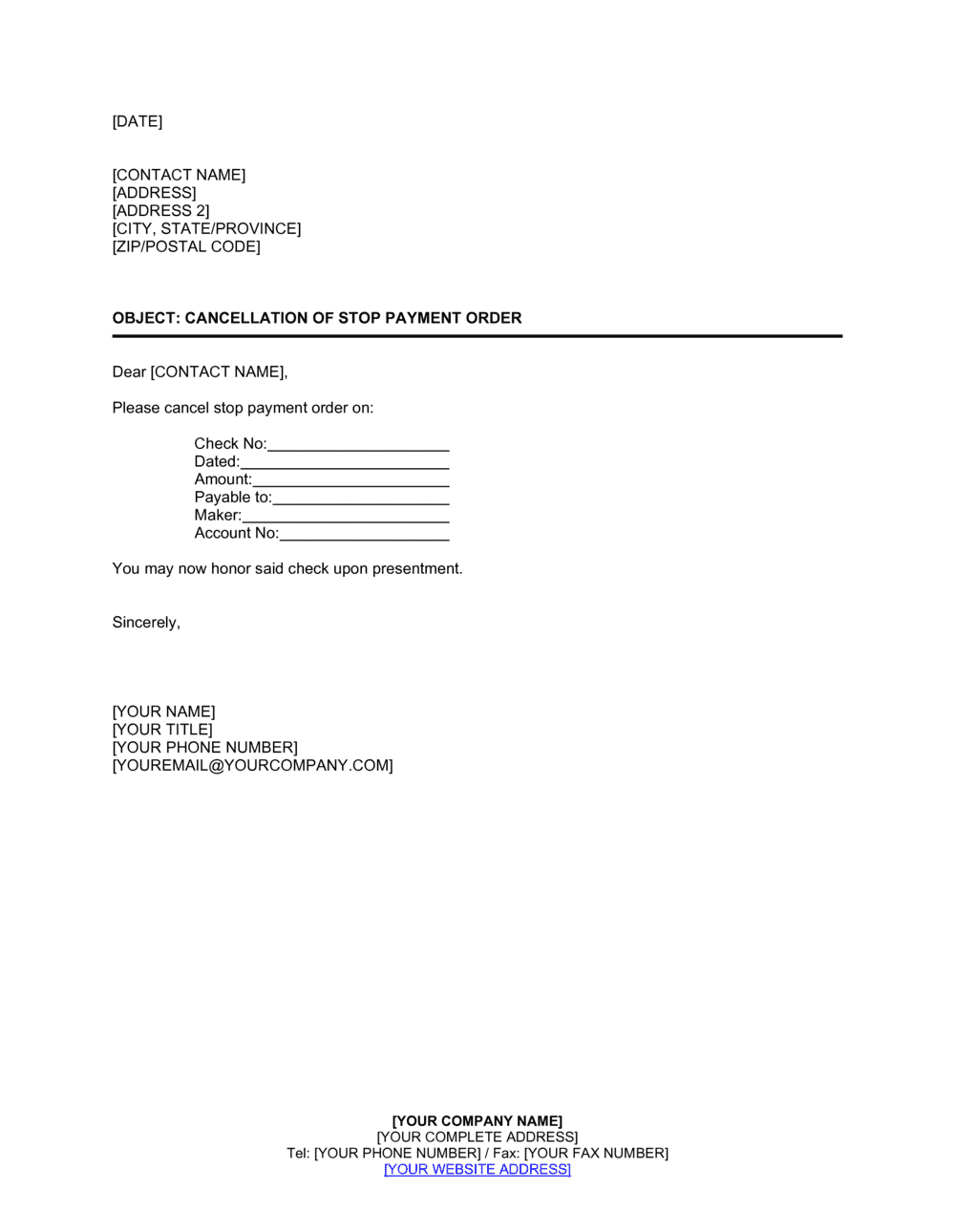
Cancellation of Stop Payment Order Template

Free Word download • Edit online • Save & share with Drive • Export to PDF

1 page20–30 min to fillDifficulty: StandardSignature requiredLegal review recommended
Learn more ↓
FreeCancellation of Stop Payment Order Template

At a glance

What it is
A Cancellation of Stop Payment Order is a formal written instruction from an account holder to their financial institution directing the bank to lift a previously placed stop payment on a specific check or payment transaction. This free Word download gives you a structured, bank-ready document you can edit online and export as PDF to submit to your financial institution quickly and with a clear paper trail.
When you need it
Use it when a dispute that prompted the original stop payment has been resolved, when goods or services originally withheld have been delivered, or when a replacement check is no longer needed and the original instrument should be honored. Submitting a written cancellation protects you if the bank processes the payment after the stop-payment fee period expires.
What's inside
Account holder identification, bank and account details, a precise description of the original stop payment instruction being revoked, authorization language releasing the bank from liability, and a dated signature block with account holder acknowledgment.

What is a Cancellation of Stop Payment Order?

A Cancellation of Stop Payment Order is a formal written instruction from a bank account holder to their financial institution directing the bank to lift a previously placed stop payment on a specific check or payment transaction. Once processed, the cancellation restores the instrument to active status — meaning the bank will honor the check when it is next presented, provided the account has sufficient funds. The document identifies the account holder, the specific instrument being unblocked by check number, amount, and payee, and includes a hold harmless clause releasing the bank from liability for processing the payment in good faith after the stop is removed.

Why You Need This Document

Attempting to cancel a stop payment without a signed written document leaves you with no proof the instruction was authorized, no record of when the cancellation took effect, and no protection if the bank fails to lift the hold before the check is presented. A verbal request logged in a call center record is not equivalent to a signed authorization in most banks' compliance frameworks — and if the bank honors the check before the stop is properly cancelled, or refuses to honor it after you believed the stop was removed, you have no documentary evidence to support a claim or a defense. Beyond the immediate banking relationship, a completed cancellation form creates the audit trail that accountants, lawyers, and dispute resolution bodies require when a payment becomes the subject of a broader dispute. Using this template ensures the bank receives every identifier it needs to act quickly, that fee authorization is unambiguous, and that the effective date is clearly defined — turning a process that commonly stalls over missing information into a straightforward, one-submission transaction.

Which variant fits your situation?

If your situation is…Use this template
Cancelling a stop payment on a personal or business checkCancellation of Stop Payment Order
Placing a new stop payment instruction on a checkStop Payment Order
Disputing an unauthorized electronic funds transferBank Error Dispute Letter
Formally notifying a payee that a check has been cancelledNotice of Dishonoured Cheque
Instructing a bank to close or freeze an account after fraudAccount Freeze Request Letter
Documenting a payment settlement reached after a prior stop paymentSettlement Agreement

Common mistakes to avoid

❌ Submitting with a DBA or trade name instead of the registered account name

Why it matters: Banks validate authorization against the name on file for the account. A mismatch triggers a manual review or outright rejection, delaying the cancellation by several business days.

Fix: Use the exact legal entity name registered with the bank — confirm it against a recent bank statement before completing the form.

❌ Omitting the original stop payment date

Why it matters: Multiple stop payments may be active on the same account. Without the original placement date, the bank cannot definitively identify which instruction to cancel, risking the wrong stop payment being lifted or none at all.

Fix: Include all four identifiers — check number, amount, payee name, and original stop payment date — to give the bank an unambiguous match.

❌ Failing to obtain all required co-signatures on a joint account

Why it matters: If the account agreement requires dual authorization, a single-signature cancellation is legally insufficient and the bank may refuse to process it — leaving the stop payment in place past a critical deadline.

Fix: Review the account agreement before submitting. For joint or business accounts, identify every required signatory and obtain all signatures before delivery to the bank.

❌ Not confirming sufficient funds before the cancellation takes effect

Why it matters: Lifting the stop payment on a check that subsequently bounces for insufficient funds exposes the account holder to NSF fees, potential check-fraud liability, and damage to the banking relationship.

Fix: Verify available account balance and, if necessary, transfer funds to cover the check amount before the cancellation's effective date.

❌ Submitting verbally or by informal email without a signed document

Why it matters: Many banks require written authorization for stop payment cancellations. A verbal request may be noted in a call log but does not constitute a formal instruction — the stop payment may remain active, and you lose your paper trail.

Fix: Always submit a signed written cancellation form through the bank's official channel and retain a bank-stamped copy or acknowledgment email as proof.

❌ Using 'immediately' as the effective date without specifying a calendar date

Why it matters: Banks typically require one to two business days to process a stop payment cancellation. An undefined effective date creates ambiguity about when the bank's processing obligation begins and when the account holder assumes responsibility for the payment.

Fix: Enter a specific calendar date that allows at least one full business day for processing, and verify timing with the bank when submitting.

The 9 key clauses, explained

Account Holder Identification

In plain language: States the full legal name, address, and contact information of the person or entity authorizing the cancellation.

Sample language
The undersigned, [ACCOUNT HOLDER FULL NAME], residing at [ADDRESS], hereby submits this Cancellation of Stop Payment Order with respect to the account identified below.

Common mistake: Using a trade name or DBA instead of the registered legal entity name. Banks match authorization against account registration, and a name mismatch can cause the request to be rejected or delayed.

Bank and Account Identification

In plain language: Identifies the specific financial institution and account number to which the cancellation applies, preventing the instruction from being applied to the wrong account.

Sample language
Financial Institution: [BANK NAME] | Branch: [BRANCH ADDRESS] | Account Number: [ACCOUNT NUMBER] | Account Type: [CHECKING / SAVINGS / BUSINESS].

Common mistake: Omitting the account type or branch details. Large banks process thousands of daily requests; incomplete account identification routes the document to a general queue and delays processing.

Original Stop Payment Reference

In plain language: Identifies the specific stop payment being cancelled by referencing the check number, amount, payee name, and the date the stop payment was originally placed.

Sample language
This cancellation applies to the stop payment order placed on [ORIGINAL STOP PAYMENT DATE] for Check No. [CHECK NUMBER], payable to [PAYEE NAME], in the amount of $[AMOUNT], drawn on the above account.

Common mistake: Referencing only the check number without the amount and payee. If the check number is incorrect or a duplicate, the bank has no secondary identifiers to match the instrument and may honor the wrong item.

Authorization to Honor the Instrument

In plain language: Expressly instructs the bank to lift the stop payment and process the identified check or payment if it is presented for payment.

Sample language
The Account Holder hereby authorizes and directs [BANK NAME] to remove the stop payment instruction referenced above and to honor Check No. [CHECK NUMBER] in the amount of $[AMOUNT] upon its next presentation, subject to the account having sufficient funds.

Common mistake: Failing to include 'upon its next presentation' language. Without this qualifier, ambiguity about timing can result in liability if the check clears at an inconvenient time.

Reason for Cancellation (Optional but Recommended)

In plain language: A brief statement of why the stop payment is being revoked — dispute resolved, goods received, replacement check no longer needed — providing context and supporting any future audit trail.

Sample language
The Account Holder cancels this stop payment order because [THE UNDERLYING DISPUTE HAS BEEN RESOLVED / THE GOODS AND SERVICES HAVE BEEN DELIVERED / OTHER REASON].

Common mistake: Skipping this clause entirely. While optional, omitting the reason makes the document harder to interpret in a dispute and provides no narrative record if the payment is later challenged.

Hold Harmless and Indemnification

In plain language: Releases the bank from liability for processing the payment after the stop is lifted, and indemnifies the bank against claims arising from honoring the instrument in good faith.

Sample language
The Account Holder agrees to hold harmless and indemnify [BANK NAME] from any and all claims, losses, or damages arising from the bank's good-faith processing of the above-identified instrument following the removal of the stop payment instruction.

Common mistake: Narrowing the indemnification to the account holder's own claims only. Banks require protection against third-party claims as well — a one-sided release may be rejected as insufficient.

Acknowledgment of Fee

In plain language: Confirms the account holder understands and accepts any fee charged by the bank to process the cancellation of the stop payment order.

Sample language
The Account Holder acknowledges that [BANK NAME] may charge a cancellation fee of $[FEE AMOUNT] to the above account in accordance with its current fee schedule, and authorizes the bank to debit such fee accordingly.

Common mistake: Leaving the fee amount blank. Banks vary in their charges; leaving it blank creates a dispute if the account holder later claims the fee was unexpected or unauthorized.

Effective Date of Cancellation

In plain language: Specifies the date on which the cancellation takes effect, giving both the account holder and the bank a clear reference point for when the instrument may be honored.

Sample language
This Cancellation of Stop Payment Order shall be effective as of [DATE] or upon the bank's acceptance and processing of this instruction, whichever is later.

Common mistake: Using 'immediately' without specifying a calendar date. Banks require processing time — typically one to two business days — and an undefined effective date creates confusion about when liability for the payment transfers.

Signature and Date

In plain language: The account holder's wet or electronic signature, printed name, title (if a business account), and the date of execution, confirming the instruction is authorized.

Sample language
Authorized Signature: ___________________________ | Printed Name: [FULL NAME] | Title (if applicable): [TITLE] | Date: [DATE].

Common mistake: Only one signature on a joint account that requires dual authorization. If the account agreement requires two signatories, a single signature gives the bank grounds to reject the cancellation.

How to fill it out

  1. 1

    Gather your original stop payment documentation

    Locate the original stop payment confirmation from your bank, which should include the stop payment date, check number, amount, and payee. You will need these exact details to complete the cancellation form accurately.

    💡 Cross-reference your bank's records online or by phone before filling in the form — even a one-digit difference in the check number can cause the cancellation to be misapplied.

  2. 2

    Enter your account holder and bank details

    Complete the account holder identification block with your full legal name or registered business name, address, and contact information. Then enter your bank name, branch address, and full account number.

    💡 Use the exact name on file with the bank — not a DBA or abbreviated name — to prevent processing delays.

  3. 3

    Identify the original stop payment precisely

    Fill in the check number, exact dollar amount, payee name, and the date the stop payment was originally placed. All four identifiers should match your bank's stop payment record.

    💡 If you are unsure of the exact stop payment date, call your bank's customer service line and request a stop payment history report before submitting.

  4. 4

    Draft the authorization to honor the instrument

    Complete the authorization clause directing the bank to lift the stop payment and honor the check upon its next presentation. Confirm that the account will have sufficient funds to cover the payment on or before the anticipated presentation date.

    💡 If funds may be tight on the expected presentation date, coordinate with the payee on timing before submitting the cancellation.

  5. 5

    Add the reason for cancellation

    Briefly state why the stop payment is being revoked — resolved dispute, confirmed delivery of goods or services, or mutual agreement with the payee. Even a single sentence creates a useful audit trail.

    💡 Keep the reason factual and neutral — this document may be reviewed by a bank compliance officer or introduced as evidence in a future dispute.

  6. 6

    Review the hold harmless and fee acknowledgment clauses

    Read the indemnification language carefully before signing. Confirm the fee amount listed matches your bank's current fee schedule, and verify that you are comfortable releasing the bank from liability for good-faith processing.

    💡 Call your bank to confirm the current cancellation fee before inserting the amount — fees change and an incorrect figure may require a corrected submission.

  7. 7

    Sign, date, and submit to the bank

    Execute the form with a wet or electronic signature matching the bank's account authorization requirements. For joint accounts, obtain all required co-signatures. Submit the form in person, by secure mail, or through the bank's secure document portal.

    💡 Request a written confirmation receipt or bank-stamped copy of the cancellation — this is your proof of submission if the bank fails to lift the stop payment in time.

  8. 8

    Confirm the cancellation was processed

    Follow up with your bank within one to two business days to confirm the stop payment has been removed from their system and the check will be honored on presentation.

    💡 Note the name of the bank representative who confirms processing and retain that record alongside your submitted cancellation form.

Frequently asked questions

What is a cancellation of stop payment order?

A cancellation of stop payment order is a formal written instruction from a bank account holder directing their financial institution to lift a previously placed stop payment on a specific check or payment transaction. Once the cancellation is processed, the bank will honor the instrument if it is presented within the account's normal payment parameters. It creates a documented record that the account holder authorized the reversal and releases the bank from liability for processing the payment in good faith.

When should I cancel a stop payment order?

Cancel a stop payment when the underlying reason for placing it no longer applies — for example, when a billing dispute with a vendor has been resolved, when goods or services previously withheld have been delivered and accepted, or when a replacement check you issued turns out to be unnecessary. You should also cancel if the stop payment is approaching its expiration date and you want to ensure the original check remains blocked only for as long as necessary, not indefinitely.

Does a stop payment order expire automatically?

In most jurisdictions and at most financial institutions, a stop payment order is not permanent. In the United States, the Uniform Commercial Code provides that a stop payment on a check typically expires after six months unless renewed. Many banks in Canada and the UK apply similar time limits. If you want the stop payment to remain active beyond the expiration period, you must renew it in writing. If you want it removed before expiration, submit a formal cancellation.

What information do I need to cancel a stop payment order?

You will need the full account holder name as registered with the bank, the bank name and account number, the check number, the exact dollar amount of the stopped check, the payee name, and the date the original stop payment was placed. The more precisely you identify the instrument, the faster the bank can locate and remove the specific stop payment instruction without affecting other holds on the account.

Can I cancel a stop payment order verbally?

Some banks may accept a verbal cancellation by phone, but relying on a verbal instruction is risky. Without a written record, you have no proof the cancellation was authorized if the bank fails to process it or if the payment is later disputed. Most banks require written authorization for stop payment cancellations, and a signed document protects both parties. Always confirm the bank's requirements before submitting.

Is there a fee to cancel a stop payment order?

Many financial institutions charge a fee to process a stop payment cancellation, separate from the original stop payment fee. Fees typically range from $0 to $35 depending on the institution and account type. Some banks waive the cancellation fee for premium or business account holders. Confirm the applicable fee with your bank before submitting the cancellation form and authorize the debit explicitly in writing.

What happens if the bank honors the check after I place a stop payment but before I file the cancellation?

If a bank honors a check after a valid stop payment has been placed, the bank may be liable for the amount under the Uniform Commercial Code (US) or equivalent legislation, provided the stop payment was properly placed and the bank had sufficient time to act on it. You should notify the bank immediately in writing and request a refund of the payment. A formal cancellation of stop payment order should be filed only after the dispute is resolved, not as a substitute for a wrongful-payment claim.

Can a business account holder cancel a stop payment order?

Yes. Business account holders cancel stop payment orders using the same process as individual account holders, but with added requirements. Business accounts typically require the signature of an authorized signatory as listed in the bank's account authorization documentation — often a signing officer, director, or designated account manager. For accounts requiring dual authorization, both signatories must sign the cancellation form before the bank will process the instruction.

How this compares to alternatives

vs Stop Payment Order

A stop payment order instructs the bank not to honor a specific check or payment. A cancellation of stop payment order reverses that instruction and directs the bank to process the payment. You need the original stop payment details to complete a valid cancellation — they are sequential steps in the same payment management process, not interchangeable documents.

vs Notice of Dishonoured Cheque

A notice of dishonoured cheque formally informs the payee that a check has been returned unpaid — whether due to a stop payment, insufficient funds, or a closed account. A cancellation of stop payment order is sent to the bank, not the payee, to lift the restriction before dishonor occurs. If the check has already been dishonored, a notice of dishonour is the appropriate follow-on document.

vs Settlement Agreement

A settlement agreement documents the terms under which two parties resolve a dispute, including any agreed payment obligations. A cancellation of stop payment order is the operational banking instruction that implements the payment component of that settlement. The two documents work together — the settlement agreement triggers the cancellation, and the cancellation executes the agreed payment.

vs Bank Error Dispute Letter

A bank error dispute letter challenges an unauthorized or incorrect transaction processed by the bank — it is a claim against the bank. A cancellation of stop payment order is a voluntary instruction from the account holder authorizing the bank to act. Use a dispute letter when the bank acted wrongly; use a cancellation when you are changing your own prior instruction.

Industry-specific considerations

Professional Services

Law firms and accounting practices cancel stop payments after fee disputes are resolved and client payment plans are confirmed in writing.

Construction and Trades

Contractors lift stop payments on subcontractor and supplier checks once defective work is remedied or materials disputes are settled, often as part of a broader lien release process.

Retail and E-commerce

Retailers cancel stop payments on vendor or refund checks when order fulfillment issues are confirmed resolved, restoring the supplier relationship and clearing accounts payable backlogs.

Real Estate and Property Management

Property managers lift stop payments on tenant security deposit checks or repair reimbursements after lease disputes are settled, with the cancellation often attached to the settlement agreement as an exhibit.

Jurisdictional notes

United States

Under the Uniform Commercial Code Article 4, a stop payment order on a check generally expires six months after it is placed unless renewed in writing. Banks are typically not liable for honoring a check if the stop payment has lapsed. State law variations exist, and some states apply different rules to electronic fund transfers under Regulation E. Confirm your bank's specific expiration policy before deciding whether to cancel or allow the stop to lapse.

Canada

Canadian banks operate stop payment and cancellation procedures under the Bills of Exchange Act and individual bank account agreements. Stop payments typically remain active for six months, with renewal required beyond that period. Quebec account holders should confirm whether their bank requires French-language documentation for stop payment instructions. Business accounts in federally regulated banks may require additional signing authority documentation.

United Kingdom

In the UK, stop payment instructions on cheques are governed by the Bills of Exchange Act 1882 and the Payment Services Regulations 2017. Banks must act on a cancellation of a stop payment instruction promptly once properly authorized. Cheques are less commonly used in UK commercial transactions than BACS or CHAPS payments; for electronic payments subject to a payment recall, the process differs and is governed by the Payment Services Regulations rather than cheque law.

European Union

Within the EU, payment instrument rules vary by member state, with the Payment Services Directive 2 (PSD2) providing an overarching framework for electronic payment revocations. Cheque usage varies significantly across EU member states — common in France but rare in Germany and the Netherlands. GDPR considerations apply to the personal data included in a stop payment cancellation form when processed by a financial institution. Confirm local bank requirements, particularly for cross-border euro transactions subject to SEPA rules.

Template vs lawyer — what fits your deal?

PathBest forCostTime
Use the templateAccount holders cancelling a stop payment after a straightforward resolved dispute with a known payeeFree15–20 minutes
Template + legal reviewBusiness accounts, disputes involving significant amounts, or situations where the underlying transaction is partially unresolved$150–$400 for a one-hour attorney review1–2 business days
Custom draftedHigh-value transactions, cross-border payments, or stop payment cancellations connected to ongoing litigation or formal settlement agreements$500–$1,500+3–7 business days

Glossary

Stop Payment Order
A formal instruction from an account holder to their bank directing the institution not to honor a specific check or payment transaction.
Cancellation of Stop Payment Order
A written revocation instructing the bank to lift a previously placed stop payment and permit the specified instrument to be honored.
Account Holder
The individual or legal entity whose name is on the bank account from which the original check or payment was drawn.
Drawee Bank
The financial institution holding the account on which a check is drawn — the bank responsible for honoring or rejecting the instrument.
Negotiable Instrument
A signed document, such as a check or promissory note, that promises payment of a specific sum and can be transferred to a third party.
Stale-Dated Check
A check that has not been presented for payment within the period — typically six months — after which banks may refuse to honor it.
Stop Payment Fee
The charge a financial institution levies to place or maintain a stop payment instruction, typically ranging from $15 to $35 per item.
Hold Harmless Clause
A contractual provision in which one party releases another from liability arising from a specific action — here, the bank's processing of the payment after the stop is lifted.
Indemnification
A legal obligation by one party to compensate another for losses or damages arising from a specified event or instruction.
ACH Transaction
An Automated Clearing House electronic funds transfer — a common payment method that, like checks, can be subject to stop payment instructions in some circumstances.

Part of your Business Operating System

This document is one of 3,000+ business & legal templates included in Business in a Box.

  • Fill-in-the-blanks — ready in minutes
  • 100% customizable Word document
  • Compatible with all office suites
  • Export to PDF and share electronically

Create your document in 3 simple steps.

From template to signed document — all inside one Business Operating System.
1
Download or open template

Access over 3,000+ business and legal templates for any business task, project or initiative.

2
Edit and fill in the blanks with AI

Customize your ready-made business document template and save it in the cloud.

3
Save, Share, Send, Sign

Share your files and folders with your team. Create a space of seamless collaboration.

Save time, save money, and create top-quality documents.

★★★★★

"Fantastic value! I'm not sure how I'd do without it. It's worth its weight in gold and paid back for itself many times."

Managing Director · Mall Farm
Robert Whalley
Managing Director, Mall Farm Proprietary Limited
★★★★★

"I have been using Business in a Box for years. It has been the most useful source of templates I have encountered. I recommend it to anyone."

Business Owner · 4+ years
Dr Michael John Freestone
Business Owner
★★★★★

"It has been a life saver so many times I have lost count. Business in a Box has saved me so much time and as you know, time is money."

Owner · Upstate Web
David G. Moore Jr.
Owner, Upstate Web

Run your business with a system — not scattered tools

Stop downloading documents. Start operating with clarity. Business in a Box gives you the Business Operating System used by over 250,000 companies worldwide to structure, run, and grow their business.

Free Forever Plan · No credit card required