Request Bank to Close Account Template

Free Word download β€’ Edit online β€’ Save & share with Drive β€’ Export to PDF

1 pageβ€’15–25 min to fillβ€’Difficulty: Standard
Learn more ↓
FreeRequest Bank to Close Account Template

At a glance

What it is
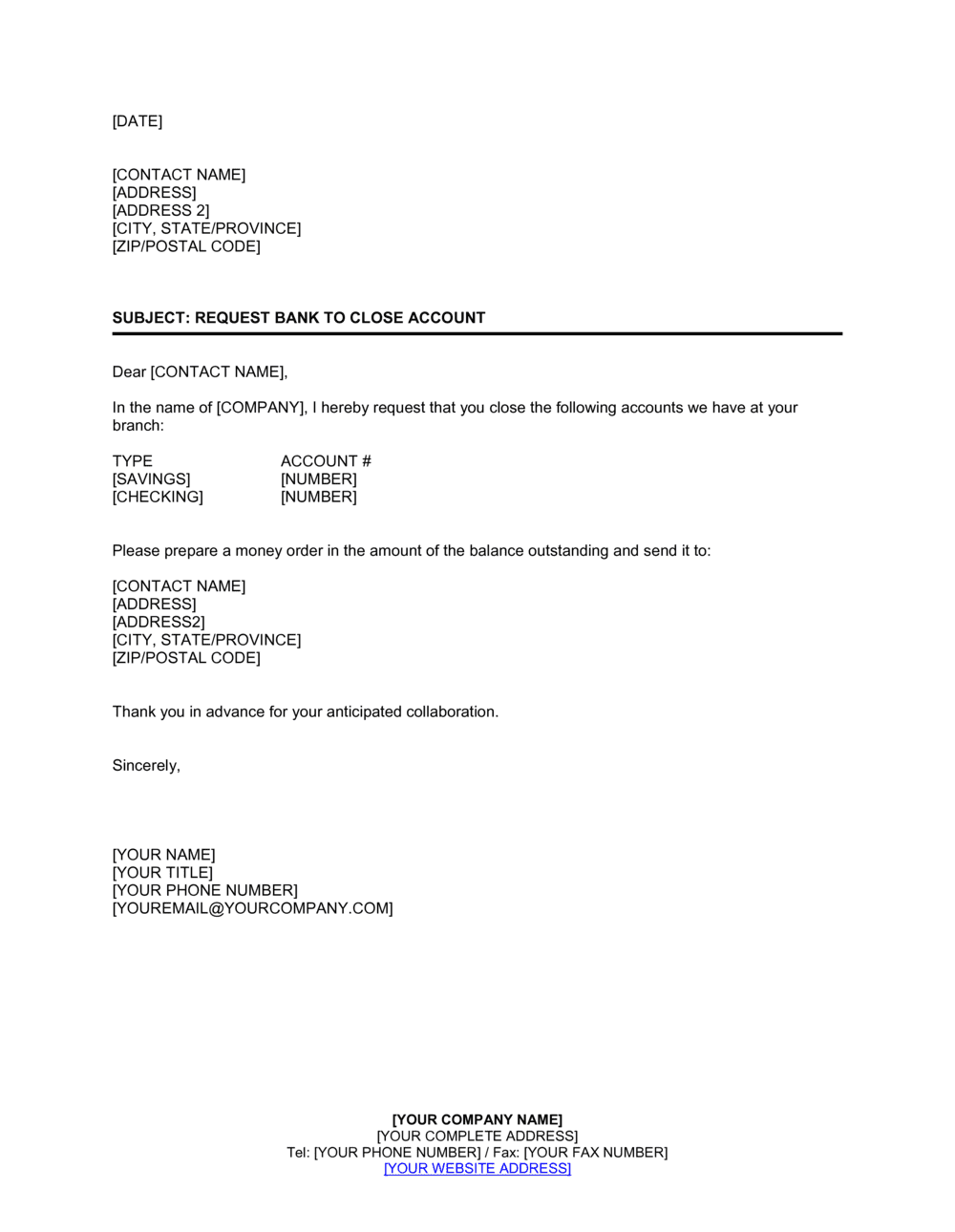
A Request to Close Bank Account is a formal written instruction from an account holder to their bank directing closure of a specific account, disposition of any remaining balance, and cancellation of all linked standing orders and direct debits. This free Word download gives you a professionally formatted letter you can edit in minutes and submit to your branch or mail to the bank's correspondence address.
When you need it
Use it when you are switching banks, consolidating accounts, dissolving a business entity, or closing a dormant account you no longer need. A written request creates a dated paper trail and reduces the risk of the account remaining open β€” and incurring fees β€” after you have stopped using it.
What's inside
Account holder identification, account number and sort/routing code, explicit closure instruction, balance disposition instructions, standing order and direct debit cancellation request, and a written confirmation requirement so you have documented proof of closure.

What is a Request to Close Bank Account?

A Request to Close Bank Account is a formal written instruction from an account holder β€” individual or business β€” to their bank directing closure of a specific account, disposition of any remaining credit balance, cancellation of all linked standing orders and direct debits, and issuance of written confirmation that closure has taken effect. Unlike a phone call or in-branch visit, a written letter creates a dated, signed record of the instruction that neither party can dispute later. For corporate accounts, most banks require a written instruction from an authorised signatory as a matter of policy before they will action the closure.

Why You Need This Document

Closing a bank account without a formal written instruction leaves you exposed to ongoing fees, misdirected payments, and β€” if standing orders are not explicitly cancelled β€” continued collection attempts against an account you believe is shut. Banks have no legal obligation to act on a verbal instruction, and without a paper trail you have no way to prove you requested closure on a specific date if a dispute arises. This template provides every element the bank needs to process the closure cleanly: account identification, a clear instruction, balance disposition, linked-product cancellation, and a written confirmation requirement β€” so you walk away with documented proof and no loose ends.

Which variant fits your situation?

If your situation is…Use this template
Closing a personal checking or savings accountRequest to Close Bank Account (Personal)
Closing a business or corporate bank accountRequest to Close Bank Account (Business)
Closing an account as part of company wind-downCompany Dissolution Notice
Transferring all funds to a new account at a different bankBank Transfer Authorization Letter
Notifying vendors of a new bank account after closureChange of Bank Account Details Letter
Cancelling a specific direct debit without closing the accountDirect Debit Cancellation Letter
Requesting a final account statement before closureRequest for Bank Statement Letter

Common mistakes to avoid

❌ Using a trading name instead of the registered legal name

Why it matters: The bank's records are filed under the legal name used at account opening. A mismatch requires a verification step that can delay closure by days or weeks.

Fix: Check your most recent account statement for the exact name the bank holds on file and use that verbatim in the letter.
❌ Not providing balance disposition instructions

Why it matters: Without instructions, the bank holds the remaining funds and requires a follow-up contact before releasing them, extending the closure process unnecessarily.

Fix: Always include at least one balance disposition option β€” an electronic transfer to a named account is faster than requesting a cheque.

❌ Requesting closure without settling an active overdraft

Why it matters: A bank cannot close an account carrying a negative balance. The closure request will be paused until the debt is resolved, and interest continues to accrue in the meantime.

Fix: Contact the bank to obtain the exact overdraft payoff amount before submitting the letter, and arrange settlement on or before the requested closure date.

❌ Not requesting written closure confirmation

Why it matters: Without written confirmation, there is no record of when β€” or whether β€” the account was formally closed, making it difficult to dispute subsequent fees or fraudulent transactions.

Fix: Include an explicit sentence requiring the bank to issue a written confirmation letter stating the account number and effective date of closure.

The 9 key clauses, explained

Account holder identification

In plain language: Opens the letter by identifying who is writing β€” full legal name, address, and contact details β€” so the bank can locate the correct customer record without ambiguity.

Sample language
[FULL LEGAL NAME / COMPANY NAME], [ADDRESS LINE 1], [CITY, STATE/COUNTY, POSTCODE] β€” Account Holder Reference: [CUSTOMER REFERENCE NUMBER, IF KNOWN]

Common mistake: Using a trading name instead of the registered legal name. The bank's records are filed under the legal name at account opening; a mismatch delays processing.

Account identification

In plain language: Specifies the exact account to be closed using the account number and sort code or routing number, eliminating any risk of the bank acting on the wrong account.

Sample language
I/We write to request closure of Account Number [ACCOUNT NUMBER], Sort Code / Routing Number [SORT CODE / ROUTING NUMBER], held at [BRANCH NAME / ADDRESS].

Common mistake: Providing only the last four digits of the account number for privacy. Banks need the full account number to process a closure β€” partial numbers cause delays.

Explicit closure instruction

In plain language: States unambiguously that the account holder is instructing the bank to close the account, including the requested effective date or instruction to close as soon as practicable.

Sample language
Please close the above-referenced account with effect from [REQUESTED CLOSURE DATE], or as soon as reasonably practicable after receipt of this letter.

Common mistake: Phrasing the instruction as a question or request for information ('I would like to know how to close my account') rather than a direct instruction. The bank may treat it as an enquiry and take no action.

Balance disposition instructions

In plain language: Directs the bank on what to do with any remaining credit balance β€” transfer to a named account, issue a banker's cheque, or hold for collection β€” so funds are not left in limbo.

Sample language
Please transfer any remaining credit balance to Account Number [RECEIVING ACCOUNT NUMBER], Sort Code [SORT CODE], held in the name of [ACCOUNT NAME] at [RECEIVING BANK NAME]. Alternatively, please issue a cheque payable to [PAYEE NAME] and mail to the address above.

Common mistake: Not providing balance disposition instructions at all. The bank will typically hold the funds and require a follow-up contact, adding weeks to the closure process.

Overdraft and liability settlement

In plain language: Acknowledges any outstanding overdraft or linked credit facility and confirms the account holder's intention to settle the balance before or at closure.

Sample language
I/We confirm that any outstanding overdraft balance or linked credit facility will be settled in full prior to the requested closure date. Please advise the exact settlement amount as of [DATE] so that payment can be arranged.

Common mistake: Ignoring an active overdraft in the letter. Banks cannot close an account with a negative balance without a repayment plan β€” omitting this delays closure and can trigger additional interest.

Standing order and direct debit cancellation

In plain language: Instructs the bank to cancel all standing orders, direct debits, and recurring payment authorities linked to the account effective on or before the closure date.

Sample language
Please cancel all standing orders, direct debits, and recurring card authorities linked to this account with immediate effect or no later than [CLOSURE DATE]. Please provide a list of cancelled mandates for my/our records.

Common mistake: Assuming the bank automatically cancels all linked payment mandates on closure. Billers can still attempt to collect against a closed account, resulting in returned payment fees and service interruptions.

Linked products and services

In plain language: Addresses any associated products β€” overdraft facilities, linked savings accounts, business debit cards, or online banking access β€” and requests their cancellation alongside the main account.

Sample language
Please also cancel/close any linked overdraft facility, associated debit card(s) (Card number ending [LAST 4 DIGITS]), and online banking access tied to this account.

Common mistake: Closing the current account without cancelling a linked savings or sweep account. The subsidiary account may remain open, accruing fees independently.

Confirmation requirement

In plain language: Formally requests that the bank issue a written closure confirmation letter stating the account number and the date closure took effect, for the account holder's records.

Sample language
Please confirm closure in writing to the address above, stating the account number and the effective date of closure. Written confirmation is required for our accounting and compliance records.

Common mistake: Not requesting written confirmation. Without it, there is no documentation that the account was closed, making it difficult to resolve any subsequent fee charges or fraudulent activity referencing the account.

Signatory and date

In plain language: Closes the letter with the authorised signatory's name, title (for corporate accounts), and the date of the letter, satisfying the bank's requirement for a verifiable instruction.

Sample language
Yours sincerely, [FULL NAME] | [JOB TITLE, IF CORPORATE] | Date: [DATE] | [COMPANY NAME, IF APPLICABLE]

Common mistake: Omitting a title or company name on a corporate account closure. Banks require confirmation that the signatory has authority to instruct on the company's behalf β€” missing this triggers a verification call.

How to fill it out

  1. 1

    Enter the account holder's full legal name and address

    Use the exact name under which the account was opened β€” individual full legal name or registered company name. Add the current correspondence address and any customer reference number shown on statements.

    πŸ’‘ Check your most recent bank statement to confirm the exact name the bank has on file before completing this field.

  2. 2

    Fill in the account number and sort code or routing number

    Locate these on a recent statement or within your online banking portal. Enter the full account number β€” not a truncated version β€” along with the branch sort code or ABA routing number.

    πŸ’‘ If you hold multiple accounts at the same bank, list each account on a separate letter to avoid any risk of the wrong account being closed.

  3. 3

    Set a requested closure date

    Choose a date at least 10–15 business days from the date you send the letter to give the bank time to process the instruction and allow pending transactions to clear.

    πŸ’‘ Avoid requesting closure dates that fall on a public holiday or at month-end, when banks process high volumes and administrative delays are more common.

  4. 4

    Specify balance disposition instructions

    Decide whether you want the remaining balance transferred electronically to a named account or issued as a cheque. Enter the receiving account details in full β€” account name, account number, sort code or routing number, and bank name.

    πŸ’‘ Have the new account open and active before submitting the closure letter so there is no delay in receiving your funds.

  5. 5

    Address any overdraft or outstanding balance

    If the account is in overdraft, note this in the letter and request the exact settlement figure as of your intended closure date. Arrange payment before submitting or simultaneously with the letter.

    πŸ’‘ Ask the bank to confirm the settlement amount in writing before making payment β€” interest accrues daily and a phone-quoted figure may be slightly different from the written payoff amount.

  6. 6

    List linked products to be cancelled

    Include the last four digits of any debit cards, the names of linked savings accounts, and any overdraft facility reference. Request written confirmation that each has been cancelled.

    πŸ’‘ Log into online banking and screenshot all active standing orders and direct debits before sending the letter β€” cross-reference against the bank's cancellation confirmation when it arrives.

  7. 7

    Sign, date, and send by tracked mail or secure email

    Date the letter and sign with the name matching the bank's authorised signatory records. For corporate accounts, include your job title. Send by tracked post or the bank's secure message portal β€” not standard email β€” and retain a copy.

    πŸ’‘ If submitting by post, send to the bank's correspondence address (usually different from the branch address) as shown on your statements β€” branch staff often cannot process written closure instructions directly.

Frequently asked questions

Do I need to write a letter to close a bank account?

Many banks allow account closure by phone, in-branch, or through online banking, but a formal written letter provides a dated paper trail that a phone call does not. For business accounts, most banks require a written instruction signed by an authorised signatory. Even for personal accounts, a letter is advisable because it documents your instruction, the requested date, and your balance disposition preference β€” reducing the risk of disputes or delays.

How long does it take for a bank to close an account after receiving the letter?

Most banks process written closure requests within 5–10 business days of receipt, though timelines vary by institution. Accounts with pending transactions, active direct debits, or outstanding overdraft balances typically take longer. Requesting a closure date at least 10–15 business days after sending the letter gives the bank enough time to clear transactions and process the instruction without rushing.

What happens to money left in a bank account when it is closed?

If you include balance disposition instructions in your closure letter, the bank will transfer the remaining funds to the account you specify or issue a cheque. If you provide no instructions, most banks will hold the funds and contact you before finalising the closure. In some jurisdictions, funds in truly dormant accounts may eventually be remitted to a government unclaimed property fund if no owner can be located.

Can a bank refuse to close my account?

Banks can delay closure if there is an outstanding balance, pending transactions, an active overdraft, or if the account is subject to a legal freeze or regulatory hold. In most jurisdictions a bank cannot indefinitely refuse to close a personal account in good standing, but they may require certain conditions β€” such as overdraft settlement or return of a debit card β€” to be met first. Business accounts may have additional contractual notice periods specified in the original account terms.

Do I need to cancel my direct debits before closing a bank account?

Yes β€” or at minimum, instruct the bank to cancel them as part of the closure process. Direct debit originators can continue attempting to collect against a closed account, resulting in returned payment fees charged to either you or the payee, and potential service interruptions. Notify each biller of the closure and provide updated payment details before the account is closed.

What should I do before submitting a bank account closure letter?

Before sending the letter, ensure all pending transactions and cheques have cleared, redirect any incoming payments or salary deposits to a new account, cancel or transfer all standing orders and direct debits, settle any overdraft balance, and stop using the account's debit card. Having a replacement account fully active before closure avoids any gap in your ability to receive or make payments.

Is a signature required on a bank account closure letter?

Personal accounts generally require a signature matching the one held on file by the bank. Business and corporate accounts typically require a signature from an authorised signatory listed on the account mandate β€” and some banks require two signatories for corporate accounts above a certain threshold. Check your account terms or call the bank's business banking team to confirm their specific requirements before sending.

How do I close a business bank account when dissolving a company?

When dissolving a company, the bank account should be closed after all outstanding liabilities are settled and any remaining funds are distributed to shareholders or transferred to a designated dissolution account. The closure letter should be signed by a director or authorised signatory and reference the dissolution. Some banks require a copy of the dissolution resolution or strike-off notice before processing the request.

How this compares to alternatives

vs Change of bank account details letter

A change of bank account details letter notifies existing payees and counterparties of a new account number β€” it does not instruct the bank itself. A closure letter is the instruction directed to the bank. When switching banks, you typically need both: the closure letter to the old bank and a change of details letter to each biller or payer.

vs Direct debit cancellation letter

A direct debit cancellation letter cancels a specific payment mandate from a specific payee without closing the account. A bank closure letter cancels all linked mandates as part of a broader account termination. Use the standalone cancellation letter when you want to stop a single recurring payment but keep the account open.

vs Company dissolution notice

A company dissolution notice formally notifies creditors, regulators, and the public that a legal entity is being wound up. A bank account closure letter is a separate operational instruction to the bank as part of that process. Dissolving a company requires both documents β€” the dissolution notice does not automatically close bank accounts.

vs Authority to operate bank account letter

An authority to operate letter adds or removes authorised signatories on an existing account without closing it. A closure letter terminates the account entirely. If you only need to change who can operate the account β€” not shut it down β€” the authority letter is the correct document.

Industry-specific considerations

Small Business and Startups

Closing operating accounts when switching banks, consolidating entities, or winding down a venture β€” with specific attention to settling merchant services and payroll direct debits.

Legal and Estate Administration

Executors and administrators use this letter to close accounts belonging to deceased individuals, accompanied by grant of probate or letters of administration documentation.

Nonprofit Organizations

Closing project-specific or chapter accounts when a program ends, with board-authorised signatory requirements and fund transfer to the parent organisation's account.

Retail and E-commerce

Closing merchant accounts and linked business current accounts when switching payment processors or consolidating banking relationships after a restructure.

Template vs pro β€” what fits your needs?

PathBest forCostTime
Use the templateIndividuals and business owners closing a standard personal or business account with no disputed balance or legal complicationsFree10 minutes
Template + professional reviewCorporate accounts requiring board authorisation, accounts linked to complex credit facilities, or closures as part of a company dissolution$50–$200 (accountant or solicitor check)1–2 hours
Custom draftedHigh-value accounts subject to regulatory scrutiny, estate administration involving probate, or multi-jurisdiction corporate banking arrangements$200–$600 (solicitor or financial adviser)1–3 days

Glossary

Account Holder
The individual or legal entity in whose name the bank account is registered and who has authority to instruct the bank.
Sort Code / Routing Number
A numeric identifier for the specific bank branch holding the account β€” used alongside the account number to uniquely identify it in payment systems.
Standing Order
A fixed, recurring payment instruction set up by the account holder directing the bank to pay a specific amount to a payee on a regular schedule.
Direct Debit
A payment instruction that authorises a third-party payee to pull variable or fixed amounts from the account on agreed dates.
Balance Disposition
Instructions specifying what the bank should do with any remaining funds in the account at the time of closure β€” such as issuing a cheque or transferring to another account.
Dormant Account
A bank account that has had no customer-initiated transactions for an extended period, typically 12–24 months depending on the institution's policy.
Closure Confirmation Letter
A written acknowledgment issued by the bank confirming that the account has been closed and the date the closure took effect.
Authorised Signatory
A person whose signature the bank has on record as being permitted to give instructions on behalf of the account holder, particularly relevant for corporate accounts.
Overdraft Facility
A pre-approved credit arrangement allowing the account balance to go below zero up to a specified limit β€” must be settled or cancelled before account closure.
Effective Date
The specific date on which the account closure takes effect and no further transactions will be processed against the account.

Part of your Business Operating System

This document is one of 3,000+ business & legal templates included in Business in a Box.

  • Fill-in-the-blanks β€” ready in minutes
  • 100% customizable Word document
  • Compatible with all office suites
  • Export to PDF and share electronically

Create your document in 3 simple steps.

From template to signed document β€” all inside one Business Operating System.
1
Download or open template

Access over 3,000+ business and legal templates for any business task, project or initiative.

2
Edit and fill in the blanks with AI

Customize your ready-made business document template and save it in the cloud.

3
Save, Share, Send, Sign

Share your files and folders with your team. Create a space of seamless collaboration.

Save time, save money, and create top-quality documents.

β˜…β˜…β˜…β˜…β˜…

"Fantastic value! I'm not sure how I'd do without it. It's worth its weight in gold and paid back for itself many times."

Managing Director Β· Mall Farm
Robert Whalley
Managing Director, Mall Farm Proprietary Limited
β˜…β˜…β˜…β˜…β˜…

"I have been using Business in a Box for years. It has been the most useful source of templates I have encountered. I recommend it to anyone."

Business Owner Β· 4+ years
Dr Michael John Freestone
Business Owner
β˜…β˜…β˜…β˜…β˜…

"It has been a life saver so many times I have lost count. Business in a Box has saved me so much time and as you know, time is money."

Owner Β· Upstate Web
David G. Moore Jr.
Owner, Upstate Web

Run your business with a system β€” not scattered tools

Stop downloading documents. Start operating with clarity. Business in a Box gives you the Business Operating System used by over 250,000 companies worldwide to structure, run, and grow their business.

Free Forever PlanΒ Β·Β No credit card required