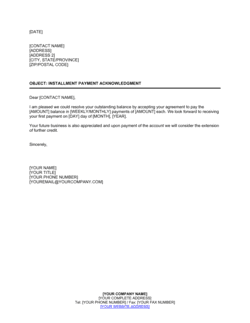
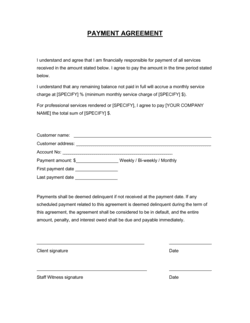
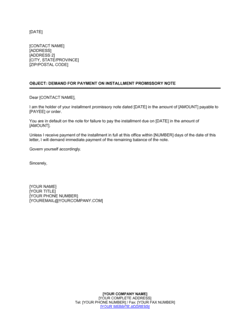
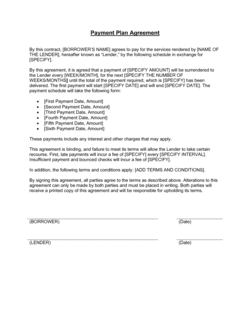
Installment Payment Arrangement Letter Template

Free Word download • Edit online • Save & share with Drive • Export to PDF

1 page20–30 min to fillDifficulty: StandardSignature requiredLegal review recommended
Learn more ↓
FreeInstallment Payment Arrangement Letter Template

At a glance

What it is
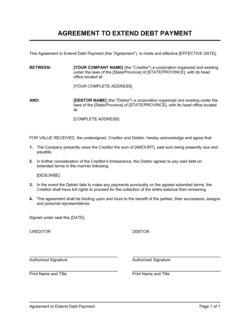
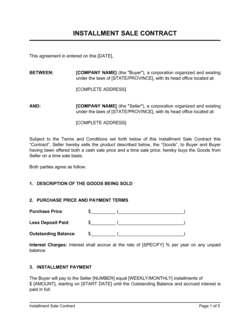
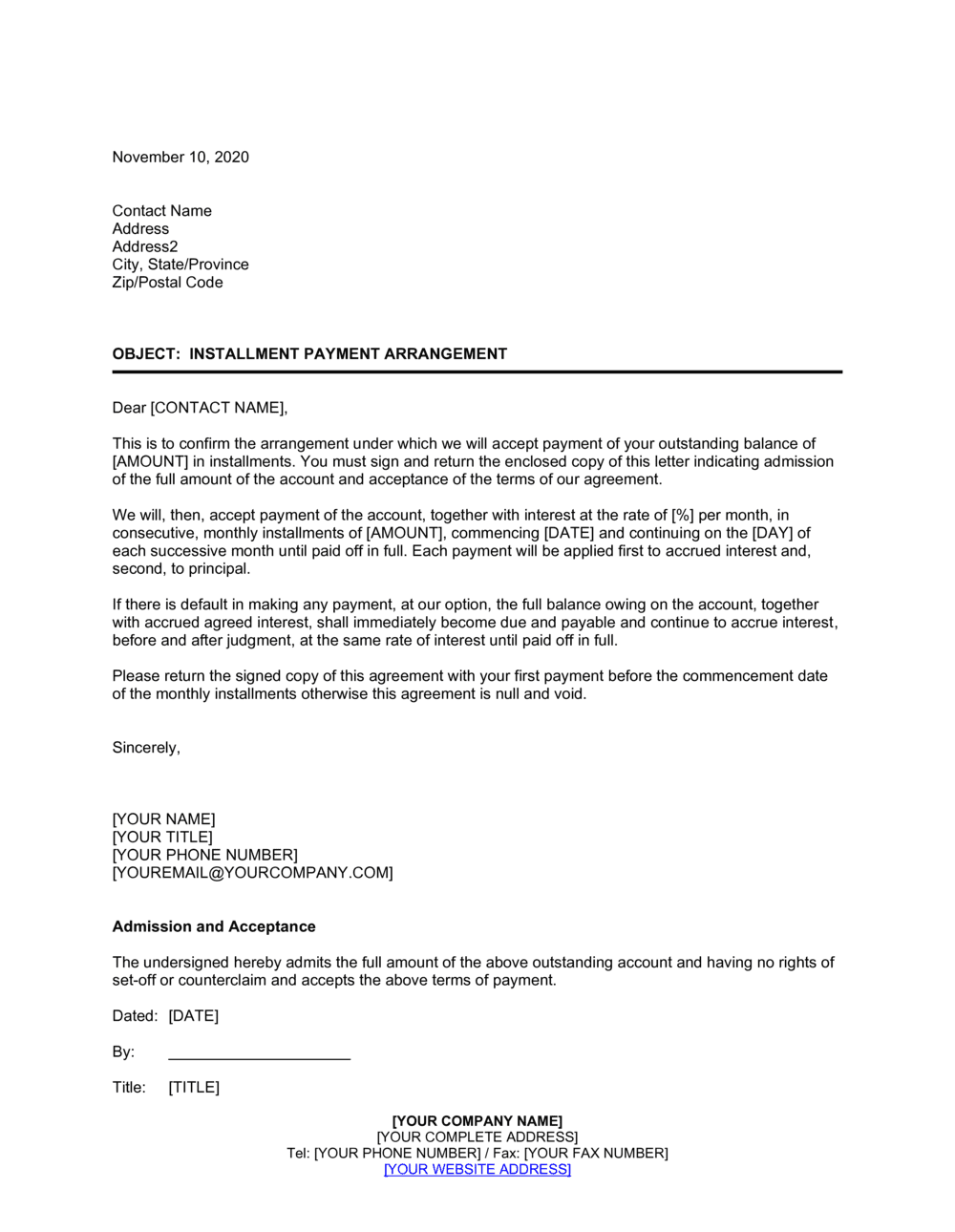
An Installment Payment Agreement is a legally binding contract between a creditor and a debtor that resolves an outstanding balance through a fixed schedule of periodic payments. This free Word download lets you specify the principal amount, interest rate, payment dates, default consequences, and acceleration terms — then export as PDF and execute with both parties' signatures in minutes.
When you need it
Use it when a customer, client, or borrower cannot pay a balance in full and both parties agree to a structured repayment plan — whether the debt arises from an unpaid invoice, a personal loan, a business transaction, or a negotiated settlement outside of court.
What's inside
Party identification, the total outstanding balance, interest rate and calculation method, a payment schedule with specific due dates and amounts, late fee provisions, default and cure period terms, an acceleration clause, and the governing law. A signature block with witness or notary option is included for jurisdictions that require it.

What is an Installment Payment Agreement?

An Installment Payment Agreement is a legally binding contract between a creditor and a debtor that resolves an outstanding balance through a series of fixed, scheduled payments rather than a single lump-sum payment. The agreement records the total amount owed, any interest that accrues on the unpaid principal, the exact dates and amounts of each installment, consequences for missed payments including late fees and acceleration of the remaining balance, and the governing law. It functions as both a repayment plan and a formal acknowledgment of the debt, giving the creditor a written, signed record they can produce in court if the debtor later disputes the obligation or stops paying.

Why You Need This Document

Without a written installment payment agreement, a creditor relying on a verbal repayment arrangement has no enforceable record of what was agreed — no due dates, no interest terms, and no acceleration mechanism if payments stop. When a debtor misses a payment and the creditor has only emails or informal notes, collecting becomes a credibility contest rather than a contract interpretation. A signed agreement with explicit default and acceleration clauses lets the creditor demand the full remaining balance immediately upon an uncured default and sue on the entire amount rather than waiting for each future installment to come due. For debtors, a written plan provides legal certainty about exactly what is owed and when, protecting against a creditor who might otherwise claim the full balance is overdue at any moment. This template covers every material term — from the acknowledgment of debt through the attorneys' fees provision — so both parties are protected from the first payment to the last.

Which variant fits your situation?

If your situation is…Use this template
Resolving an unpaid invoice through a structured payment planInstallment Payment Agreement
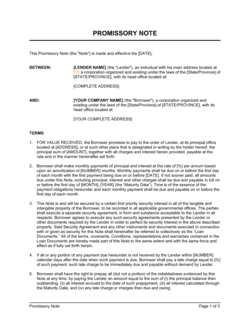
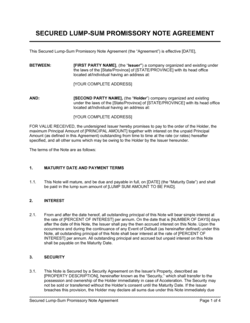
Lending money to an individual or business with scheduled repaymentPromissory Note
Settling a disputed debt or legal claim for less than the full amountDebt Settlement Agreement
Providing a borrower a formal notice that a debt is overdueDemand Letter for Payment
Granting a short-term extension on a single payment deadlinePayment Extension Agreement
Documenting a deferred payment arrangement between businessesDeferred Payment Agreement
Releasing a party from a debt obligation in full after final paymentDebt Release Letter

Common mistakes to avoid

❌ No acknowledgment of debt clause

Why it matters: Without an explicit written acknowledgment, a debtor can dispute the validity or amount of the debt in court, converting a straightforward collection into contested litigation.

Fix: Include a clause where the debtor expressly acknowledges that the stated balance is valid, due, and owing without offset — this admission is admissible as evidence if collection proceedings are later needed.

❌ Vague payment due dates

Why it matters: Terms like 'monthly' or 'on or about the first' leave room to dispute whether a payment was late, which undermines the default and late-fee provisions.

Fix: List specific calendar dates for every installment — either in the body of the agreement or in a signed Schedule A — so there is no ambiguity about when a payment is overdue.

❌ Automatic acceleration clause

Why it matters: An automatic acceleration triggers the full balance due the moment a payment is missed, which can force the creditor into immediate litigation even when a modified plan would recover more money.

Fix: Draft the acceleration clause as optional — 'Creditor may, at its sole option, declare the entire balance immediately due' — preserving the flexibility to renegotiate or allow a catch-up payment.

❌ Interest rate exceeding the jurisdiction's usury limit

Why it matters: Charging interest above the statutory maximum voids the interest clause in many jurisdictions and, in some states and provinces, can render the entire agreement unenforceable or expose the creditor to penalties.

Fix: Verify the applicable usury ceiling for the debtor's location before inserting a rate, and include a savings clause stating that any unlawful rate is automatically reduced to the maximum permitted rate.

❌ No attorneys' fees provision

Why it matters: Without it, each party bears its own legal costs. On balances under $10,000, legal fees often exceed the recovery — making enforcement economically irrational and emboldening debtors to miss payments.

Fix: Add an explicit clause awarding the prevailing creditor its reasonable attorneys' fees and court costs upon an uncured default, which shifts the cost-benefit calculation in favor of compliance.

❌ Signing after the first installment has already passed

Why it matters: An agreement executed after a payment due date has already come and gone may be treated as a modification of a prior oral arrangement, potentially weakening enforceability of the written terms.

Fix: Execute the agreement before the first scheduled payment date. If the first due date has passed, reset the payment schedule in the document to a future date and note the revised start date in the recital.

The 10 key clauses, explained

Parties and recitals

In plain language: Identifies the creditor and debtor by full legal name and address, and states the background — what the debt arose from and why both parties are entering the agreement.

Sample language
This Installment Payment Agreement ('Agreement') is entered into as of [DATE] between [CREDITOR FULL NAME], located at [ADDRESS] ('Creditor'), and [DEBTOR FULL NAME], located at [ADDRESS] ('Debtor'). The parties agree that Debtor owes Creditor the sum of $[AMOUNT] arising from [DESCRIPTION OF DEBT].

Common mistake: Using a trade name or nickname instead of the debtor's legal entity name or full legal name as an individual — a mismatch makes the agreement difficult to enforce in court or collections.

Total amount owed and acknowledgment of debt

In plain language: States the exact outstanding balance as of a specific date and has the debtor formally acknowledge the debt in writing, which is essential for later enforcement.

Sample language
Debtor acknowledges and agrees that as of [DATE], the total outstanding balance owed to Creditor is $[TOTAL AMOUNT] ('Outstanding Balance'), which Debtor agrees is valid, due, and owing without offset or defense.

Common mistake: Omitting the acknowledgment of debt language. Without it, a debtor can later dispute the balance's validity, turning a straightforward collection into contested litigation.

Payment schedule

In plain language: Sets out the exact amount, frequency, and due dates of each installment payment, and specifies where and how payments must be made.

Sample language
Debtor shall pay Creditor [NUMBER] installments of $[AMOUNT] each, due on the [DAY] of each [month/week], beginning [START DATE], with a final payment of $[FINAL AMOUNT] due on [END DATE]. Payments shall be made by [METHOD] to [PAYMENT DETAILS].

Common mistake: Stating only the payment frequency without listing specific calendar due dates — when a dispute arises, 'monthly' alone does not establish which day triggers a default.

Interest rate and calculation

In plain language: States whether interest accrues on the outstanding balance, the rate, how it is calculated, and whether it compounds or accrues simply.

Sample language
The Outstanding Balance shall bear interest at the rate of [X]% per annum, calculated on a simple interest basis on the unpaid principal balance. Interest accruing between payments shall be applied to each installment before reduction of principal.

Common mistake: Leaving the interest field blank or writing 'interest-free' when the intent is for no interest to accrue. A blank field creates ambiguity; explicitly state 0% if no interest applies.

Late fees and grace period

In plain language: Defines the grace period after a missed due date and the late fee charged if payment is not received within that window.

Sample language
If any installment is not received within [NUMBER] days of its due date, Debtor shall pay a late fee of $[AMOUNT] per missed payment. Late fees are in addition to, and do not replace, Creditor's rights upon default.

Common mistake: Setting a late fee that exceeds the statutory limit for the governing jurisdiction — in several US states and Canadian provinces, excessive late fees are unenforceable and can void the entire penalty clause.

Default and cure period

In plain language: Defines what constitutes a default — typically a missed payment — and gives the debtor a specified number of days to cure the default before the creditor may act.

Sample language
Debtor shall be in default if any payment is not received within [NUMBER] days of its due date ('Cure Period'). Upon default, Creditor shall provide written notice to Debtor. If Debtor fails to cure the default within the Cure Period, Creditor may exercise all available remedies under this Agreement.

Common mistake: Providing no cure period at all — in many jurisdictions, immediately accelerating the debt without notice or opportunity to cure can expose the creditor to a wrongful enforcement claim.

Acceleration clause

In plain language: Allows the creditor to declare the entire remaining balance immediately due if the debtor defaults and fails to cure, eliminating the need to wait for each future installment to come due.

Sample language
Upon an uncured default, Creditor may, at its sole option, declare the entire remaining Outstanding Balance, together with all accrued interest and fees, immediately due and payable without further notice to Debtor.

Common mistake: Drafting the acceleration clause as automatic rather than optional — an automatic acceleration can trigger unintended consequences for the creditor if they prefer to work out a modified payment plan.

Prepayment

In plain language: States whether the debtor may pay off the remaining balance early and whether any prepayment penalty applies.

Sample language
Debtor may prepay all or any portion of the Outstanding Balance at any time without penalty. Any prepayment shall be applied first to accrued interest, then to principal.

Common mistake: Omitting a prepayment clause entirely. The default rule varies by jurisdiction — some apply the excess to future installments rather than principal, which costs the debtor more in interest over time.

Remedies on default

In plain language: Lists what the creditor may do if the debtor defaults and fails to cure — including filing suit, pursuing collections, and seeking attorneys' fees and court costs.

Sample language
Upon an uncured default, Creditor shall be entitled to pursue all remedies available at law or in equity, including commencing legal proceedings to collect the full remaining balance, accrued interest, late fees, and reasonable attorneys' fees and costs of collection.

Common mistake: Not including an attorneys' fees provision — absent an explicit clause, each party typically bears its own legal costs, making small-balance enforcement economically impractical.

Governing law and entire agreement

In plain language: Specifies which jurisdiction's law governs the agreement and confirms it supersedes all prior oral or written understandings about the debt.

Sample language
This Agreement shall be governed by and construed in accordance with the laws of [STATE/PROVINCE/COUNTRY]. This Agreement constitutes the entire agreement of the parties with respect to the subject matter hereof and supersedes all prior negotiations, representations, and agreements.

Common mistake: Selecting a governing law with no connection to either party's location — courts in the debtor's jurisdiction may apply local law regardless, rendering the choice clause ineffective.

How to fill it out

  1. 1

    Identify both parties with full legal names

    Enter the creditor's and debtor's complete legal names and mailing addresses. For businesses, use the registered legal entity name, not a trade name or brand.

    💡 Pull the debtor's name from the original invoice, contract, or loan document to ensure it matches and closes any ambiguity about who owes the debt.

  2. 2

    State the total outstanding balance and its origin

    Enter the exact dollar amount owed as of the agreement date and include a brief description of what the debt arose from — unpaid invoices, a loan, goods delivered — so the recital is complete.

    💡 If multiple invoices or transactions make up the balance, list them in a schedule attached to the agreement rather than embedding every invoice number in the body.

  3. 3

    Set the payment schedule with specific due dates

    Choose the payment frequency (monthly, bi-weekly, or weekly), enter the amount of each installment, and list the exact calendar due date for every payment. State the payment method — check, ACH, wire transfer, or online portal.

    💡 Align due dates with the debtor's income schedule — a debtor paid on the 15th is more likely to honor a due date of the 20th than the 1st.

  4. 4

    Decide on interest rate and calculation method

    Enter the agreed interest rate as an annual percentage. If no interest will accrue, explicitly state 0%. Specify whether interest is simple or compounding and how it applies to each payment.

    💡 Check the usury limit in the governing jurisdiction before setting a rate — charging above the legal maximum voids the interest clause and can expose the creditor to penalties.

  5. 5

    Set the late fee and cure period

    Enter the late fee amount (flat dollar or percentage of the missed payment) and the number of days constituting the cure period. Confirm the fee does not exceed any statutory cap in the applicable jurisdiction.

    💡 A 5-to-10-day cure period is standard and typically satisfies notice requirements in most US states and Canadian provinces before a creditor may accelerate.

  6. 6

    Review the default, acceleration, and remedies clauses

    Confirm the default trigger (typically a missed payment not cured within the grace period), make the acceleration clause optional rather than automatic, and include an attorneys' fees provision if you may need to pursue collections.

    💡 If you anticipate the debtor may struggle, make acceleration explicitly optional so you retain flexibility to renegotiate rather than being forced to demand the full balance immediately.

  7. 7

    Select governing law and attach any schedules

    Enter the state, province, or country whose law governs the agreement. Attach a payment schedule table or invoice list as Schedule A if referenced in the body.

    💡 Choose the jurisdiction where you, as creditor, are most likely to file suit — enforcement is faster when the governing court is in your home jurisdiction.

  8. 8

    Execute with signatures before the first payment is due

    Both parties must sign the agreement before the first installment date. For larger balances or higher-risk debtors, consider having signatures witnessed or notarized. Keep a fully-executed copy accessible to both parties.

    💡 Send the debtor a PDF of the signed agreement immediately after execution — a debtor who has the document in hand is less likely to later claim they did not understand or receive the terms.

Frequently asked questions

What is an installment payment agreement?

An installment payment agreement is a legally binding contract between a creditor and a debtor that resolves an outstanding balance through a series of scheduled payments rather than a single lump sum. It specifies the total amount owed, any applicable interest, the payment schedule, late fees, and what happens if the debtor misses a payment. It is commonly used to settle unpaid invoices, personal loans, or business debts without resorting to litigation.

Is an installment payment agreement legally enforceable?

Yes — an installment payment agreement is generally enforceable as a binding contract when it includes the essential elements: offer, acceptance, consideration, and definite terms. A written agreement signed by both parties is far easier to enforce in court than an oral arrangement. Enforceability can be affected by usury violations, missing signatures, or terms that conflict with consumer protection laws in the governing jurisdiction, so consider a legal review for larger balances.

What is the difference between an installment payment agreement and a promissory note?

A promissory note is an unconditional written promise by a borrower to repay a specific amount and is typically used when originating a new loan. An installment payment agreement is used to restructure or resolve an existing debt through a payment plan — it often includes an acknowledgment of the debt's origin and more detailed default and acceleration provisions. Both can include interest and a payment schedule, but they serve different transactional purposes.

Does an installment payment agreement require notarization?

Notarization is not required for an installment payment agreement to be legally binding in most jurisdictions. However, having signatures witnessed or notarized adds evidentiary weight — a notarized signature is harder to disavow in court. For larger balances or transactions involving real property as collateral, notarization or recording may be required depending on the state or province.

What happens if the debtor misses a payment?

The agreement's default clause governs missed payments. Typically, a cure period — often 5 to 15 days — gives the debtor a chance to pay before formal default is declared. If the debtor does not cure, the creditor can assess late fees and, if the agreement contains an acceleration clause, declare the entire remaining balance immediately due. The creditor may then pursue legal action, collections, or other remedies specified in the agreement.

Can I charge interest in an installment payment agreement?

Yes, parties may agree to charge interest on the outstanding balance, but the rate must not exceed the usury limit set by the governing jurisdiction. US state usury limits typically range from 6% to 25% per annum depending on the transaction type and parties involved. In Canada, the criminal interest rate cap is 60% per annum (effective interest rate), and consumer credit transactions may be subject to lower provincial caps. Always verify the applicable limit before setting a rate.

What is an acceleration clause and should I include one?

An acceleration clause allows the creditor to demand the full remaining balance immediately if the debtor defaults and fails to cure. It is strongly recommended — without it, the creditor must wait for each future installment to come due before suing on it, which can drag recovery out for months or years. Draft it as optional rather than automatic so the creditor retains flexibility to renegotiate rather than being forced to demand the lump sum.

Can the debtor pay off the balance early?

Whether the debtor can prepay without penalty depends on the agreement's prepayment clause. Most installment payment agreements for debt resolution permit prepayment without penalty, which benefits both parties — the creditor recovers sooner, and the debtor stops accruing interest. If the creditor relies on interest income, a prepayment penalty clause can be included, but some jurisdictions restrict or prohibit prepayment penalties on consumer debt agreements.

Do I need a lawyer to draft an installment payment agreement?

For standard commercial debts under $25,000 with straightforward terms, a high-quality template is typically sufficient. A lawyer adds value when the balance is material, the debtor is a business that may dispute the debt, collateral or a guarantor is involved, the transaction crosses jurisdictions, or consumer protection laws add complexity. A 30-to-60-minute attorney review typically costs $150–$400 and is worthwhile when recovery of the debt is critical to the business.

How this compares to alternatives

vs Promissory Note

A promissory note is an unconditional written promise to repay money, typically used when a new loan is originated. An installment payment agreement resolves an existing debt by converting it into a scheduled repayment plan and usually includes an acknowledgment of the debt's origin, default remedies, and an acceleration clause. Use a promissory note for new lending and an installment agreement for restructuring a debt already owed.

vs Debt Settlement Agreement

A debt settlement agreement resolves a debt for less than the full amount owed — the creditor agrees to accept a reduced sum in full satisfaction. An installment payment agreement commits the debtor to repaying the entire outstanding balance through scheduled payments with no reduction. Choose settlement when the creditor is willing to take a haircut for faster resolution; choose installment when full recovery is the goal.

vs Demand Letter for Payment

A demand letter is a pre-litigation notice requiring the debtor to pay the full balance within a defined period — typically 10 to 30 days. An installment payment agreement is a mutually signed contract that replaces the demand by formalizing a repayment plan both parties accept. Send a demand letter first if you want immediate full payment; use an installment agreement when the debtor cannot pay in full and you prefer structured recovery to litigation.

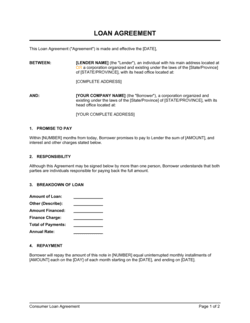
vs Loan Agreement

A loan agreement creates the terms for advancing new money from a lender to a borrower. An installment payment agreement restructures money already owed and does not involve any new disbursement of funds. Both documents include a payment schedule and default provisions, but the loan agreement also governs drawdown conditions, collateral requirements, and representations at the time of funding.

Industry-specific considerations

Professional Services

Consultants and agencies use installment agreements to recover unpaid project fees from clients who dispute final invoices or face temporary cash-flow problems.

Construction and Trades

Contractors use these agreements to collect overdue payments on completed projects without filing a mechanics' lien, preserving the client relationship while securing repayment.

Retail and Wholesale

Trade creditors recovering overdue accounts-receivable balances from buyers use installment agreements as an alternative to sending the account to a collections agency.

Real Estate and Property Management

Landlords use installment payment agreements to recover rent arrears from tenants outside of formal eviction proceedings, often as a condition of allowing the tenant to remain.

Financial Services and Lending

Private lenders and credit unions use these agreements to modify existing loan terms when a borrower is delinquent, documenting the new repayment schedule with enforceable default provisions.

Healthcare

Medical providers use patient payment plans documented as installment agreements to recover outstanding balances while complying with billing regulations and avoiding collections referrals.

Jurisdictional notes

United States

Usury limits vary significantly by state — for example, California caps most non-exempt consumer loans at 10% per annum, while some states impose no ceiling on commercial agreements between businesses. Consumer installment agreements may be subject to the Truth in Lending Act (TILA), which requires disclosure of the APR and total payment amount. Acceleration clauses are generally enforceable but may require advance written notice in states with consumer protection statutes.

Canada

The Criminal Code prohibits effective interest rates above 60% per annum for all Canadian agreements. Provincial consumer protection legislation — including Ontario's Consumer Protection Act and Quebec's Consumer Protection Act — imposes additional disclosure and rate restrictions on consumer credit agreements. Quebec agreements must be available in French for consumer transactions. Commercial debts between businesses are subject to fewer restrictions but must still comply with provincial limitation periods, which affect when an overdue installment can be sued upon.

United Kingdom

Consumer installment agreements regulated under the Consumer Credit Act 1974 require specific form and content disclosures, and credit agreements above £25,000 may be exempt. The Financial Conduct Authority (FCA) regulates consumer credit activity, and unlicensed creditors cannot enforce consumer credit agreements. Commercial installment agreements between businesses are largely governed by contract law and the Late Payment of Commercial Debts (Interest) Act 1998, which sets a statutory interest rate of 8% above the Bank of England base rate for overdue commercial debts.

European Union

The Consumer Credit Directive (2008/48/EC) harmonizes consumer credit rules across member states, requiring standardized pre-contractual information and a 14-day right of withdrawal for consumer credit agreements. GDPR applies to personal data processed in connection with the agreement — lenders and creditors must have a lawful basis for processing debtor data. Member states set their own usury limits; France caps consumer rates at approximately 1.33 times the average market rate, while Germany requires transparent APR disclosure and prohibits unconscionable terms under the Civil Code (BGB §138).

Template vs lawyer — what fits your deal?

PathBest forCostTime
Use the templateCreditors recovering commercial debts under $25,000 with a willing debtor and straightforward repayment termsFree15–30 minutes
Template + legal reviewBalances over $25,000, agreements involving collateral or a guarantor, or consumer debts subject to state or provincial regulation$150–$4001–2 days
Custom draftedComplex multi-party arrangements, cross-border debts, secured lending, or situations where the debtor has already disputed the underlying obligation$500–$2,000+3–7 days

Glossary

Principal
The original outstanding balance owed before any interest, fees, or penalties are added.
Installment
A single scheduled payment of a fixed amount made toward the total balance on a specified date.
Amortization
The process of spreading a debt across equal periodic payments so that each payment covers both interest accrued and a portion of the principal.
Acceleration Clause
A provision that makes the entire remaining balance immediately due and payable if the debtor misses a payment or breaches the agreement.
Default
A debtor's failure to make a required payment or fulfill another material obligation under the agreement by the specified due date.
Cure Period
A defined window — typically 5 to 15 days — given to a debtor after a missed payment to pay the overdue amount before the creditor may enforce default remedies.
Late Fee
A fixed dollar amount or percentage of the overdue payment charged when a payment is not received by the due date or end of the cure period.
Per Annum Interest Rate
The annual interest rate expressed as a percentage of the outstanding principal, used to calculate interest accruing on unpaid balances.
Prepayment
Payment of all or part of the remaining balance before the scheduled due date, sometimes subject to a penalty clause or permitted without restriction.
Guarantor
A third party who agrees to be personally liable for the debt if the primary debtor fails to make required payments.
Collateral
An asset pledged by the debtor to secure repayment, which the creditor may claim if the debtor defaults.
Promissory Note
A written, unconditional promise by a borrower to repay a specific amount to a lender under stated terms — often used alongside or instead of an installment payment agreement.

Part of your Business Operating System

This document is one of 3,000+ business & legal templates included in Business in a Box.

  • Fill-in-the-blanks — ready in minutes
  • 100% customizable Word document
  • Compatible with all office suites
  • Export to PDF and share electronically

Create your document in 3 simple steps.

From template to signed document — all inside one Business Operating System.
1
Download or open template

Access over 3,000+ business and legal templates for any business task, project or initiative.

2
Edit and fill in the blanks with AI

Customize your ready-made business document template and save it in the cloud.

3
Save, Share, Send, Sign

Share your files and folders with your team. Create a space of seamless collaboration.

Save time, save money, and create top-quality documents.

★★★★★

"Fantastic value! I'm not sure how I'd do without it. It's worth its weight in gold and paid back for itself many times."

Managing Director · Mall Farm
Robert Whalley
Managing Director, Mall Farm Proprietary Limited
★★★★★

"I have been using Business in a Box for years. It has been the most useful source of templates I have encountered. I recommend it to anyone."

Business Owner · 4+ years
Dr Michael John Freestone
Business Owner
★★★★★

"It has been a life saver so many times I have lost count. Business in a Box has saved me so much time and as you know, time is money."

Owner · Upstate Web
David G. Moore Jr.
Owner, Upstate Web

Run your business with a system — not scattered tools

Stop downloading documents. Start operating with clarity. Business in a Box gives you the Business Operating System used by over 250,000 companies worldwide to structure, run, and grow their business.

Free Forever Plan · No credit card required