- Clerical Responsibilities
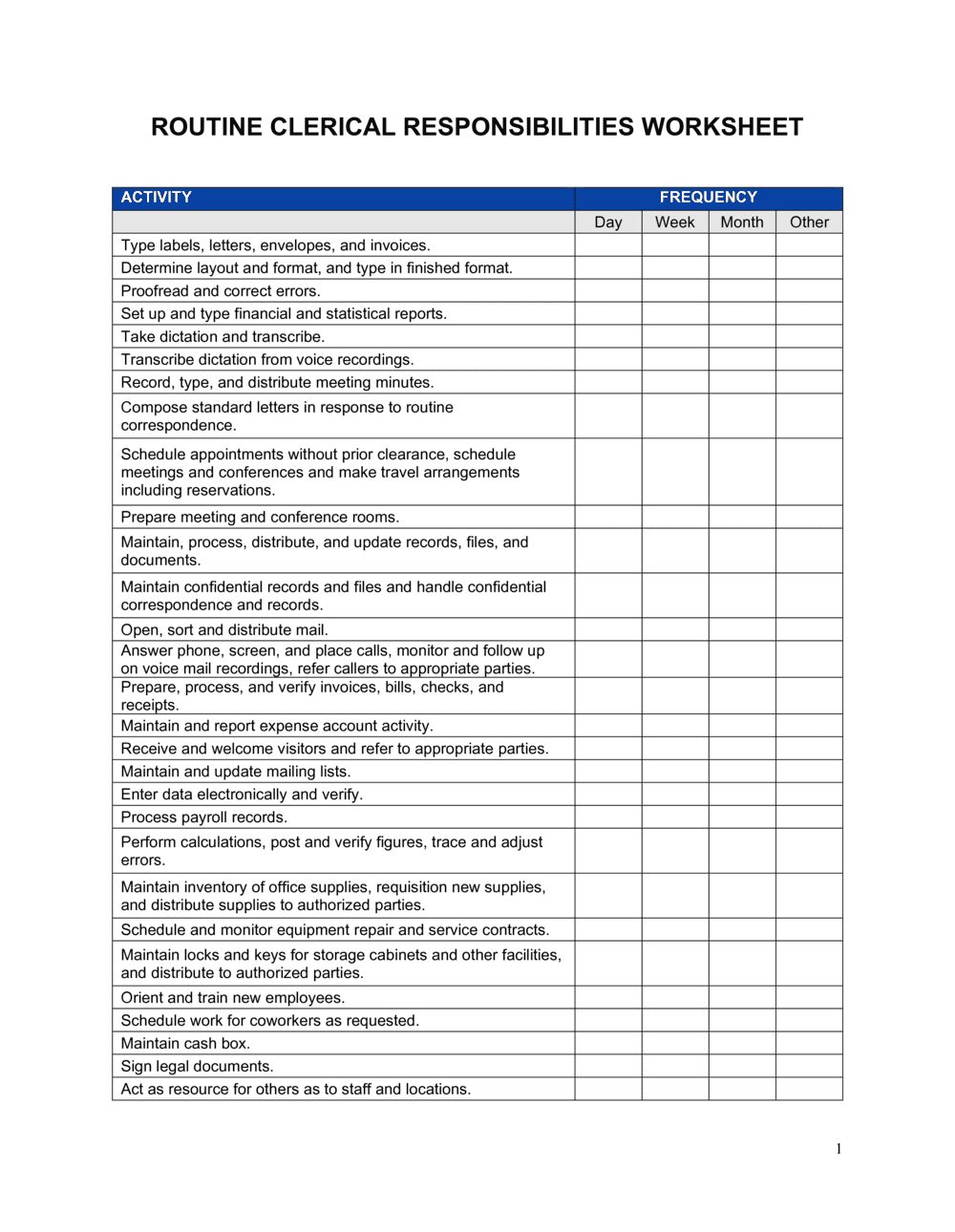
- Recurring administrative tasks such as filing, data entry, correspondence, scheduling, and records management that support the operational functions of an office.
- Duty Assignment
- A formal allocation of a specific task or set of tasks to a named employee or role, including the frequency, priority level, and output standard expected.
- Reporting Structure
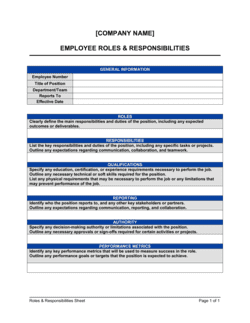
- The documented chain of supervision that identifies to whom the employee is directly accountable for the performance of their assigned duties.
- Performance Standard
- A measurable or observable benchmark — such as accuracy rate, turnaround time, or task completion frequency — against which the employee's work is evaluated.
- Acknowledgment Clause
- A signed statement by the employee confirming they have read, understood, and agreed to the duties and standards documented in the worksheet.
- Confidentiality Obligation
- A provision requiring the employee to protect non-public information encountered in the course of performing clerical duties, such as personnel files, financial records, or client data.
- Task Frequency
- How often a duty must be performed — classified as daily, weekly, monthly, or as-needed — to meet operational requirements.
- Priority Rating
- A classification system (e.g., critical, high, routine) indicating the relative importance and time-sensitivity of each assigned task.
- Scope of Duties
- The defined boundary of tasks and functions the employee is expected to perform, distinguishing their role from adjacent positions.
- At-Will vs. For-Cause Termination
- At-will employment allows either party to end the relationship at any time; for-cause termination requires documented evidence that the employee failed to meet stated duties or standards.
- Constructive Dismissal
- A legal claim arising when an employer unilaterally changes an employee's documented duties so significantly that the employee is effectively forced to resign.