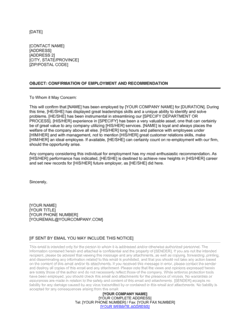
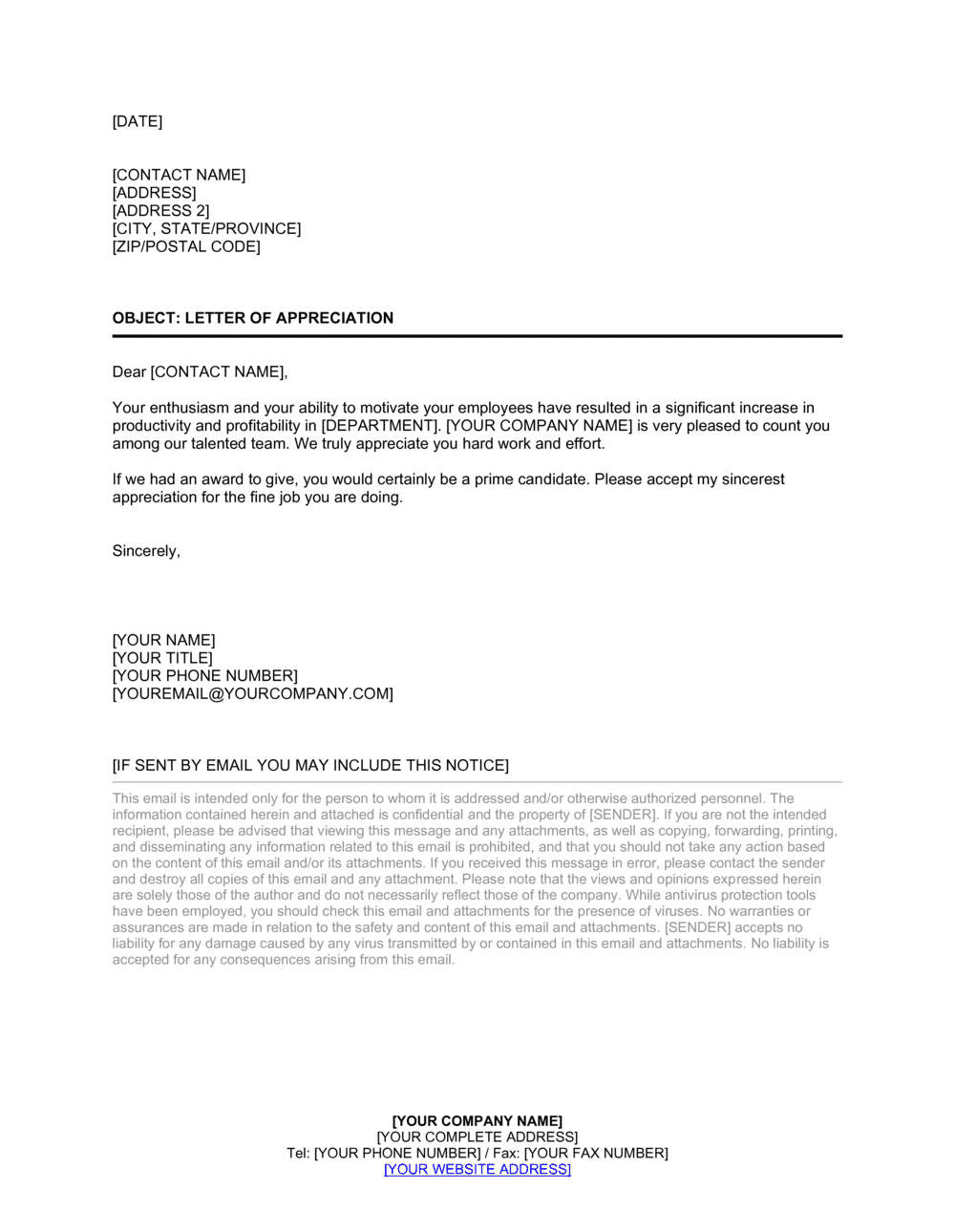
Letter of Appreciation to Employee Template

Free Word download β€’ Edit online β€’ Save & share with Drive β€’ Export to PDF

1 pageβ€’15–20 min to fillβ€’Difficulty: Standard
Learn more ↓
FreeLetter of Appreciation to Employee Template

At a glance

What it is
A Letter of Appreciation to Employee is a formal written notice from an employer or manager to an employee recognizing a specific achievement, sustained performance, or demonstration of company values. This free Word download gives you a ready-to-edit template you can personalize and send as a printed letter or PDF within minutes.
When you need it
Use it after a project completion, a performance milestone, an exceptional client interaction, or a period of sustained above-and-beyond contribution. It is also appropriate when recognizing long service, a successful onboarding period, or a team member who stepped up during a difficult period.
What's inside
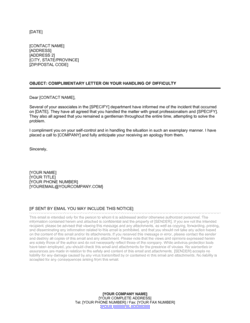
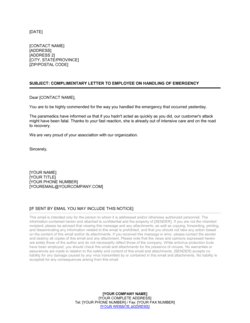
A formal header with sender and recipient details, a subject line naming the recognition purpose, an opening that states the appreciation directly, body paragraphs describing the specific achievement and its impact, a forward-looking statement on the employee's continued role, and a closing with the manager's or executive's name and title.

What is a Letter of Appreciation to an Employee?

A Letter of Appreciation to an Employee is a formal written communication from an employer, manager, or senior leader to an individual employee that recognizes a specific achievement, sustained performance, or demonstration of company values. Unlike a verbal thank-you or an informal email, it is a deliberate, documented gesture that names the exact contribution being recognized and connects it to a tangible outcome for the team or organization. It is typically printed on company letterhead or sent as a signed PDF and is one page in length.

Why You Need This Document

Employees who feel their work goes unnoticed are significantly more likely to disengage or leave β€” and replacing a single mid-level employee typically costs 50–200% of their annual salary in recruiting, onboarding, and lost productivity. A well-timed, specific appreciation letter costs nothing but fifteen minutes and delivers a measurable signal that leadership is paying attention. It also creates a written record that supports future promotion decisions and performance reviews, giving the recognition organizational permanence beyond the moment it is delivered. This template gives you the structure to write a letter that is personal, specific, and professional β€” so the recognition lands the way it was intended.

Which variant fits your situation?

If your situation is…Use this template
Recognizing completion of a specific projectLetter of Appreciation to Employee (Project Completion)
Acknowledging years of service or a work anniversaryEmployee Service Award Letter
Praising a team rather than an individualLetter of Appreciation to Team
Recognizing performance at end of year as part of a review cycleEmployee Performance Review
Thanking an employee who is leaving the companyReference Letter for Employee
Formally commending an employee in response to a client complimentEmployee Commendation Letter
Recognizing a new hire who excelled during onboardingProbationary Period Completion Letter

Common mistakes to avoid

❌ Using generic praise instead of specific details

Why it matters: A letter that says 'you always go above and beyond' reads as a template, not a personal acknowledgment, and has minimal retention impact.

Fix: Name the exact project, date, or behavior being recognized and add at least one measurable or observable outcome to ground the appreciation in reality.

❌ Signing the letter from HR instead of the employee's manager

Why it matters: Employees respond most strongly to recognition from someone they report to or look up to organizationally β€” an HR signature can feel procedural rather than genuine.

Fix: Route the letter for signature to the employee's direct manager or a relevant senior leader before it is delivered.

❌ Sending the letter by email without any personal delivery

Why it matters: A cold email attachment is easy to miss and fails to create the moment of recognition that makes appreciation memorable.

Fix: Hand-deliver the letter in a brief one-on-one conversation or present it in a small team setting where the recognition can be witnessed by peers.

❌ Delaying the letter weeks after the achievement

Why it matters: Recognition loses most of its motivational effect when it arrives long after the event β€” the employee has moved on and the connection feels forced.

Fix: Issue the letter within five business days of the achievement or occasion whenever possible. Timeliness is a signal that leadership is paying attention.

The 8 key clauses, explained

Sender and recipient header

In plain language: Identifies the organization sending the letter, the manager or executive signing it, the employee's name and title, and the date.

Sample language
[COMPANY NAME] | [SENDER NAME], [SENDER TITLE] | To: [EMPLOYEE FULL NAME], [EMPLOYEE TITLE] | Date: [DATE]

Common mistake: Omitting the employee's job title or department. Without it, the letter reads as a generic form rather than a personal acknowledgment.

Subject line

In plain language: A brief one-line label that names the purpose of the letter so the employee understands what they are reading before the first sentence.

Sample language
Re: Letter of Appreciation β€” [SPECIFIC ACHIEVEMENT OR OCCASION]

Common mistake: Using a vague subject like 'Recognition' or leaving it blank. A specific subject line immediately signals that the letter is about the individual, not a mass communication.

Opening salutation and direct statement of appreciation

In plain language: Addresses the employee by name and states the appreciation plainly in the first sentence β€” no preamble.

Sample language
Dear [EMPLOYEE FIRST NAME], I am writing to express my sincere appreciation for your [SPECIFIC CONTRIBUTION] during [TIME PERIOD OR PROJECT NAME].

Common mistake: Burying the appreciation after two or three sentences of context. State it directly in the first sentence so the employee's first impression is the recognition itself.

Description of the specific achievement

In plain language: Names the exact behavior, project, or outcome being recognized with enough detail to show the letter was written about this individual specifically.

Sample language
Your leadership of the [PROJECT NAME] initiative β€” delivered [X days] ahead of schedule and [X]% under budget β€” demonstrated the kind of ownership we rely on to move the business forward.

Common mistake: Writing in generalities ('you always work hard') instead of naming the specific action. Vague praise has less retention impact than a single concrete detail.

Impact statement

In plain language: Explains the tangible effect the employee's contribution had on the team, clients, or organization β€” connecting their effort to a real outcome.

Sample language
The result of your work directly contributed to [OUTCOME β€” e.g., securing a $[X] contract / reducing processing time by [X]% / receiving a commendation from [CLIENT NAME]].

Common mistake: Describing effort without outcome. Linking the employee's action to a measurable or observable result doubles the motivational value of the recognition.

Acknowledgment of personal qualities or values demonstrated

In plain language: Highlights the character traits, skills, or company values the employee embodied β€” making the recognition feel personal, not purely transactional.

Sample language
Throughout this process, you demonstrated [QUALITY β€” e.g., exceptional attention to detail / calm under pressure / genuine commitment to our clients], which reflects our core values of [VALUE 1] and [VALUE 2].

Common mistake: Listing every value on the company wall. Naming one or two specific traits the employee actually displayed is more credible than a list.

Forward-looking statement

In plain language: Expresses confidence in the employee's continued contribution and signals that their work is noticed at the leadership level.

Sample language
We look forward to continuing to build on this momentum with you and are excited to see what you accomplish in your next chapter at [COMPANY NAME].

Common mistake: Skipping this sentence entirely. Without it, the letter reads as a thank-you for work already done rather than an investment in the employee's ongoing relationship with the company.

Closing and signature

In plain language: Closes warmly with the sender's name, title, and optionally a handwritten signature for physical letters or an inserted signature image for digital ones.

Sample language
With appreciation, [SENDER NAME] | [TITLE] | [COMPANY NAME]

Common mistake: Having HR sign a letter that should come from the employee's direct manager or a senior executive. The letter carries more weight when it comes from someone the employee reports to or respects organizationally.

How to fill it out

  1. 1

    Fill in the header with accurate names and titles

    Enter the company name, sender's full name and title, the employee's full name and job title, and today's date. Confirm the employee's title against HR records to avoid errors.

    πŸ’‘ For printed letters, use company letterhead so the document carries the weight of an official communication.

  2. 2

    Write a specific subject line

    Replace the placeholder subject with the actual occasion or achievement β€” for example, 'Re: Letter of Appreciation β€” Q1 Client Retention Project' rather than the generic default.

    πŸ’‘ Employees often keep these letters for years. A specific subject line makes it easy to recall the moment when they re-read it.

  3. 3

    State the appreciation in the first sentence

    Address the employee by first name and express appreciation plainly in the opening sentence. Do not wind up with context before the recognition β€” lead with it.

    πŸ’‘ Read your opening sentence aloud. If it doesn't make the employee feel recognized immediately, rewrite it.

  4. 4

    Name the specific achievement with concrete details

    Replace the achievement placeholder with the actual project name, timeframe, and any measurable result β€” cost saved, deadline met, client feedback received.

    πŸ’‘ If you don't have a number, use a date or a named project. Specificity matters more than precision.

  5. 5

    Add the impact statement

    Describe what changed or improved as a direct result of the employee's contribution. Connect their individual effort to a team, client, or business outcome.

    πŸ’‘ Even a qualitative outcome ('the client specifically mentioned your responsiveness in their renewal conversation') is more powerful than no impact statement at all.

  6. 6

    Include the forward-looking statement

    Write one sentence expressing confidence in the employee's future contributions. Keep it sincere and specific to the role rather than a generic 'we look forward to working with you.'

    πŸ’‘ Mentioning a specific upcoming project or goal shows the employee they are part of your plans, not just being thanked for the past.

  7. 7

    Sign from the right person and deliver intentionally

    The letter should be signed by the employee's direct manager, department head, or a senior executive β€” not defaulted to HR. Deliver it in a one-on-one conversation, not dropped on a desk or sent as a cold email attachment.

    πŸ’‘ Pairing the written letter with a brief verbal acknowledgment in private significantly increases its impact on employee morale and retention.

Frequently asked questions

What is a letter of appreciation to an employee?

A letter of appreciation to an employee is a formal written document from an employer or manager that recognizes a specific contribution, achievement, or demonstration of company values. Unlike a verbal thank-you, it creates a permanent record that can be placed in the employee's personnel file, reinforces desired behaviors, and signals that leadership notices individual effort.

When should you send an employee appreciation letter?

The most effective time to send one is within a few days of the triggering event β€” a project completion, an exceptional client interaction, a work anniversary, or a period of sustained above-and-beyond performance. Timeliness matters because recognition loses motivational value quickly after the event. Annual review cycles are a secondary trigger, not a substitute for timely acknowledgment.

Does a letter of appreciation need to be signed?

No legal signature is required for a letter of appreciation to be effective β€” it is not a binding document. However, a handwritten or digitally inserted signature from the employee's manager or a senior executive adds authenticity and personal weight that an unsigned letter lacks. Physical letters on company letterhead with a wet signature carry the strongest impression.

What is the difference between a letter of appreciation and a letter of commendation?

A letter of appreciation thanks an employee for a specific contribution and is typically delivered privately or in a small team setting. A letter of commendation is a more formal document that goes into the employee's official personnel file and may be referenced in future performance reviews or promotion decisions. Both recognize achievement, but commendations carry more formal organizational weight.

How long should a letter of appreciation be?

One page is standard and sufficient. Most effective appreciation letters run three to four short paragraphs β€” an opening statement of appreciation, a description of the specific achievement and its impact, a personal quality acknowledged, and a forward-looking close. Longer letters risk losing the employee's attention; shorter ones risk feeling perfunctory.

Should appreciation letters go in the employee's personnel file?

Yes, when the recognition relates to a significant achievement or sustained performance. Filing the letter creates a positive record that can support future promotion decisions, performance reviews, and references. Inform the employee that a copy will be filed β€” knowing the recognition is on record adds to its perceived value.

Can an appreciation letter improve employee retention?

Research consistently shows that feeling recognized is one of the top drivers of employee engagement and retention. A well-written, specific appreciation letter costs nothing but the manager's time and has been linked to higher discretionary effort, lower turnover intent, and stronger team morale. The key is specificity and timeliness β€” generic or delayed recognition has a measurably smaller effect.

What should you avoid writing in an employee appreciation letter?

Avoid vague generalities like 'you always work hard,' comparisons to other employees, references to compensation or future salary decisions, and language that could be read as a promise of promotion or continued employment. Keep the letter focused on the specific achievement and its impact. Do not have HR sign a letter that should come from the employee's direct manager or a senior leader.

How this compares to alternatives

vs Employee commendation letter

A commendation letter is a more formal document explicitly intended for an employee's personnel file and referenced in official performance or promotion decisions. A letter of appreciation is warmer and more personal β€” typically delivered directly to the employee rather than filed. Use an appreciation letter for meaningful recognition moments and a commendation when the achievement needs to be formally recorded.

vs Performance review

A performance review evaluates an employee's overall output against defined goals and competencies over a review period β€” covering strengths, development areas, and ratings. A letter of appreciation focuses on a single positive moment and carries no evaluative component. Both can coexist in the same recognition cycle, but they serve different purposes.

vs Letter of recommendation for an employee

A recommendation letter is written to support an employee's application to a new role, program, or opportunity β€” it speaks to a third party. A letter of appreciation is addressed to the employee directly and exists solely to recognize their contribution within the current organization. They may draw on the same achievements but serve entirely different audiences and functions.

vs Employee recognition certificate

A recognition certificate is a visual award document designed to be displayed or framed β€” its primary function is symbolic and public. A letter of appreciation is a written communication that can convey nuance, specific detail, and organizational context that a certificate cannot. Both can be issued together for maximum impact, but the letter carries the substantive recognition.

Industry-specific considerations

Professional Services

Recognizing billable staff who went beyond client expectations, contributed to a pitch win, or mentored junior team members during a high-demand period.

Healthcare

Acknowledging clinical or administrative staff for patient care quality, adherence to safety protocols, or performance during high-census or emergency periods.

Retail / Hospitality

Praising front-line employees for customer satisfaction scores, peak-season performance, or handling a difficult service situation with professionalism.

Technology / SaaS

Commending engineers, product managers, or support staff for shipping a release on time, resolving a critical incident, or earning a strong NPS score from clients.

Template vs pro β€” what fits your needs?

PathBest forCostTime
Use the templateAny manager or business owner writing an appreciation letter for a single employee or standard recognition occasionFree10–15 minutes
Template + professional reviewSenior executives writing letters for high-profile employees or letters that will be filed as formal commendations$0–$100 (HR or communications team review)30–60 minutes
Custom draftedOrganizations building a formal, branded recognition program with multiple letter variants and approval workflows$200–$800 (HR consultant or copywriter)1–3 days

Glossary

Letter of Appreciation
A formal written document from an employer to an employee acknowledging a specific contribution, achievement, or quality of work.
Recognition Program
A structured organizational initiative that identifies and rewards employees for performance, loyalty, or behavior aligned with company values.
Intrinsic Motivation
The drive to perform based on personal satisfaction and meaning rather than external rewards β€” formal recognition is shown to reinforce it.
Employee Engagement
The degree to which employees feel committed to their organization's goals and are motivated to contribute beyond minimum requirements.
Service Anniversary
The annual milestone marking the date an employee joined the organization β€” a common trigger for formal appreciation letters.
Commendation
Formal praise documented in writing, which may be placed in an employee's personnel file as a permanent positive record.
Discretionary Effort
The additional work an employee chooses to do beyond their job description β€” what appreciation letters most commonly acknowledge.
Personnel File
The employer's official record of an employee's documents, including offer letters, performance reviews, and recognition correspondence.
Tone of Voice
The style and manner of written communication β€” appreciation letters should be warm and specific, not generic or corporate.
Forward-Looking Statement
A sentence near the letter's close that expresses confidence in the employee's continued contribution, reinforcing retention intent.

Part of your Business Operating System

This document is one of 3,000+ business & legal templates included in Business in a Box.

  • Fill-in-the-blanks β€” ready in minutes
  • 100% customizable Word document
  • Compatible with all office suites
  • Export to PDF and share electronically

Create your document in 3 simple steps.

From template to signed document β€” all inside one Business Operating System.
1
Download or open template

Access over 3,000+ business and legal templates for any business task, project or initiative.

2
Edit and fill in the blanks with AI

Customize your ready-made business document template and save it in the cloud.

3
Save, Share, Send, Sign

Share your files and folders with your team. Create a space of seamless collaboration.

Save time, save money, and create top-quality documents.

β˜…β˜…β˜…β˜…β˜…

"Fantastic value! I'm not sure how I'd do without it. It's worth its weight in gold and paid back for itself many times."

Managing Director Β· Mall Farm
Robert Whalley
Managing Director, Mall Farm Proprietary Limited
β˜…β˜…β˜…β˜…β˜…

"I have been using Business in a Box for years. It has been the most useful source of templates I have encountered. I recommend it to anyone."

Business Owner Β· 4+ years
Dr Michael John Freestone
Business Owner
β˜…β˜…β˜…β˜…β˜…

"It has been a life saver so many times I have lost count. Business in a Box has saved me so much time and as you know, time is money."

Owner Β· Upstate Web
David G. Moore Jr.
Owner, Upstate Web

Run your business with a system β€” not scattered tools

Stop downloading documents. Start operating with clarity. Business in a Box gives you the Business Operating System used by over 250,000 companies worldwide to structure, run, and grow their business.

Start freeΒ Β·Β No credit card required