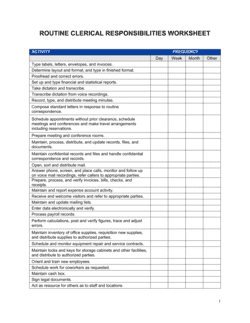
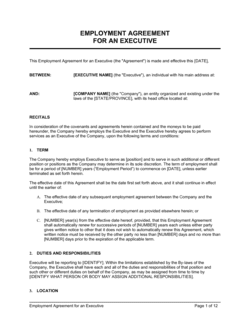
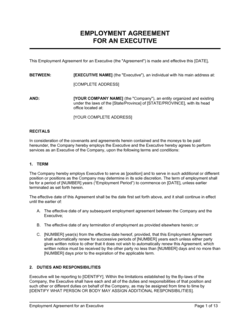
Roles and Responsibilities Template

Free Word download • Edit online • Save & share with Drive • Export to PDF

1 page20–30 min to fillDifficulty: StandardSignature requiredLegal review recommended
Learn more ↓
FreeRoles and Responsibilities Template

At a glance

What it is
A Roles and Responsibilities document is a binding agreement that formally defines the duties, decision-making authority, accountability boundaries, and reporting lines assigned to each party in a business relationship, team, or project. This free Word download gives you a structured starting point you can edit online and export as PDF to align employees, contractors, project teams, or joint-venture partners on exactly who owns what.
When you need it
Use it at the start of a new project, when onboarding a new hire or contractor, when restructuring a team, or whenever overlapping responsibilities are causing operational confusion or accountability gaps. It is equally useful for formalizing partner or vendor obligations in a multi-party engagement.
What's inside
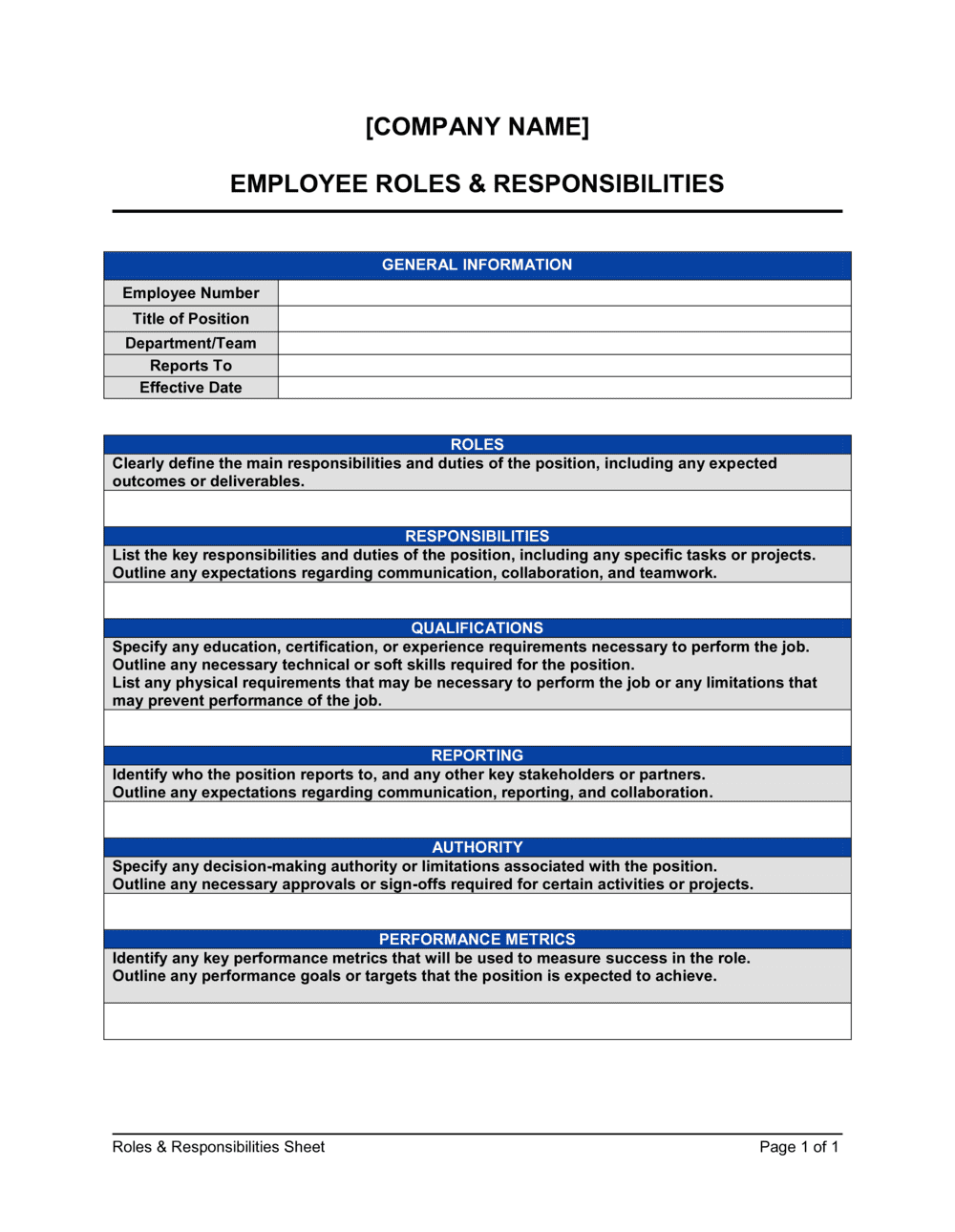
Party identification and context, a structured list of assigned duties and deliverables, decision-making authority and escalation paths, performance expectations and KPIs, confidentiality and compliance obligations, amendment procedures, and signatures from all accountable parties.

What is a Roles and Responsibilities Document?

A Roles and Responsibilities document is a binding agreement that formally assigns specific duties, decision-making authority, performance standards, and accountability boundaries to each named party in a business relationship, project team, or organizational function. Unlike a casual job description or an informal verbal understanding, this document creates enforceable obligations — defining not just what each party is supposed to do, but to what standard, within what authority limits, and with what consequences when those obligations are not met. It is used across employment, contracting, joint ventures, and cross-functional projects wherever overlapping or unclear responsibilities create operational or legal risk.

Why You Need This Document

Without a documented roles and responsibilities agreement, accountability is governed by assumption — and assumptions fail at the worst possible moments. When a deliverable is missed, a budget is overspent, or a compliance obligation is ignored, the absence of a written assignment makes it nearly impossible to attribute fault, manage performance, or defend against a claim. Co-founders without documented role splits routinely end up in court over who controlled what; project teams without defined authority thresholds stall on every decision above a trivial dollar amount; vendors without explicit scope assignments deliver against the wrong expectations and dispute every out-of-scope request. A signed roles and responsibilities document eliminates these failure modes before they occur — giving every party a shared, written reference for what success looks like and who owns each piece of it. This template provides the structure to do that in under an hour, with language precise enough to hold up when it matters.

Which variant fits your situation?

If your situation is…Use this template
Assigning roles across a defined project with a set end dateProject Roles and Responsibilities
Defining duties for a newly hired full-time employeeEmployment Contract with Job Description
Splitting responsibilities between two or more co-foundersCo-Founder Agreement
Assigning accountability in a joint venture between companiesJoint Venture Agreement
Documenting vendor and client obligations in a service engagementService Level Agreement (SLA)
Outlining responsibilities for a contractor on a fixed-term projectIndependent Contractor Agreement
Establishing department-level responsibilities in a growing organizationOrganizational Chart with RACI Matrix

Common mistakes to avoid

❌ Assigning accountability to a team instead of an individual

Why it matters: When a team is listed as accountable, no single person feels ownership. Failures get attributed to 'the group,' and the document becomes unenforceable against any individual.

Fix: Assign accountability to one named individual per responsibility, even if a team does the work. List supporting team members under the responsible party, not the accountable one.

❌ Leaving authority thresholds undefined

Why it matters: Without explicit approval limits, every decision either stalls waiting for sign-off or gets made unilaterally with no documented authority — both outcomes create operational and legal risk.

Fix: Set specific financial thresholds (e.g., '$5,000 without approval, $5,001 and above requires written sign-off from [NAME]') and operational equivalents for scope changes and resource allocation.

❌ Not updating the document when responsibilities change

Why it matters: Roles evolve in practice, but if the document doesn't reflect current reality, the original terms remain legally operative — meaning the party performing new duties may not be covered, and the party no longer performing old ones may still be obligated.

Fix: Build a scheduled review into the agreement — annually at minimum — and execute a signed amendment every time material responsibilities shift.

❌ Writing duties in vague, aspirational language

Why it matters: Phrases like 'support the team' or 'drive results' provide no objective standard for performance evaluation and cannot support a breach or termination decision.

Fix: Rewrite each duty as a specific, action-oriented statement with a measurable outcome, deadline, or quality standard attached.

❌ Omitting a handover and transition clause

Why it matters: When a role-holder exits without a documented transition obligation, institutional knowledge, vendor relationships, and in-progress work vanish with them, often causing project failure or costly delays.

Fix: Include an explicit transition clause requiring a structured handover — with a defined timeframe and a named recipient — upon termination or reassignment.

❌ Signing after responsibilities have already begun

Why it matters: In common-law jurisdictions, consideration issues can arise when one party has already started performing — restricting the document's enforceability for clauses like confidentiality and IP assignment.

Fix: Execute the document before the effective date. If a post-start signature is unavoidable, provide documented additional consideration — a bonus, increased compensation, or additional benefit — at the time of signing.

The 10 key clauses, explained

Parties and Context

In plain language: Identifies every individual, team, or organization covered by the document and describes the business context — project, department, or engagement — in which the roles apply.

Sample language
This Roles and Responsibilities Agreement ('Agreement') is entered into as of [DATE] between [PARTY A FULL NAME] ('Party A') and [PARTY B FULL NAME] ('Party B'), in connection with [PROJECT / ENGAGEMENT DESCRIPTION] ('the Engagement').

Common mistake: Listing job titles or team names instead of legal entity names or full individual names — if a dispute arises, vague party identification makes the agreement difficult to enforce against a specific person or organization.

Defined Roles and Titles

In plain language: States the formal title of each role covered, its position within the organizational or project hierarchy, and the start date from which the role assignment is effective.

Sample language
[PARTY A] shall serve as [ROLE TITLE] within the [DEPARTMENT / PROJECT TEAM], effective [START DATE], reporting to [SUPERVISOR TITLE / NAME].

Common mistake: Using informal or inconsistent role titles across the document — discrepancies between the agreement and payroll, HR systems, or org charts create confusion about who the agreement actually covers.

Core Duties and Deliverables

In plain language: Lists the specific tasks, outputs, and responsibilities each party is expected to perform, with enough detail to evaluate whether the role is being fulfilled.

Sample language
[PARTY A] shall be responsible for: (a) [DUTY 1]; (b) [DUTY 2]; (c) delivering [DELIVERABLE] by [DATE / MILESTONE]. All deliverables must meet the acceptance criteria set out in Schedule A.

Common mistake: Writing duties so broadly — 'manage the project' or 'handle communications' — that no objective standard exists for evaluating performance or assigning blame when something goes wrong.

Decision-Making Authority and Scope

In plain language: Defines what decisions each party can make independently, what requires approval from another party, and the financial or operational thresholds that trigger escalation.

Sample language
[PARTY A] has authority to approve expenditures up to $[AMOUNT] without additional sign-off. Decisions involving expenditures above $[AMOUNT] or changes to project scope require written approval from [PARTY B / APPROVING ROLE].

Common mistake: Leaving authority thresholds undefined — when no one knows who can approve a $5,000 expense or a scope change, every decision stalls or gets made unilaterally without accountability.

Performance Standards and KPIs

In plain language: Establishes measurable benchmarks that define satisfactory performance for each role, including timelines, quality standards, and reporting frequency.

Sample language
[PARTY A] shall maintain a [METRIC] of no less than [TARGET] as measured [WEEKLY / MONTHLY]. Performance will be reviewed on a [FREQUENCY] basis against the KPIs set out in Schedule B.

Common mistake: Including aspirational goals rather than measurable standards — 'deliver excellent results' cannot be assessed objectively and provides no basis for a performance conversation or a breach claim.

Reporting and Communication Obligations

In plain language: Specifies who each party reports to, how often status updates are required, the format of those updates, and the escalation path for issues outside the party's authority.

Sample language
[PARTY A] shall provide a written status report to [SUPERVISOR / PARTY B] every [FREQUENCY], using the format set out in Schedule C. Material issues must be escalated within [X] business days of identification.

Common mistake: Omitting an escalation path entirely — without a defined route for raising problems, issues either get buried or escalate chaotically, and both outcomes are difficult to attribute to any party's documented failure.

Confidentiality and Information Handling

In plain language: Prohibits parties from disclosing information obtained in the course of performing their responsibilities and defines how confidential materials must be stored and returned.

Sample language
Each party shall maintain the confidentiality of all non-public information received in connection with this Agreement and shall not disclose such information to any third party without prior written consent. Upon termination, all confidential materials shall be returned or destroyed within [X] days.

Common mistake: Cross-referencing a separate NDA that no longer exists or has different terms — conflicting confidentiality clauses in multiple documents create gaps that a departing employee or contractor can exploit.

Compliance and Regulatory Obligations

In plain language: Requires each party to perform their responsibilities in accordance with applicable laws, internal policies, and industry regulations, and assigns accountability for any resulting compliance failures.

Sample language
[PARTY A] shall perform all assigned duties in compliance with applicable [LAWS / REGULATIONS / INDUSTRY STANDARDS] and the Company's [POLICY NAME] policy. Any compliance breach by [PARTY A] shall be [PARTY A]'s sole responsibility.

Common mistake: Referencing 'all applicable laws' without specifying the industry or jurisdiction — vague compliance language provides no practical guidance and is frequently ignored until a regulator or court imposes the standard.

Amendment and Role Modification

In plain language: Sets out the process for updating or reassigning responsibilities, ensuring changes are documented in writing and signed by all affected parties before taking effect.

Sample language
Any modification to the roles, duties, or authority levels set out in this Agreement must be made in writing and signed by all parties. Verbal agreements or email exchanges do not constitute an amendment unless subsequently reduced to a written and signed addendum.

Common mistake: Allowing roles to drift informally over time without amending the document — when responsibilities change in practice but not on paper, the original agreement becomes a liability rather than a protection.

Term, Termination, and Transition

In plain language: Specifies how long the role assignment lasts, the conditions under which it can be ended, the notice required, and the handover obligations when a party exits the role.

Sample language
This Agreement is effective from [START DATE] and continues until [END DATE / PROJECT COMPLETION / TERMINATED BY NOTICE]. Either party may terminate by providing [X] days' written notice. Upon termination, [PARTY A] shall complete a structured handover to [SUCCESSOR / PARTY B] within [X] business days.

Common mistake: No handover or transition clause — when a key role-holder leaves without a documented transition obligation, critical context, relationships, and in-progress work disappear with them.

How to fill it out

  1. 1

    Identify all parties and the governing context

    Enter the full legal name of every individual or organization covered by the document. Describe the project, department, or engagement in enough detail that someone unfamiliar with the business understands the scope.

    💡 Use the same party names here as appear in any related contract (employment agreement, SOW, or JV agreement) to avoid creating conflicting references.

  2. 2

    Define each role with a formal title and reporting line

    Assign a consistent title to each role, state who it reports to, and set an effective date. Cross-reference your HR system or org chart to ensure titles match.

    💡 If the role has a dotted-line reporting relationship in addition to a primary one, document both — dual reporting without clarity is a common source of accountability gaps.

  3. 3

    List core duties with enough specificity to be measurable

    Write each duty as an action-oriented statement with a subject, verb, and object. Attach a Schedule A if the duty list is long enough to clutter the main document.

    💡 For each duty, ask: could a third party objectively determine whether this was done? If not, add a qualifier — deadline, quantity, quality standard, or format.

  4. 4

    Set decision-making authority thresholds

    Define financial and operational approval limits for each party. State what requires single-party sign-off, what requires joint approval, and what requires escalation to a higher authority.

    💡 Start with the decisions that caused the most friction or delay in the last 90 days — those are the exact thresholds the document needs to resolve.

  5. 5

    Establish performance standards and KPIs

    Link each role to at least two measurable KPIs — deadline adherence, output volume, quality score, or a financial metric. Place detailed KPI tables in Schedule B to keep the main body readable.

    💡 KPIs that are reviewed regularly get taken seriously; KPIs that sit in a drawer do not. Specify the review frequency in this clause to create a built-in accountability cadence.

  6. 6

    Document reporting frequency and escalation paths

    State how often each party must report on their responsibilities, to whom, and in what format. Name the escalation contact and set a response time standard.

    💡 A named escalation contact — not just a title — reduces delays. If the person in that role changes, update the agreement by amendment rather than leaving it to informal knowledge.

  7. 7

    Add confidentiality, compliance, and amendment clauses

    Tailor the confidentiality clause to the sensitivity of information each party handles. Reference specific regulations (HIPAA, GDPR, SOX) if applicable. Confirm the amendment clause requires written sign-off.

    💡 If the parties are already covered by a standalone NDA, reference it here and confirm which document controls in a conflict — do not replicate conflicting terms.

  8. 8

    Obtain signatures before responsibilities take effect

    All parties must sign before the effective date. Route for signature in the order the roles interact — the assigning party first, then the role-holder. Retain a fully executed copy for each signatory.

    💡 Use a timestamped eSign tool so you have an audit trail if the assignment date is later disputed — this is especially important for co-founder and contractor role assignments.

Frequently asked questions

What is a roles and responsibilities document?

A roles and responsibilities document is a formal agreement that defines the specific duties, decision-making authority, performance standards, and accountability structures assigned to each party in a business relationship, project, or organizational function. It transforms informal expectations into documented, enforceable obligations — reducing conflicts, eliminating accountability gaps, and providing a clear reference when disputes arise about who was supposed to do what.

When should I use a roles and responsibilities document?

Use one at the start of any new project, team, or engagement where multiple parties share accountability for outcomes. Common triggers include onboarding a new employee or contractor, launching a cross-functional project, forming a joint venture, restructuring a department, or formalizing a vendor relationship. It is also valuable when recurring disputes about task ownership signal that informal role definitions are no longer sufficient.

Is a roles and responsibilities document legally binding?

Yes, when properly drafted, executed with signatures, and supported by consideration — typically the employment relationship, the project engagement, or the compensation being paid. Like any contract, its enforceability depends on the specificity of its terms; vague duties and undefined authority limits are harder to enforce than precise, measurable obligations. In most jurisdictions, a signed document with clear terms and identified parties is generally enforceable.

What is the difference between a roles and responsibilities document and a job description?

A job description is typically a recruiting and HR tool that summarizes the general nature of a role for purposes of hiring and compensation banding. A roles and responsibilities document is a binding agreement that defines specific duties, authority thresholds, performance standards, and escalation paths for a named individual in a specific context — and is signed by both parties. Job descriptions are informational; roles and responsibilities documents create enforceable obligations.

How detailed should a roles and responsibilities document be?

Detailed enough that a third party unfamiliar with the business could determine objectively whether each party fulfilled their obligations. Each duty should include an action verb, an output or outcome, and a standard or deadline. Authority thresholds should be expressed in specific dollar amounts or operational metrics. KPIs should be measurable and tied to a review frequency. Vague language — however well-intentioned — provides no protection when accountability is disputed.

What is a RACI matrix and how does it relate to this document?

A RACI matrix assigns one of four statuses to each party for every task or decision: Responsible (does the work), Accountable (owns the outcome), Consulted (provides input), or Informed (receives updates). A RACI matrix is a visual tool that can be embedded as a schedule or attachment within a roles and responsibilities document to make authority and accountability relationships immediately scannable. For complex projects with many tasks and parties, a RACI is the most efficient way to document role assignments.

Can a roles and responsibilities document be used for contractors?

Yes, and it is strongly recommended. For contractors, the document should be attached to or referenced within the independent contractor agreement to ensure consistency between the two. Be careful not to introduce employment-like language — such as requiring the contractor to follow specific work methods or work set hours — that could support a misclassification claim. Focus on deliverables and outcomes rather than the means of performance.

What happens if responsibilities change after the document is signed?

The original signed terms remain operative until formally amended. If responsibilities shift informally without a signed amendment, the party performing new duties may be acting outside their documented scope, and the party no longer performing original duties may still be legally obligated to do so. Execute a written, signed amendment each time material responsibilities change — and include a clause in the original document requiring this process.

Do I need a lawyer to draft a roles and responsibilities document?

For straightforward internal team or project assignments, a well-structured template is typically sufficient. Consider engaging a lawyer when the document governs a high-value joint venture, a co-founder relationship with equity implications, a heavily regulated industry context, or a cross-border engagement where different employment laws apply. A legal review of 1–2 hours for a template-based document typically costs $200–$500 and is worthwhile when the stakes — financial, regulatory, or reputational — are significant.

How this compares to alternatives

vs Job Description

A job description is a recruiting tool that summarizes the general nature of a role for hiring and compensation purposes. A roles and responsibilities document is a binding agreement with specific duties, authority thresholds, and performance standards signed by both parties. Use a job description to attract candidates; use a roles and responsibilities document to create enforceable obligations once someone is in the role.

vs Service Level Agreement (SLA)

An SLA defines the performance standards a service provider must meet — uptime, response time, resolution time — and the remedies for failure. A roles and responsibilities document defines who is accountable for what within a team or organization, including internal roles that an SLA never addresses. Use an SLA for vendor or client service commitments; use a roles and responsibilities document for internal or joint-team accountability structures.

vs Independent Contractor Agreement

An independent contractor agreement governs the commercial relationship — payment, IP ownership, termination, and legal status. A roles and responsibilities document defines the specific work scope and accountability framework within that relationship. For contractor engagements, both documents are needed: the contractor agreement as the governing commercial instrument, with a roles and responsibilities attachment defining deliverables and authority.

vs Joint Venture Agreement

A joint venture agreement establishes the legal structure, profit sharing, governance, and exit terms of a partnership between two or more companies. A roles and responsibilities document defines the operational duties and decision-making authority of each party within that structure. The JV agreement creates the entity and its rules; the roles and responsibilities document makes day-to-day accountability clear enough to actually operate it.

Industry-specific considerations

Technology / SaaS

Defining ownership of product features, sprint deliverables, and on-call responsibilities across engineering, product, and QA teams where accountability gaps cause release delays.

Construction and Engineering

Assigning safety obligations, subcontractor supervision duties, and project milestone accountability across general contractors, subcontractors, and site managers on multi-party projects.

Healthcare

Formalizing clinical versus administrative duties, patient data handling responsibilities, and HIPAA compliance obligations across care teams, administrators, and third-party vendors.

Professional Services

Documenting partner, manager, and associate responsibilities on client engagements, including deliverable ownership, client communication rights, and billing authority thresholds.

Manufacturing

Assigning quality control sign-off authority, supplier relationship ownership, and production scheduling duties to prevent single points of failure on the shop floor.

Financial Services

Documenting compliance officer duties, trading authority limits, and audit response responsibilities in line with regulatory requirements from bodies such as the SEC, FCA, or OSFI.

Jurisdictional notes

United States

In at-will employment states, a roles and responsibilities document does not create a fixed-term employment right unless it explicitly says so — include a savings clause confirming at-will status is unchanged. For contractors, avoid language that controls the method of performance rather than the outcome, as this can support an employee misclassification claim under IRS and DOL standards. Non-disclosure obligations embedded in this document should align with applicable state law, particularly in California where standalone NDAs face specific restrictions.

Canada

Canadian courts scrutinize any document that modifies an employee's duties or conditions of employment after the start date — a post-hire roles document that significantly alters duties may require fresh consideration to be enforceable. In Quebec, all employment-related documents intended for provincial employees must be provided in French. Performance standards and KPIs embedded in the document should be reasonable and consistently applied to avoid constructive dismissal exposure under provincial employment standards acts.

United Kingdom

UK employers must provide a written statement of employment particulars by day one; a roles and responsibilities document can supplement but not replace that statutory requirement. Significant unilateral changes to an employee's documented duties without consent can constitute a breach of contract or trigger a constructive dismissal claim under the Employment Rights Act 1996. Data handling responsibilities included in the document should align with UK GDPR obligations, particularly where the role involves processing personal data.

European Union

The EU Transparent and Predictable Working Conditions Directive requires employers to provide clear written terms on the nature of work by the first day of employment; a roles and responsibilities document helps satisfy this obligation. Member states including France, Germany, and the Netherlands impose strong employee protections against unilateral role changes — amendments to documented responsibilities may require employee consent or a formal consultation process. Where the role involves processing personal data, GDPR Article 24 requires clear documentation of controller and processor responsibilities, which this document can formally capture.

Template vs lawyer — what fits your deal?

PathBest forCostTime
Use the templateInternal team role assignments, project charters, and contractor scope definitions in single-jurisdiction engagementsFree30–60 minutes
Template + legal reviewCo-founder role splits with equity implications, multi-party projects above $100K, or regulated industries$200–$5001–3 days
Custom draftedJoint ventures, executive-level role separations, cross-border engagements, or disputes requiring forensic clarity$1,000–$4,000+1–2 weeks

Glossary

RACI Matrix
A responsibility-assignment chart identifying who is Responsible, Accountable, Consulted, and Informed for each task or decision.
Accountable Party
The single individual or entity who owns a decision or outcome and cannot delegate that ownership, even if others do the work.
Responsible Party
The person or team that performs the actual work to complete a task, as distinct from the accountable party who owns the result.
Scope of Authority
The defined boundaries within which a party may make decisions, commit resources, or act on behalf of the organization without seeking additional approval.
Escalation Path
The defined sequence of individuals or roles to contact when a decision exceeds a party's scope of authority or when a conflict arises.
Key Performance Indicator (KPI)
A measurable metric used to evaluate whether a party is fulfilling their responsibilities to the expected standard.
Delegation of Authority
The formal transfer of decision-making power from a higher authority to a subordinate or designated party for a specific scope of work.
Reporting Line
The formal relationship defining to whom a role reports and who has supervisory responsibility over that role.
Deliverable
A specific, tangible output or outcome that a party is obligated to produce within a defined timeframe as part of their assigned responsibilities.
Amendment
A formally documented and signed change to the terms of an existing agreement, updating responsibilities without replacing the entire document.
Indemnification
A contractual obligation by one party to compensate another for losses or liabilities arising from a failure to perform assigned responsibilities.

Part of your Business Operating System

This document is one of 3,000+ business & legal templates included in Business in a Box.

  • Fill-in-the-blanks — ready in minutes
  • 100% customizable Word document
  • Compatible with all office suites
  • Export to PDF and share electronically

Create your document in 3 simple steps.

From template to signed document — all inside one Business Operating System.
1
Download or open template

Access over 3,000+ business and legal templates for any business task, project or initiative.

2
Edit and fill in the blanks with AI

Customize your ready-made business document template and save it in the cloud.

3
Save, Share, Send, Sign

Share your files and folders with your team. Create a space of seamless collaboration.

Save time, save money, and create top-quality documents.

★★★★★

"Fantastic value! I'm not sure how I'd do without it. It's worth its weight in gold and paid back for itself many times."

Managing Director · Mall Farm
Robert Whalley
Managing Director, Mall Farm Proprietary Limited
★★★★★

"I have been using Business in a Box for years. It has been the most useful source of templates I have encountered. I recommend it to anyone."

Business Owner · 4+ years
Dr Michael John Freestone
Business Owner
★★★★★

"It has been a life saver so many times I have lost count. Business in a Box has saved me so much time and as you know, time is money."

Owner · Upstate Web
David G. Moore Jr.
Owner, Upstate Web

Run your business with a system — not scattered tools

Stop downloading documents. Start operating with clarity. Business in a Box gives you the Business Operating System used by over 250,000 companies worldwide to structure, run, and grow their business.

Free Forever Plan · No credit card required