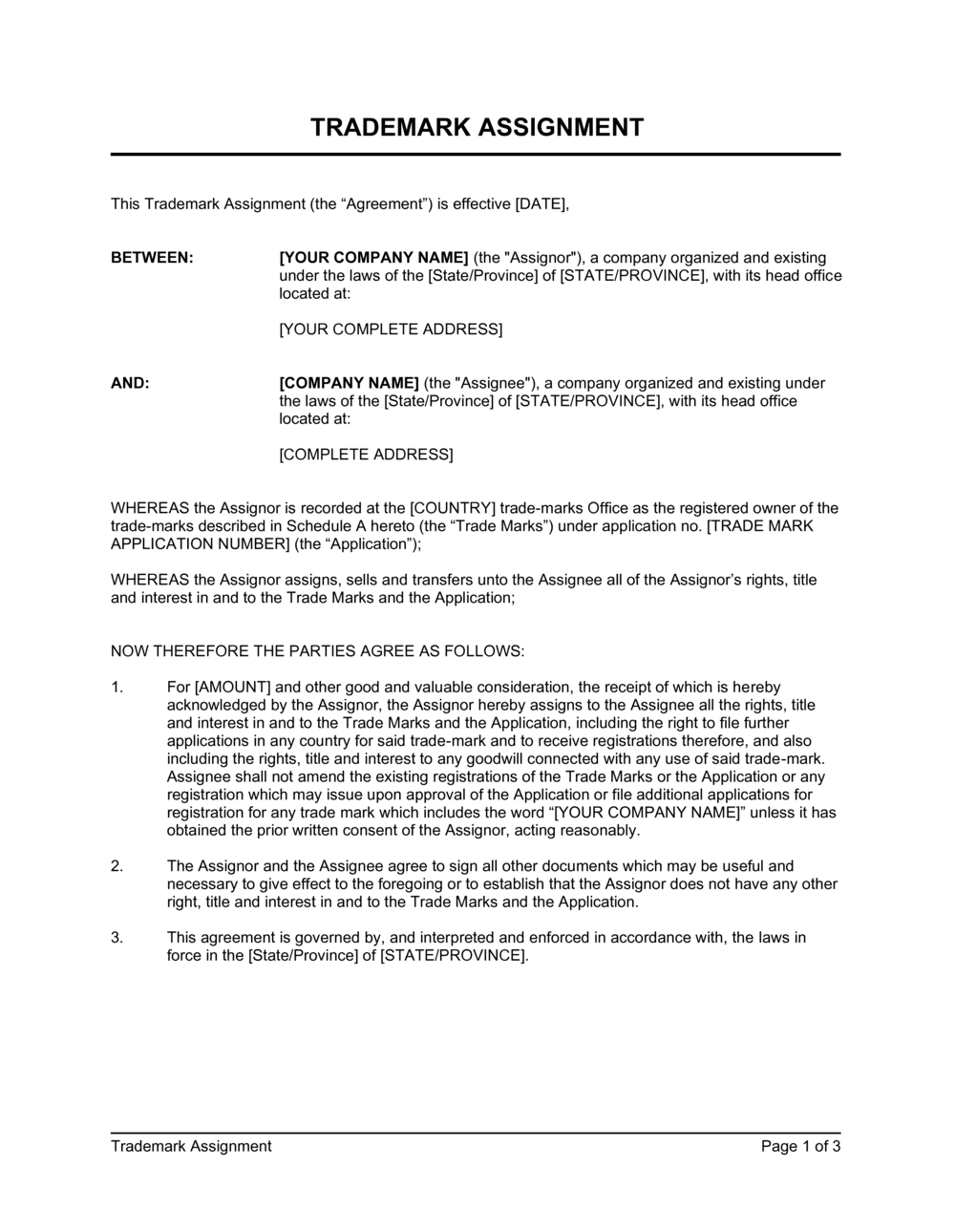
Trademark Assignment Short Form Template

Free Word download β€’ Edit online β€’ Save & share with Drive β€’ Export to PDF

3 pagesβ€’20–25 min to fillβ€’Difficulty: Standard
Learn more ↓
FreeTrademark Assignment Short Form Template

At a glance

What it is
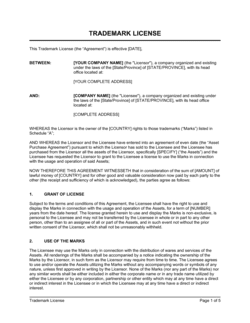
A Trademark Assignment Short Form is a concise one-to-two page document that transfers ownership of a registered or unregistered trademark from one party (the assignor) to another (the assignee). This free Word download gives you a structured, fillable form you can edit online and export as PDF for immediate use in business sales, mergers, or brand transfers.
When you need it
Use it whenever a trademark changes hands β€” during a business acquisition, asset sale, brand licensing restructuring, or when a founder transfers a personally registered mark to their company. It is also used to record an assignment with the USPTO or equivalent national trademark office.
What's inside
Assignor and assignee identification, a precise description of the mark being transferred, the registration or application number, the consideration paid, a representation of good title, and signature blocks for both parties.

What is a Trademark Assignment Short Form?

A Trademark Assignment Short Form is a concise legal document that permanently transfers ownership of a registered or unregistered trademark from one party β€” the assignor β€” to another β€” the assignee. Unlike a full-length assignment agreement, the short form distills the transfer into its essential components: the parties' identities, a precise description of the mark, the applicable registration number, the consideration exchanged, a goodwill transfer statement, and execution blocks. It is the standard instrument used to record trademark ownership changes with the USPTO and equivalent national trademark offices worldwide.

Why You Need This Document

Without a signed assignment form, trademark ownership stays in the name of the original registrant regardless of any verbal agreement or payment made. A founder who registered a mark in their own name before incorporation β€” an extremely common scenario β€” leaves their startup without clear title to its own brand unless the mark is formally assigned to the company. Banks, investors, and acquirers routinely conduct IP due diligence, and an unresolved chain of title will stall a financing round or acquisition. Filing this form with the USPTO also protects the assignee against third-party claims: an unrecorded transfer provides no constructive notice, meaning a later purchaser of the same mark can take priority. This template gives you the correct language β€” including the goodwill transfer clause that is legally required for a valid assignment β€” in a fillable format you can complete and file in under 15 minutes.

Which variant fits your situation?

If your situation is…Use this template
Transferring a trademark with full warranties and representationsTrademark Assignment Agreement (Long Form)
Assigning a trademark as part of a full business saleBusiness Sale Agreement
Licensing a trademark without transferring ownershipTrademark License Agreement
Transferring patent rights rather than trademark rightsPatent Assignment Agreement
Assigning all IP (trademarks, patents, copyrights) in one documentIP Assignment Agreement
Founding team assigning IP to a newly incorporated entityFounders IP Assignment Agreement

Common mistakes to avoid

❌ Omitting goodwill transfer language

Why it matters: Under US trademark law and most common-law jurisdictions, a trademark assigned without its associated goodwill is considered an 'assignment in gross' and is invalid β€” the assignee acquires no enforceable rights.

Fix: Ensure the template's goodwill transfer clause is present and unmodified before signing. Never delete that paragraph to shorten the document.
❌ Using a trade name instead of the registered legal entity name

Why it matters: The USPTO will reject a recordation request if the assignor's name on the form does not exactly match the name on the trademark registration record β€” even a missing 'Inc.' causes delays.

Fix: Look up the exact owner name in the USPTO TESS database and copy it character-for-character into the assignor field.

❌ Leaving consideration blank on intra-company transfers

Why it matters: An assignment with no stated consideration may be challenged as unenforceable for lack of a bargained-for exchange, particularly in litigation or bankruptcy proceedings.

Fix: Always state at least a nominal amount β€” '$1.00 and other good and valuable consideration' is universally accepted and legally sufficient.

❌ Failing to record the assignment with the USPTO

Why it matters: An unrecorded assignment is valid between the parties but does not provide constructive notice to third parties β€” a subsequent bona-fide purchaser of the same mark may take priority over an unrecorded earlier assignment.

Fix: File the signed assignment through the USPTO's Electronic Trademark Assignment System (ETAS) as soon as both parties have executed the form.

The 9 key fields, explained

Assignor identification

Assignee identification

Mark description

Registration or application number

Consideration

Goodwill transfer statement

Warranties and representations

Effective date

Signature blocks

How to fill it out

  1. 1

    Identify both parties with their full legal names

    Enter the assignor's and assignee's exact registered legal names, entity types (LLC, corporation, individual), and addresses. Cross-reference incorporation documents and the USPTO registration record to confirm the names match exactly.

    πŸ’‘ Pull the assignor's name directly from the USPTO TESS database entry for the mark β€” a single character difference will trigger a recordation rejection.

  2. 2

    Enter the trademark details and registration number

    Describe the mark clearly β€” word mark, logo, or composite β€” and include the USPTO registration number, registration date, and international class. If the mark is pending, use the application serial number instead.

    πŸ’‘ If you are assigning multiple marks, list them in a Schedule A attachment rather than cramming them into the main form body.

  3. 3

    State the consideration

    Enter the agreed purchase price or, for nominal transfers, a stated amount of at least $1. Acknowledge receipt of the consideration with the standard 'receipt and sufficiency' language already built into the template.

    πŸ’‘ For intra-company transfers, $1 consideration is standard and legally sufficient β€” but it must be explicitly stated.

  4. 4

    Include the goodwill transfer statement

    Confirm that the goodwill associated with the mark is being transferred along with the mark itself. This language is pre-populated in the template β€” do not delete it.

    πŸ’‘ A trademark assignment without an explicit goodwill transfer is void under US trademark law and the laws of most common-law countries.

  5. 5

    Set the effective date

    Enter a specific calendar date for the ownership transfer. This date should align with the closing date of any broader business transaction, or simply be the date both parties execute the form.

    πŸ’‘ If the assignment is part of a business sale, use the closing date of that transaction as the effective date so all asset transfers align.

  6. 6

    Execute and file with the USPTO

    Have the authorized signatory for the assignor (and ideally the assignee) sign and date the form. Then submit it to the USPTO via the Electronic Trademark Assignment System (ETAS) to record the ownership change in the official register.

    πŸ’‘ USPTO recordation costs $40 per mark per assignee as of 2025 β€” file promptly after signing to protect against third-party claims.

Frequently asked questions

What is a trademark assignment short form?

A trademark assignment short form is a concise one-to-two page document that transfers ownership of a trademark from one party to another. It captures the essential transfer elements β€” assignor and assignee identification, mark description, registration number, consideration, and goodwill transfer β€” without the extended warranties and representations found in a long-form assignment agreement. It is most commonly used for straightforward transfers where the parties have already agreed on terms.

What is the difference between a trademark assignment and a trademark license?

A trademark assignment permanently transfers ownership of the mark from the assignor to the assignee β€” after signing, the assignor no longer holds any rights. A license grants a third party permission to use the mark while the original owner retains ownership. Use an assignment when selling a brand; use a license when allowing a business partner or franchisee to use your brand under defined conditions.

Do I need to record a trademark assignment with the USPTO?

Recording is not legally required for the assignment to be valid between the two parties, but it is strongly recommended. Recording with the USPTO via the Electronic Trademark Assignment System (ETAS) provides constructive notice to third parties and protects the assignee from a later purchaser who claims they did not know the mark had changed hands. The current USPTO recordation fee is $40 per mark per assignee.

Can I use a short form assignment to transfer multiple trademarks at once?

Yes. Attach a Schedule A listing each mark with its registration number, class, and description. The main form body references Schedule A, and both documents are filed together. The USPTO charges the recordation fee per mark, so each entry in Schedule A carries a separate fee.

Does a trademark assignment need to be notarized?

Notarization is not required by the USPTO for domestic trademark assignments. The assignor's signature is sufficient for recordation purposes. Some parties choose to have the form notarized for added evidentiary weight in potential disputes, but this is optional for most standard transfers.

What happens if I forget to include the goodwill transfer clause?

Under US trademark law, an assignment that does not transfer the goodwill associated with the mark is considered an 'assignment in gross' and is legally void. The assignee would not obtain valid trademark rights, even if they paid full consideration and recorded the document. Always verify the goodwill clause is present before signing.

When should I use a long-form trademark assignment instead of the short form?

Use a long-form assignment when the transfer involves significant financial consideration, when you need detailed warranties about the mark's registrability and freedom from infringement claims, when the assignment is part of a complex acquisition with multiple IP assets, or when either party wants indemnification provisions. The short form is appropriate for straightforward transfers β€” founder-to-company, intra-group restructurings, or simple brand sales β€” where the parties know and trust each other.

How this compares to alternatives

vs Trademark Assignment Agreement (Long Form)

A long-form assignment agreement adds detailed representations, warranties, indemnification clauses, and dispute-resolution terms. The short form covers the essential transfer mechanics in one to two pages and is sufficient for straightforward transfers between parties who have already agreed on terms. Use the long form when significant money or complex IP is involved.

vs Trademark License Agreement

A license agreement grants permission to use a trademark while the original owner retains ownership. An assignment permanently transfers ownership. If you intend to keep using the mark yourself or want ongoing royalty income, a license is the correct instrument β€” not an assignment.

vs IP Assignment Agreement

An IP assignment agreement transfers all intellectual property β€” trademarks, patents, copyrights, and trade secrets β€” in a single document. The trademark assignment short form covers trademarks only. Use the broader IP agreement when a transaction involves multiple types of intellectual property.

vs Bill of Sale

A bill of sale documents the sale of tangible personal property and establishes proof of purchase. A trademark assignment transfers intangible IP rights and must include specific trademark-law elements (goodwill transfer, registration number) that a bill of sale does not contain. They serve different asset classes and are not interchangeable.

Industry-specific considerations

Technology / SaaS

Founders routinely register trademarks personally before incorporation and must assign them to the company entity before raising institutional capital.

Retail and Consumer Brands

Brand acquisitions and portfolio restructurings frequently require short-form assignments to transfer individual product marks between holding entities.

Professional Services

Firm mergers and partner buyouts require trademark transfers for the firm name and any service marks associated with proprietary methodologies.

Franchising

Franchisors consolidate trademark ownership in a central IP holding entity and use assignment forms to migrate marks from operating subsidiaries.

Template vs pro β€” what fits your needs?

PathBest forCostTime
Use the templateFounders transferring a mark to their company, intra-group restructurings, or simple brand sales with agreed termsFree10–15 minutes
Template + professional reviewTransfers involving more than $10,000 in consideration or marks with significant commercial value$150–$400 (one-hour IP attorney review)1–2 days
Custom draftedComplex acquisitions with multiple marks, contested ownership histories, or cross-border transfers requiring foreign-office recordation$500–$2,500+1–2 weeks

Glossary

Assignor
The current owner of the trademark who is transferring rights to another party.
Assignee
The party receiving ownership of the trademark through the assignment.
Consideration
The value exchanged for the trademark transfer β€” a dollar amount, a nominal sum (e.g., $1), or other agreed compensation.
Registration Number
The unique identifier assigned by the USPTO or national trademark office when a trademark is officially registered.
Goodwill
The commercial reputation and customer recognition associated with a trademark, which must be transferred alongside the mark itself for the assignment to be valid.
USPTO
United States Patent and Trademark Office β€” the federal agency responsible for registering trademarks and recording ownership changes in the US.
Recordation
The formal process of filing an assignment document with the USPTO (or equivalent office) to update the official ownership record of a trademark.
Unregistered Mark
A trademark that has not been formally registered with a national trademark office but may still carry common-law rights based on actual use in commerce.
Chain of Title
The documented history of ownership transfers for a trademark, from the original creator to the current owner.
Schedule A
An attachment to the assignment form that lists multiple trademarks being transferred when more than one mark is covered by the same agreement.

Part of your Business Operating System

This document is one of 3,000+ business & legal templates included in Business in a Box.

  • Fill-in-the-blanks β€” ready in minutes
  • 100% customizable Word document
  • Compatible with all office suites
  • Export to PDF and share electronically

Create your document in 3 simple steps.

From template to signed document β€” all inside one Business Operating System.
1
Download or open template

Access over 3,000+ business and legal templates for any business task, project or initiative.

2
Edit and fill in the blanks with AI

Customize your ready-made business document template and save it in the cloud.

3
Save, Share, Send, Sign

Share your files and folders with your team. Create a space of seamless collaboration.

Save time, save money, and create top-quality documents.

β˜…β˜…β˜…β˜…β˜…

"Fantastic value! I'm not sure how I'd do without it. It's worth its weight in gold and paid back for itself many times."

Managing Director Β· Mall Farm
Robert Whalley
Managing Director, Mall Farm Proprietary Limited
β˜…β˜…β˜…β˜…β˜…

"I have been using Business in a Box for years. It has been the most useful source of templates I have encountered. I recommend it to anyone."

Business Owner Β· 4+ years
Dr Michael John Freestone
Business Owner
β˜…β˜…β˜…β˜…β˜…

"It has been a life saver so many times I have lost count. Business in a Box has saved me so much time and as you know, time is money."

Owner Β· Upstate Web
David G. Moore Jr.
Owner, Upstate Web

Run your business with a system β€” not scattered tools

Stop downloading documents. Start operating with clarity. Business in a Box gives you the Business Operating System used by over 250,000 companies worldwide to structure, run, and grow their business.

Start freeΒ Β·Β No credit card required