Worksheet_Business Selection

Free download • Use as a template • Print or share

2 pages20–30 min to useDifficulty: StandardSignature requiredLegal review recommended
Learn more ↓
FreeWorksheet_Business Selection Template

At a glance

What it is
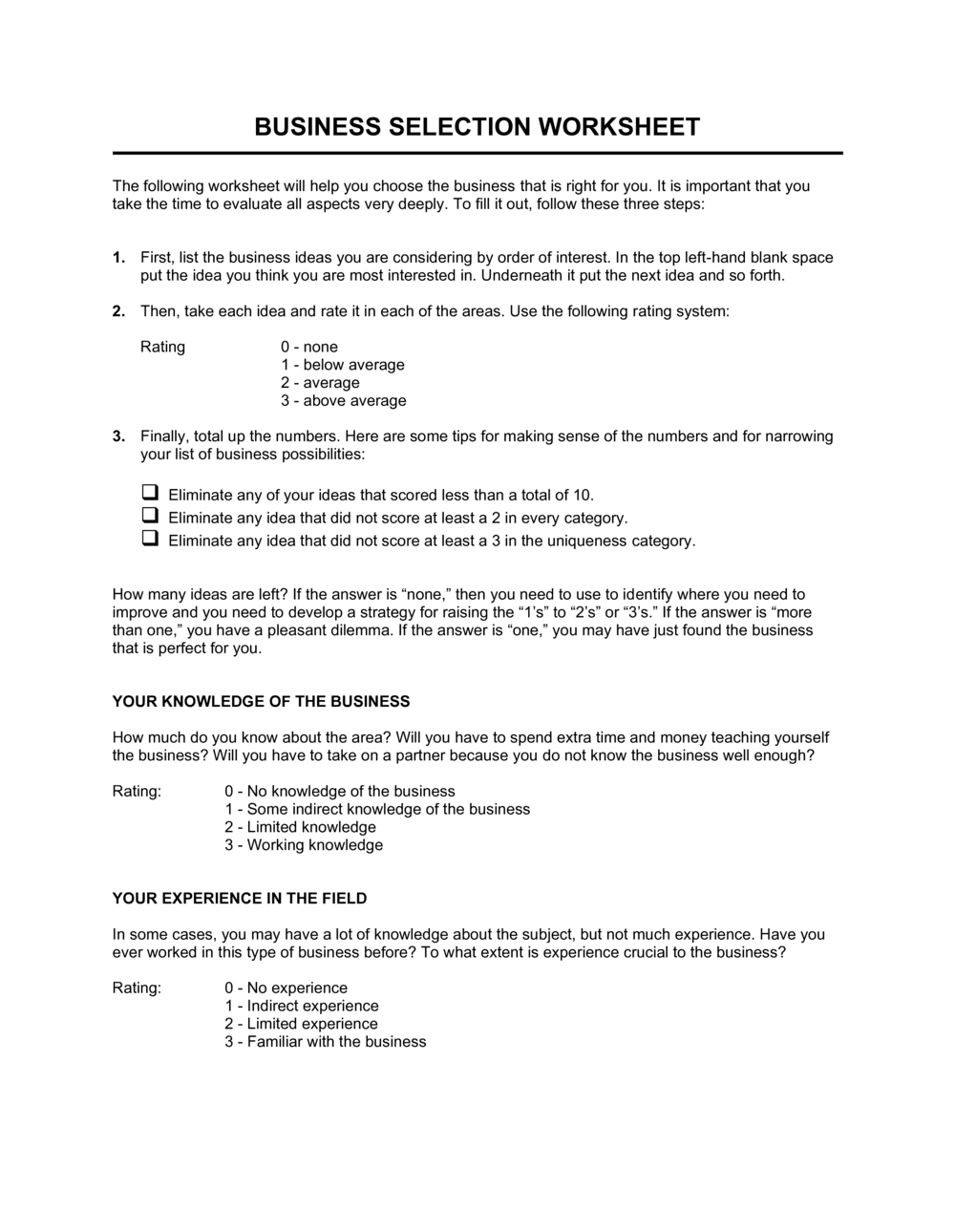
A Worksheet Business Selection is a structured legal document that guides founders, partners, and advisors through a systematic comparison of available business entity types — sole proprietorship, partnership, LLC, S-Corp, and C-Corp — before formation. This free Word download walks you through the key legal, tax, and operational criteria that determine which structure best fits your situation, and produces a documented rationale you can share with your attorney, accountant, or co-founders.
When you need it
Use it before registering a new business, when restructuring an existing entity, or when bringing on investors or co-founders whose entry changes the optimal structure. It is also used by advisors when onboarding new clients who have not yet formed a legal entity.
What's inside
Owner and business profile information, a side-by-side comparison of entity types across liability, taxation, governance, and formation cost criteria, a scoring or weighting section for each factor, a recommended entity selection field, and a signature block for owner and advisor acknowledgment.

What is a Worksheet Business Selection?

A Worksheet Business Selection is a structured legal document that guides business owners, founders, and their advisors through a systematic comparison of available entity types — sole proprietorship, partnership, LLC, S-Corp, and C-Corp — before any formation filing is made. It evaluates liability exposure, tax treatment, ownership structure, compliance costs, investor readiness, and jurisdiction-specific considerations side by side, producing a written record of the analysis and the rationale for the final entity choice. Unlike a generic checklist, a properly completed business selection worksheet is signed by both the owner and any participating advisor, creating a documented acknowledgment that the decision was made with full awareness of its legal and tax consequences.

Why You Need This Document

Entity selection is one of the most consequential decisions a business owner makes — and one of the most commonly made without adequate analysis. Choosing the wrong structure can mean unlimited personal liability for business debts, thousands of dollars in avoidable self-employment taxes each year, or a forced and expensive conversion when an investor requires a Delaware C-Corp and you formed an LLC in your home state. Without a documented worksheet, there is no written record of why the structure was chosen, which becomes a serious problem when co-founders dispute ownership, the IRS questions the classification, or a new attorney needs to understand the formation history years later. This template forces the analysis to happen before the filing — not after — and creates the paper trail that protects the decision long-term.

Which variant fits your situation?

If your situation is…Use this template
Solo founder with no outside investors and minimal liability exposureSole Proprietorship Setup Checklist
Two or more founders splitting ownership without formal incorporationPartnership Agreement
Founder seeking pass-through taxation with personal liability protectionLLC Operating Agreement
Founder planning to raise venture capital or issue stock optionsC-Corporation Formation Checklist
Small business owner wanting S-Corp tax treatmentS-Corporation Shareholder Agreement
Nonprofit mission-driven organizationNonprofit Articles of Incorporation
Existing business converting entity type mid-operationBusiness Restructuring Plan

Common mistakes to avoid

❌ Choosing entity type based on formation cost alone

Why it matters: A sole proprietorship costs nothing to form but exposes all personal assets to business debts and lawsuits. A $500 LLC filing fee can protect a lifetime of personal savings.

Fix: Complete the liability and tax sections of the worksheet before reviewing formation costs — the cost comparison is the last input, not the first.

❌ Forming an LLC when venture capital is planned

Why it matters: Institutional venture capital investors almost universally require a Delaware C-Corp. Converting an LLC to a C-Corp mid-stream triggers tax events and legal fees of $5,000–$20,000 that a correct initial selection would have avoided.

Fix: Complete the investor and financing readiness section of the worksheet before any formation filing. If VC is even a possibility, consult a startup attorney before deciding.

❌ Ignoring state-specific franchise and excise taxes

Why it matters: California imposes an $800 minimum franchise tax on all LLCs regardless of revenue. Texas, Delaware, and other states have their own franchise tax structures. Selecting a formation state without modeling these costs produces inaccurate total cost-of-ownership comparisons.

Fix: Research the franchise tax and annual compliance costs for every state where the business will operate — not just where it will be formed — and include these in the cost comparison section.

❌ Completing the worksheet without an attorney or CPA review

Why it matters: Entity selection has permanent tax and legal consequences that are difficult and expensive to unwind. An error in the worksheet that leads to an incorrect formation filing can take 12–24 months and thousands of dollars to correct.

Fix: Treat this worksheet as preparation for — not a replacement for — a one-hour consultation with a business attorney and a CPA. Most advisors charge $200–$400 for a formation-focused review session.

❌ Failing to document the rationale for the selected entity

Why it matters: Without a written record, the reasoning behind the original entity choice is lost when advisors change, co-founders dispute ownership, or the IRS questions the structure.

Fix: Complete the recommended entity and rationale section in full and store the signed worksheet with the company's permanent formation records.

❌ Using a trade name instead of the intended legal entity name

Why it matters: A worksheet completed under a DBA or brand name creates a mismatch with the formation documents, state filings, and tax registrations — triggering corrections across multiple government agencies.

Fix: Confirm the exact legal entity name you plan to register — after a name availability search — before completing any section of the worksheet.

The 10 key clauses, explained

Owner and Business Profile

In plain language: Records the owner's name, address, proposed business name, industry, and the stage of business development to anchor all subsequent analysis.

Sample language
Owner: [FULL LEGAL NAME] | Proposed Business Name: [BUSINESS NAME] | Industry: [INDUSTRY TYPE] | Stage: [Pre-launch / Operating / Restructuring] | State/Province of Formation: [JURISDICTION]

Common mistake: Completing the profile for a trade name rather than the intended legal entity name — if the names differ, the formation documents and this worksheet will reference different entities, creating ambiguity in legal filings.

Business Goals and Planning Horizon

In plain language: Captures the owner's primary objectives — liability protection, tax minimization, investor readiness, or simplicity — and the expected operating horizon, since these factors directly determine which structures are appropriate.

Sample language
Primary objective: [LIABILITY PROTECTION / TAX EFFICIENCY / INVESTOR READINESS / OPERATIONAL SIMPLICITY]. Expected operating horizon: [X] years. Anticipated revenue in Year 1: $[AMOUNT]. Number of owners: [NUMBER].

Common mistake: Selecting an entity type based solely on cost of formation without accounting for long-term tax consequences — an LLC costs $50–$500 to form but may result in thousands more in self-employment tax annually compared to an S-Corp election.

Liability Analysis

In plain language: Evaluates the owner's personal liability exposure under each entity type and flags the industries or activities that make liability protection particularly critical.

Sample language
Industry liability risk level: [HIGH / MEDIUM / LOW]. Personal asset exposure without liability shield: estimated $[AMOUNT]. Recommended minimum protection: [LLC / Corporation]. Notes: [e.g., 'operates in a regulated industry; professional liability exposure exists regardless of entity type.']

Common mistake: Assuming an LLC automatically protects personal assets without maintaining proper documentation, separate bank accounts, and operating formalities — courts can pierce the veil when these are absent.

Tax Treatment Comparison

In plain language: Compares the tax treatment of each entity type — sole proprietorship, single-member LLC, multi-member LLC, S-Corp, and C-Corp — including self-employment tax, pass-through eligibility, and corporate tax exposure.

Sample language
Sole Proprietorship: all net income subject to self-employment tax (15.3% on first $[THRESHOLD]). LLC (default): same as sole proprietorship unless S-Corp election made. S-Corp: salary of $[REASONABLE COMP] subject to payroll tax; remaining distributions are not. C-Corp: corporate tax rate [X]%; dividends taxed again at individual rate.

Common mistake: Treating LLC and S-Corp taxation as identical — an LLC with an S-Corp election can reduce self-employment tax on distributions above a reasonable salary, but requires payroll setup and additional compliance costs that erode the benefit for businesses earning less than ~$40,000 in net profit.

Ownership and Control Structure

In plain language: Documents the number of owners, their ownership percentages, voting rights, and management roles to determine which entity structures are compatible with the intended governance arrangement.

Sample language
Number of owners: [NUMBER]. Ownership split: [OWNER 1 NAME] — [X]%, [OWNER 2 NAME] — [X]%. Management: [Member-managed / Manager-managed / Board-governed]. Voting threshold for major decisions: [MAJORITY / SUPERMAJORITY / UNANIMOUS].

Common mistake: Choosing a sole proprietorship or single-member LLC when a co-founder relationship exists — even an informal co-founder arrangement requires a formal multi-owner structure with a written agreement to avoid disputes over ownership and control.

Formation Cost and Compliance Requirements

In plain language: Outlines the one-time formation costs and ongoing annual compliance obligations — filing fees, registered agent fees, annual reports, franchise taxes — for each entity type under consideration.

Sample language
Sole Proprietorship: $0 formation, minimal compliance. LLC: state filing fee $[AMOUNT], annual report $[AMOUNT], registered agent $[AMOUNT]/yr. S-Corp: same as LLC plus payroll setup ~$[AMOUNT]/yr. C-Corp: state filing $[AMOUNT], registered agent, annual meeting minutes, stock ledger maintenance.

Common mistake: Selecting a C-Corp for a two-person service business because 'it sounds most professional' — C-Corp compliance requirements (board minutes, stock ledger, annual meetings) add $1,500–$5,000/year in accounting and legal overhead that is unnecessary for most small businesses.

Investor and Financing Readiness

In plain language: Assesses whether the business intends to raise equity capital, issue stock options, or take on institutional investors — factors that typically require a Delaware C-Corp structure.

Sample language
Anticipated equity fundraising: [YES / NO / UNDECIDED]. Expected funding stage: [Pre-seed / Seed / Series A / None]. Stock option plan required: [YES / NO]. Preferred entity for institutional VC investment: Delaware C-Corporation. Notes: [ADVISOR NOTES ON INVESTOR REQUIREMENTS].

Common mistake: Forming an LLC when venture capital is the intended funding path — most institutional investors will not invest in an LLC, requiring a costly conversion to a C-Corp that could have been avoided at formation.

State and Jurisdiction Selection

In plain language: Identifies the optimal state or province for formation based on operational location, tax environment, franchise tax obligations, and legal protections.

Sample language
Primary operating state: [STATE]. Proposed formation state: [STATE]. Reason for out-of-state formation (if applicable): [e.g., 'Delaware for legal infrastructure and investor preference']. Foreign qualification required in: [STATES / PROVINCES]. Estimated franchise tax liability: $[AMOUNT]/yr.

Common mistake: Forming in Delaware or Nevada 'for tax benefits' when the business operates entirely in another state — this requires foreign qualification in the home state anyway, doubling filing fees and registered agent costs with no net tax advantage for most small businesses.

Recommended Entity Selection and Rationale

In plain language: Records the final entity recommendation, the primary reasons for the selection, and any conditions or next steps required before formation.

Sample language
Recommended Entity: [ENTITY TYPE]. Primary reasons: (1) [REASON], (2) [REASON], (3) [REASON]. Conditions precedent to formation: [e.g., 'co-founder agreement to be signed simultaneously']. Next steps: (1) File [DOCUMENT] with [AGENCY] by [DATE], (2) Open business bank account, (3) Draft operating agreement.

Common mistake: Filling in a recommendation without documenting the reasoning — if the business is ever audited, disputed, or restructured, an undocumented entity choice gives the IRS or a court no basis for the original decision.

Owner and Advisor Acknowledgment

In plain language: A signature block confirming that the owner has reviewed the analysis, understands the implications of the selected entity type, and has been advised to consult legal and tax professionals before finalizing the decision.

Sample language
Owner: I, [OWNER FULL NAME], acknowledge that I have reviewed this worksheet and understand that this document is an analytical tool, not legal or tax advice. I agree to consult a licensed attorney and/or CPA before filing formation documents. Signature: _______________ Date: [DATE]. Advisor (if applicable): [ADVISOR NAME, CREDENTIAL] Signature: _______________ Date: [DATE].

Common mistake: Omitting the advisor acknowledgment block when a CPA or attorney assisted in completing the worksheet — without the advisor's signature, their involvement and the advice given are undocumented, creating liability exposure for both parties.

How to fill it out

  1. 1

    Complete the owner and business profile section

    Enter the owner's full legal name, the proposed business name, industry classification, state or province of intended formation, and the current stage of the business. Use the legal name you intend to register — not a trade name or DBA.

    💡 Run a business name availability search in your formation state before completing this section. Discovering a name conflict after the worksheet is complete wastes time.

  2. 2

    Define your primary business goals and planning horizon

    Rank your top three priorities among liability protection, tax minimization, investor readiness, and operational simplicity. Enter your expected operating horizon and Year 1 revenue estimate. These inputs drive the entire entity recommendation.

    💡 If investor readiness ranks in your top two priorities, a Delaware C-Corp is almost certainly the right answer — document this early to avoid revisiting it later.

  3. 3

    Complete the liability analysis

    Identify the industry-specific liability risks your business faces and estimate the value of personal assets you would expose without a liability shield. Note any professional licensing requirements, as some professions require a PLLC or PC rather than a standard LLC.

    💡 If you are in a licensed profession — medicine, law, accounting, engineering — confirm with your state licensing board which entity types are permitted before completing this section.

  4. 4

    Fill in the tax treatment comparison

    Enter the applicable tax rates, self-employment tax thresholds, and estimated net profit for Year 1. Compare the after-tax income under each entity type to quantify the tax difference — not just the conceptual distinction.

    💡 The S-Corp election typically starts generating net tax savings when annual net profit exceeds $40,000–$60,000. Below that threshold, payroll setup costs often erode the benefit.

  5. 5

    Document the ownership and control structure

    List every owner, their ownership percentage, and their intended management role. Confirm the voting threshold required for major decisions. Any structure with two or more owners automatically eliminates sole proprietorship as an option.

    💡 If ownership is anything other than 50/50 or clearly majority-controlled, document the tiebreaker mechanism now — ambiguity here is the most common source of co-founder disputes.

  6. 6

    Compare formation costs and annual compliance obligations

    Research the current filing fees, annual report fees, and registered agent costs for your formation state. Add estimated accounting costs specific to each entity type. Total the first-year and ongoing annual cost for each option.

    💡 Call your state's Secretary of State office or check their website directly — formation fee schedules change annually and third-party sites often publish outdated numbers.

  7. 7

    Record the recommended entity and rationale

    Select the recommended entity type, document the three to five primary reasons supporting the choice, and list the specific next steps — filing, bank account, operating agreement — with responsible parties and target dates.

    💡 Attach this completed worksheet to the formation file so any attorney, accountant, or future partner can see the documented reasoning for the original structure decision.

  8. 8

    Obtain signatures from owner and advisor

    Have the owner and any participating advisor sign and date the acknowledgment block before taking any formation steps. The signature confirms the analysis was reviewed and that the owner understands this worksheet is analytical, not a substitute for legal advice.

    💡 Date the signature within 30 days of the intended formation filing — a worksheet signed months before the actual filing may not reflect current tax law or the owner's updated circumstances.

Frequently asked questions

What is a worksheet business selection document?

A worksheet business selection is a structured analytical document that guides a business owner through a systematic comparison of available legal entity types — sole proprietorship, partnership, LLC, S-Corp, and C-Corp — before formation. It evaluates liability exposure, tax treatment, ownership structure, formation costs, and investor readiness side by side to produce a documented rationale for the entity choice. Both the owner and any participating advisor typically sign the completed worksheet to acknowledge the analysis.

Why does choosing a business entity require a formal document?

Entity selection has permanent legal and tax consequences that are expensive to undo. A documented worksheet creates a written record of the analysis and the reasoning behind the decision — useful when co-founders dispute ownership later, when the IRS questions the structure, or when a new accountant or attorney needs to understand the original intent. It also ensures the owner considered all relevant factors rather than defaulting to the cheapest or most familiar option.

What are the main business entity types covered in this worksheet?

The worksheet covers five primary structures: sole proprietorship (simplest, no liability protection), general partnership (shared ownership, no entity-level liability shield), limited liability company or LLC (flexibility plus liability protection), S-Corporation (pass-through tax with payroll tax savings above a threshold), and C-Corporation (separate taxable entity, preferred for venture-backed startups). Professional entities — PLLC and PC — are also noted for licensed professions where standard LLCs may not be permitted.

What is the difference between an LLC and an S-Corp?

An LLC is a legal structure that determines liability protection and ownership mechanics. An S-Corp is a tax election that can be made by an LLC or a corporation. An LLC taxed as an S-Corp allows the owner to pay themselves a reasonable salary — subject to payroll tax — and take additional profits as distributions that are not subject to self-employment tax. This distinction becomes meaningful when annual net profit exceeds approximately $40,000–$60,000.

Should I form in Delaware even if I operate in another state?

Delaware formation is generally advantageous only for businesses planning to raise institutional venture capital, where investors and their counsel expect Delaware law. For most small businesses operating in a single state, forming in the home state avoids the cost of foreign qualification — registering in a second state — plus duplicate registered agent and filing fees. The worksheet's jurisdiction section walks through this analysis based on your specific situation.

Is a worksheet business selection document legally binding?

The worksheet itself is generally not a binding legal contract between the owner and a third party. However, the signed acknowledgment section creates a documented record of the analysis and the owner's informed consent to proceed — which can be relevant in disputes between co-founders, in attorney-client engagement documentation, or in demonstrating due diligence to the IRS. The underlying entity formation documents filed with the state are the legally operative instruments.

Do I need a lawyer to complete a business selection worksheet?

A well-structured template enables most business owners to complete the analytical sections independently. However, the completed worksheet should be reviewed by a business attorney and a CPA before any formation filing is made. Entity selection involves interacting tax, liability, and governance considerations that are difficult to fully evaluate without professional input. A one-hour review session typically costs $200–$400 and is worthwhile for any business with meaningful revenue or liability exposure.

What happens if I choose the wrong business entity?

Correcting an incorrect entity selection typically requires dissolving the original entity, forming the new one, transferring assets, updating all contracts and bank accounts, re-registering with tax authorities, and potentially triggering a taxable event. Total costs commonly run $3,000–$15,000 in legal and accounting fees plus the time disruption to the business. In some cases — particularly LLC-to-C-Corp conversions for VC fundraising — the process can take two to three months. The worksheet exists specifically to avoid this outcome.

Can this worksheet be used when restructuring an existing business?

Yes. The worksheet is equally applicable to conversion analysis — for example, when a sole proprietor wants to form an LLC, or when an LLC owner wants to elect S-Corp tax treatment. The same liability, tax, ownership, and cost comparison sections apply. The key difference is that a restructuring analysis must also account for the tax consequences of the conversion itself, which requires a CPA's input before any action is taken.

How this compares to alternatives

vs LLC Operating Agreement

A worksheet business selection is used before formation to determine which entity type is appropriate. An LLC operating agreement is the governing document executed after an LLC is formed, defining membership, management, and profit distribution. The worksheet precedes the operating agreement — you complete the worksheet to confirm an LLC is the right choice, then draft the operating agreement to govern it.

vs Partnership Agreement

A partnership agreement governs the relationship between partners in an already-formed partnership — covering capital contributions, profit splits, and exit rights. A business selection worksheet is completed before any entity is formed, and may conclude that a partnership is not the optimal structure at all. Use the worksheet first; draft the partnership agreement only if the analysis confirms a general or limited partnership is appropriate.

vs Business Plan

A business plan presents the market opportunity, strategy, and financials to investors or lenders. A business selection worksheet addresses the narrower question of legal structure — liability, tax treatment, and governance — before operations begin. Most founders need both, but they serve distinct purposes: the business plan is external-facing and strategic; the worksheet is internal, legal, and foundational.

vs Articles of Incorporation

Articles of incorporation are the formal government filing that legally creates a corporation — they are the output of the entity selection decision. A business selection worksheet is the analytical step that precedes the filing, documenting why a corporation was chosen and which state to file in. Completing the worksheet before drafting articles of incorporation ensures the filing reflects an informed, documented decision.

Industry-specific considerations

Professional Services

Licensed professionals such as attorneys, CPAs, and engineers often must form a PLLC or PC rather than a standard LLC — the worksheet flags this licensing constraint before the owner files incorrect formation documents.

Technology / SaaS

Venture-backed startups almost universally require a Delaware C-Corp; the investor readiness section of the worksheet identifies this early and prevents costly LLC-to-C-Corp conversions after a term sheet is signed.

Retail / E-commerce

Multi-state sales tax obligations and inventory liability make LLC formation with an S-Corp election common in this sector; the worksheet's tax and jurisdiction sections capture these considerations systematically.

Construction and Trades

High liability exposure from job-site accidents and contractor disputes makes the LLC or corporation liability shield particularly critical; the worksheet's liability analysis section quantifies the personal asset exposure without that protection.

Jurisdictional notes

United States

Entity selection is governed at the state level in the US — there is no federal business formation statute. Delaware, Wyoming, and Nevada offer business-friendly LLC statutes and are popular formation states for out-of-state operators, but businesses must also register as a foreign entity in their home state, adding cost. California imposes an $800 annual minimum franchise tax on all LLCs, regardless of revenue. The IRS recognizes sole proprietorships, partnerships, LLCs (disregarded entity, partnership, or S-Corp election), and C-Corps as distinct tax classifications.

Canada

Canadian business structures include sole proprietorship, general partnership, and incorporation at either the federal level (Canada Business Corporations Act) or provincial level. The Canadian equivalent of the US LLC is the corporation with a unanimous shareholder agreement, as true LLC structures are not available in most provinces. Quebec operates under civil law, which affects the drafting and interpretation of shareholder and partnership agreements. Federal incorporation offers national name protection but requires registration in each province where the business operates.

United Kingdom

UK business structures include sole trader, ordinary business partnership, limited liability partnership (LLP), and private limited company (Ltd). The LLP is the closest equivalent to a US LLC and is common for professional services firms. Private limited companies are governed by the Companies Act 2006 and require filing annual confirmation statements and accounts at Companies House. Scotland operates under Scots law, which differs from English law in partnership and property matters. The choice between an LLP and a Ltd company is primarily driven by tax treatment and investor expectations.

European Union

EU member states each have their own business formation laws — there is no single pan-EU entity type for small businesses. The most common private company equivalents are the GmbH (Germany and Austria), SARL (France and Luxembourg), SL (Spain), and BV (Netherlands). Formation requirements, minimum capital obligations, and annual compliance costs vary significantly by country. Businesses operating across multiple EU member states may consider a Societas Europaea (SE) for simplified cross-border governance, though this is typically used only by larger enterprises. GDPR compliance obligations apply to all entities regardless of structure.

Template vs lawyer — what fits your deal?

PathBest forCostTime
Use the templateSolo founders or small business owners forming a straightforward domestic LLC or sole proprietorship with no outside investorsFree1–2 hours
Template + legal reviewMulti-owner businesses, S-Corp elections, or any formation in a state with complex franchise tax rules$200–$500 for a one-hour attorney and CPA review session2–5 days
Custom draftedVenture-backed startups, licensed professionals with entity-type restrictions, or multi-state or international operations$500–$2,500 for a full formation package with attorney-drafted operating agreement or bylaws1–2 weeks

Glossary

Sole Proprietorship
A business owned and operated by a single individual with no legal separation between the owner and the business entity.
Limited Liability Company (LLC)
A flexible business structure that provides personal liability protection to its members while allowing pass-through taxation.
S-Corporation
A corporation that elects to pass corporate income, losses, deductions, and credits through to shareholders for federal tax purposes, avoiding double taxation.
C-Corporation
A standard corporation taxed separately from its owners, subject to corporate income tax — the preferred structure for venture-backed startups.
Pass-Through Taxation
A tax treatment in which business income is reported on the owner's personal tax return rather than at the entity level, avoiding corporate-level tax.
Personal Liability
The legal exposure of an owner's personal assets — savings, home, car — to business debts and lawsuits when no liability shield exists.
Operating Agreement
A governing document for an LLC that defines ownership percentages, management structure, profit distributions, and member rights.
Articles of Incorporation
The formal legal document filed with a state or provincial authority to register a corporation, establishing its existence and basic governance rules.
Registered Agent
A designated person or service authorized to receive legal and official government documents on behalf of a business entity.
Double Taxation
The taxation of corporate profits at both the corporate level and again at the individual level when dividends are distributed to shareholders.
Self-Employment Tax
A tax covering Social Security and Medicare contributions that sole proprietors and LLC members pay on net business income in the US.
Piercing the Corporate Veil
A legal action in which a court holds owners personally liable for business debts because they failed to maintain proper separation between personal and business finances.

Part of your Business Operating System

This document is one of 3,000+ business & legal templates included in Business in a Box.

  • Fill-in-the-blanks — ready in minutes
  • 100% customizable Word document
  • Compatible with all office suites
  • Export to PDF and share electronically

Create your document in 3 simple steps.

From template to signed document — all inside one Business Operating System.
1
Download or open template

Access over 3,000+ business and legal templates for any business task, project or initiative.

2
Edit and fill in the blanks with AI

Customize your ready-made business document template and save it in the cloud.

3
Save, Share, Send, Sign

Share your files and folders with your team. Create a space of seamless collaboration.

Save time, save money, and create top-quality documents.

★★★★★

"Fantastic value! I'm not sure how I'd do without it. It's worth its weight in gold and paid back for itself many times."

Managing Director · Mall Farm
Robert Whalley
Managing Director, Mall Farm Proprietary Limited
★★★★★

"I have been using Business in a Box for years. It has been the most useful source of templates I have encountered. I recommend it to anyone."

Business Owner · 4+ years
Dr Michael John Freestone
Business Owner
★★★★★

"It has been a life saver so many times I have lost count. Business in a Box has saved me so much time and as you know, time is money."

Owner · Upstate Web
David G. Moore Jr.
Owner, Upstate Web

Run your business with a system — not scattered tools

Stop downloading documents. Start operating with clarity. Business in a Box gives you the Business Operating System used by over 250,000 companies worldwide to structure, run, and grow their business.

Start free · No credit card required