Conducting Market Segmentation Template

Free Word download • Edit online • Save & share with Drive • Export to PDF

5 pages25–35 min to fillDifficulty: ComplexSignature requiredLegal review recommended
Learn more ↓
FreeConducting Market Segmentation Template

At a glance

What it is
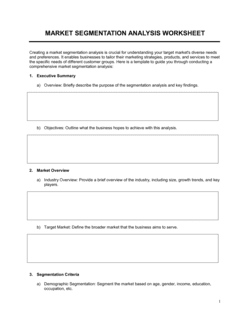
A Conducting Market Segmentation document is a structured analytical report that divides a total addressable market into distinct, actionable customer groups based on shared demographic, psychographic, behavioral, or geographic characteristics. This free Word download provides a ready-to-edit framework you can complete, export as PDF, and present to leadership, investors, or marketing teams as the foundation for targeted strategy.
When you need it
Use it when entering a new market, launching a product or service, realigning marketing spend across customer groups, or preparing a go-to-market strategy that requires evidence-based audience prioritization. It is also required by many investors and lenders as supporting documentation for business plans and pitch decks.
What's inside
Market overview, segmentation criteria and methodology, detailed segment profiles, segment sizing and attractiveness scoring, competitive positioning per segment, prioritization framework, and strategic recommendations for targeting and positioning.

What is a Conducting Market Segmentation?

A Market Segmentation Analysis is a structured analytical document that divides a total addressable market into distinct, actionable customer groups based on shared demographic, psychographic, behavioral, or geographic characteristics. The document combines quantitative segment sizing with qualitative profile descriptions, attractiveness scoring, competitive mapping, and targeted positioning recommendations — giving marketing, product, and sales teams a single source of truth for deciding where to focus resources and how to tailor their message for each priority audience.

Unlike a high-level market overview, a segmentation report is grounded in data: it documents methodology, sources, and assumptions so that conclusions can be tested, updated, and defended to investors or senior leadership. When executed properly, it transforms abstract market size statistics into a specific prioritized list of customer groups that drives budget allocation, product roadmap decisions, and go-to-market sequencing.

Why You Need This Document

Without a completed market segmentation analysis, marketing budgets default to broad-reach campaigns that generate impressions but not qualified buyers, product teams build for hypothetical average users rather than real distinct needs, and sales teams pursue every lead with the same pitch — converting at lower rates across the board. The cost of skipping this step compounds: a company that enters a new market without segment prioritization typically spends 18–24 months discovering through expensive trial and error what a 3-week segmentation exercise would have revealed upfront.

Investors and lenders increasingly expect segment-level evidence in business plans and pitch decks — a total market size number without a credible breakdown of who within that market you are targeting and why signals strategic immaturity. This template gives you the structure to move from raw market data to a defensible, prioritized segment strategy, complete with attractiveness scoring, competitive maps, and actionable recommendations tied directly to the next planning cycle.

Which variant fits your situation?

If your situation is…Use this template
Segmenting a B2C consumer market by demographics and lifestyleConsumer Market Segmentation Report
Segmenting a B2B market by company size, industry, and buying behaviorB2B Market Segmentation Analysis
Quick single-page segment summary for internal alignmentCustomer Persona Template
Mapping segments to products and pricing tiersGo-to-Market Strategy Template
Prioritizing geographic markets for expansionMarket Expansion Plan
Supporting a business plan with audience analysisBusiness Plan Template
Analyzing competitor positioning across customer segmentsCompetitive Analysis Template

Common mistakes to avoid

❌ Defining segments that cannot be reached

Why it matters: A segment defined by psychographic traits like 'sustainability-conscious early adopters' is strategically compelling but worthless if no available media channel or list can target it at scale.

Fix: For each segment, confirm before finalizing that at least two accessible acquisition channels — paid media, outbound lists, industry events, or partner ecosystems — can address it.

❌ Over-segmenting into too many groups

Why it matters: Seven or more segments typically exceed a company's capacity to develop distinct positioning, creative, and channel strategies for each — leading to generic messaging that serves none of them well.

Fix: Consolidate segments until you have three to six distinct groups, each large enough to justify dedicated marketing investment and different enough to require a materially distinct message.

❌ Skipping a bottoms-up segment size validation

Why it matters: Top-down sizing ('2% of a $10B market') frequently produces unrealistic revenue projections that collapse under investor or leadership scrutiny because no one counted actual reachable buyers.

Fix: Multiply an estimated count of addressable accounts or customers by average purchase value to produce a bottoms-up estimate, then reconcile it with the top-down figure.

❌ Using the same positioning statement across all segments

Why it matters: Generic positioning that speaks to everyone converts no one — buyers in each segment have distinct pain points, language, and decision criteria that a single message cannot address.

Fix: Write a separate positioning statement and at least two segment-specific proof points for every priority segment before releasing the document to the marketing or sales team.

❌ Presenting conclusions without documenting assumptions

Why it matters: When market conditions change or results disappoint, stakeholders cannot diagnose which assumption failed — making the segmentation document impossible to update rather than iterate on.

Fix: Include a dedicated section listing five to seven key assumptions with the direction and magnitude of their impact on segment rankings if they prove incorrect.

❌ Ending the report without concrete action items

Why it matters: A segmentation report with no budget allocation, campaign brief, or product roadmap connection delivers zero business value — it becomes a research artifact rather than a strategy driver.

Fix: Close the document with a prioritized action table assigning each recommendation a specific owner, deliverable, and deadline tied to the next planning or budget cycle.

The 10 key clauses, explained

Market Overview and Scope

In plain language: Defines the total market being analyzed, its current size in revenue or units, geographic boundaries, and the time horizon the analysis covers.

Sample language
This analysis covers the [MARKET NAME] market in [GEOGRAPHY], estimated at $[X]B in [YEAR] (Source: [CITATION]), projected to reach $[X]B by [YEAR] at a [X]% CAGR. The scope includes [INCLUDE] and excludes [EXCLUDE].

Common mistake: Defining the market too broadly — claiming a $500B global industry when you can realistically reach only a $40M domestic niche inflates every downstream estimate and undermines credibility.

Segmentation Criteria and Methodology

In plain language: States which segmentation variables were chosen (demographic, psychographic, behavioral, geographic, or firmographic) and why, and describes the data sources and analytical method used.

Sample language
Segments were identified using [METHODOLOGY — e.g., cluster analysis / qualitative research / survey data] applied to [DATA SOURCE]. Primary segmentation variables: [VARIABLE 1], [VARIABLE 2], [VARIABLE 3]. Secondary variables: [VARIABLE 4].

Common mistake: Choosing segmentation variables based on available data rather than strategic relevance — resulting in segments that are easy to describe but impossible to reach through marketing or sales channels.

Segment Identification and Profiles

In plain language: Describes each discrete customer segment with its defining characteristics, including a named label, key attributes, and representative persona.

Sample language
Segment [NUMBER] — [SEGMENT NAME]: [DESCRIPTION]. Key attributes: [AGE / INDUSTRY / BEHAVIOR / GEOGRAPHY]. Representative persona: [PERSONA NAME], [DESCRIPTION], primary pain point: [PAIN POINT].

Common mistake: Creating too many segments — more than six for most markets — resulting in profiles so granular that no actionable targeting strategy can address each one with available resources.

Segment Sizing

In plain language: Estimates the number of potential customers and revenue opportunity within each segment using top-down and bottom-up calculations.

Sample language
Segment [NAME] comprises approximately [X] potential buyers in [GEOGRAPHY], representing a serviceable addressable market of $[X]M based on an average contract value of $[X] and an estimated [X]% penetration rate.

Common mistake: Using top-down market share assumptions without a bottoms-up count of reachable buyers — a segment that is '2% of a $10B market' is meaningless without knowing how many actual purchasable accounts exist.

Segment Attractiveness Scoring

In plain language: Scores each segment across multiple dimensions — size, growth rate, competitive intensity, margin potential, and strategic fit — to produce a comparable ranking.

Sample language
Segments were scored on a 1–5 scale across five dimensions: market size, growth rate, competitive intensity (inverted), margin potential, and strategic fit. Segment [NAME] scored [X]/25, ranking [RANK] of [TOTAL].

Common mistake: Weighting all attractiveness dimensions equally regardless of business context — a capital-light service business should weight margin potential far more heavily than a volume-driven manufacturer.

Competitive Positioning Per Segment

In plain language: Maps the competitive landscape within each prioritized segment, identifying which competitors own the segment and where whitespace exists for your offering.

Sample language
In Segment [NAME], the dominant competitor is [COMPETITOR A] with an estimated [X]% share. [COMPETITOR B] serves the adjacent [SUBSEGMENT] but lacks [CAPABILITY]. The unaddressed need is [SPECIFIC GAP].

Common mistake: Describing competitors generically across the whole market rather than segment-by-segment — a competitor dominant in Segment 1 may be absent from Segment 3, changing the attractiveness calculation entirely.

Target Segment Prioritization

In plain language: Presents the recommended primary, secondary, and tertiary segments to target based on the attractiveness scoring and competitive analysis, with rationale for each.

Sample language
Primary target: Segment [NAME] (score [X]/25) — [RATIONALE]. Secondary target: Segment [NAME] (score [X]/25) — [RATIONALE]. Tertiary or future consideration: Segment [NAME] — [RATIONALE FOR DEFERRAL].

Common mistake: Recommending every segment as a target to avoid making a hard choice — a segmentation document that prioritizes everything prioritizes nothing and provides no strategic direction.

Positioning and Messaging Framework Per Segment

In plain language: Defines the core value proposition, key messages, and proof points for each priority segment, grounded in that segment's specific pain points and decision criteria.

Sample language
For Segment [NAME]: Value proposition — '[COMPANY] helps [SEGMENT] achieve [OUTCOME] by [DIFFERENTIATOR].' Primary message: [MESSAGE]. Supporting proof points: [PROOF POINT 1], [PROOF POINT 2].

Common mistake: Using a single company-level positioning statement across all segments rather than tailoring messaging to each segment's specific decision drivers and language.

Data Sources, Limitations, and Assumptions

In plain language: Documents the research sources used, any gaps in available data, and the key assumptions that would materially change the conclusions if they prove incorrect.

Sample language
Primary sources: [SOURCE 1 — e.g., IBISWorld, Statista, proprietary survey of N=[X]]. Key assumptions: [ASSUMPTION 1], [ASSUMPTION 2]. If [ASSUMPTION] does not hold, Segment [NAME] attractiveness score decreases by approximately [X] points.

Common mistake: Omitting a limitations section entirely — presenting segmentation conclusions as certainties rather than estimates based on available data undermines trust when assumptions are later challenged.

Strategic Recommendations and Next Steps

In plain language: Translates the segmentation findings into concrete actions — budget allocation, channel strategy, product positioning, and prioritized go-to-market activities — with an owner and timeline for each.

Sample language
Recommendation 1: Allocate [X]% of Q[QUARTER] marketing budget to Segment [NAME] via [CHANNEL]. Owner: [ROLE]. Deadline: [DATE]. Recommendation 2: Develop [ASSET / OFFER] tailored to Segment [NAME] pain point of [PAIN POINT]. Owner: [ROLE]. Deadline: [DATE].

Common mistake: Ending the document with segment descriptions and scores but no action items — a segmentation report that isn't connected to a budget decision or campaign plan is an academic exercise, not a strategy tool.

How to fill it out

  1. 1

    Define the market scope and time horizon

    Start by naming the specific market you are analyzing, its geographic boundaries, and the period the analysis covers. Include at least two independent sources for your total market size estimate.

    💡 Lock the scope before collecting any data — scope creep mid-analysis is the single biggest cause of delayed and inconsistent segmentation reports.

  2. 2

    Select your segmentation variables

    Choose two to four primary segmentation variables relevant to how your buyers actually differ in needs and purchasing behavior — not just what data you happen to have. For B2C, combine demographic and behavioral variables. For B2B, start with firmographics and buying-stage behavior.

    💡 Test your variable choices with a simple question: if two customers differ on this variable, do they need a materially different product, message, or channel? If not, drop the variable.

  3. 3

    Gather and analyze data for each segment

    Use primary research (surveys, interviews, CRM data) and secondary sources (industry reports, census data, trade associations) to quantify each segment. Aim for at least two data sources per segment to cross-validate estimates.

    💡 A sample of 50–100 customer interviews consistently produces more actionable segment insight than a 1,000-respondent survey that asks only demographic questions.

  4. 4

    Build segment profiles with personas

    For each discrete segment, write a one-paragraph profile covering key attributes, primary pain points, decision criteria, and preferred information channels. Attach a named persona to make the segment tangible for internal stakeholders.

    💡 Use verbatim quotes from customer interviews in the persona section — real language resonates more with sales and product teams than analyst-written summaries.

  5. 5

    Score each segment on attractiveness dimensions

    Rate each segment 1–5 on size, growth rate, competitive intensity (inverted — lower competition scores higher), margin potential, and strategic fit with your capabilities. Weight the dimensions according to your business model priorities.

    💡 Document your weighting rationale explicitly — if leadership challenges the prioritization later, you need to show why margin was weighted 2× versus size.

  6. 6

    Map competitive positioning per priority segment

    For each top-scoring segment, identify the two or three competitors most active in that segment, their primary value proposition, and the gap your offering fills. A 2×2 positioning matrix helps make this visual.

    💡 Focus on the segment-level competitive picture, not the market-level one — a competitor that dominates Segment A may have zero presence in Segment B.

  7. 7

    Write targeted positioning statements and messaging

    Draft a positioning statement for each priority segment using the format: '[Company] helps [segment] achieve [outcome] by [differentiator], unlike [alternative].' Then list two to three supporting proof points specific to that segment.

    💡 Have a sales rep review each positioning statement before finalizing — if they wouldn't say it to a prospect, it won't drive action.

  8. 8

    Document assumptions, limitations, and recommended next steps

    List the three to five assumptions that most significantly affect your segment rankings, note any data gaps, and close the document with specific action items — owner, deliverable, and deadline — tied directly to the prioritized segments.

    💡 Schedule a 90-day review at the time of sign-off to revisit segment attractiveness scores against real market data and campaign results.

Frequently asked questions

What is market segmentation?

Market segmentation is the process of dividing a total addressable market into distinct subgroups of customers who share similar characteristics and needs. Each segment should be internally homogeneous — customers within the group respond similarly to a given offer — and externally heterogeneous, meaning different segments require different products, messages, or channels to be reached effectively. The output is a prioritized list of customer groups that guides marketing, product, and sales investment decisions.

What are the four main types of market segmentation?

The four standard segmentation bases are demographic (age, income, education, gender), psychographic (values, lifestyle, personality), behavioral (purchase frequency, brand loyalty, occasion, benefit sought), and geographic (region, city size, climate). Most effective segmentation analyses combine two or more bases — for example, demographic plus behavioral for B2C, or firmographic plus buying-stage for B2B — because single-variable segments rarely reflect how buyers actually differ in needs.

How many market segments should a company target?

Most companies can effectively serve three to six segments simultaneously. Below three, you risk over-simplifying real differences in customer needs. Above six, you typically lack the budget, creative capacity, and channel breadth to execute distinct strategies for each. The right number depends on your available marketing resources — start with two to three priority segments and expand only once you have proven acquisition economics in the initial targets.

What data do I need to conduct a market segmentation analysis?

You need a combination of primary and secondary research. Secondary sources include industry reports (IBISWorld, Statista, trade associations), census data, and competitor analysis. Primary sources include customer surveys, one-on-one interviews, CRM and transactional data, and website analytics. A minimum viable dataset for segmentation includes market size by geography, customer count by identifiable group, and at least 30–50 survey or interview responses per proposed segment.

What is the difference between a market segment and a customer persona?

A market segment is a statistically defined group of customers sharing measurable characteristics — for example, 'B2B software companies with 50–500 employees in financial services.' A customer persona is a semi-fictional character that brings that segment to life — a named individual with a job title, daily frustrations, goals, and preferred communication channels. Segments are analytical units; personas are communication tools. A complete segmentation document produces both.

How often should a market segmentation analysis be updated?

Revisit segment definitions and sizing annually at minimum, and immediately following any significant market disruption — a new competitive entrant, regulatory change, or macroeconomic shift that alters customer behavior. Segment attractiveness scores should be updated against actual campaign performance data every six months. A segmentation document more than 18 months old without a data refresh is likely misaligning marketing spend.

Do I need professional help to conduct market segmentation?

For most small and mid-size businesses, a structured template combined with available secondary research and internal CRM data is sufficient to produce an actionable segmentation analysis. Engage a market research firm or strategy consultant when the market is highly complex, when primary research across thousands of respondents is required, when a capital raise depends on defensible segment sizing, or when entering a completely new industry with no existing customer data.

What makes a market segment viable?

A viable segment must satisfy four criteria: measurable (you can quantify its size and characteristics), accessible (you can reach it through available marketing and sales channels), substantial (it is large enough to justify the cost of a tailored strategy), and actionable (your business has the capability to develop a distinct offer for it). Segments that fail any one of these tests should be merged with an adjacent group or deferred until capabilities improve.

How is a market segmentation report different from a competitive analysis?

A market segmentation report focuses on understanding and categorizing customer groups — who they are, what they need, and how attractive each group is to pursue. A competitive analysis focuses on the supplier side — who your competitors are, what they offer, and how they are positioned. The two documents are complementary: segmentation tells you which customers to target; competitive analysis tells you how to win against rivals within each chosen segment. Most go-to-market plans require both.

How this compares to alternatives

vs Competitive Analysis

A competitive analysis maps the supplier side of a market — who your rivals are, what they offer, and how they are positioned. A market segmentation report maps the demand side — who the customers are and how they differ in needs. Both documents inform go-to-market strategy, but segmentation defines where to compete while competitive analysis defines how to win. Most marketing plans require both before budget allocation.

vs Go-to-Market Strategy

A go-to-market strategy translates segmentation findings into a concrete execution plan — channel mix, launch timeline, pricing, and sales enablement. Market segmentation is the upstream research that a go-to-market strategy is built on. You cannot write a credible go-to-market plan without first completing the segmentation work that identifies which customers to prioritize and why.

vs Business Plan Market Analysis Section

A business plan's market analysis section summarizes the market opportunity at a high level to support a capital-raise narrative. A standalone segmentation document is the detailed research report that underpins that summary — with full segment profiles, attractiveness scores, and competitive maps. The business plan cites the conclusions; the segmentation document contains the evidence and methodology.

vs Customer Persona Template

A customer persona template documents a single semi-fictional buyer archetype with goals, pain points, and behavioral traits. A market segmentation report defines and sizes multiple distinct customer groups quantitatively before producing personas for each priority segment. Personas are a communication output of segmentation; you need the segmentation analysis first to ensure your personas reflect statistically meaningful groups rather than anecdotes.

Industry-specific considerations

SaaS / Technology

Segmentation by company size, tech stack compatibility, and product-led versus sales-led buying behavior drives pricing tier design and inbound versus outbound channel allocation.

Retail / E-commerce

Behavioral and RFM segmentation (recency, frequency, monetary value) applied to purchase history data determines loyalty program tiers, re-engagement campaigns, and personalized promotion strategies.

Healthcare / Life Sciences

Segmentation by patient population, payer type, and care-setting (hospital, clinic, home) shapes product positioning, reimbursement strategy, and regulatory approval pathway prioritization.

Financial Services

Segments defined by wealth tier, risk tolerance, and life stage (accumulation, pre-retirement, drawdown) determine product bundling, advisory channel allocation, and compliance disclosure requirements.

Professional Services

Firmographic segmentation by company size and industry vertical allows consultancies and agencies to specialize service lines, set differentiated pricing, and build targeted thought-leadership content.

Manufacturing / B2B Distribution

Segmentation by order volume, production process type, and geographic proximity to distribution centers informs pricing tiers, minimum order quantities, and key account management resource allocation.

Jurisdictional notes

United States

Market segmentation analyses used in advertising and targeting must comply with FTC guidelines on deceptive practices and, where personal data is used for segmentation, applicable state privacy laws including the California Consumer Privacy Act (CCPA) and its amendment CPRA. Segmentation based on protected characteristics such as race, religion, or national origin for credit, housing, or employment decisions may trigger Fair Housing Act or ECOA liability.

Canada

When market segmentation relies on personal data collected from Canadian residents, PIPEDA and its provincial equivalents (particularly Quebec's Law 25) govern how that data may be used for profiling and targeting. Quebec's French-language requirements may also affect how segment-targeted marketing materials are produced and distributed within the province.

United Kingdom

Post-Brexit, UK market segmentation using personal data is governed by the UK GDPR and the Data Protection Act 2018. Profiling and automated segmentation decisions that produce legal or similarly significant effects on individuals require a lawful basis and, in some cases, a Data Protection Impact Assessment. The ICO has published specific guidance on AI-assisted customer profiling.

European Union

EU GDPR Article 22 places strict limits on solely automated segmentation decisions that significantly affect individuals. Processing special-category data (health, political opinions, ethnicity) for segmentation purposes requires explicit consent or another Article 9 exemption. Member states may impose additional restrictions, and data used for segmentation must be processed under a documented lawful basis with retention limits defined in a data protection policy.

Template vs lawyer — what fits your deal?

PathBest forCostTime
Use the templateMarketing teams and founders conducting initial segmentation using internal CRM data and available secondary researchFree1–3 weeks
Template + legal reviewCompanies preparing investor-facing segmentation supporting a capital raise or major market entry$500–$2,500 for a market research advisor or strategy consultant review2–4 weeks
Custom draftedEnterprise market entries, heavily regulated industries, or segmentation requiring large-scale primary research and statistical modeling$5,000–$30,000 for a full-service market research engagement6–12 weeks

Glossary

Market Segmentation
The process of dividing a total addressable market into distinct subgroups of consumers or businesses that share common characteristics and respond similarly to marketing stimuli.
Demographic Segmentation
Dividing a market based on measurable population attributes such as age, gender, income, education level, occupation, or household size.
Psychographic Segmentation
Grouping customers by lifestyle, values, attitudes, interests, and personality traits rather than purely observable demographic data.
Behavioral Segmentation
Classifying customers by their purchasing behavior, usage rate, brand loyalty, occasion-based buying, or stage in the buyer journey.
Geographic Segmentation
Dividing a market by physical location — country, region, city size, climate, or proximity to distribution points.
Segment Attractiveness
A scored assessment of how valuable and accessible a segment is, typically measured by size, growth rate, competitive intensity, and margin potential.
Total Addressable Market (TAM)
The total revenue opportunity available if a company captured 100% of the demand in a defined market — the outer boundary before segmentation.
Ideal Customer Profile (ICP)
A detailed description of the company or individual who would derive the most value from your product and is most likely to buy, retain, and refer.
Segment Persona
A semi-fictional representation of the typical buyer within a segment, including goals, pain points, decision-making criteria, and preferred channels.
Positioning Statement
A concise internal statement defining how a product or service is differentiated from alternatives in the mind of a specific target segment.
Firmographics
The B2B equivalent of demographics — attributes used to segment companies, including industry, employee count, annual revenue, geography, and technology stack.

Part of your Business Operating System

This document is one of 3,000+ business & legal templates included in Business in a Box.

  • Fill-in-the-blanks — ready in minutes
  • 100% customizable Word document
  • Compatible with all office suites
  • Export to PDF and share electronically

Create your document in 3 simple steps.

From template to signed document — all inside one Business Operating System.
1
Download or open template

Access over 3,000+ business and legal templates for any business task, project or initiative.

2
Edit and fill in the blanks with AI

Customize your ready-made business document template and save it in the cloud.

3
Save, Share, Send, Sign

Share your files and folders with your team. Create a space of seamless collaboration.

Save time, save money, and create top-quality documents.

★★★★★

"Fantastic value! I'm not sure how I'd do without it. It's worth its weight in gold and paid back for itself many times."

Managing Director · Mall Farm
Robert Whalley
Managing Director, Mall Farm Proprietary Limited
★★★★★

"I have been using Business in a Box for years. It has been the most useful source of templates I have encountered. I recommend it to anyone."

Business Owner · 4+ years
Dr Michael John Freestone
Business Owner
★★★★★

"It has been a life saver so many times I have lost count. Business in a Box has saved me so much time and as you know, time is money."

Owner · Upstate Web
David G. Moore Jr.
Owner, Upstate Web

Run your business with a system — not scattered tools

Stop downloading documents. Start operating with clarity. Business in a Box gives you the Business Operating System used by over 250,000 companies worldwide to structure, run, and grow their business.

Free Forever Plan · No credit card required