Drug and Alcohol Policy Template

Free Word download β€’ Edit online β€’ Save & share with Drive β€’ Export to PDF

1 pageβ€’20–25 min to fillβ€’Difficulty: Standard
Learn more ↓
FreeDrug and Alcohol Policy Template

At a glance

What it is
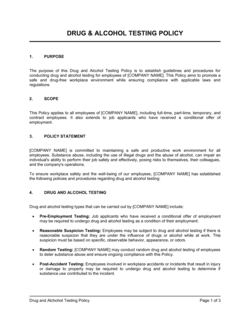
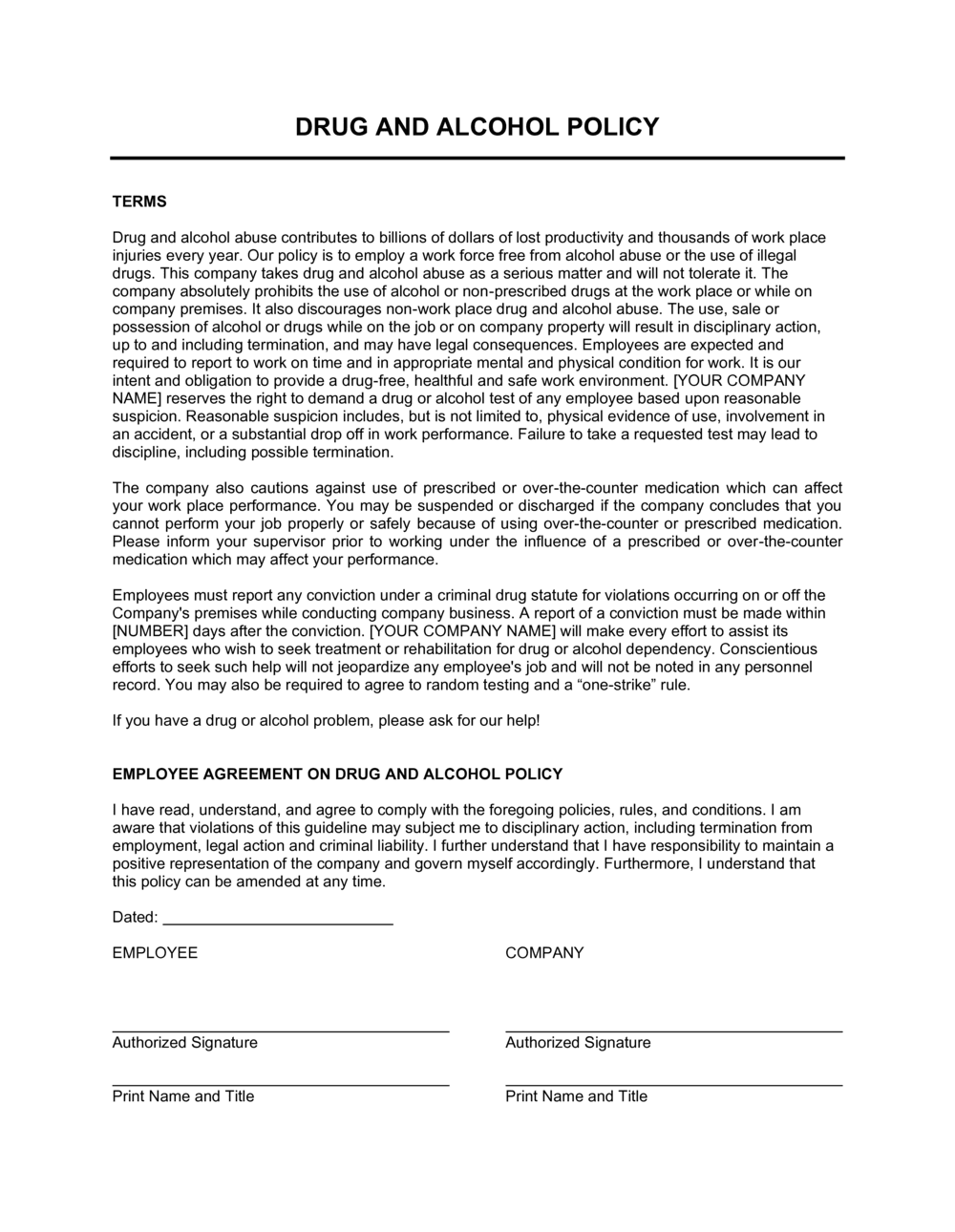
A Drug and Alcohol Policy is a formal written document that defines an employer's rules regarding the use, possession, and testing of drugs and alcohol in the workplace. This free Word download gives you a structured, ready-to-edit template covering prohibited conduct, testing procedures, employee assistance programs, and disciplinary consequences β€” exportable as PDF for immediate distribution to staff.
When you need it
Use it when onboarding new employees, updating your employee handbook, responding to a workplace incident involving substance use, or meeting compliance requirements for government contracts or safety-sensitive industries.
What's inside
Purpose and scope, definitions of prohibited conduct, testing procedures and circumstances, prescription medication protocols, employee assistance program references, manager responsibilities, disciplinary actions, and employee acknowledgment.

What is a Drug and Alcohol Policy?

A Drug and Alcohol Policy is a formal workplace document that defines an employer's rules regarding the use, possession, sale, and testing of drugs and alcohol β€” on company premises, during work hours, and in any situation where impairment could affect job performance or safety. It establishes the circumstances under which testing will occur, the procedures employees and managers must follow, the support resources available, and the disciplinary consequences for confirmed violations. A well-structured policy functions as both a safety management tool and a legal compliance document, giving employers a defensible framework for consistent enforcement.

Why You Need This Document

Without a written drug and alcohol policy, employers have no consistent basis for testing, disciplining, or terminating employees involved in substance-related incidents β€” and any action taken is exposed to legal challenge. Federal law requires a written policy for government contractors and DOT-regulated employers; for everyone else, the absence of one creates liability the moment a workplace accident, injury, or incident occurs. Courts and regulators consistently look for three things when evaluating employer conduct: a written policy that was communicated to employees, a signed acknowledgment confirming receipt, and consistent enforcement. This template gives you all three starting points in a single, editable Word document β€” ready to customize for your workforce and distribute on day one.

Which variant fits your situation?

If your situation is…Use this template
DOT-regulated employer with drivers, pilots, or rail workersDOT Drug and Alcohol Policy
Federal contractor required to maintain a drug-free workplace programDrug-Free Workplace Policy (Federal Contractor)
General office environment with a zero-tolerance standardDrug And Alcohol Policy
Construction or manufacturing site with safety-sensitive rolesSafety-Sensitive Drug Testing Policy
Healthcare facility with licensed professional staffHealthcare Substance Abuse Policy
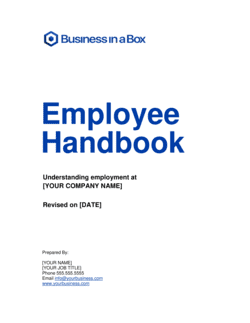
Policy embedded within a broader employee handbookEmployee Handbook
Post-incident or reasonable-suspicion testing framework onlyDrug Testing Consent Form

Common mistakes to avoid

❌ Excluding contractors and temporary workers from scope

Why it matters: Contractors and temps on company premises can cause the same safety incidents as direct employees. Excluding them creates a coverage gap that regulators and courts notice.

Fix: Explicitly name every worker category in the scope section and require staffing agencies to confirm their workers have acknowledged the policy before arriving on site.

❌ No documented random-selection process

Why it matters: Random testing programs that lack a verifiable, consistent selection methodology have been successfully challenged in court as pretextual, voiding the entire testing program.

Fix: Use a third-party random-selection service or a documented internal draw process with a written record of each selection cycle.

❌ Requiring disclosure of the specific prescription medication

Why it matters: Asking employees to name their medication or diagnosis creates ADA and HIPAA exposure. The employer has no legitimate need for the specific drug name β€” only the impairment risk.

Fix: Reframe the disclosure requirement as: 'Notify your supervisor or HR if you are taking any medication that your prescribing physician has advised may impair your ability to safely perform your duties.'

❌ Blanket zero-tolerance termination for all first-time violations

Why it matters: Employees with a substance use disorder may qualify as having a disability under the ADA. Terminating without offering rehabilitation or reasonable accommodation can result in an ADA discrimination claim.

Fix: Build a graduated response into the disciplinary section: mandatory EAP assessment and rehabilitation for a first violation, with termination reserved for a second violation or for sale or distribution.

❌ Omitting the employee acknowledgment form

Why it matters: Without a signed acknowledgment, the employer cannot prove the employee was ever informed of the policy, which makes any disciplinary action based on it vulnerable to challenge.

Fix: Attach a separate acknowledgment page to the policy, collect signatures at onboarding and at each policy update, and store copies in at least two locations.

❌ Failing to update the policy when laws change

Why it matters: Cannabis legalization in multiple US states has created conflicts between state employment law and federal drug-free workplace requirements that outdated policies fail to address.

Fix: Review the policy annually with HR or an employment law resource. Add a cannabis-specific provision that distinguishes between federally regulated roles and non-safety-sensitive positions.

The 9 key sections, explained

Purpose and scope

Prohibited conduct

Testing circumstances and procedures

Alcohol-specific rules

Prescription and over-the-counter medications

Employee assistance program (EAP)

Manager and supervisor responsibilities

Disciplinary consequences

Employee acknowledgment

How to fill it out

  1. 1

    Define the scope and covered workforce

    Identify every category of worker the policy applies to β€” full-time, part-time, temporary, contract, and volunteer. List all company locations and worksites where the policy is in effect.

    πŸ’‘ If your company uses staffing agencies, confirm whether agency workers are covered by your policy or the agency's. Gaps here create liability when an agency worker causes an incident.

  2. 2

    List all prohibited conduct with specific language

    Draft each prohibited behavior as a clear, concrete statement β€” possession, use, distribution, being under the influence. Address both on-duty and off-duty use that impairs on-duty performance.

    πŸ’‘ Avoid the word 'impairment' without defining it. Reference observable behaviors β€” slurred speech, unsteady movement, odor of alcohol β€” so supervisors know exactly what to document.

  3. 3

    Specify every testing circumstance

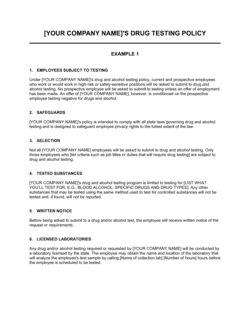
    List the exact conditions that trigger testing: pre-employment, random, reasonable suspicion, post-accident, return-to-duty, and follow-up. For each, describe the collection method and turnaround time.

    πŸ’‘ If you test randomly, document the randomization process β€” a third-party random-selection service is the cleanest approach and is easiest to defend legally.

  4. 4

    Set BAC thresholds and prescription medication rules

    State the specific BAC level at which an employee is considered in violation. Add a prescription medication section requiring employees to report any medication that may impair safe performance β€” without requiring disclosure of the diagnosis.

    πŸ’‘ For safety-sensitive roles regulated by DOT, use the 0.04 BAC threshold exactly. Deviating from the regulatory standard β€” even to be stricter β€” can create compliance problems.

  5. 5

    Document the EAP referral and voluntary disclosure process

    Name your EAP provider, include contact information, and state clearly whether voluntary self-referral before a violation is discovered protects the employee from automatic discipline.

    πŸ’‘ A credible EAP provision reduces legal risk and demonstrates good faith to regulators. If you do not have a formal EAP, list community resources and a confidential HR contact as a minimum.

  6. 6

    Outline disciplinary consequences in a graduated scale

    Specify the penalty for a first confirmed violation, a second violation, and any categories β€” sale, distribution, or safety-sensitive role violations β€” that trigger immediate termination.

    πŸ’‘ Before finalizing the disciplinary scale, have HR confirm whether any employees are in ADA-protected roles where a rehabilitation opportunity must be offered before termination.

  7. 7

    Collect signed employee acknowledgments

    Distribute the policy to all current employees and collect signed acknowledgment forms. For new hires, include the acknowledgment in the onboarding packet and obtain signature before the first day.

    πŸ’‘ Store signed acknowledgments in both the employee's personnel file and a separate HR compliance folder. A two-location backup protects you if a physical file is lost.

  8. 8

    Train managers on reasonable-suspicion procedures

    Provide supervisors with the documentation form, a list of observable behavioral indicators, and a clear protocol for contacting HR before acting. Conduct a 30-minute walkthrough annually.

    πŸ’‘ Untrained supervisors are the most common point of failure in drug and alcohol programs. One inconsistently applied reasonable-suspicion test can expose the company to a discrimination claim.

Frequently asked questions

What is a drug and alcohol policy?

A drug and alcohol policy is a formal written document that sets an employer's rules regarding the use, possession, testing, and consequences related to drugs and alcohol in the workplace. It defines prohibited conduct, outlines when and how testing will occur, describes available employee assistance resources, and states the disciplinary consequences for violations. It is a core component of a workplace safety and compliance program.

Is a drug and alcohol policy legally required?

Federal law requires a drug-free workplace policy for federal contractors receiving grants of $25,000 or more under the Drug-Free Workplace Act of 1988. DOT-regulated employers β€” including trucking, aviation, and rail companies β€” must maintain written policies and testing programs under federal regulations. For non-regulated private employers, a written policy is not universally mandated but is strongly recommended as a liability management measure.

Can an employer test employees for drugs and alcohol?

In most US states and Canadian provinces, employers may conduct drug and alcohol testing for pre-employment, post-accident, reasonable suspicion, and random circumstances β€” provided a written policy authorizing testing is in place and employees have been notified. Some states restrict or ban random testing for non-safety-sensitive roles. Employers in safety-sensitive, DOT-regulated industries are required to test under federal regulations regardless of state law.

How should a drug and alcohol policy address cannabis?

Cannabis legalization at the state level has created complexity for employers. Federal contractors and DOT-regulated employers must still prohibit cannabis use regardless of state law. Non-regulated employers in states where cannabis is legal should distinguish between safety-sensitive and non-safety-sensitive roles, focus on on-duty impairment rather than off-duty use, and consider whether pre-employment THC testing is consistent with their hiring goals. Reviewing the policy annually with an employment law resource is advisable as laws continue to change.

What happens if an employee tests positive?

A positive result should be reviewed by a Medical Review Officer before any disciplinary action is taken. If confirmed, most policies follow a graduated response: a first violation typically results in mandatory EAP referral, a suspension, and return-to-duty testing before reinstatement. A second violation commonly results in termination. Employees in safety-sensitive roles or those found selling or distributing substances on company premises typically face immediate termination on a first offense.

Do employees have privacy rights during drug testing?

Employees retain some privacy rights during testing. Observed urine collection β€” where a same-gender monitor watches the collection β€” requires specific justification such as prior tampering. Medical information generated by testing must be kept confidential and separate from the general personnel file. Employers should use a certified laboratory and a Medical Review Officer to ensure both accuracy and privacy compliance.

What should a supervisor do if they suspect an employee is impaired?

The supervisor should document specific, objective observations in writing β€” unusual behavior, physical signs, smell, or statements made by the employee. They should consult HR before taking any action, remove the employee from safety-sensitive duties immediately, and arrange safe transportation home if the employee cannot safely drive. The supervisor should not accuse the employee of drug or alcohol use; they should describe observed behavior and defer to HR and the testing process for the conclusion.

How often should a drug and alcohol policy be updated?

Review the policy at least once a year, and immediately following any change in applicable federal or state law β€” particularly around cannabis legalization, testing requirements, or ADA accommodation guidance. Policies that are more than two years old without review may contain provisions that conflict with current law, creating compliance and litigation risk.

Should the policy be included in the employee handbook?

Yes, including the drug and alcohol policy in the employee handbook ensures all staff receive it during onboarding and creates a consistent record of distribution. The policy can also stand alone as a separate document, which makes it easier to update without reissuing the entire handbook. Whichever approach you use, collect a signed acknowledgment from each employee confirming receipt.

How this compares to alternatives

vs Employee Handbook

An employee handbook is a comprehensive reference document covering all workplace policies β€” attendance, conduct, benefits, and more. A drug and alcohol policy is a standalone document focused exclusively on substance use rules, testing, and consequences. The drug policy is typically embedded in the handbook but must be detailed enough to stand alone for compliance purposes.

vs Drug Testing Consent Form

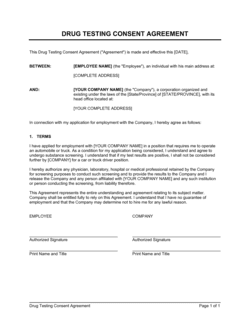
A drug testing consent form is a single-purpose document an employee signs before a specific test, authorizing the collection and analysis of a biological specimen. A drug and alcohol policy is the governing framework that explains when testing occurs, what the consequences are, and what support is available. The consent form operationalizes one step of the policy.

vs Code of Conduct

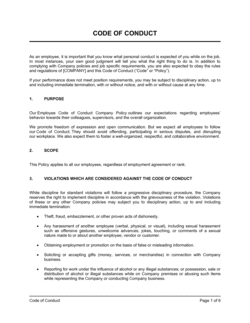
A code of conduct establishes broad professional and ethical behavioral standards across all aspects of employment. A drug and alcohol policy is a specific, operationally detailed document focused on substance use, testing logistics, and disciplinary consequences. Both belong in an employee handbook, but they serve different purposes and should remain separate documents.

vs Disciplinary Action Form

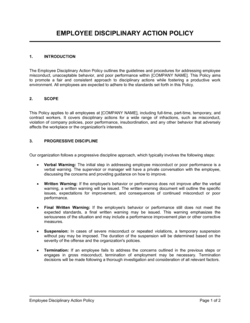
A disciplinary action form documents a specific policy violation and the employer's response after the fact. A drug and alcohol policy is the preventive framework that defines what conduct is prohibited and what consequences will follow before any violation occurs. The disciplinary form is used to execute the consequences the policy prescribes.

Industry-specific considerations

Transportation and logistics

DOT regulations mandate written policies, random testing at specific annual rates, and MRO review for all covered drivers and operators.

Construction

High injury risk from heavy equipment and heights makes zero-tolerance for on-site impairment the industry norm; post-accident testing is standard on most job sites.

Healthcare

State licensing boards often require healthcare facilities to have substance abuse policies covering licensed staff, with mandatory reporting obligations for confirmed violations.

Manufacturing

Safety-sensitive machinery operation means random and post-accident testing programs are common, with immediate removal from the production floor as a standard first response to suspected impairment.

Template vs pro β€” what fits your needs?

PathBest forCostTime
Use the templateNon-regulated private employers establishing a baseline workplace substance use policyFree1–2 hours to customize
Template + professional reviewEmployers in safety-sensitive industries, DOT-regulated businesses, or jurisdictions with cannabis-specific employment law$300–$800 for an HR consultant or employment attorney review3–5 business days
Custom draftedFederal contractors, multi-state employers with complex testing programs, or companies with prior litigation involving substance-related incidents$1,000–$3,500+ for a custom employment law firm draft1–3 weeks

Glossary

Drug-Free Workplace
A work environment where the employer has established written policies and programs prohibiting the use, possession, and distribution of controlled substances.
Reasonable Suspicion Testing
Drug or alcohol testing triggered by a supervisor's documented, objective observations of behavior, appearance, or conduct suggesting impairment.
Pre-Employment Testing
Drug screening conducted after a conditional job offer is made and before the candidate's first day of work.
Post-Accident Testing
Drug and alcohol testing required following a workplace accident or safety incident to determine whether impairment was a contributing factor.
Chain of Custody
The documented process that tracks a biological specimen from collection through laboratory analysis, ensuring the sample has not been tampered with.
MRO (Medical Review Officer)
A licensed physician responsible for reviewing and interpreting drug test results, including evaluating legitimate medical explanations for positive results.
EAP (Employee Assistance Program)
An employer-sponsored confidential counseling and referral service that helps employees address substance abuse, mental health, and other personal problems.
Safety-Sensitive Position
A job role where impairment could directly cause or contribute to a workplace accident, injury, or death β€” including drivers, equipment operators, and healthcare workers.
Zero-Tolerance Policy
A disciplinary standard under which any confirmed positive test or confirmed policy violation results in immediate termination, with no graduated response.
Return-to-Duty Testing
Drug or alcohol testing required before an employee who violated the policy may resume work, typically following completion of a rehabilitation program.

Part of your Business Operating System

This document is one of 3,000+ business & legal templates included in Business in a Box.

  • Fill-in-the-blanks β€” ready in minutes
  • 100% customizable Word document
  • Compatible with all office suites
  • Export to PDF and share electronically

Create your document in 3 simple steps.

From template to signed document β€” all inside one Business Operating System.
1
Download or open template

Access over 3,000+ business and legal templates for any business task, project or initiative.

2
Edit and fill in the blanks with AI

Customize your ready-made business document template and save it in the cloud.

3
Save, Share, Send, Sign

Share your files and folders with your team. Create a space of seamless collaboration.

Save time, save money, and create top-quality documents.

β˜…β˜…β˜…β˜…β˜…

"Fantastic value! I'm not sure how I'd do without it. It's worth its weight in gold and paid back for itself many times."

Managing Director Β· Mall Farm
Robert Whalley
Managing Director, Mall Farm Proprietary Limited
β˜…β˜…β˜…β˜…β˜…

"I have been using Business in a Box for years. It has been the most useful source of templates I have encountered. I recommend it to anyone."

Business Owner Β· 4+ years
Dr Michael John Freestone
Business Owner
β˜…β˜…β˜…β˜…β˜…

"It has been a life saver so many times I have lost count. Business in a Box has saved me so much time and as you know, time is money."

Owner Β· Upstate Web
David G. Moore Jr.
Owner, Upstate Web

Run your business with a system β€” not scattered tools

Stop downloading documents. Start operating with clarity. Business in a Box gives you the Business Operating System used by over 250,000 companies worldwide to structure, run, and grow their business.

Free Forever PlanΒ Β·Β No credit card required