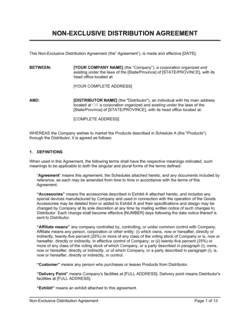
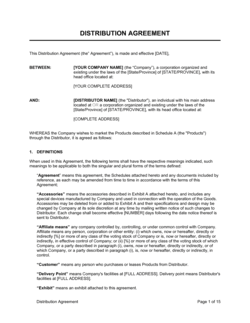
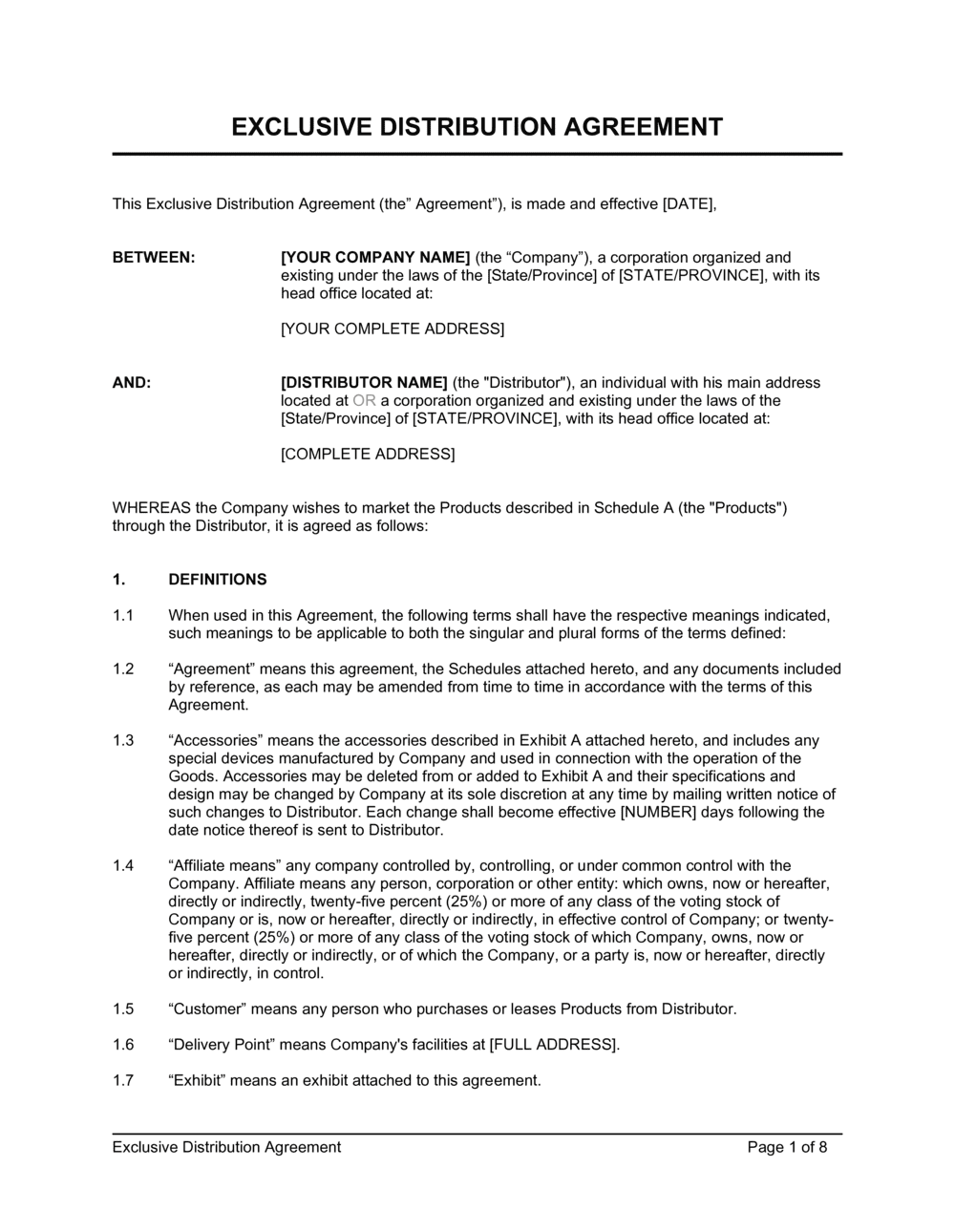
Exclusive Distribution Agreement Template

Free Word download • Edit online • Save & share with Drive • Export to PDF

8 pages30–40 min to fillDifficulty: ComplexSignature requiredLegal review recommended
Learn more ↓
FreeExclusive Distribution Agreement Template

At a glance

What it is
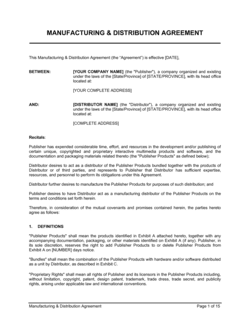
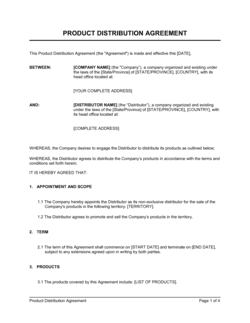
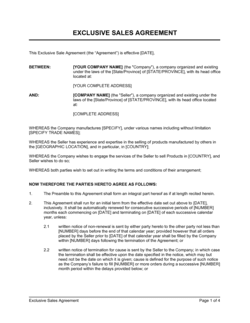
An Exclusive Distribution Agreement is a legally binding contract between a supplier (or manufacturer) and a distributor that grants the distributor the sole right to sell specified products within a defined territory for a set period. This free Word download covers territory scope, product definitions, minimum purchase obligations, pricing, IP licensing, and termination in a single ready-to-edit document you can export as PDF and execute immediately.
When you need it
Use it whenever you appoint a single distributor to represent your products in a new region, country, or channel — and you need that exclusivity arrangement to be enforceable in writing. It is equally essential for distributors who want to confirm that the supplier cannot undercut them by selling directly or appointing competing distributors in the same territory.
What's inside
Territory and product definitions, grant of exclusivity, minimum purchase commitments, pricing and payment terms, IP and trademark licensing, marketing obligations, confidentiality, term and renewal, termination triggers, and governing law with dispute resolution.

What is an Exclusive Distribution Agreement?

An Exclusive Distribution Agreement is a legally binding contract in which a supplier or manufacturer grants a single distributor the sole right to sell specified products within a defined territory for a set period. Unlike a general sales contract, it creates a bilateral commitment: the distributor agrees to actively develop the market — typically through minimum purchase obligations and marketing investment — while the supplier agrees not to appoint competing distributors or sell direct in the same territory. The result is a structured commercial relationship that gives the distributor the certainty needed to invest in infrastructure while giving the supplier a committed, accountable sales partner in each region.

Why You Need This Document

Operating a distribution relationship on a handshake or a simple purchase-order history leaves both parties exposed. A supplier who appoints a distributor verbally and later sells direct — or appoints a second distributor in the same region — faces a breach-of-contract claim with no written terms to limit liability or define the remedy. A distributor who builds a warehouse, hires a sales team, and develops a market without a signed exclusivity agreement has no legal protection against the supplier switching to a direct model the moment the territory becomes profitable. Beyond the exclusivity mechanics, this agreement governs what happens when the relationship ends: who owns unsold inventory, what notice is required, and whether the distributor's customer list belongs to the distributor or the supplier. A signed Exclusive Distribution Agreement, reviewed against the applicable competition law framework before execution, eliminates all four of those exposures for the cost of a single legal review.

Which variant fits your situation?

If your situation is…Use this template
Granting one distributor exclusive rights in a single territoryExclusive Distribution Agreement
Allowing multiple distributors to sell in the same region without exclusivityNon-Exclusive Distribution Agreement
Appointing a representative to find buyers but not take title to goodsSales Agency Agreement
Permitting a distributor to resell software or SaaS productsSoftware Reseller Agreement
Granting rights across multiple tiers — distributor resells to sub-distributorsMaster Distribution Agreement
Short-term or pilot distribution arrangement with defined evaluation periodDistribution Letter of Intent
Combining distribution rights with a co-branding or white-label arrangementWhite Label Distribution Agreement

Common mistakes to avoid

❌ Vague or regional territory definitions

Why it matters: Territorial ambiguity is the leading cause of distribution agreement disputes. If the contract says 'Asia' rather than listing specific countries, both parties will interpret the boundaries differently the moment a cross-border order arrives.

Fix: List every country in the territory explicitly in the body of the agreement or in a dedicated Schedule. If the territory changes over time, include a mechanism for written amendments to the schedule.

❌ MPOs without defined consequences

Why it matters: A minimum purchase obligation that carries no stated remedy is a target, not an obligation. A distributor who misses it can argue the supplier's only recourse is to sue for damages — a costly and uncertain remedy.

Fix: Draft a tiered consequence clause: cure period, then conversion to non-exclusive, then right to terminate. Include the consequence language in the same clause as the MPO, not in a separate general remedies section.

❌ No carve-out clause for existing or key accounts

Why it matters: If the supplier already sells direct to major customers in the exclusive territory — or intends to — an exclusive grant with no carve-out means those sales are technically a breach of the agreement.

Fix: List any pre-existing direct customers or reserved channels in Schedule C before signing. Both parties should initial the schedule to confirm they reviewed it.

❌ Granting IP rights with no usage guidelines

Why it matters: Distributors operating without brand guidelines create unauthorized marketing materials, make unsupported product claims, or modify logos — each of which can create trademark dilution or product liability exposure for the supplier.

Fix: Attach a Brand Usage Guidelines document as a schedule and require the distributor's written approval from the supplier for any marketing material before publication.

❌ No residual stock clause on termination

Why it matters: A distributor holding six months of inventory at termination has no obligation to return it — and may sell it at clearance prices, undercut new distribution channels, or simply hold it indefinitely.

Fix: Include a residual stock clause specifying whether the supplier will repurchase unsold inventory (at cost or a stated percentage), the sell-down period allowed, and any restrictions on how the distributor may clear remaining stock.

❌ Auto-renewal without a notice floor

Why it matters: Automatic renewal clauses that require only 30 days' notice to prevent renewal are routinely missed — resulting in parties being locked into a renewed term neither intended. Courts in several jurisdictions will enforce a renewed term even if the party objecting claims the notice requirement was unreasonable.

Fix: Set auto-renewal notice periods at 90 days minimum and calendar the deadline in your operations system the moment the agreement is signed. Consider adding a mutual-confirmation mechanism requiring both parties to affirmatively renew.

The 10 key clauses, explained

Parties, Recitals, and Defined Terms

In plain language: Identifies the supplier and distributor by their full legal entity names and registered addresses, states the background context for the agreement, and defines all capitalized terms used throughout.

Sample language
This Exclusive Distribution Agreement ('Agreement') is entered into as of [DATE] by and between [SUPPLIER LEGAL NAME], a [STATE/COUNTRY] [ENTITY TYPE] ('Supplier'), and [DISTRIBUTOR LEGAL NAME], a [STATE/COUNTRY] [ENTITY TYPE] ('Distributor').

Common mistake: Using a trading name instead of the registered legal entity name. If the signing entity and the contracting entity differ, the agreement may be unenforceable against the intended party.

Grant of Exclusivity and Territory

In plain language: States that the supplier appoints the distributor as its sole authorized reseller within a precisely defined territory and confirms that no other distributor will be appointed and the supplier will not sell directly within that territory.

Sample language
Supplier hereby grants to Distributor the exclusive right to market, promote, sell, and distribute the Products within [TERRITORY] ('Exclusive Territory'). Supplier shall not, during the Term, appoint any other distributor or agent, or sell the Products directly to customers, within the Exclusive Territory, except as set forth in Schedule C (Carve-Outs).

Common mistake: Defining the territory by region name alone (e.g., 'Southeast Asia') without listing specific countries. Vague territorial definitions create disputes when a customer in an unlisted country places an order.

Product Scope

In plain language: Lists the specific products covered by the exclusivity grant and reserves the supplier's right to add, modify, or discontinue products with notice.

Sample language
The exclusivity granted herein applies solely to the products listed in Schedule A ('Products'). Supplier may add or remove Products from Schedule A with [30] days' written notice. Products not listed in Schedule A remain outside the scope of this Agreement.

Common mistake: Leaving the product schedule blank or using a generic category description. Broad product definitions allow distributors to claim exclusivity over entire product lines the supplier never intended to include.

Minimum Purchase Obligations

In plain language: Sets the minimum quantity or dollar value of products the distributor must order per contract year to maintain exclusivity, and states what happens if the threshold is missed.

Sample language
Distributor shall purchase no less than [QUANTITY / $AMOUNT] of Products per calendar year ('MPO'). Failure to meet the MPO in any year shall entitle Supplier, at its sole discretion, to (a) convert the appointment to non-exclusive, (b) reduce the Exclusive Territory, or (c) terminate this Agreement on [60] days' notice.

Common mistake: Setting MPOs as aspirational targets rather than binding obligations with stated consequences. An MPO without a defined remedy is unenforceable and provides no protection against a passive distributor.

Pricing, Payment Terms, and Invoicing

In plain language: Establishes the transfer price at which the supplier sells to the distributor, the payment timeline, acceptable currencies, and late-payment interest.

Sample language
Supplier shall sell Products to Distributor at the prices set out in Schedule B, which may be updated by Supplier on [90] days' written notice. Payment terms: net [30] days from invoice date. Overdue balances shall accrue interest at [1.5]% per month.

Common mistake: Not specifying whether the supplier can unilaterally change transfer prices and on what notice. Without this, a price increase mid-term may be treated as a contract modification requiring distributor consent.

Marketing, Promotional, and Reporting Obligations

In plain language: Defines each party's obligations to fund and execute marketing activities within the territory, and requires the distributor to submit periodic sales reports.

Sample language
Distributor shall devote commercially reasonable efforts to promote the Products in the Exclusive Territory, maintain a trained sales team of no fewer than [X] representatives, and submit quarterly sales reports to Supplier by the [15th] day following each calendar quarter.

Common mistake: Vague 'best efforts' or 'commercially reasonable efforts' language without any measurable indicator. Courts apply these standards inconsistently — attach specific KPIs or a minimum activity schedule to create an enforceable benchmark.

Intellectual Property and Trademark License

In plain language: Grants the distributor a limited, non-transferable license to use the supplier's trademarks, logos, and marketing materials solely to promote the products within the exclusive territory.

Sample language
Supplier grants Distributor a limited, non-exclusive, non-sublicensable license to use Supplier's Marks solely in connection with the promotion and sale of Products within the Exclusive Territory and in accordance with Supplier's Brand Guidelines. All goodwill generated by such use shall inure to Supplier.

Common mistake: Granting IP rights without referencing brand guidelines or usage restrictions. Distributors operating without guidelines can create unauthorized marketing materials, dilute trademarks, or cause brand inconsistency that damages the supplier's global reputation.

Confidentiality

In plain language: Requires both parties to protect the other's confidential business information — pricing, customer data, product roadmaps, and business strategies — during and after the term.

Sample language
Each party shall hold the other's Confidential Information in strict confidence and shall not disclose it to any third party or use it for any purpose other than performing its obligations under this Agreement. This obligation survives termination for [3] years.

Common mistake: Failing to specify a post-termination survival period. Without it, confidentiality obligations may lapse the moment the contract ends, leaving pricing and customer data unprotected precisely when a distributor is most likely to act as a competitor.

Term, Renewal, and Termination

In plain language: Defines the initial contract period, automatic or optional renewal mechanisms, notice required to terminate for convenience or cause, and the consequences of termination including residual stock handling.

Sample language
This Agreement commences on [START DATE] and continues for an initial term of [2] years ('Initial Term'), renewing automatically for successive [1]-year periods unless either party provides [90] days' written notice of non-renewal. Either party may terminate for material breach with [30] days' written notice if the breach is not cured within that period.

Common mistake: Omitting a residual stock clause. When a distributor holds significant inventory at termination, failure to address repurchase obligations or sell-down periods creates disputes that outlast the contract by years.

Governing Law, Dispute Resolution, and Notices

In plain language: Specifies which jurisdiction's law governs the agreement, whether disputes go to arbitration or court, and the format and address for formal notices.

Sample language
This Agreement is governed by the laws of [STATE/COUNTRY], without regard to conflicts-of-law principles. Any dispute shall be resolved by binding arbitration under [ICC/AAA/LCIA] rules in [CITY]. Notices shall be in writing and delivered by email with read receipt or courier to the addresses in the preamble.

Common mistake: Choosing a governing law with no connection to where either party operates. Courts in the distributor's jurisdiction may refuse to apply the chosen law to mandatory local provisions — particularly around termination notice and indemnity rights — regardless of what the contract states.

How to fill it out

  1. 1

    Identify both parties by their full legal entity names

    Enter the registered legal names and principal business addresses of the supplier and distributor in the preamble. Confirm entity types — LLC, corporation, Ltd — and jurisdictions of formation.

    💡 Request a copy of each party's certificate of incorporation or business registration before executing to verify legal names match exactly.

  2. 2

    Define the exclusive territory with precision

    List specific countries, states, provinces, or named market segments covered by the exclusivity. If carve-outs exist — such as key accounts the supplier retains — list them in Schedule C at this stage.

    💡 Ambiguous territory definitions are the single most litigated clause in distribution agreements. If in doubt, list countries individually rather than using regional groupings.

  3. 3

    Populate Schedule A with a specific product list

    List every SKU, product line, or product category covered by the exclusivity grant. Note any products the supplier sells that are explicitly excluded from the agreement.

    💡 Add a version date to Schedule A so both parties can confirm which version was in effect at any given point if a dispute arises.

  4. 4

    Set minimum purchase obligations with consequences

    Enter annual MPOs in units or dollar value. Choose the remedy for non-achievement: conversion to non-exclusive, territory reduction, or termination for cause. Include a cure period — typically 60 days — before the remedy triggers.

    💡 Negotiate MPOs against the distributor's projected sales plan. Setting them too high encourages stock-dumping at discount; too low removes any incentive to invest in market development.

  5. 5

    Complete Schedule B with transfer pricing and payment terms

    List the supplier's transfer prices per SKU or product line, state the invoicing currency, and confirm net payment terms and late-fee rates. Note the notice period required before the supplier can revise pricing.

    💡 For multi-currency arrangements, specify which party bears foreign-exchange risk and whether a reference exchange rate applies.

  6. 6

    Define marketing obligations and reporting cadence

    Specify minimum marketing spend, required sales force size, approved channels, and the format and frequency of sales reports the distributor must provide.

    💡 Attach a first-year business plan as Schedule D — it functions as the distributor's marketing commitment and gives the supplier a baseline against which to measure performance.

  7. 7

    Tailor the term, renewal, and termination mechanics

    Set the initial term, renewal period, and notice required for non-renewal or termination for convenience. Add a residual stock clause specifying whether the supplier must repurchase unsold inventory at cost, at a discount, or not at all.

    💡 A 90-day non-renewal notice period is standard for mid-size distribution arrangements; 180 days is appropriate when the distributor has made significant capital investment in warehousing or tooling.

  8. 8

    Choose governing law and dispute resolution mechanism

    Select a governing law that has a genuine connection to one of the parties' operating jurisdictions. Choose arbitration for cross-border arrangements to avoid enforceability issues with foreign court judgments.

    💡 For EU distributors, note that certain EU member states' mandatory agency and distribution law applies regardless of the governing law clause — confirm with local counsel before finalizing.

Frequently asked questions

What is an exclusive distribution agreement?

An exclusive distribution agreement is a binding contract in which a supplier grants a single distributor the sole right to sell specified products within a defined territory for a stated period. In exchange, the distributor typically commits to minimum purchase volumes, active marketing, and regular sales reporting. The agreement prevents the supplier from appointing competing distributors or selling directly in the territory, and gives the distributor the commercial certainty needed to invest in market development.

What is the difference between an exclusive and a non-exclusive distribution agreement?

An exclusive agreement prohibits the supplier from appointing other distributors or selling directly in the defined territory during the term. A non-exclusive agreement allows the supplier to appoint multiple distributors or sell direct in the same region simultaneously. Exclusive arrangements justify greater distributor investment in marketing and infrastructure but require the supplier to accept reduced flexibility. Non-exclusive arrangements suit suppliers who want broad market coverage without committing to a single partner.

What should an exclusive distribution agreement include?

At minimum: full legal names of both parties, a precise territory definition, a specific product schedule, the grant of exclusivity language, minimum purchase obligations with stated consequences, transfer pricing and payment terms, IP and trademark license, marketing and reporting obligations, confidentiality provisions, term and renewal mechanics, termination triggers, a residual stock clause, and governing law with dispute resolution. Missing any of these creates gaps that courts will fill using jurisdiction-specific defaults — often unfavorable to the supplier.

What happens if the distributor fails to meet minimum purchase obligations?

If the agreement includes a properly drafted MPO clause with stated consequences, the supplier may convert the arrangement to non-exclusive, reduce the territory, or terminate the agreement after a cure period — typically 30 to 60 days. Without a stated remedy, the supplier's options are limited to a breach-of-contract claim, which requires proving damages. Well-drafted MPO clauses specify the consequence, the cure period, and the notice required to trigger each remedy, making enforcement straightforward.

Can a supplier sell directly to customers in the exclusive territory?

Under a properly drafted exclusivity grant, no — the supplier commits not to sell direct or appoint competing distributors within the exclusive territory during the term. However, carve-outs are common: suppliers often reserve the right to sell to pre-existing key accounts, government customers, or e-commerce customers ordering directly through the supplier's website. Any such carve-outs must be listed explicitly in the agreement before signing.

How long should an exclusive distribution agreement last?

Initial terms of one to three years are most common for new distribution relationships. Longer terms — three to five years — are appropriate when the distributor is making significant capital investment in warehousing, tooling, or a dedicated sales force. Agreements typically auto-renew for one-year periods unless either party provides 90 to 180 days' notice of non-renewal. Tying the initial term length to the distributor's expected payback period for upfront investment is a practical benchmark.

Do I need a lawyer to draft an exclusive distribution agreement?

For domestic arrangements with straightforward territories and standard payment terms, a high-quality template is a strong starting point. Legal review is strongly recommended when the territory spans multiple countries with different mandatory distribution laws, when the distributor is making a material capital investment, when market shares approach competition law thresholds, or when the agreement involves significant IP licensing. A one-to-two-hour review typically costs $400–$800 and is worthwhile for any arrangement expected to generate more than $250,000 in annual trade.

What are the most common reasons exclusive distribution agreements are terminated?

The four most frequent termination triggers are: failure to meet minimum purchase obligations, the distributor's insolvency or change of control, material breach of the exclusivity arrangement (such as selling outside the territory or appointing sub-distributors without consent), and the supplier's strategic decision to establish a direct sales operation in the territory. A well-drafted agreement should address each of these scenarios explicitly, including the notice period, cure rights, and residual stock obligations that apply to each termination trigger.

How this compares to alternatives

vs Non-Exclusive Distribution Agreement

A non-exclusive agreement permits the supplier to appoint multiple distributors or sell direct in the same territory simultaneously. It offers the supplier greater flexibility but gives the distributor no competitive protection and typically results in lower distributor investment in market development. Use a non-exclusive agreement when market coverage and speed are the priorities; use an exclusive agreement when distributor investment and relationship depth matter more.

vs Sales Agency Agreement

A sales agency agreement appoints an agent to solicit orders on the supplier's behalf — the agent never takes title to goods and earns a commission on sales. An exclusive distribution agreement transfers title to the distributor, who buys and resells products at their own risk. The distinction has significant legal consequences: agents in the EU and Canada are protected by mandatory agency law entitling them to compensation on termination; distributors generally are not.

vs Master Distribution Agreement

A master distribution agreement grants the distributor the right to appoint sub-distributors across a larger territory, creating a two-tier distribution structure. A standard exclusive distribution agreement governs a direct bilateral relationship with no sub-distribution right. Master agreements require additional clauses governing sub-distributor qualification, oversight, and liability — and are appropriate only where the master distributor has the infrastructure to manage a distribution network.

vs Franchise Agreement

A franchise agreement grants the franchisee the right to operate under the franchisor's brand and business system, with detailed operational standards, ongoing fees, and a deep IP license. An exclusive distribution agreement grants the right to resell products without mandating how the distributor runs its business. Franchise relationships involve significantly more control, compliance obligations, and regulatory disclosure requirements than distribution arrangements.

Industry-specific considerations

Consumer Goods and FMCG

Territory exclusivity tied to retail channel coverage metrics; sell-through obligations calibrated to Nielsen or Circana distribution benchmarks; promotional co-op fund mechanics embedded in the pricing schedule.

Manufacturing and Industrial Equipment

Distributor investment in demonstration equipment and trained service technicians as a condition of exclusivity; product liability and warranty pass-through provisions; spare parts stocking obligations.

Technology and Software Hardware

Exclusivity scoped by vertical market or named account list rather than geography; required certification programs for distributor sales and technical staff; software license pass-through terms for bundled products.

Food and Beverage

Cold-chain and shelf-life compliance obligations; regulatory import and customs coordination duties; sell-by date and recall cooperation provisions tied to supplier indemnification clauses.

Jurisdictional notes

United States

US federal and state antitrust law — including the Sherman Act and Robinson-Patman Act — applies to exclusive distribution arrangements. Vertical exclusivity is evaluated under the rule of reason; market share is a key factor. Several states, including California and New York, have specific franchise and dealer protection statutes that may apply to distribution relationships even when the word 'franchise' is not used. Resale price maintenance by agreement is per se illegal under federal law.

Canada

The Competition Act governs vertical restraints including exclusive dealing and tied selling. Exclusive arrangements are generally permitted but may be subject to review where the supplier has market power and the effect is to substantially lessen competition. Several provinces — including Ontario and Quebec — have Arthur Wishart Act-equivalent legislation and franchise disclosure laws that may apply to distribution arrangements with sufficient operational control elements. Quebec requires contracts to be available in French for commercially active parties in the province.

United Kingdom

Post-Brexit, the UK has adopted its own Vertical Agreements Block Exemption Order (VABEO), which mirrors the EU's VBER but applies independently to arrangements affecting UK trade. Exclusive distribution is permitted for suppliers with UK market share below 30%. The UK Competition and Markets Authority actively monitors distribution arrangements in consumer goods and technology sectors. Termination of long-standing distribution relationships may attract common-law claims for reasonable notice beyond any contractual period.

European Union

The EU Vertical Block Exemption Regulation (VBER), updated in June 2022, permits exclusive distribution where neither supplier nor distributor exceeds 30% market share, and the agreement does not contain hardcore restrictions — including absolute territorial protection, resale price maintenance, or restrictions on passive sales outside the territory. Commercial agents in EU member states are protected by the Commercial Agents Directive, entitling them to a compensation or indemnity payment on termination. Distributors (who take title) do not receive equivalent statutory protection, but national mandatory termination-notice laws in France, Belgium, and Spain may apply regardless of the governing law clause.

Template vs lawyer — what fits your deal?

PathBest forCostTime
Use the templateDomestic single-territory arrangements with standard payment terms and a distributor familiar with the product categoryFree30–60 minutes
Template + legal reviewCross-border arrangements, significant distributor capital investment, or territories in the EU where mandatory distribution law applies$400–$8002–5 days
Custom draftedMulti-country exclusivity, complex IP licensing, competition law thresholds above 20% market share, or enterprise-value distribution relationships$2,000–$8,000+2–4 weeks

Glossary

Exclusive Territory
The defined geographic area or market segment within which the distributor holds the sole right to sell the supplier's products.
Minimum Purchase Obligation (MPO)
A contractually required quantity or value of products the distributor must purchase within each contract period to retain exclusivity.
Grant of Exclusivity
The contractual clause in which the supplier formally agrees not to appoint other distributors or sell directly within the defined territory.
Resale Price Maintenance (RPM)
A practice where the supplier sets the minimum or fixed price at which the distributor may resell products — subject to competition law restrictions in most jurisdictions.
Sell-Through Obligation
A requirement that the distributor actively sell products to end customers at or above a specified rate, rather than warehousing them to satisfy MPO thresholds.
Carve-Out
An exception to the exclusivity grant that reserves certain customers, channels, or sub-territories for the supplier to serve directly.
Right of First Refusal
A clause giving the distributor the first opportunity to extend exclusivity or match a competing offer before the supplier appoints another distributor at contract end.
Termination for Convenience
A provision allowing either party to end the agreement without cause by giving a specified notice period — typically 90 to 180 days.
Residual Stock Obligation
A clause governing how unsold inventory held by the distributor is handled upon termination — whether the supplier must repurchase it and at what price.
Parallel Imports
Products sold by the supplier or other distributors outside the exclusive territory that enter and are resold within it, undermining the distributor's exclusivity.
Governing Law
The jurisdiction whose legal system and statutes apply to interpreting and enforcing the agreement — distinct from where each party is located or incorporated.

Part of your Business Operating System

This document is one of 3,000+ business & legal templates included in Business in a Box.

  • Fill-in-the-blanks — ready in minutes
  • 100% customizable Word document
  • Compatible with all office suites
  • Export to PDF and share electronically

Create your document in 3 simple steps.

From template to signed document — all inside one Business Operating System.
1
Download or open template

Access over 3,000+ business and legal templates for any business task, project or initiative.

2
Edit and fill in the blanks with AI

Customize your ready-made business document template and save it in the cloud.

3
Save, Share, Send, Sign

Share your files and folders with your team. Create a space of seamless collaboration.

Save time, save money, and create top-quality documents.

★★★★★

"Fantastic value! I'm not sure how I'd do without it. It's worth its weight in gold and paid back for itself many times."

Managing Director · Mall Farm
Robert Whalley
Managing Director, Mall Farm Proprietary Limited
★★★★★

"I have been using Business in a Box for years. It has been the most useful source of templates I have encountered. I recommend it to anyone."

Business Owner · 4+ years
Dr Michael John Freestone
Business Owner
★★★★★

"It has been a life saver so many times I have lost count. Business in a Box has saved me so much time and as you know, time is money."

Owner · Upstate Web
David G. Moore Jr.
Owner, Upstate Web

Run your business with a system — not scattered tools

Stop downloading documents. Start operating with clarity. Business in a Box gives you the Business Operating System used by over 250,000 companies worldwide to structure, run, and grow their business.

Start free · No credit card required