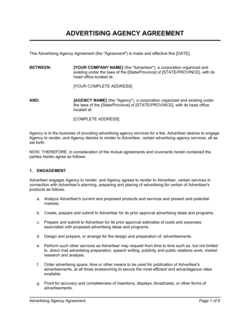
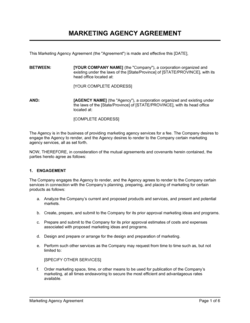
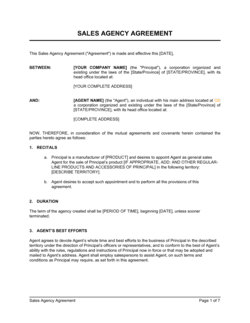
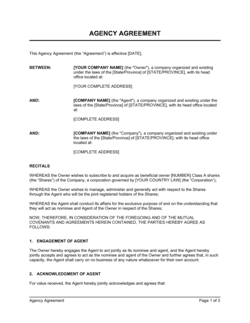
International Agent Agreement Template

Free Word download • Edit online • Save & share with Drive • Export to PDF

5 pages30–40 min to fillDifficulty: ComplexSignature requiredLegal review recommended
Learn more ↓
FreeInternational Agent Agreement Template

At a glance

What it is
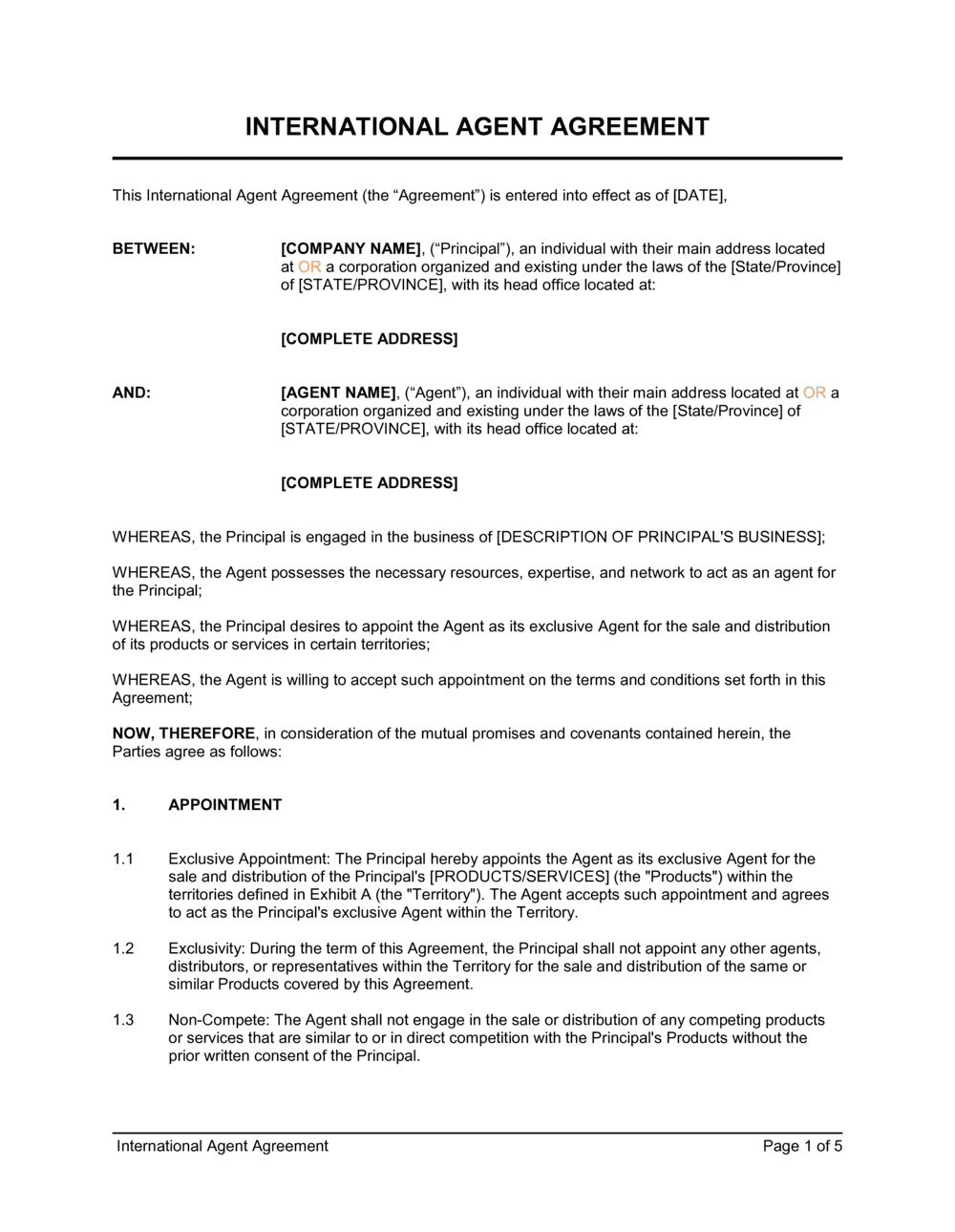
An International Agent Agreement is a legally binding contract between a principal (a company seeking to expand internationally) and an agent (an individual or firm in a foreign country) appointed to solicit sales, develop business, or represent the principal within a defined territory. This free Word download covers every material term — territory, exclusivity, commissions, expense reimbursement, term and renewal, post-termination compensation, and governing law — in a single document you can edit online and export as PDF for execution.
When you need it
Use it when appointing a foreign sales agent, business development representative, or market-entry partner in any international territory where you lack a local legal entity or direct sales force. It is equally critical when formalizing an existing informal agency arrangement before disputes over commission or territory arise.
What's inside
Appointment and territory clause, exclusivity terms, agent duties and performance targets, commission rates and payment mechanics, expense policy, term and renewal provisions, post-termination compensation and goodwill indemnity, confidentiality and IP protection, compliance and anti-bribery obligations, and governing law with dispute resolution.

What is an International Agent Agreement?

An International Agent Agreement is a legally binding contract between a principal — typically a company seeking to grow sales or market presence abroad — and a commercial agent appointed in a foreign country to solicit orders, negotiate contracts, or develop business on the principal's behalf within a defined territory. Unlike a distributor, the agent does not purchase goods or assume inventory risk; they act in the principal's name, the principal invoices the end customer directly, and the agent earns a commission on confirmed sales. The agreement governs every material dimension of that relationship: the scope and exclusivity of the territory, performance targets, commission rate and payment mechanics, expense reimbursement, confidentiality and IP protection, anti-bribery compliance obligations, and the agent's rights — including statutory goodwill indemnity — when the relationship ends.

Why You Need This Document

Operating through a foreign agent without a written agreement is one of the costliest mistakes a company can make when entering international markets. Without documented territory boundaries and exclusivity terms, parallel agents create channel conflict and commission disputes within months. Without minimum performance targets tied to consequences, an exclusive agent can sit on a valuable territory indefinitely while blocking direct sales or competing appointments. Without an anti-bribery clause and documented due diligence, a single improper payment by the agent can trigger FCPA or UK Bribery Act liability for the principal — penalties that run into the tens of millions. And without a post-termination clause that reflects applicable law, a terminated agent in Germany, France, or any EU member state can claim a goodwill indemnity equivalent to a full year's commission regardless of what the contract says or says nothing. This template gives you the documented framework to appoint an international agent correctly from day one — protecting your territory, your commissions, your IP, and your compliance position before the first order is ever placed.

Which variant fits your situation?

If your situation is…Use this template
Agent will buy and resell goods under their own name and riskInternational Distribution Agreement
Agent operates exclusively in a single defined country or territoryExclusive International Agent Agreement
Agent operates in multiple territories on a non-exclusive basisNon-Exclusive International Agent Agreement
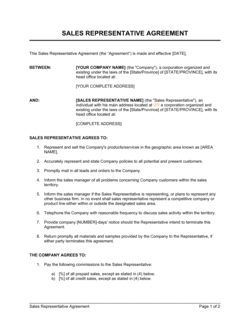
Engaging a domestic sales representative on commission within one countrySales Representative Agreement
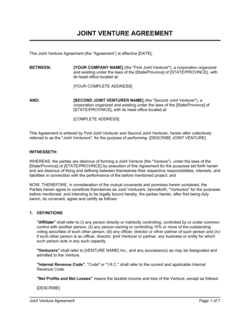
Appointing a joint venture partner rather than a commissioned agentJoint Venture Agreement
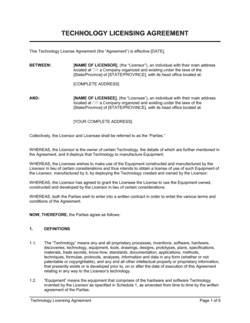
Granting a foreign party the right to sublicense IP alongside agency dutiesInternational Licensing Agreement
Formalizing a referral-only arrangement with a capped finder's feeReferral Agreement

Common mistakes to avoid

❌ No minimum performance targets in an exclusive territory

Why it matters: An exclusive agent with no targets can hold a territory indefinitely, generating no revenue while blocking the principal from appointing anyone else or selling directly.

Fix: Always include minimum quarterly or annual sales figures with explicit consequences — conversion to non-exclusive or right to terminate — for consecutive shortfalls.

❌ Attempting to waive statutory goodwill indemnity in advance

Why it matters: In the EU, UK, and many other jurisdictions, an agent's right to goodwill indemnity or compensation on termination cannot be contracted away in advance. The waiver clause is void and the full statutory entitlement survives.

Fix: Remove any advance waiver of indemnity rights and instead negotiate the calculation method and cap in line with what the applicable statute permits.

❌ Omitting the anti-bribery and compliance clause

Why it matters: Without a written compliance obligation, a principal whose agent pays a bribe to a foreign official has virtually no defence under the UK Bribery Act's 'failure to prevent' offence, which carries unlimited fines and criminal liability.

Fix: Include a standalone anti-bribery clause naming the FCPA and UK Bribery Act, with audit rights and immediate-termination consequences for breach.

❌ Choosing the agent's local law as governing law without advice

Why it matters: Many countries have mandatory commercial agency statutes that override contractual governing-law choices when the agent operates locally — leaving the principal subject to local law regardless of what the contract says.

Fix: Select a neutral governing law (England and Wales, Switzerland, Singapore, or New York) and take brief local-law advice on any mandatory rules that apply in the agent's operating country.

❌ Tying commission to invoice date rather than payment received

Why it matters: If a customer defaults, the principal has already paid commission on revenue it never collected — recovering overpaid commission from a foreign agent is expensive and rarely successful.

Fix: Draft the commission-earned trigger as 'when Principal receives cleared funds from the customer' and include a clawback provision if payment is subsequently reversed.

❌ No IP protection clause allowing the agent to register the principal's brand locally

Why it matters: In many countries, a local agent can register the principal's trademark in their own name, creating an extortion dynamic where the principal cannot operate in that market without buying back its own brand.

Fix: Include an explicit clause prohibiting the agent from registering any of the principal's trademarks, domain names, or trade names — and register key trademarks in target markets before appointing an agent.

The 9 key clauses, explained

Appointment and Territory

In plain language: Defines the scope of the agency — whether the agent is exclusive or non-exclusive, the geographic territory covered, and any product or service lines included.

Sample language
[PRINCIPAL NAME] hereby appoints [AGENT NAME] as its [exclusive / non-exclusive] agent for the sale of [PRODUCTS/SERVICES] in the territory of [COUNTRY / REGION] ('Territory'). Agent shall not solicit orders outside the Territory without prior written consent.

Common mistake: Defining territory by continent or region rather than specific countries. Vague geography creates overlap disputes with other agents and makes exclusivity claims unenforceable.

Agent Duties and Performance Targets

In plain language: Sets out what the agent must do — minimum sales targets, reporting obligations, market feedback, trade show attendance — and the consequences of failing to meet them.

Sample language
Agent shall use best efforts to promote and solicit orders for the Products in the Territory. Agent shall achieve minimum annual sales of [CURRENCY][AMOUNT] by [DATE]. Failure to meet minimum targets for two consecutive quarters shall entitle Principal to convert this agreement to non-exclusive.

Common mistake: No minimum performance targets at all. Without them, an exclusive agent can sit on a territory indefinitely, blocking the principal from appointing others while generating no revenue.

Commission Rate and Payment

In plain language: States the commission percentage, the basis on which it is calculated (net invoice value, gross sale, or received payment), the payment trigger, and the timing of payment.

Sample language
Principal shall pay Agent a commission of [X]% of the net invoice value of all orders solicited by Agent and accepted by Principal. Commission is earned when Principal receives full payment from the customer and shall be paid within [30] days of the month-end in which payment is received.

Common mistake: Tying commission to invoicing rather than payment received. If the customer does not pay and the principal has already paid commission, recovery is costly and contested.

Expenses and Reimbursement

In plain language: Clarifies which expenses the agent may incur on the principal's behalf, the pre-approval threshold, and the documentation required for reimbursement.

Sample language
Agent shall bear all routine operating expenses. Principal shall reimburse Agent for pre-approved travel and accommodation expenses incurred specifically for [TRADE SHOWS / CUSTOMER VISITS] upon submission of receipts, provided expenses do not exceed [CURRENCY][AMOUNT] per month without prior written approval.

Common mistake: No expense policy at all. Absent a written limit, agents submit unlimited expenses as agency costs, treating the principal as a reimbursement source for general overhead.

Term, Renewal, and Termination

In plain language: Sets the initial contract term, the mechanism for renewal or expiry, notice periods for termination, and immediate-termination triggers for cause.

Sample language
This Agreement commences on [DATE] and continues for [12] months, renewing automatically for successive [12]-month terms unless either party gives [90] days' written notice of non-renewal. Principal may terminate immediately for cause, including Agent's material breach, insolvency, or conviction of a criminal offence.

Common mistake: Setting notice periods shorter than the statutory minimum in the agent's country. Many EU member states and the UK mandate minimum notice periods that override the contract; failing to meet them exposes the principal to wrongful termination liability.

Post-Termination Compensation and Goodwill Indemnity

In plain language: Addresses the agent's right to compensation after the agreement ends — whether under statute or contract — for the customer base and market share created during the relationship.

Sample language
Upon termination, Agent shall be entitled to compensation in accordance with applicable law. Where the EU Commercial Agents Directive or equivalent legislation applies, the maximum goodwill indemnity shall be one year's average annual commission calculated over the preceding [5] years or the duration of the contract, whichever is shorter.

Common mistake: Attempting to waive statutory goodwill indemnity rights in the contract. In the EU, UK, and many other jurisdictions, these rights cannot be waived in advance — the clause is void and the full statutory entitlement applies regardless.

Confidentiality and Intellectual Property

In plain language: Prohibits the agent from disclosing the principal's confidential information or using the principal's trademarks, trade secrets, or materials outside the scope of the agency.

Sample language
Agent shall not disclose or use any Confidential Information of Principal for any purpose other than performing the duties under this Agreement. All trademarks, marketing materials, and product specifications remain the sole property of Principal. Agent acquires no licence beyond what is strictly necessary to perform its duties.

Common mistake: No IP clause — allowing the agent to register the principal's trademark in the agent's country. In many jurisdictions, a local party who registers a foreign brand in bad faith can hold the rightful owner to ransom.

Compliance, Anti-Bribery, and Sanctions

In plain language: Requires the agent to comply with all applicable anti-corruption laws — including the US FCPA and UK Bribery Act — and prohibits payments to government officials or sanctioned parties.

Sample language
Agent warrants that it has not offered, given, or received any bribe, kickback, or improper payment in connection with this Agreement and shall not do so. Agent shall comply with all applicable anti-corruption laws including the US Foreign Corrupt Practices Act and the UK Bribery Act 2010. Any breach of this clause is grounds for immediate termination.

Common mistake: Omitting the anti-bribery clause because the principal is not US- or UK-based. FCPA applies to any company with US securities listings or US-dollar transactions; UK Bribery Act applies to any company carrying on business in the UK, regardless of incorporation.

Governing Law and Dispute Resolution

In plain language: Designates which country's law governs the agreement and how disputes are resolved — arbitration, mediation, or litigation — and the seat of proceedings.

Sample language
This Agreement is governed by the laws of [COUNTRY / STATE]. Any dispute shall be finally resolved by arbitration under the [ICC / LCIA / AAA] Rules, with the seat in [CITY]. The language of the proceedings shall be [LANGUAGE]. Either party may seek injunctive relief in any competent court.

Common mistake: Choosing the agent's local law as governing law without understanding local mandatory protections. EU commercial agency law applies regardless of governing-law choice when the agent operates in an EU member state — overriding any contrary contractual provision.

How to fill it out

  1. 1

    Identify the parties and their legal entities

    Enter the principal's full registered company name, country of incorporation, and registered address. Then enter the agent's full legal name or entity name, country, and address. Confirm that the agent has the legal capacity to act as a commercial agent in their jurisdiction.

    💡 Run a company registry check in the agent's country before execution — engaging a dissolved or unregistered entity voids the contract and creates undisclosed personal liability.

  2. 2

    Define the territory with country-level precision

    List each country or territory covered by name. If the agreement is exclusive, state that explicitly and confirm no conflicting arrangements exist with other agents in the same territory.

    💡 Include a schedule of territories as an exhibit rather than embedding them in the body — it makes future amendments (adding or removing countries) cleaner and avoids re-executing the full agreement.

  3. 3

    Set minimum performance targets

    Enter minimum annual or quarterly sales targets in the agreed currency. Specify the consequence of missing targets for two or more consecutive periods — typically conversion to non-exclusive or right to terminate.

    💡 Set Year 1 targets at 60–70% of your internal forecast to account for market-entry ramp time. Unrealistic targets invite early disputes and agent defensiveness.

  4. 4

    Specify commission rate, basis, and payment timing

    Enter the commission percentage, confirm whether it is calculated on net invoice value or cash received, and set the payment deadline after month-end. If different rates apply to different product lines or customer tiers, list them in a schedule.

    💡 Pay commission on cash received, not invoice date — this aligns agent incentives with your actual cash flow and eliminates disputes over bad-debt commission clawbacks.

  5. 5

    Fill in the term, notice period, and renewal mechanics

    Set the initial term (12 months is standard for a first appointment), the notice period for non-renewal (90 days is common), and whether the agreement auto-renews or requires affirmative renewal. Add immediate-termination triggers for cause.

    💡 Check the statutory minimum notice period in the agent's operating country before setting your notice period — several EU jurisdictions mandate 1 month per year of relationship, up to 6 months.

  6. 6

    Address post-termination compensation explicitly

    State whether goodwill indemnity applies by statute or is excluded where lawfully permitted. Include the calculation formula and cap. If your governing law is outside the EU, consider whether you are granting or denying contractual goodwill compensation.

    💡 Even where goodwill indemnity is not mandatory, offering a contractual formula (e.g., 3–6 months' average commission) in exchange for a clean non-compete is often preferable to silence followed by a statutory claim.

  7. 7

    Insert the anti-bribery and compliance clause verbatim

    Do not modify or soften the anti-bribery clause. Ensure it names the FCPA and UK Bribery Act by name, requires the agent to maintain compliance records, and grants the principal audit rights.

    💡 Regulators treat a weak or absent anti-bribery clause as evidence of inadequate compliance controls. A strong written obligation in the contract is the first layer of your adequate-procedures defence.

  8. 8

    Choose governing law and arbitration seat deliberately

    Select a governing law in a neutral, commercially sophisticated jurisdiction — England and Wales, Switzerland, Singapore, or New York are common choices. Pair it with an arbitration clause under ICC, LCIA, or SIAC rules for enforceable cross-border awards.

    💡 Avoid choosing the agent's local law as governing law unless you have taken advice on local mandatory agency statutes — several protect agents to a degree the contract cannot override.

Frequently asked questions

What is an international agent agreement?

An international agent agreement is a contract appointing an individual or company in a foreign country to represent the principal — soliciting orders, developing business, or negotiating contracts on the principal's behalf — within a defined territory, in exchange for a commission on sales generated. Unlike a distributor, the agent does not buy goods or take title; they act in the principal's name and the principal remains the contracting party with the end customer.

What is the difference between an agent and a distributor?

An agent solicits orders on the principal's behalf without taking title to goods — the principal invoices the customer directly and pays the agent a commission. A distributor buys goods from the principal, takes on inventory risk, and resells under its own name and margin. Agents create smaller upfront risk for the principal but give the principal less control over pricing and customer relationships than a direct sales force. Distributors carry their own risk but require deeper margin sharing.

Does EU commercial agency law apply to my agreement?

If your agent operates in any EU member state, EU Commercial Agents Directive 86/653/EEC applies — regardless of which governing law you chose in the contract. It mandates minimum notice periods, entitles the agent to goodwill indemnity or compensation on termination, and gives the agent the right to request written contract terms. These protections cannot be waived in advance. Similar legislation based on the Directive applies in the UK under the Commercial Agents (Council Directive) Regulations 1993.

What is a goodwill indemnity and when is it owed?

A goodwill indemnity (or compensation) is a statutory payment owed to a commercial agent when the principal terminates the agreement — compensating the agent for customers or increased business they brought to the principal that continues to benefit the principal post-termination. In the EU and UK, the indemnity is capped at one year's average annual commission over the preceding five years. It is owed unless the agent has committed a breach justifying immediate termination, or the agent voluntarily terminates without cause.

Can I make the agent agreement exclusive?

Yes — exclusive arrangements are common for market entry. Exclusivity means the principal will not appoint other agents or sell directly into the defined territory during the agreement term. However, exclusivity without minimum performance targets is commercially dangerous: the principal has no enforceable remedy if the agent fails to generate sales but refuses to relinquish the territory. Always pair exclusivity with binding sales minimums and a conversion-to-non-exclusive clause for missed targets.

Does the FCPA apply to my international agent?

Yes, if your company has US securities listings, conducts US-dollar transactions, or has any US nexus, the FCPA applies to bribes paid by your agent on your behalf — even if you were unaware of the payment. The FCPA's anti-bribery provision applies to issuers, domestic concerns, and persons acting within US territory. A written anti-bribery clause, compliance training records, and agent due-diligence documentation are the core of an adequate-procedures defence.

What governing law should I choose for an international agent agreement?

Most principals choose a neutral, commercially sophisticated jurisdiction — England and Wales, Switzerland, Singapore, or New York — to govern the contract. This choice is generally respected in international arbitration. However, if the agent operates in the EU, UK, or a country with mandatory commercial agency statutes, local law provisions will apply in parallel regardless of your contractual choice. Take brief local-law advice in the agent's operating country before finalising the governing-law clause.

What notice period is required to terminate an international agent agreement?

The EU Commercial Agents Directive and the UK equivalent mandate minimum notice periods of 1 month in the first year, 2 months in the second year, and 3 months in subsequent years — which cannot be reduced by contract. Many EU member states extend these minimums further. Outside the EU and UK, statutory requirements vary: some countries impose no minimum; others protect agents under general labour or commercial law principles. Always confirm the statutory floor in the agent's country before drafting the termination clause.

Do I need a lawyer to draft an international agent agreement?

A high-quality template covers the core commercial and legal structure for straightforward appointments in most jurisdictions. Engage a lawyer when the agent operates in a country with complex mandatory agency protections (Germany, France, Belgium, or Latin American jurisdictions with special agent laws), when the commission at stake exceeds $100K annually, or when the anti-bribery exposure is material. A one-hour local-law review in the agent's country ($300–$800) is strongly recommended for first-time appointments in any new jurisdiction.

How this compares to alternatives

vs International Distribution Agreement

A distribution agreement appoints a foreign party to buy goods outright and resell them under their own name, bearing inventory and credit risk. An agent agreement keeps the principal as the contracting party with end customers and limits the foreign party to soliciting orders for a commission. Use a distribution agreement when you want a partner to carry stock and bear market risk; use an agent agreement when you want to retain control over pricing, customer relationships, and invoicing.

vs Sales Representative Agreement

A sales representative agreement appoints a domestic commissioned representative — typically within a single country. An international agent agreement adds cross-border complexity: mandatory commercial agency statutes, goodwill indemnity rights, FCPA and Bribery Act compliance obligations, foreign trademark protection, and multi-jurisdictional dispute resolution. Use a sales rep agreement for domestic arrangements; use an international agent agreement for any cross-border appointment.

vs Joint Venture Agreement

A joint venture creates a shared legal entity or contractual collaboration where both parties contribute resources, share risks, and split profits. An international agent agreement is a pure agency — the agent acts on the principal's behalf for a commission and bears no equity stake or shared liability. A joint venture is appropriate when market entry requires substantial local investment or regulatory partnership; an agent agreement suits market development where the principal wants to retain full ownership and control.

vs International Licensing Agreement

A licensing agreement grants a foreign party the right to use the principal's IP — trademark, patent, or technology — in exchange for royalties, without the licensee acting as the principal's representative. An agent agreement appoints a representative to generate business on the principal's behalf without granting any IP rights beyond what is strictly necessary to perform agency duties. Use a licensing agreement when the core value is IP exploitation; use an agent agreement when the goal is to generate direct sales in a foreign market.

Industry-specific considerations

Manufacturing and Wholesale

Agents appointed to develop distributor and retail networks in new export markets, with commission tied to confirmed orders and minimum volume commitments per territory.

Technology / SaaS

Agents soliciting enterprise software deals on the principal's behalf in markets where a local sales entity is not yet justified; commission structures typically tied to annual contract value.

Professional Services

Consulting and advisory firms using local agents to source engagements in regulated or relationship-driven markets, with strict conflict-of-interest and confidentiality obligations.

Food and Beverage

Producers entering foreign retail and food-service channels through commissioned agents, with regulatory compliance and labelling requirements attached as agent obligations.

Healthcare and MedTech

Medical device and pharmaceutical companies appointing agents to access hospital procurement channels, with anti-bribery and healthcare-industry compliance obligations elevated to contract conditions.

Retail and Consumer Goods

Brand owners using agents to secure placement in foreign department stores or specialty retailers, with territorial brand-protection clauses preventing unauthorised trademark registration.

Jurisdictional notes

United States

The US does not have a federal commercial agency statute equivalent to the EU Directive — agent relationships are governed by state contract and agency law. However, the Foreign Corrupt Practices Act (FCPA) applies to all US issuers and domestic concerns whose agents pay bribes to foreign officials, creating significant principal liability for agent misconduct. California provides additional protections for commissioned salespeople under Labor Code provisions; check state law if the agent is based in the US.

Canada

Canada has no federal commercial agency statute, but several provinces — including Ontario and Quebec — have legislation protecting certain categories of agent on termination. Quebec's Civil Code imposes specific obligations on mandates (the Quebec equivalent of agency). Anti-bribery exposure is governed by the Corruption of Foreign Public Officials Act (CFPOA), which has similar reach to the FCPA and applies to Canadian companies and their agents operating abroad. Contracts must be available in French in Quebec for provincially regulated businesses.

United Kingdom

The Commercial Agents (Council Directive) Regulations 1993 remain in force post-Brexit and closely follow the EU Directive. They mandate minimum notice periods, entitle agents to goodwill indemnity or compensation on termination (capped at one year's average commission), and cannot be waived in advance. The UK Bribery Act 2010 creates corporate criminal liability for failing to prevent bribery by associated persons — including foreign agents — making a written compliance clause and documented due-diligence process essential elements of an adequate-procedures defence.

European Union

EU Commercial Agents Directive 86/653/EEC is implemented in all member states and applies whenever the agent operates in the EU, overriding any contrary contractual governing-law choice. It guarantees minimum notice periods scaling from 1 to 3 months, goodwill indemnity or compensation rights on termination, and the agent's right to a written contract. Several member states — including Germany, France, and Belgium — provide protections beyond the Directive minimum. Termination must be for documented cause to avoid triggering indemnity; even legitimate performance-based termination may give rise to a statutory claim.

Template vs lawyer — what fits your deal?

PathBest forCostTime
Use the templateStandard agent appointments in common-law jurisdictions or markets with straightforward agency law, where annual commission is under $50KFree30–60 minutes
Template + legal reviewFirst-time appointments in EU member states, UK, or any jurisdiction with mandatory commercial agency statutes, or where annual commission exceeds $50K$300–$800 for a local-law review in the agent's country2–5 days
Custom draftedHigh-value exclusive arrangements, agents in highly regulated sectors (healthcare, defence, financial services), or markets with complex mandatory protections (Germany, France, Brazil, Mexico)$2,000–$8,000+2–4 weeks

Glossary

Principal
The company or individual who appoints the agent and on whose behalf the agent solicits orders or conducts business.
Commercial Agent
A self-employed intermediary who has ongoing authority to negotiate or conclude contracts on behalf of the principal, typically in exchange for a commission.
Exclusive Territory
A defined geographic area within which the principal agrees not to appoint any other agent or directly solicit customers during the agreement term.
Commission
A percentage of the net sale value of orders procured by the agent that the principal pays to the agent upon receipt of payment from the customer.
Goodwill Indemnity
A statutory payment owed to a commercial agent upon termination in many jurisdictions — typically equal to one year's average commission — compensating the agent for customers and market share generated during the relationship.
Del Credere
An optional clause under which the agent guarantees the creditworthiness of customers they introduce, accepting liability for customer non-payment in exchange for a higher commission rate.
FCPA (Foreign Corrupt Practices Act)
A US law prohibiting companies and their agents from bribing foreign government officials to obtain or retain business; applies to the principal regardless of which country the agent operates in.
UK Bribery Act 2010
UK legislation creating corporate liability for failing to prevent bribery committed by persons associated with the company, including foreign agents — making a written compliance obligation in the agency contract a critical protective measure.
Post-Term Restriction
A clause preventing the agent from soliciting the principal's customers or representing competing businesses for a defined period after the agreement ends.
Force Majeure
A clause excusing a party from performance obligations when an extraordinary event beyond their control — war, natural disaster, or pandemic — makes performance impossible or commercially impracticable.
Choice of Law
The contractual designation of which country's or state's law governs the interpretation and enforcement of the agreement, independent of where the parties are located.
Indemnification
An obligation by one party to compensate the other for specified losses, liabilities, or costs — here typically the principal indemnifying the agent for authorized commitments made on the principal's behalf.

Part of your Business Operating System

This document is one of 3,000+ business & legal templates included in Business in a Box.

  • Fill-in-the-blanks — ready in minutes
  • 100% customizable Word document
  • Compatible with all office suites
  • Export to PDF and share electronically

Create your document in 3 simple steps.

From template to signed document — all inside one Business Operating System.
1
Download or open template

Access over 3,000+ business and legal templates for any business task, project or initiative.

2
Edit and fill in the blanks with AI

Customize your ready-made business document template and save it in the cloud.

3
Save, Share, Send, Sign

Share your files and folders with your team. Create a space of seamless collaboration.

Save time, save money, and create top-quality documents.

★★★★★

"Fantastic value! I'm not sure how I'd do without it. It's worth its weight in gold and paid back for itself many times."

Managing Director · Mall Farm
Robert Whalley
Managing Director, Mall Farm Proprietary Limited
★★★★★

"I have been using Business in a Box for years. It has been the most useful source of templates I have encountered. I recommend it to anyone."

Business Owner · 4+ years
Dr Michael John Freestone
Business Owner
★★★★★

"It has been a life saver so many times I have lost count. Business in a Box has saved me so much time and as you know, time is money."

Owner · Upstate Web
David G. Moore Jr.
Owner, Upstate Web

Run your business with a system — not scattered tools

Stop downloading documents. Start operating with clarity. Business in a Box gives you the Business Operating System used by over 250,000 companies worldwide to structure, run, and grow their business.

Free Forever Plan · No credit card required