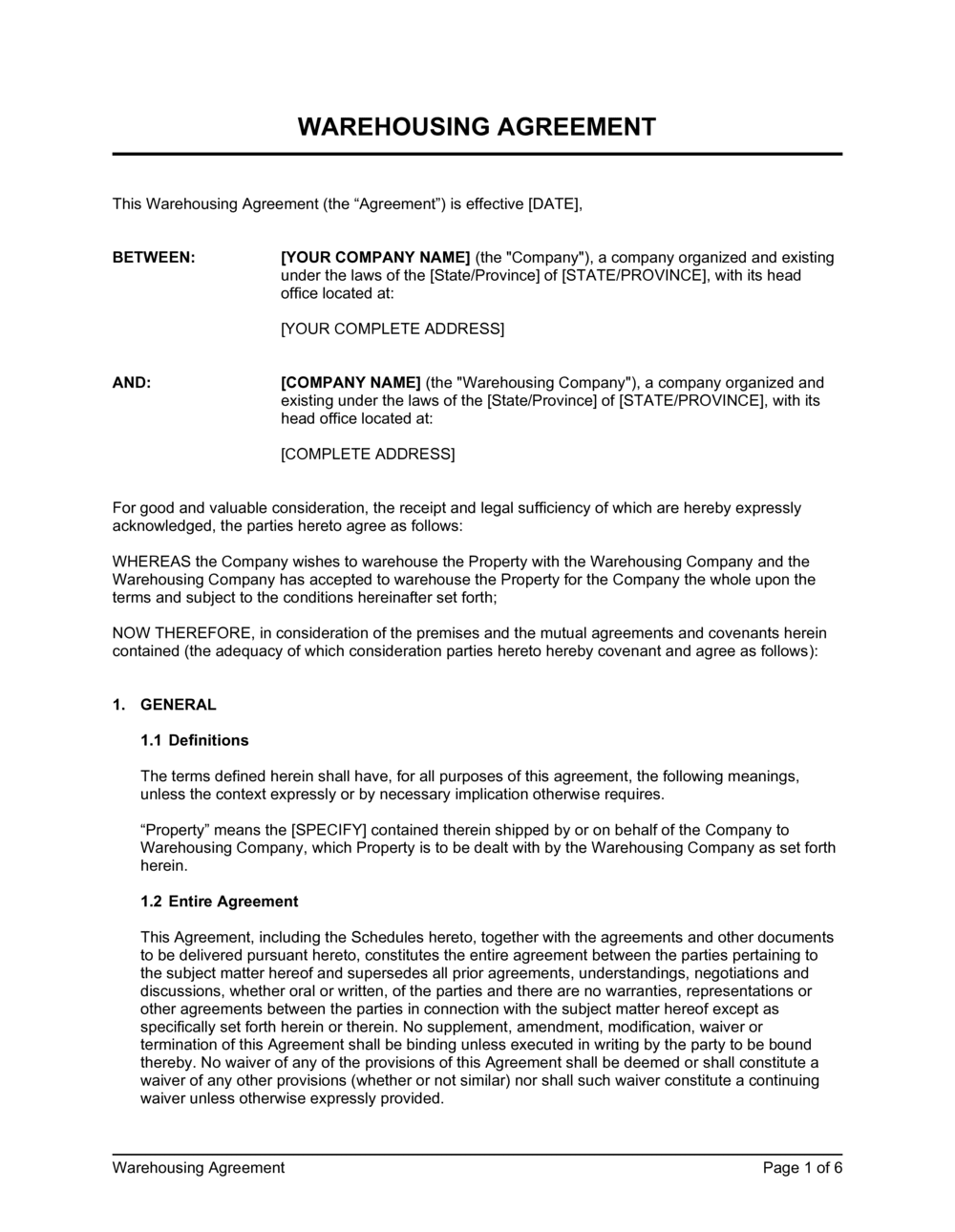
Warehousing Agreement Template

Free Word download • Edit online • Save & share with Drive • Export to PDF

6 pages25–35 min to fillDifficulty: ComplexSignature requiredLegal review recommended
Learn more ↓
FreeWarehousing Agreement Template

At a glance

What it is
A Warehousing Agreement is a legally binding contract between a goods owner (depositor) and a warehouse operator (warehouseman) that governs the storage, handling, and release of goods at a designated facility. This free Word download covers all material terms — fees, liability caps, insurance obligations, lien rights, and access — and can be edited online and exported as PDF. Unlike a lease, it does not transfer possession of the space itself; it creates a service relationship for the safekeeping and management of specific goods.
When you need it
Use it whenever a business entrusts physical inventory to a third-party storage operator — whether launching a 3PL relationship, scaling seasonal overflow storage, or formalizing an existing informal arrangement. It is also appropriate when a warehouse operator needs a standard intake document for every customer depositing goods at their facility.
What's inside
Description of goods and storage space, fee schedule and billing terms, liability allocation and damage caps, insurance requirements for both parties, lien rights over stored goods, access and inspection procedures, inventory recordkeeping obligations, and termination and release conditions.

What is a Warehousing Agreement?

A Warehousing Agreement is a legally binding contract between a goods owner (the depositor) and a warehouse operator (the warehouseman) that governs the storage, handling, and release of physical inventory at a designated facility. It establishes a service relationship — not a tenancy — meaning the operator retains control of the space while assuming a defined duty of care over the depositor's specific goods. The agreement sets out every material term: the storage fee schedule, liability caps for loss or damage, insurance requirements for both parties, lien rights over unpaid accounts, inventory recordkeeping and reconciliation obligations, and the procedures for accessing and releasing goods. Unlike a commercial lease, a warehousing agreement does not transfer possession of the physical space; it creates enforceable obligations around how a third party handles property entrusted to its care.

Why You Need This Document

Without a written warehousing agreement, the relationship is governed entirely by the applicable warehouse statute — which provides a bare framework but no fee schedule, no liability cap, no reconciliation process, and no lien enforcement procedure tailored to your situation. Depositors who rely on verbal arrangements or informal emails have no basis to recover for inventory shortfalls, no agreed process when a dispute over damage arises, and no mechanism to compel timely inventory reports. Warehouse operators without a signed agreement cannot lawfully enforce a lien against a non-paying depositor, cannot limit their liability exposure to commercially reasonable levels, and cannot charge holdover fees when a depositor fails to remove goods after the relationship ends. Every day goods sit in a third-party facility without a written contract is a day where a loss event — fire, theft, flood, or a simple picking error — produces a dispute with no agreed rules to resolve it. This template gives both parties a documented, enforceable foundation before the first pallet crosses the dock.

Which variant fits your situation?

If your situation is…Use this template
Storing goods with a full-service 3PL that also handles fulfillmentThird-Party Logistics (3PL) Agreement
Renting an entire warehouse unit with exclusive possessionCommercial Lease Agreement
Short-term overflow storage for a single shipment or seasonWarehousing Agreement (Short-Term)
Cold-chain or temperature-controlled goods requiring special handlingCold Storage Agreement
Cross-border goods held in a bonded customs warehouseBonded Warehouse Agreement
Goods stored as collateral security for a lenderField Warehousing Agreement
Documenting the release of specific goods from storageWarehouse Receipt

Common mistakes to avoid

❌ No declared-value mechanism for high-value goods

Why it matters: A standard liability cap of $0.50 per pound or $100 per pallet can leave the depositor with a $10,000 recovery on $500,000 of damaged electronics or pharmaceuticals. The gap is unrecoverable unless the contract provides a declared-value option.

Fix: Add a declared-value clause allowing the depositor to specify a higher per-unit value and pay an incremental fee — typically 0.1–0.25% of declared value per year — in exchange for full-value liability coverage from the operator.

❌ Omitting accessorial fees from the fee schedule

Why it matters: Services like repackaging, lot rotation, cycle counting, and after-hours access are routinely provided but not billed until the depositor receives an invoice line they never agreed to, triggering payment disputes and relationship breakdowns.

Fix: Request the operator's complete rate card before drafting and list every expected service with its fee in Schedule A. Include a clause requiring written change orders for any new service not in the schedule.

❌ No written release authorization requirement

Why it matters: Verbal or informal email release instructions have resulted in goods being released to unauthorized parties. The warehouse operator may bear liability for conversion if it cannot document a properly authorized release.

Fix: Require a signed release order on the depositor's letterhead or an authenticated portal instruction for every outbound shipment. Specify that the operator is entitled to rely on written release orders without further inquiry.

❌ Referencing a lien right without following the statutory procedure

Why it matters: Warehouse lien statutes prescribe exact notice periods, sale formats, and proceeds-accounting requirements. An operator who skips a step — even on a clearly delinquent account — can be held liable for conversion of the goods.

Fix: Identify the applicable warehouse lien statute by jurisdiction (e.g., UCC Article 7 in the US, the Warehousemen's Lien Act in Ontario) and replicate its required notice periods and sale procedures verbatim in the lien clause.

The 10 key clauses, explained

Parties, facility description, and term

In plain language: Identifies the depositor and warehouseman as legal entities, specifies the storage facility address and designated storage area, and sets the start date and initial term with renewal provisions.

Sample language
This Warehousing Agreement ('Agreement') is entered into on [DATE] between [DEPOSITOR LEGAL NAME], a [STATE/PROVINCE] [ENTITY TYPE] ('Depositor'), and [WAREHOUSE OPERATOR LEGAL NAME], a [STATE/PROVINCE] [ENTITY TYPE] ('Warehouseman'). Warehouseman shall store Depositor's goods at [FACILITY ADDRESS], [DESIGNATED AREA], commencing [START DATE] for an initial term of [TERM LENGTH], renewing automatically on a [monthly/annual] basis unless terminated in accordance with Section [X].

Common mistake: Describing the storage area by common name only (e.g., 'Bay 4') without a floor plan reference or square footage. Ambiguity about the allocated space leads to disputes when the operator needs to reposition inventory.

Description of goods

In plain language: Defines the categories, quantities, and any special characteristics of the goods to be stored — including hazardous, perishable, or high-value designations that affect handling obligations.

Sample language
Depositor shall store the following goods ('Goods'): [DESCRIPTION OF GOODS], with a maximum stored quantity of [X UNITS / PALLETS / SQ FT] at any one time. Goods designated as [HAZARDOUS / TEMPERATURE-SENSITIVE / HIGH-VALUE] shall be stored in accordance with Schedule B — Special Handling Requirements.

Common mistake: Using a generic description like 'general merchandise' without identifying hazardous or perishable items. If undisclosed goods cause damage to other inventory or require special handling, the depositor bears full liability and may void the operator's insurance.

Fees, billing, and payment terms

In plain language: Sets out the storage rate (monthly per pallet, per square foot, or per unit), in-and-out handling fees, accessorial charges, billing cycle, and consequences for late payment.

Sample language
Depositor shall pay Warehouseman: (a) a monthly storage fee of $[X] per pallet position; (b) an inbound handling fee of $[X] per pallet received; (c) an outbound handling fee of $[X] per pallet released. Invoices are issued on the [1st] of each month and due within [30] days. Balances unpaid after [30] days accrue interest at [1.5]% per month.

Common mistake: Omitting accessorial charges — repackaging, labeling, temperature monitoring, or after-hours access fees — from the fee schedule. These become disputes when the operator invoices for services the depositor assumed were included.

Warehouseman's standard of care and liability

In plain language: Defines the legal standard of care the operator must apply to the goods, the liability cap per occurrence or per unit, and the categories of loss that are excluded from liability (e.g., inherent vice, acts of God).

Sample language
Warehouseman shall exercise reasonable care in storing, handling, and releasing the Goods. Warehouseman's liability for loss or damage to Goods shall not exceed $[X] per [unit / pound / pallet]. Warehouseman shall not be liable for loss caused by: (a) inherent vice or nature of the Goods; (b) acts of God; (c) Depositor's failure to disclose special characteristics; or (d) compliance with Depositor's instructions.

Common mistake: Setting a liability cap far below the actual market value of the stored goods without requiring the depositor to declare excess value and pay an additional fee. If goods worth $500,000 are capped at $50,000 per occurrence, the depositor carries an uninsured gap they may not discover until a claim.

Insurance obligations

In plain language: Requires both parties to maintain specified insurance coverages — the depositor for the full replacement value of goods, and the operator for general liability and property coverage — and requires certificates of insurance on request.

Sample language
Depositor shall maintain all-risk cargo insurance covering the Goods at full replacement value, naming Warehouseman as an additional insured. Warehouseman shall maintain: (a) commercial general liability insurance of not less than $[X] per occurrence; (b) property insurance covering the facility. Each party shall provide certificates of insurance within [10] business days of request.

Common mistake: Requiring insurance certificates only at contract signing and never at renewal. Policies lapse; a depositor whose cargo insurance expired six months ago is effectively uninsured, and the warehouse operator may not discover this until a claim is filed.

Inventory recordkeeping and reconciliation

In plain language: Requires the warehouse operator to maintain accurate inventory records by SKU, lot, or serial number, and sets the frequency and process for physical inventory reconciliation between the parties.

Sample language
Warehouseman shall maintain a perpetual inventory record of all Goods by [SKU / LOT NUMBER / SERIAL NUMBER] and provide Depositor with inventory reports [weekly / monthly] in the agreed format. Warehouseman and Depositor shall conduct a physical inventory reconciliation no less than [quarterly / annually]. Discrepancies exceeding [X]% of total SKU count shall be investigated within [15] business days.

Common mistake: No defined reconciliation frequency or discrepancy threshold. Without a process, shrinkage accumulates undetected for months and becomes a large, disputed claim rather than a manageable operational finding.

Access, inspection, and release of goods

In plain language: Grants the depositor the right to inspect goods and access the facility during business hours, and sets the procedure — notice, authorization, and documentation — for releasing goods to the depositor or a named carrier.

Sample language
Depositor shall have the right to inspect Goods at the facility during normal business hours upon [24-hour] prior written notice. Warehouseman shall release Goods only upon receipt of a written release order signed by an authorized representative of Depositor. Release to a third-party carrier requires a bill of lading or carrier authorization letter.

Common mistake: No written release authorization requirement. Verbal or email-only release instructions have resulted in goods being handed to unauthorized parties — a loss the warehouse operator may bear if the depositor disputes authorization.

Warehouseman's lien

In plain language: Preserves the operator's statutory lien over stored goods for unpaid fees, and sets out the notice and sale procedure the operator must follow before exercising that lien.

Sample language
Warehouseman shall have a lien on all Goods stored under this Agreement for all lawful charges for storage and handling. If charges remain unpaid for more than [30] days after written notice to Depositor, Warehouseman may exercise its lien rights in accordance with [applicable statute — e.g., UCC Article 7 / Warehousemen's Lien Act], including public or private sale of sufficient Goods to satisfy the outstanding balance after [X] days' further notice.

Common mistake: Referencing a lien right without specifying the statutory procedure and notice periods required by the governing jurisdiction. An improperly exercised lien — wrong notice period, wrong sale method — can expose the operator to conversion liability even if the depositor owes money.

Termination, removal of goods, and holdover

In plain language: Sets the notice period for termination by either party, the deadline by which the depositor must remove goods after notice, and the holdover rate applicable if goods remain past the removal deadline.

Sample language
Either party may terminate this Agreement upon [30] days' written notice. Depositor shall remove all Goods from the facility within [15] days of the effective termination date. Goods remaining after the removal deadline shall accrue storage charges at [1.5×] the then-current monthly rate ('Holdover Rate'). If Goods remain [30] days after the removal deadline, Warehouseman may exercise its lien in accordance with Section [X].

Common mistake: No holdover rate provision. Without one, a depositor who fails to remove goods on time pays nothing extra, leaving the operator unable to allocate the space to a new customer while the former depositor's inventory sits on the floor.

Governing law, dispute resolution, and limitation of actions

In plain language: Specifies the governing jurisdiction's law, the dispute resolution mechanism (arbitration or court), and the limitation period for bringing a claim for loss or damage to stored goods — which may be shorter than the statutory default.

Sample language
This Agreement is governed by the laws of [STATE / PROVINCE / COUNTRY]. Any dispute arising under this Agreement shall be resolved by binding arbitration administered by [AAA / JAMS / applicable body] in [CITY]. Claims for loss or damage to Goods must be presented in writing within [9] months of the date of loss, and any action must be commenced within [2] years, or shall be time-barred.

Common mistake: Omitting a shortened limitation-of-actions clause. Without it, depositors can bring stale claims for inventory shortfalls years after the fact, when records have been destroyed and warehouse staff have turned over.

How to fill it out

  1. 1

    Identify both parties with their full legal entity names

    Enter the depositor's and warehouseman's registered legal names, states of incorporation, and principal business addresses. Do not use trade names or DBAs in the party block.

    💡 Cross-reference the warehouse operator's motor carrier or storage license number and include it in the recitals — it confirms the operator's legal authority to provide storage services.

  2. 2

    Describe the goods precisely and flag any special characteristics

    List goods by category, SKU range, or product type and specify the maximum quantity or pallet count at any time. Identify hazardous, temperature-sensitive, perishable, or high-value items and attach a Schedule B for special handling requirements.

    💡 Attach a current product safety data sheet (SDS) for any hazardous goods and cross-reference it in the goods description clause — this protects the depositor if special handling is disputed later.

  3. 3

    Complete the fee schedule with all charge types

    Enter the monthly storage rate, inbound and outbound handling fees, and any accessorial charges — repackaging, labeling, temperature monitoring, or after-hours access. Specify the billing cycle and the due date.

    💡 Ask the warehouse operator for their current rate card before drafting and confirm every service listed in Schedule A has a corresponding fee line — anything not priced in the contract will be disputed when invoiced.

  4. 4

    Set the liability cap at a commercially meaningful level

    Negotiate a per-unit or per-occurrence liability cap that reflects a reasonable allocation of risk, and include a declared-value mechanism allowing the depositor to pay an additional fee for higher coverage on high-value goods.

    💡 Compare the liability cap to the replacement cost of your maximum inventory level at any one time — if the cap is less than 20% of that figure, require the operator to carry higher limits or obtain gap coverage through your own cargo policy.

  5. 5

    Define insurance requirements and attach certificate obligations

    Specify minimum policy limits for both parties, name each party as an additional insured on the other's applicable policy, and require certificates of insurance at signing and at each annual renewal.

    💡 Set a calendar reminder 30 days before each policy renewal date to request updated certificates — a lapsed policy is the single most common gap discovered only at the time of a claim.

  6. 6

    Establish the inventory reconciliation process

    Set the report format, frequency (weekly or monthly electronic inventory reports), and the schedule for physical reconciliation. Define the discrepancy threshold that triggers an investigation and the resolution timeline.

    💡 Require the operator to send inventory reports in a machine-readable format (CSV or EDI) that imports directly into your ERP or inventory management system — manual re-keying introduces its own errors.

  7. 7

    Set release authorization and access procedures

    Name the depositor's authorized representatives who may issue release orders, specify the written format required (signed release form or authenticated email), and define the notice period for facility inspections.

    💡 Limit authorized release signatories to two or three named individuals and include a process for updating the list — departing employees who remain on the authorized list are an ongoing security risk.

  8. 8

    Confirm governing law and sign before goods are deposited

    Select the governing jurisdiction — typically the state or province where the facility is located — and execute the agreement before the first delivery. Both authorized signatories must sign.

    💡 For cross-border arrangements where the depositor and facility are in different jurisdictions, have counsel confirm which jurisdiction's warehousing statute applies to the lien and liability provisions before you finalize.

Frequently asked questions

What is a warehousing agreement?

A warehousing agreement is a contract between a goods owner (depositor) and a warehouse operator (warehouseman) that governs the storage, handling, and release of physical inventory at a designated facility. It sets the fees, liability allocation, insurance obligations, lien rights, and access procedures that apply while the goods are in the operator's care. Unlike a commercial lease, it does not transfer possession of the space — it creates a service relationship for the safekeeping of specific goods.

What is the difference between a warehousing agreement and a commercial lease?

A commercial lease transfers exclusive possession of a defined physical space to the tenant, who controls it and is responsible for everything inside. A warehousing agreement creates a service relationship in which the operator retains control of the space and assumes a duty of care over the depositor's goods. The depositor pays for storage services, not rent; the operator can reposition inventory within the facility as long as the goods remain accessible and undamaged. Choosing the wrong document — a lease when you need a storage service — eliminates the operator's duty of care and your ability to claim for losses.

Who bears liability for lost or damaged goods in a warehousing agreement?

In most jurisdictions, the warehouse operator is liable for loss or damage caused by its failure to exercise reasonable care. However, most warehousing agreements include a liability cap — a maximum dollar amount per unit, per pound, or per occurrence — that limits the operator's exposure regardless of actual value. Depositors whose goods exceed the cap should either negotiate a declared-value mechanism or ensure their own cargo insurance covers the gap. Losses caused by inherent defects, undisclosed hazardous characteristics, or acts of God are typically excluded from the operator's liability.

What is a warehouseman's lien and how does it work?

A warehouseman's lien is a statutory right allowing a warehouse operator to retain — and ultimately sell — stored goods when the depositor fails to pay storage fees or other charges. In the United States, the lien is governed by UCC Article 7, which prescribes specific notice periods and sale procedures. To exercise the lien lawfully, the operator must provide written notice to the depositor and any known lienholder, wait the required period, and conduct a commercially reasonable sale. An improperly exercised lien can expose the operator to conversion liability even if the depositor owes money.

What insurance do I need for a warehousing agreement?

The depositor should carry all-risk cargo insurance covering the full replacement value of goods at the facility at any one time. The warehouse operator should carry commercial general liability insurance (typically $1–$5 million per occurrence) and property insurance covering the building and its contents. Both parties should name each other as additional insureds on their respective policies and exchange certificates of insurance at signing and at each annual renewal. Relying solely on the operator's policy is risky — most warehouse liability policies cover only losses caused by the operator's negligence, not all-risk cargo loss.

Is a warehousing agreement required by law?

No jurisdiction requires a written warehousing agreement as a condition of storing goods. However, without one, the relationship is governed entirely by the applicable warehousing statute — UCC Article 7 in the US, provincial warehouse lien acts in Canada — which sets default terms that may not reflect the parties' actual intentions. Critically, statutory defaults typically do not include liability caps, detailed fee schedules, or reconciliation procedures. Any business entrusting significant inventory to a third party should insist on a written agreement before the first delivery.

What is the standard of care a warehouse operator owes to stored goods?

Under UCC Article 7 and equivalent statutes in most common-law jurisdictions, a warehouse operator owes the depositor the level of care that a reasonably careful person would exercise under like circumstances. This is a negligence standard, not strict liability — the operator is not automatically liable for every loss, only for losses caused by its failure to exercise reasonable care. Factors like the nature of the goods, the temperature and security controls in place, and whether the depositor disclosed special characteristics all affect whether the standard was met.

How long should a warehousing agreement term be?

Most warehousing agreements run for an initial term of one year with automatic monthly renewals. Short-term or overflow storage arrangements may use a month-to-month structure from the start. Either party should have the right to terminate on 30 days' written notice. Fixed-term agreements with no early-exit right expose the depositor to continued fees even if the goods sell out or the business relationship deteriorates. Include a termination-for-convenience clause with a reasonable notice period regardless of the initial term length.

What happens if the depositor does not remove goods after the agreement ends?

If the depositor fails to remove goods by the contractual removal deadline after termination, the warehouse operator is entitled to charge a holdover rate — typically 1.5 to 2 times the standard monthly storage fee — for every day the goods remain. If the goods remain for an extended period, usually 30 days beyond the removal deadline, the operator may exercise its warehouseman's lien to recover unpaid charges through a statutory sale of the goods. A well-drafted holdover clause protects the operator's ability to re-lease the space while providing the depositor a clear incentive to act promptly.

Can a warehousing agreement cover temperature-controlled or hazardous goods?

Yes, but the agreement must specifically identify those goods and include a Schedule detailing the required handling conditions — temperature ranges, humidity controls, segregation requirements, and regulatory compliance obligations. Hazardous goods must be disclosed at the time of contracting; depositing undisclosed hazardous materials typically voids the operator's liability coverage and shifts full responsibility for any resulting damage to the depositor. Cold-chain arrangements may warrant a separate Cold Storage Agreement with more detailed handling specifications.

How this compares to alternatives

vs Commercial Lease Agreement

A commercial lease transfers exclusive possession of a defined physical space to the tenant, who controls access and bears responsibility for everything inside. A warehousing agreement creates a service relationship — the operator retains control of the facility and owes a duty of care over the depositor's specific goods. Use a lease when you want to operate your own warehouse; use a warehousing agreement when you want a third party to store and manage inventory on your behalf.

vs Third-Party Logistics (3PL) Agreement

A 3PL agreement covers a broader service scope than a warehousing agreement — it typically includes order fulfillment, picking and packing, returns processing, and transportation coordination in addition to storage. A warehousing agreement focuses exclusively on storage and handling at a fixed location. If your 3PL does more than store goods, a 3PL agreement is the appropriate document; a warehousing agreement may be an exhibit within it.

vs Consignment Agreement

A consignment agreement transfers goods to a third party (consignee) for the purpose of sale on the owner's behalf, with title retained by the consignor until sale. A warehousing agreement transfers custody only — the depositor retains title and the operator has no right to sell the goods except through a lien enforcement process. Use a consignment agreement when goods are intended to be sold by the holder; use a warehousing agreement when goods are intended to be stored and returned.

vs Bailment Agreement

Warehousing agreements are a species of bailment — the legal relationship in which personal property is delivered to another party for a specific purpose. A general bailment agreement covers a wider range of property relationships (equipment loans, vehicle parking, artwork storage) without the industry-specific terms — fee schedules, lien rights, inventory reconciliation — that a warehousing agreement includes. Use the warehousing agreement for any commercial goods-storage relationship; use a general bailment agreement only for simple, low-value, or short-term property handoffs.

Industry-specific considerations

E-commerce and retail

SKU-level inventory tracking, peak-season pallet overflow, last-mile pick-and-pack integration, and returns processing create multiple touchpoints where liability and reconciliation terms are critical.

Food and beverage

Temperature and humidity control obligations, lot traceability for recalls, FIFO rotation requirements, and FSMA or HACCP compliance add layers of special handling terms not present in standard storage contracts.

Manufacturing and distribution

High-volume inbound and outbound activity, component staging for production runs, and tight SLA requirements on order fulfillment turnaround make fee schedules and release authorization procedures especially important.

Pharmaceutical and healthcare

GDP (Good Distribution Practice) compliance, serialization and track-and-trace obligations, controlled substance segregation, and temperature excursion documentation require extensive Schedule B handling specifications and audit-right provisions.

Jurisdictional notes

United States

Warehousing agreements in the US are primarily governed by UCC Article 7 (Documents of Title), which sets the standard of care, lien rights, and warehouse receipt requirements. State-level variations exist — California and New York have supplementary warehouse regulations. The FMC regulates ocean cargo warehouses. Liability caps below $0.50 per pound may be unenforceable in some states unless the depositor was given a meaningful opportunity to declare excess value.

Canada

Canada has no federal equivalent to UCC Article 7; warehousing is regulated provincially. Ontario's Warehousemen's Lien Act, BC's Warehouse Lien Act, and equivalent provincial statutes govern lien rights and notice procedures. Quebec imposes distinct civil-law rules under the Civil Code governing deposit contracts. Contracts should specify the applicable provincial statute to avoid ambiguity on lien enforcement procedures.

United Kingdom

UK warehousing is governed primarily by the common law of bailment, with no dedicated modern warehousing statute. The Torts (Interference with Goods) Act 1977 governs uncollected goods and lien enforcement. Industry-standard terms are often those published by the UK Warehousing Association (UKWA). Post-Brexit, goods moving between Great Britain and Northern Ireland or the EU require careful customs warehousing compliance under the UK Global Tariff and customs-controlled warehouse authorizations.

European Union

EU warehousing is governed by member state law — Germany's Handelsgesetzbuch (HGB), France's Code de commerce, and Netherlands' Civil Code each impose different duty-of-care and liability frameworks. Customs warehousing (Type A–F) is regulated under the Union Customs Code (UCC Regulation 952/2013) for non-EU goods. GDPR applies to any personal data processed in connection with customer or supplier inventory records. Multi-country operations should specify the governing member state's law explicitly.

Template vs lawyer — what fits your deal?

PathBest forCostTime
Use the templateSmall-volume storage arrangements between established businesses where goods value per shipment is under $50,000Free30–60 minutes
Template + legal reviewStorage of high-value, perishable, or hazardous goods; 3PL relationships; or any arrangement where the depositor's inventory exceeds $100,000 in value$400–$9002–4 days
Custom draftedLarge-scale logistics contracts, cross-border or bonded warehouse arrangements, pharmaceutical or cold-chain storage, or where the operator serves institutional clients with compliance obligations$2,000–$8,000+2–4 weeks

Glossary

Depositor
The party that owns or controls the goods being stored and delivers them to the warehouse operator under the agreement.
Warehouseman
The warehouse operator responsible for receiving, storing, handling, and releasing goods on behalf of the depositor.
Warehouse Receipt
A document issued by the warehouse operator acknowledging receipt of specific goods, which may serve as a document of title in commercial transactions.
Bailment
A legal relationship in which one party (bailor) delivers personal property to another (bailee) for a specific purpose, with the property to be returned or released as directed — the legal foundation of most warehousing relationships.
Warehouseman's Lien
A statutory right allowing a warehouse operator to retain or sell stored goods if the depositor fails to pay storage fees or other charges.
Standard of Care
The level of diligence the warehouse operator is legally required to apply to the stored goods — typically 'reasonable care under like circumstances' under the UCC and equivalent statutes.
Liability Cap
A contractual ceiling on the warehouse operator's financial exposure for loss or damage to stored goods, typically expressed as a dollar amount per unit, per pound, or per pallet.
In-and-Out Fee
A per-unit or per-pallet charge for physically receiving goods into the warehouse (inbound) or loading them for shipment (outbound), separate from the monthly storage rate.
Shrinkage
Inventory loss due to theft, administrative error, or undetected damage — typically measured as a percentage of total stored SKU count during a reconciliation cycle.
Force Majeure
A clause excusing a party from performance obligations caused by events outside its reasonable control, such as natural disasters, strikes, or government actions.
Hold Harmless Clause
A contractual provision in which one party agrees not to hold the other liable for certain specified losses, risks, or damages.

Part of your Business Operating System

This document is one of 3,000+ business & legal templates included in Business in a Box.

  • Fill-in-the-blanks — ready in minutes
  • 100% customizable Word document
  • Compatible with all office suites
  • Export to PDF and share electronically

Create your document in 3 simple steps.

From template to signed document — all inside one Business Operating System.
1
Download or open template

Access over 3,000+ business and legal templates for any business task, project or initiative.

2
Edit and fill in the blanks with AI

Customize your ready-made business document template and save it in the cloud.

3
Save, Share, Send, Sign

Share your files and folders with your team. Create a space of seamless collaboration.

Save time, save money, and create top-quality documents.

★★★★★

"Fantastic value! I'm not sure how I'd do without it. It's worth its weight in gold and paid back for itself many times."

Managing Director · Mall Farm
Robert Whalley
Managing Director, Mall Farm Proprietary Limited
★★★★★

"I have been using Business in a Box for years. It has been the most useful source of templates I have encountered. I recommend it to anyone."

Business Owner · 4+ years
Dr Michael John Freestone
Business Owner
★★★★★

"It has been a life saver so many times I have lost count. Business in a Box has saved me so much time and as you know, time is money."

Owner · Upstate Web
David G. Moore Jr.
Owner, Upstate Web

Run your business with a system — not scattered tools

Stop downloading documents. Start operating with clarity. Business in a Box gives you the Business Operating System used by over 250,000 companies worldwide to structure, run, and grow their business.

Start free · No credit card required