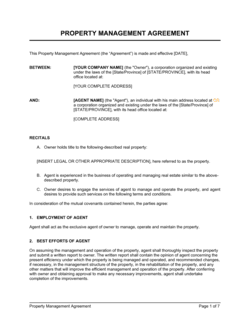
Storage Agreement Template

Free Word download β€’ Edit online β€’ Save & share with Drive β€’ Export to PDF

5 pagesβ€’25–35 min to fillβ€’Difficulty: Complexβ€’Signature requiredβ€’Legal review recommended
Learn more ↓
FreeStorage Agreement Template

At a glance

What it is
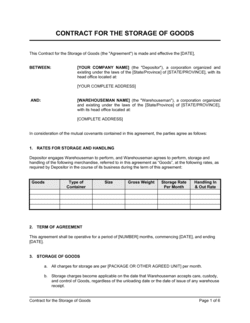
A Storage Agreement is a legally binding contract between a storage provider and a customer that governs the rental of a storage unit, bay, lot, or warehouse space for goods, vehicles, or personal property. This free Word download covers fees, payment terms, access hours, security obligations, liability limits, insurance requirements, lien rights, and termination β€” and can be edited online and exported as PDF before signing.
When you need it
Use it whenever a business or individual rents storage space to another party, whether for self-storage units, vehicle storage, warehouse overflow, document archiving, or equipment holding. It is equally necessary when a customer needs a written record of their rights, access terms, and the provider's liability limits before handing over property.
What's inside
Parties and unit description, storage fees and payment schedule, access hours and entry rights, permitted and prohibited items, liability caps and insurance requirements, lien rights on stored goods, and termination and abandonment procedures.

What is a Storage Agreement?

A Storage Agreement is a legally binding contract between a storage provider and a customer that governs the rental of a unit, bay, lot, or warehouse space for the storage of goods, vehicles, or personal property. It defines the monthly fee, payment schedule, access hours, permitted and prohibited items, the provider's liability cap, the customer's insurance obligations, the provider's lien rights over stored goods in the event of non-payment, and the process for terminating the arrangement. Unlike a standard property lease, a storage agreement typically creates a bailment or limited license β€” meaning the provider retains significant rights to access the space, deny entry, and ultimately sell stored goods through a statutory lien process if the customer defaults.

Why You Need This Document

Without a signed storage agreement, a provider who sells or disposes of a non-paying customer's goods risks a wrongful-conversion claim β€” even if the customer has owed fees for months. A customer who stores goods without a written contract has no documented record of the provider's liability limits, access rights, or insurance obligations, leaving both sides exposed to costly disputes. Lien enforcement β€” the primary legal tool available to storage operators β€” is entirely procedural: miss a single step in the statutory notice process and the sale is invalidated. A properly drafted storage agreement, referencing the correct lien statute and mirroring its notice requirements, is the foundation that makes enforcement predictable and defensible. This template gives providers and customers a clear, enforceable starting point in minutes, with every critical clause in place before a key or access code changes hands.

Which variant fits your situation?

If your situation is…Use this template
Renting a standard self-storage unit to a residential customerSelf-Storage Rental Agreement
Storing a vehicle, boat, or RV on a lot or in a garageVehicle Storage Agreement
Warehousing bulk goods or pallets for a commercial clientWarehouse Storage Agreement
Temporary storage as part of a household moveMoving and Storage Agreement
Document and records archiving for a businessDocument Storage Agreement
Cold or climate-controlled storage for perishable goodsCold Storage Agreement
Short-term storage with a defined end date and no auto-renewalFixed-Term Storage Agreement

Common mistakes to avoid

❌ Skipping the lien statute reference

Why it matters: Lien enforcement is procedural β€” if your contract describes a notice period or auction process that differs from the governing statute, a court can invalidate the lien sale and expose you to a conversion claim worth the full value of the goods.

Fix: Cite the exact statutory provision governing storage liens in your jurisdiction and mirror its notice timing and process requirements in the contract.

❌ No abandonment clause

Why it matters: Without a written definition of abandonment and a prescribed disposal process, disposing of goods a customer leaves behind β€” even months after they stop paying β€” can be treated as conversion, regardless of your intent.

Fix: Define abandonment explicitly (e.g., non-payment for 30+ days with no contact) and tie it to the same lien-and-notice process used for non-payment terminations.

❌ Liability cap with no gross-negligence carve-out

Why it matters: Courts in most jurisdictions refuse to enforce liability caps that purport to cover a party's own reckless or intentional conduct β€” and may void the entire limitation clause as a result.

Fix: Add a single sentence confirming that the cap does not apply to losses caused by the provider's gross negligence or willful misconduct.

❌ Vague or absent prohibited-items list

Why it matters: If a customer stores hazardous materials that cause a fire or contamination and your contract only says 'no dangerous items,' you may face difficulty recovering clean-up costs or limiting your liability to other tenants.

Fix: Use a specific enumerated list referencing OSHA/EPA hazardous-material categories, and require the customer to sign an acknowledgment that they have read and understood the list.

❌ Governing law in a different jurisdiction than the facility

Why it matters: Self-storage lien laws, late-fee caps, and notice requirements are entirely jurisdiction-specific. Applying the wrong state's law means your lien and termination procedures may be unenforceable.

Fix: Always set governing law to the jurisdiction where the physical facility is located, regardless of where the customer or their business is based.

❌ No move-in condition documentation

Why it matters: Without a documented baseline, a customer can claim pre-existing damage when vacating β€” and you have no written or photographic evidence to dispute it, leaving you liable for repairs you did not cause.

Fix: Conduct a dated photographic inspection at move-in and move-out, attach the photos to the signed agreement, and have the customer countersign the move-in checklist.

The 10 key clauses, explained

Parties and storage unit description

In plain language: Identifies the storage provider and the customer as legal entities, and describes the specific unit, bay, or space being rented β€” including its size, location, and unit number.

Sample language
This Storage Agreement is entered into on [DATE] between [PROVIDER LEGAL NAME], a [STATE/PROVINCE] [ENTITY TYPE] ('Provider'), and [CUSTOMER FULL NAME / ENTITY NAME] ('Customer'). Provider agrees to rent to Customer storage unit #[UNIT NUMBER], measuring approximately [DIMENSIONS], located at [FACILITY ADDRESS].

Common mistake: Describing the unit by a nickname or informal label rather than its official unit number and address. If a dispute arises over which space was rented, a vague description creates ambiguity that favors the customer.

Term and renewal

In plain language: States the start date, whether the agreement is month-to-month or fixed-term, and whether it auto-renews if the customer does not give notice to vacate.

Sample language
This Agreement commences on [START DATE] and continues on a month-to-month basis until terminated by either party with [30] days' written notice. Failure to provide notice before the last day of any rental month will result in an automatic renewal for one additional month.

Common mistake: Omitting the auto-renewal trigger entirely. Without it, a customer who stops paying but doesn't formally vacate creates a holdover situation with no clear legal basis for removal or fee escalation.

Storage fees and payment terms

In plain language: Defines the monthly or periodic fee, the due date, accepted payment methods, late fees, and any fee-increase notice requirement.

Sample language
Customer shall pay Provider a monthly storage fee of $[AMOUNT], due on the [1st] day of each calendar month. Payments received after the [5th] day of the month are subject to a late fee of $[AMOUNT] per day. Provider may adjust fees on [30] days' written notice.

Common mistake: Setting a late fee without specifying when it starts accruing. Courts in some states cap late fees or require a grace period β€” a fee that starts on day 1 may be unenforceable.

Access rights and hours

In plain language: Specifies when and how the customer may access the unit, who else is authorized to enter, and the circumstances under which the provider may restrict or deny access.

Sample language
Customer shall have access to the storage unit during facility hours of [HOURS] on [DAYS]. Provider reserves the right to deny access to Customer who is in default of any payment obligation under this Agreement, on 24 hours' notice.

Common mistake: Granting 24-hour access without a security protocol or surveillance clause to back it up. A provider who promises round-the-clock access but lacks adequate security may face heightened liability for after-hours theft.

Permitted and prohibited items

In plain language: Lists the categories of goods the customer may store and expressly prohibits hazardous, illegal, perishable, or high-value items that exceed the unit's liability coverage.

Sample language
Customer may store lawfully owned personal property and household goods. Customer shall not store: (a) hazardous or flammable materials; (b) perishable food items; (c) living animals or plants; (d) stolen, illegal, or counterfeit goods; (e) firearms or ammunition without required permits; or (f) any item whose presence violates applicable law.

Common mistake: Relying on a generic 'no hazardous materials' statement without defining the term. OSHA and EPA have specific hazardous-material classifications β€” a court will apply those definitions, not a common-sense reading.

Liability and limitation of damages

In plain language: Sets the maximum dollar amount the provider can be held liable for if the customer's property is lost, stolen, or damaged β€” and carves out gross negligence or willful misconduct from the cap.

Sample language
Provider's liability for any loss, theft, or damage to stored property shall not exceed $[AMOUNT] per incident, regardless of the actual value of the goods. This cap does not apply to losses caused by Provider's gross negligence or willful misconduct.

Common mistake: Setting a liability cap but failing to carve out gross negligence. Courts in most jurisdictions will not enforce a cap that purports to shield a party from liability for their own reckless or intentional conduct.

Insurance requirements

In plain language: Requires the customer to carry their own insurance on the stored property and confirms that the provider's facility insurance does not cover the customer's goods.

Sample language
Customer is solely responsible for insuring stored property against loss, theft, fire, flood, and other risks. Provider carries no insurance covering Customer's personal property. Provider recommends Customer obtain a minimum of $[AMOUNT] in contents insurance prior to storing goods at the facility.

Common mistake: Implying that the facility's general liability policy covers stored goods. If the customer reads this incorrectly and skips insurance, the provider faces reputational and potential legal exposure after any loss.

Lien rights

In plain language: Grants the provider a statutory lien over stored goods if the customer defaults, and outlines the notice and auction process required before the provider can sell the property.

Sample language
In the event Customer fails to pay fees when due, Provider shall have a lien on all property stored in the unit pursuant to [APPLICABLE STATE/PROVINCIAL STATUTE]. Provider shall provide [14] days' written notice to Customer's last known address before auctioning or otherwise disposing of stored goods.

Common mistake: Stating lien rights without citing the governing statute or following the prescribed notice timeline. Lien enforcement is heavily procedural β€” skipping a required step can make the sale wrongful and expose the provider to conversion liability.

Termination and vacating the unit

In plain language: Defines how either party can end the agreement, the notice period required, the condition in which the unit must be returned, and what happens to goods left behind after termination.

Sample language
Either party may terminate this Agreement with [30] days' written notice. Customer shall remove all property and return the unit in clean condition by the last day of the notice period. Property remaining after the termination date will be treated as abandoned and subject to the lien and disposal process in Section [X].

Common mistake: No abandonment clause at all. Without a written abandonment definition and process, a provider who disposes of left-behind goods β€” even after months β€” may face a conversion claim from the customer.

Governing law and dispute resolution

In plain language: Specifies which jurisdiction's law governs the agreement and the mechanism for resolving disputes β€” small claims court, mediation, or arbitration.

Sample language
This Agreement is governed by the laws of [STATE / PROVINCE / COUNTRY]. Any dispute arising under this Agreement shall first be submitted to non-binding mediation. If mediation fails, disputes shall be resolved in the courts of [COUNTY / JURISDICTION], and both parties consent to personal jurisdiction therein.

Common mistake: Specifying a governing jurisdiction that is different from where the facility is located. Self-storage and warehouse lien laws are jurisdiction-specific β€” applying the wrong state's law to a lien enforcement action can invalidate the entire process.

How to fill it out

  1. 1

    Enter both parties' legal names and the facility address

    Use the storage provider's full registered legal entity name β€” not a trade name β€” and the customer's legal name as it appears on government ID or their business registration. Include the full facility address and the specific unit number.

    πŸ’‘ Confirm the unit number against your facility management system before signing β€” reassigning a unit after a contract is executed creates a documentation headache.

  2. 2

    Set the term, start date, and renewal terms

    Choose month-to-month or fixed-term and enter the start date. For month-to-month agreements, specify the notice period required to terminate and whether the agreement auto-renews if notice is not given.

    πŸ’‘ Month-to-month with a 30-day notice period is the industry standard for residential self-storage. Commercial warehouse clients often prefer 60-day notice to plan logistics.

  3. 3

    Fill in the fee schedule and late-fee terms

    Enter the monthly fee, the due date, the grace period before late fees apply, the late fee amount, and the notice period required before a fee increase takes effect. Check your jurisdiction's statutory limits on late fees before finalizing this section.

    πŸ’‘ In several US states, late fees exceeding a fixed dollar cap or starting before a mandatory grace period are unenforceable β€” research your state's self-storage act before filling this in.

  4. 4

    Define access hours and authorized persons

    Enter the specific access hours and days. List any persons other than the primary customer who are authorized to access the unit. Specify the conditions under which access can be denied β€” typically non-payment or a breach of the prohibited-items clause.

    πŸ’‘ Require customers to update their authorized-persons list in writing. Verbal authorizations are hard to enforce and create security and liability issues if a dispute arises.

  5. 5

    List prohibited items and any special use restrictions

    Review the prohibited-items list and add any facility-specific restrictions β€” for example, prohibiting motorized vehicles in indoor units not designated for vehicle storage, or restricting business-inventory use in residential self-storage agreements.

    πŸ’‘ Post a printed prohibited-items list inside every unit at move-in and photograph it. This creates a contemporaneous record that the customer was notified at the time of possession.

  6. 6

    Set the liability cap and insurance requirement

    Enter a specific dollar amount for the liability cap β€” typically $250–$500 for residential self-storage, higher for commercial warehouse agreements. Confirm the customer must carry their own contents insurance and note the minimum coverage amount you recommend.

    πŸ’‘ Offer renters' or contents insurance at the point of signing if your facility has a partnership with an insurer. Customers who decline in writing are significantly less likely to pursue a claim after a loss.

  7. 7

    Reference the applicable lien statute

    Insert the correct statutory citation for lien rights in the governing jurisdiction β€” for example, the relevant state's Self-Storage Facility Act. Enter the required notice period and auction process steps as prescribed by statute.

    πŸ’‘ Do not paraphrase the statute β€” replicate its notice requirements exactly. Many lien sales have been invalidated because the operator's contract described a different process than the statute requires.

  8. 8

    Sign before the customer takes possession

    Both parties must sign and date the agreement before the customer is given a key, code, or access card to the unit. Conduct a move-in inspection with the customer present and document the unit's condition with dated photographs.

    πŸ’‘ Use Business in a Box eSign to timestamp execution and store the fully-executed copy β€” this creates an auditable record that is harder to dispute than a paper copy signed and filed manually.

Frequently asked questions

What is a storage agreement?

A storage agreement is a legally binding contract between a storage provider and a customer that sets the terms for renting a unit, bay, lot, or warehouse space to store goods, vehicles, or personal property. It covers the monthly fee, access hours, permitted and prohibited items, liability limits, insurance obligations, lien rights, and termination procedures. Both parties sign before the customer takes possession of the space.

Is a storage agreement legally enforceable?

A storage agreement is generally enforceable when properly executed by both parties, provided its terms comply with applicable state or provincial law. Key provisions β€” particularly lien rights, late fees, and liability caps β€” are subject to statutory limits that vary by jurisdiction. A clause that contradicts a mandatory statutory minimum is typically void, but the rest of the contract usually remains in effect.

What is a storage lien and how does it work?

A storage lien is a legal right the provider holds over stored goods when the customer defaults on fees. Most US states and Canadian provinces have a self-storage or warehouse lien statute that prescribes a specific process: written notice to the customer at their last known address, a mandatory waiting period (typically 14–30 days), and a public auction or private sale. Providers who skip any step in the statutory process risk a wrongful-conversion claim.

What is the difference between a storage agreement and a lease?

A storage agreement creates a bailment or license to use space β€” the customer does not have exclusive possession in the same way a commercial tenant does under a lease. This distinction matters because many standard landlord-tenant protections (notice to cure, eviction procedures) do not apply to storage arrangements in most jurisdictions. The provider retains far greater rights to access and ultimately dispose of stored goods than a landlord has over a tenant's property.

Does the storage provider's insurance cover my goods?

In nearly all cases, no. A storage facility's general liability or property insurance covers the building and the provider's equipment β€” not the customer's stored goods. Customers are typically required to carry their own contents or renters' insurance. The storage agreement should make this explicit, and providers should recommend a minimum coverage amount based on the likely value of goods being stored.

Can a storage provider limit their liability for damage or theft?

Yes, in most jurisdictions a storage provider can contractually cap their liability for loss or damage β€” typically to a fixed dollar amount per incident. However, the cap generally cannot shield the provider from liability caused by their own gross negligence or intentional misconduct. Courts in some states also require that the liability cap be conspicuously displayed and acknowledged by the customer to be enforceable.

What happens if I stop paying but leave my belongings in the unit?

If you stop paying, the provider will typically send a written default notice and then initiate the statutory lien process. After the required notice period β€” usually 14 to 30 days depending on the jurisdiction β€” the provider may auction or otherwise dispose of stored goods to recover unpaid fees. Any proceeds in excess of fees owed are generally returned to the customer. The storage agreement should describe this process in detail, mirroring the applicable statute.

Do I need a lawyer to draft or review a storage agreement?

For straightforward residential self-storage rentals, a well-drafted template is generally sufficient. Consider having a lawyer review the agreement if you are operating a commercial warehouse or vehicle storage facility, handling high-value goods, operating in a state with complex lien statutes, or if the customer is a business client with significant inventory. A 1–2 hour review typically costs $200–$500 and is worthwhile for any arrangement involving goods valued above your liability cap.

What notice is required to terminate a storage agreement?

Notice requirements depend on the agreement's terms and the governing jurisdiction. Month-to-month storage agreements typically require 30 days' written notice from either party. Some jurisdictions require the provider to give additional notice before denying access or enforcing a lien. Always check the applicable self-storage or warehouse act for mandatory minimums β€” a contractual notice period shorter than the statutory minimum is generally unenforceable.

How this compares to alternatives

vs Warehouse Agreement

A warehouse agreement typically governs commercial bulk storage by a professional warehouseman under the Uniform Commercial Code or equivalent, often involving warehouse receipts and higher statutory liability. A storage agreement covers a wider range of arrangements β€” from self-storage units to vehicle lots β€” and is generally used for smaller-scale or residential storage. The two documents overlap but differ in their liability frameworks and applicable statutes.

vs Lease Agreement

A lease grants the tenant exclusive possession of a defined space with landlord-tenant protections β€” notice to cure, eviction procedures, and habitability standards. A storage agreement creates a limited license or bailment with fewer tenant protections and far greater provider rights to access, deny entry, and ultimately sell stored goods. Mischaracterizing a storage arrangement as a lease can inadvertently trigger landlord-tenant law, complicating lien enforcement significantly.

vs Bill of Lading

A bill of lading documents the transfer of goods to a carrier for transport and sets carrier liability during transit. A storage agreement governs stationary custody of goods at a defined location. When a logistics provider both transports and stores goods, both documents are needed β€” the bill of lading covers goods in transit and the storage agreement covers goods at rest.

vs Property Management Agreement

A property management agreement appoints a manager to oversee a real-estate asset on the owner's behalf β€” collecting rents, arranging maintenance, and managing tenants. A storage agreement is a direct rental contract between the storage provider and the end customer. They serve entirely different functions; storage facilities that outsource operations to a management company need both.

Industry-specific considerations

Self-Storage

Month-to-month unit rentals with statutory lien rights, late-fee caps, and mandatory auction procedures specific to each state's self-storage act.

Logistics and Warehousing

Pallet-based or bulk storage for commercial clients with defined access windows, inventory liability tied to declared goods value, and freight-carrier interface clauses.

Automotive and Marine

Vehicle, boat, and RV storage on indoor or outdoor lots with specific condition documentation, keys-in-possession protocols, and higher liability caps for high-value assets.

Retail and E-commerce

Overflow inventory storage with defined SKU access, insurance requirements covering merchandise value, and short-term or seasonal term structures tied to peak fulfillment periods.

Jurisdictional notes

United States

All 50 states have enacted self-storage facility acts that govern lien rights, required notice periods, and auction procedures β€” and they vary significantly. Late fees are capped by statute in many states and may require a mandatory grace period before accruing. Liability caps must often be conspicuously displayed in the contract or at the facility entrance to be enforceable. California, Florida, and Texas each impose distinct procedural requirements for lien sales that must be mirrored exactly in the agreement.

Canada

Storage and bailment law in Canada is primarily governed at the provincial level, with Ontario's Repair and Storage Liens Act and British Columbia's Warehouse Lien Act as the most commonly applicable statutes. Quebec's civil law framework treats storage as a contract of deposit, imposing higher care obligations on the provider than common-law provinces. Notice periods before lien enforcement typically range from 15 to 30 days depending on the province. Contracts in Quebec must be available in French.

United Kingdom

Storage agreements in the UK are governed primarily by the common law of bailment and the Torts (Interference with Goods) Act 1977, which sets out the process for disposing of uncollected goods. Providers must give reasonable notice before selling abandoned property. The Consumer Rights Act 2015 applies to agreements with individual consumers and may render unfair liability exclusion clauses unenforceable. GDPR obligations apply to any customer data held as part of the agreement.

European Union

EU member states handle storage and warehouse agreements under national civil codes, with significant variation β€” Germany's HGB imposes carrier-like liability on commercial warehousemen, while France's Civil Code treats storage as a depositum contract with defined care obligations. The EU Unfair Contract Terms Directive (93/13/EEC) invalidates terms that create a significant imbalance to the detriment of consumers, which can affect broad liability exclusions in B2C storage contracts. GDPR compliance is required for all customer data collected at sign-up.

Template vs lawyer β€” what fits your deal?

PathBest forCostTime
Use the templateResidential self-storage operators and small facilities renting standard units to individual customersFree20–30 minutes
Template + legal reviewVehicle storage, commercial warehouse clients, high-value goods, or facilities in states with complex self-storage lien statutes$200–$6001–3 days
Custom draftedLarge-scale logistics and warehousing operations, multi-jurisdiction storage networks, or facilities handling regulated or hazardous goods$1,000–$3,500+1–3 weeks

Glossary

Bailee
The party (typically the storage provider) who takes temporary possession of another person's property under a contract, without acquiring ownership.
Bailor
The party (typically the customer) who entrusts their property to a bailee for storage or safekeeping.
Lien
A legal right the storage provider holds over stored goods, allowing the provider to sell the goods if the customer defaults on fees β€” subject to statutory notice requirements.
Liability Cap
A contractual ceiling on the maximum dollar amount the storage provider can be held responsible for in the event of loss, theft, or damage to stored property.
Indemnification
A clause requiring one party to compensate the other for losses, damages, or legal costs arising from specified events β€” typically the customer's negligent use of the space.
Access Hours
The specific times during which the customer is permitted to enter the storage facility or unit, as defined in the agreement.
Holdover Tenant
A customer who continues to occupy a storage unit after the agreement's end date without entering a renewal β€” typically subject to higher rates or immediate termination.
Prohibited Items
A list of goods the customer is barred from storing, including hazardous materials, flammable substances, perishables, and illegally obtained property.
Abandonment
When a customer vacates or stops paying without notice, leaving goods behind β€” triggering a statutory process before the provider can dispose of or auction the property.
Bailment
The legal relationship created when one party temporarily transfers possession of personal property to another party for a defined purpose, without transferring ownership.
Force Majeure
A clause excusing a party from performance obligations due to events outside their control, such as natural disasters, fire, or government-ordered closures.

Part of your Business Operating System

This document is one of 3,000+ business & legal templates included in Business in a Box.

  • Fill-in-the-blanks β€” ready in minutes
  • 100% customizable Word document
  • Compatible with all office suites
  • Export to PDF and share electronically

Create your document in 3 simple steps.

From template to signed document β€” all inside one Business Operating System.
1
Download or open template

Access over 3,000+ business and legal templates for any business task, project or initiative.

2
Edit and fill in the blanks with AI

Customize your ready-made business document template and save it in the cloud.

3
Save, Share, Send, Sign

Share your files and folders with your team. Create a space of seamless collaboration.

Save time, save money, and create top-quality documents.

β˜…β˜…β˜…β˜…β˜…

"Fantastic value! I'm not sure how I'd do without it. It's worth its weight in gold and paid back for itself many times."

Managing Director Β· Mall Farm
Robert Whalley
Managing Director, Mall Farm Proprietary Limited
β˜…β˜…β˜…β˜…β˜…

"I have been using Business in a Box for years. It has been the most useful source of templates I have encountered. I recommend it to anyone."

Business Owner Β· 4+ years
Dr Michael John Freestone
Business Owner
β˜…β˜…β˜…β˜…β˜…

"It has been a life saver so many times I have lost count. Business in a Box has saved me so much time and as you know, time is money."

Owner Β· Upstate Web
David G. Moore Jr.
Owner, Upstate Web

Run your business with a system β€” not scattered tools

Stop downloading documents. Start operating with clarity. Business in a Box gives you the Business Operating System used by over 250,000 companies worldwide to structure, run, and grow their business.

Start freeΒ Β·Β No credit card required