Waiter and Waitress Job Description Template

Free Word download β€’ Edit online β€’ Save & share with Drive β€’ Export to PDF

2 pagesβ€’20–30 min to fillβ€’Difficulty: Standardβ€’Signature requiredβ€’Legal review recommended
Learn more ↓
FreeWaiter and Waitress Job Description Template

At a glance

What it is
A Waiter and Waitress Job Description is a formal employment document that defines the duties, responsibilities, qualifications, and working conditions for front-of-house service staff in a restaurant or hospitality setting. This free Word download gives you a professionally structured, editable template you can customize with your establishment's specifics and export as PDF for onboarding, posting, or inclusion in an employment agreement.
When you need it
Use it when hiring new servers, formalizing existing roles, updating outdated job descriptions ahead of a performance review cycle, or attaching a defined scope of duties to an employment contract. It is also required by many multi-location restaurant groups and franchise operators to maintain role consistency across properties.
What's inside
Role summary and reporting structure, detailed duties and responsibilities, required and preferred qualifications, physical and scheduling requirements, compensation structure including tipping policy, and acknowledgment and signature block for both employer and employee.

What is a Waiter and Waitress Job Description?

A Waiter and Waitress Job Description is a formal employment document that defines the duties, responsibilities, qualifications, physical requirements, and working conditions for front-of-house service staff in a restaurant, hotel, catering operation, or any other food service establishment. Unlike a casual verbal briefing or a generic hiring post, a properly structured job description creates a written record of mutual expectations β€” what the employer requires, what the employee agrees to perform, and what standards govern the employment relationship from day one. When signed by both parties, it becomes a legally significant document that supports performance management, disciplinary actions, wage compliance, and accommodation evaluations under applicable employment law.

Why You Need This Document

Operating without a signed, written job description exposes restaurant and hospitality employers to four distinct categories of risk. First, wage and tip disputes β€” particularly around tip credit applicability and pool arrangements β€” hinge on whether the employee received written notice of the compensation structure before their first tipped shift. Second, performance management and termination decisions become difficult to defend when no written record exists of what duties and standards were communicated. Third, accommodation requests under the ADA and equivalent legislation require a documented baseline of the role's physical requirements to evaluate what is essential versus marginal. Fourth, health and food safety incidents trigger regulatory scrutiny that is far harder to manage when illness-reporting obligations and certification requirements were never put in writing. This template gives restaurant operators a professionally structured, jurisdiction-aware starting point that covers all of these bases β€” reducing onboarding time, strengthening compliance, and creating the written foundation that every subsequent performance conversation depends on.

Which variant fits your situation?

If your situation is…Use this template
Hiring servers for a full-service sit-down restaurantWaiter and Waitress Job Description
Hiring for a fast-casual or counter-service food outletFood Service Worker Job Description
Staffing a banquet or events team for a hotel or venueBanquet Server Job Description
Hiring a head server or floor supervisorRestaurant Supervisor Job Description
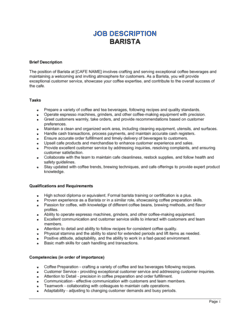
Documenting a barista or coffee bar server roleBarista Job Description
Hiring bar staff alongside dining room serversBartender Job Description
Onboarding a server with a formal employment contract attachedEmployment Contract (At-Will)

Common mistakes to avoid

❌ Omitting side work and pre/post-shift duties

Why it matters: Servers who claim they were never told about opening and closing tasks are difficult to discipline or terminate for non-performance when no written record of those duties exists.

Fix: List all side work tasks explicitly under the core duties clause β€” by shift (opening, mid, closing) β€” so expectations are clear from day one.

❌ Stating a tip pool arrangement that conflicts with payroll practice

Why it matters: Under the FLSA and equivalent provincial laws, undisclosed or unauthorized tip deductions constitute wage theft β€” exposing the employer to back-pay liability, penalties, and class-action risk.

Fix: Document the exact tip pool structure in writing, confirm it complies with current federal and state/provincial law, and have the employee sign acknowledgment before their first tipped shift.

❌ Omitting the physical requirements clause

Why it matters: Without documented physical requirements, the employer cannot evaluate accommodation requests under the ADA or equivalent legislation, and has no baseline for what constitutes an essential versus marginal function of the role.

Fix: Include standing duration, lifting limits, and environmental conditions in the physical requirements clause, even if they seem self-evident for a service role.

❌ Using the same job description across fine dining and fast-casual locations

Why it matters: Service standards, physical demands, and tip credit applicability differ significantly between service concepts β€” a mismatched description undermines performance management and may mistate wage obligations.

Fix: Maintain a separate job description for each distinct service concept or location, tailored to the actual duties, standards, and compensation structure of that role.

❌ Collecting only the employee's signature

Why it matters: A unilateral signature does not create a clear mutual record. In a dispute, the employee can credibly claim they never discussed the terms with a manager β€” weakening the document's evidentiary weight.

Fix: Add a manager signature line below the employee's and collect both signatures at onboarding, before the first shift begins.

❌ Referencing conduct or service standards that do not exist in writing

Why it matters: Disciplinary actions based on verbal standards are routinely overturned in grievance processes and employment tribunal hearings because there is no objective record of what standard was communicated.

Fix: Ensure the Employee Handbook and service standards guide referenced in the job description exist as current, dated, written documents that the employee receives and signs for separately.

The 10 key clauses, explained

Position Title and Department

In plain language: Formally names the role, its classification within the organization, and the department it belongs to β€” establishing the legal identity of the position.

Sample language
Position Title: [WAITER / WAITRESS / SERVER] | Department: Food and Beverage | Reports To: [FLOOR MANAGER / RESTAURANT MANAGER / F&B DIRECTOR] | Location: [ESTABLISHMENT NAME, ADDRESS]

Common mistake: Using informal titles like 'floor person' or 'team member' that do not align with payroll records β€” this creates classification inconsistencies and complicates overtime and tip-credit calculations.

Role Summary

In plain language: A 2–4 sentence overview of the position's primary purpose and its contribution to the guest experience, giving the employee a clear context for their work.

Sample language
The [WAITER/WAITRESS] is responsible for delivering an exceptional dining experience to guests of [ESTABLISHMENT NAME] by taking orders accurately, serving food and beverages promptly, and maintaining a professional and welcoming presence throughout the guest's visit.

Common mistake: Writing a generic summary that could apply to any hospitality role. A role summary should reference the specific concept, service style (fine dining, casual, fast-casual), and guest expectation level of the establishment.

Core Duties and Responsibilities

In plain language: The detailed list of tasks the employee is expected to perform on every shift β€” the operational heart of the job description.

Sample language
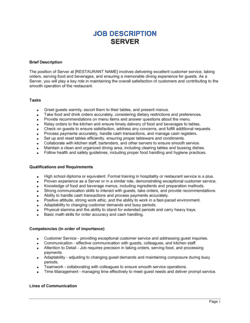
Greet and seat guests within [X] minutes of arrival; present menus and describe daily specials; take accurate food and beverage orders using [POS SYSTEM NAME]; coordinate with kitchen staff to ensure timely delivery; process payments including cash, card, and [DIGITAL PAYMENT PLATFORMS]; complete pre- and post-shift side work as assigned.

Common mistake: Omitting pre- and post-shift side work duties. Employees who claim they were never told about opening or closing tasks are harder to performance-manage without this language in writing.

Required Qualifications and Experience

In plain language: States the minimum education, experience, certifications, and skills an applicant must have to be considered for the role.

Sample language
Minimum [X] year(s) of experience in a [FULL-SERVICE / FINE DINING / CASUAL] restaurant environment; valid [FOOD HANDLER'S CARD / FOOD SAFETY CERTIFICATION] as required by [STATE/PROVINCE]; ability to read, write, and communicate effectively in [LANGUAGE(S)]; legal authorization to work in [COUNTRY].

Common mistake: Listing qualifications that create inadvertent discrimination β€” for example, requiring a high school diploma for a role where the diploma is not genuinely necessary. This can expose the employer to disparate-impact claims under employment law.

Physical and Environmental Requirements

In plain language: Documents the physical demands of the role β€” standing hours, lifting limits, environmental conditions β€” which is essential for ADA compliance in the US and equivalent legislation in other jurisdictions.

Sample language
Must be able to stand and walk for up to [8] hours per shift; lift and carry trays weighing up to [30] lbs; work in environments with varying temperature and noise levels; navigate a fast-paced, crowded floor safely.

Common mistake: Omitting physical requirements entirely. Without this clause, accommodation requests become harder to evaluate and the employer has no documented baseline for determining what constitutes an essential versus marginal function of the role.

Scheduling and Availability Requirements

In plain language: Defines expected shift patterns, weekend and holiday availability, and flexibility requirements β€” setting clear expectations before an offer is made.

Sample language
Must be available to work [DAYS OF WEEK], including weekends and public holidays; shifts typically run [X] to [X] hours; advance scheduling is provided [X] days prior; shift swaps must be approved by [MANAGER TITLE].

Common mistake: Failing to state holiday and weekend availability requirements in the written document. When an employee later claims they were not told about weekend shifts, no written record exists to resolve the dispute.

Compensation, Tipping, and Benefits

In plain language: States the base hourly rate or tipped minimum wage, tip credit policy if applicable, tip pooling arrangements, and any additional benefits.

Sample language
Base hourly rate: $[X.XX] per hour ([FULL / TIPPED MINIMUM WAGE]) in accordance with [STATE/PROVINCE] law. Tips are [RETAINED BY THE SERVER / POOLED AMONG FOH STAFF / SHARED WITH BACK OF HOUSE] per establishment policy. Benefits: [MEAL ALLOWANCE / HEALTH COVERAGE / OTHER] as described in the Employee Handbook.

Common mistake: Stating a tip pooling policy in the job description that conflicts with the actual payroll practice. Under the FLSA and many provincial laws, undisclosed tip pool deductions can trigger wage-theft liability and back-pay obligations.

Conduct, Dress Code, and Service Standards

In plain language: Documents behavioral expectations, uniform requirements, and the service standards the employee is accountable to β€” creating an enforceable performance baseline.

Sample language
Employees are required to wear the designated uniform as described in the Employee Handbook, maintain personal hygiene standards, and adhere to the establishment's code of conduct at all times. Service must meet the standards outlined in the [SERVICE STANDARDS GUIDE / TRAINING MANUAL].

Common mistake: Referencing a training manual or service standards guide that does not exist in writing. Courts and arbitrators give little weight to verbal service standards when an employee disputes a disciplinary action.

Health, Safety, and Food Handling

In plain language: Sets out the employee's obligations under applicable food safety regulations, including certification requirements, hygiene protocols, and incident reporting.

Sample language
Employee must hold a valid [FOOD HANDLER'S CARD / SERVSAFE CERTIFICATION] and comply with all applicable food safety regulations under [STATE / PROVINCIAL / NATIONAL FOOD SAFETY LAW]. Any illness that may affect food safety must be reported to [MANAGER TITLE] before the start of the shift.

Common mistake: Omitting the illness-reporting obligation. Without it, an employer has no documented basis for sending a symptomatic employee home, which can create both public health liability and wrongful-exclusion disputes.

Acknowledgment and Signature Block

In plain language: A signed confirmation by both employer and employee that the employee has received, read, and understood the job description β€” creating a dated record of mutual agreement.

Sample language
I, [EMPLOYEE FULL NAME], acknowledge that I have received, read, and understood the duties and responsibilities described in this Job Description for the position of [WAITER/WAITRESS] at [ESTABLISHMENT NAME]. Signature: _______________ Date: _______________ | Manager Signature: _______________ Date: _______________

Common mistake: Collecting only the employee's signature and not the employer's. A dual-signature block creates a cleaner evidentiary record and signals to the employee that the document is a mutual, formal agreement β€” not a unilateral notice.

How to fill it out

  1. 1

    Enter the establishment and position details

    Fill in the legal name of your business, the property address, and the exact job title as it will appear on payroll records. Select the reporting relationship β€” typically Floor Manager or Restaurant Manager.

    πŸ’‘ Match the job title exactly to how it appears in your payroll system to avoid wage and tip classification discrepancies.

  2. 2

    Write a role summary specific to your service concept

    In 2–4 sentences, describe the role's primary purpose and the service style of your establishment β€” fine dining, casual, fast-casual, or hotel dining. Generic summaries reduce the document's value for performance management.

    πŸ’‘ Mention your concept by name (e.g., 'upscale Italian trattoria') so the standard of care is clear from day one.

  3. 3

    List all core duties in operational order

    Start with guest arrival tasks (greeting, seating, presenting menus), move through the service sequence (ordering, delivery, upselling, payment), and end with side work and closing duties. Use action verbs for each item.

    πŸ’‘ Include side work duties explicitly β€” 'roll silverware, wipe down menus, restock condiment stations' β€” to prevent disputes over unassigned tasks.

  4. 4

    Set minimum qualifications and required certifications

    State the minimum experience level, any required food handler or alcohol service certifications, and language requirements. Only list qualifications that are genuinely necessary for the role.

    πŸ’‘ Check your state or province for mandatory food handler certification requirements before finalizing β€” some jurisdictions require it within 30 days of hire, others before the first shift.

  5. 5

    Document physical requirements and scheduling expectations

    Specify the maximum hours of standing, lifting limits, and environmental conditions. Then set out availability expectations β€” days of the week, holiday coverage, and advance notice requirements for schedule changes.

    πŸ’‘ In the US, the physical requirements clause is a prerequisite for evaluating ADA accommodation requests. Document it even if it seems obvious.

  6. 6

    Enter compensation and tipping policy details

    State the base hourly rate, whether a tip credit applies, and the exact tipping arrangement β€” retained by the server, pooled among FOH staff, or shared with BOH. Reference the Employee Handbook for benefit details.

    πŸ’‘ If you operate a tip pool, confirm it complies with the FLSA 2018 amendments β€” back-of-house employees may be included only if the employer does not take a tip credit.

  7. 7

    Reference conduct standards and the employee handbook

    Add a clause directing the employee to the Employee Handbook for detailed conduct, uniform, and disciplinary policies. Do not duplicate handbook content β€” reference it by name and confirm the employee will receive a copy.

    πŸ’‘ Date the handbook version you reference. When policies update, re-issue the acknowledgment page with the new version date.

  8. 8

    Obtain signatures before the first shift

    Have both the employee and the manager sign and date the acknowledgment block before the employee's first shift. File a copy in the employee's personnel record and provide the employee with a copy.

    πŸ’‘ Use Business in a Box eSign to timestamp the acknowledgment digitally and store the executed copy in BIB Drive β€” especially useful for high-turnover environments where paper records are easily lost.

Frequently asked questions

What is a waiter and waitress job description?

A waiter and waitress job description is a formal written document that defines the duties, responsibilities, required qualifications, physical requirements, scheduling expectations, and compensation terms for front-of-house service staff in a restaurant or hospitality setting. It serves as both a hiring tool and an enforceable reference document for performance management, disciplinary actions, and employment compliance.

Is a job description legally binding?

A job description is generally not a standalone contract, but it becomes a legally significant document when signed by both the employer and employee as part of the onboarding process. Signed job descriptions are used in employment tribunals, wrongful termination claims, and wage disputes to establish what duties were communicated and agreed to. Including a formal acknowledgment and signature block significantly increases the document's evidentiary weight.

What should a server job description include?

At minimum: position title and reporting structure, role summary, detailed list of core duties (including side work), required qualifications and certifications, physical and scheduling requirements, compensation and tipping policy, conduct and dress code standards, health and food safety obligations, and a signed acknowledgment block. Omitting any of these creates gaps that can complicate performance management and wage compliance.

How does tip credit affect the job description?

In the US, employers who apply a tip credit must clearly communicate the tipped minimum wage and tip credit arrangement to employees β€” in writing β€” before the first tipped shift. Including the tip credit policy in the job description or a linked compensation addendum satisfies this requirement. Failure to provide written notice can void the tip credit, requiring the employer to pay the full federal or state minimum wage retroactively.

Do I need a separate job description for every restaurant location?

If duties, service standards, or compensation structures differ between locations β€” as they typically do between a fine dining flagship and a casual satellite β€” you should maintain separate job descriptions for each. Multi-location operators who use a single generic document face enforcement problems when disciplining an employee at a location with materially different expectations than those described in the document.

When should a server job description be updated?

Update the job description whenever duties materially change β€” for example, when you introduce a new POS system, change your tipping model, add alcohol service responsibilities, or shift from full-service to counter-service. Employees should acknowledge and sign the updated version. In jurisdictions with notice-of-change requirements, such as the UK and parts of Canada, failing to update employment documents when terms change can constitute a breach of contract.

Can a job description be used to defend against an unfair dismissal claim?

Yes β€” a signed, specific job description is one of the strongest tools an employer has in defending a dismissal for performance or conduct. It establishes what the employee was told their duties were, what standards were communicated, and that they acknowledged understanding those expectations. Courts and employment tribunals in the US, Canada, and the UK routinely examine the job description to determine whether the employer's expectations were clearly set out in writing.

Does a waiter job description need to cover alcohol service?

If the role involves serving alcohol, the job description should reference any required alcohol service certification β€” such as TIPS, ServSafe Alcohol, or a provincial Smart Serve certification in Ontario β€” and the employee's obligation to comply with applicable liquor laws. In many US states and Canadian provinces, serving alcohol without the required certification exposes both the employee and the employer to personal liability for dram shop violations.

What physical requirements should be listed for a server position?

Standard physical requirements for a server role include the ability to stand and walk for up to 8 hours per shift, carry trays weighing up to 30 lbs, work in a high-noise and varying-temperature environment, and navigate a crowded floor safely. In the US, documenting these requirements is essential for evaluating ADA accommodation requests β€” it establishes which functions are essential to the role and which are marginal.

How this compares to alternatives

vs Employment Contract

An employment contract is a comprehensive binding agreement covering compensation, IP, termination, and restrictive covenants. A job description defines role-specific duties and qualifications. The two documents complement each other β€” the job description is typically attached as a schedule to the employment contract. Using a job description alone without an employment contract leaves critical terms like notice period, severance, and IP ownership unaddressed.

vs Offer Letter

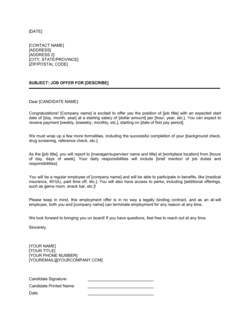
An offer letter confirms the role and compensation to secure candidate acceptance. A job description defines the scope of duties and performance expectations. The offer letter precedes the hire; the job description governs the ongoing employment relationship. Relying solely on an offer letter means the employer has no written baseline for duties, physical requirements, or conduct standards.

vs Employee Handbook

An employee handbook sets company-wide policies β€” conduct, leave, benefits, and disciplinary procedures β€” that apply to all staff. A job description is role-specific and documents the individual duties, qualifications, and standards for a single position. Both documents should be issued at onboarding; the job description references the handbook for policies that apply across all roles.

vs Performance Review Template

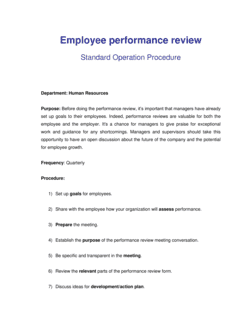
A performance review evaluates how well an employee has fulfilled their role over a defined period. A job description defines what those expectations are. Without a signed job description, performance reviews become subjective β€” the employee can credibly dispute that a particular duty or standard was ever communicated. The job description is the foundation the performance review is built on.

Industry-specific considerations

Full-Service Restaurants

Service sequence documentation is critical β€” from greeting through payment β€” and side work duties must reflect the table-service model and any tableside preparation responsibilities.

Hotels and Resorts

Server job descriptions must differentiate between dining room, banquet, pool, and in-room service roles, each carrying different physical demands, scheduling patterns, and tip arrangements.

Catering and Events

Event-based server roles involve variable scheduling, off-site venues, and load-in/load-out physical demands that differ materially from restaurant work and must be separately documented.

Healthcare and Institutional Food Service

Servers in hospital cafeterias and care facilities face stricter food safety and hygiene certification requirements and may have patient interaction protocols that go beyond standard restaurant service duties.

Jurisdictional notes

United States

Under the FLSA, employers must provide written notice of the tip credit arrangement before the first tipped shift β€” failure to do so voids the tip credit and triggers full minimum wage liability. Tip pool rules changed under the 2018 FLSA amendments, allowing back-of-house inclusion only when the employer does not take a tip credit. State laws in California, New York, and Washington impose higher tipped minimums and stricter disclosure requirements. ADA documentation of physical requirements is mandatory for evaluating reasonable accommodations.

Canada

Employment Standards Acts in each province establish minimum wage floors for servers β€” Ontario's tipped server minimum was eliminated in 2022, making the general minimum wage applicable to all workers. Gratuity and service charge distribution rules vary by province. Quebec requires all employment documents for provincially regulated employers to be provided in French. Scheduling notice requirements differ across provinces β€” BC's Employment Standards Act requires 48 hours' advance notice for certain shift changes.

United Kingdom

Under the Employment Rights Act 1996, employers must provide a written statement of particulars β€” including job title and duties β€” on or before the first day of work. The National Living Wage applies to all workers aged 21 and over regardless of tip income. The Employment (Allocation of Tips) Act 2023 requires all tips, gratuities, and service charges to be passed to workers fairly and transparently, with a written tipping policy maintained by the employer. Zero-hours contract provisions must be clearly documented.

European Union

The EU Transparent and Predictable Working Conditions Directive requires employers to provide written information on duties, working hours, and compensation within 7 days of the start date. Variable scheduling and on-call arrangements face increasing restrictions across member states β€” Germany's Nachweisgesetz requires written employment terms to be provided on day one. GDPR requires that employee personal data collected during onboarding β€” including certifications and health-related physical requirement records β€” be processed under a documented lawful basis.

Template vs lawyer β€” what fits your deal?

PathBest forCostTime
Use the templateIndependent restaurant owners and small hospitality businesses hiring standard front-of-house serversFree15–30 minutes
Template + legal reviewMulti-location operators, employers using tip credits, or establishments in jurisdictions with complex wage and tip laws$150–$400 for an employment lawyer review1–3 days
Custom draftedHotel groups, large catering companies, or employers in heavily regulated labor markets with union considerations$500–$2,000+1–2 weeks

Glossary

Job Description
A formal written document that outlines the duties, responsibilities, required qualifications, and working conditions for a specific role within an organization.
Front of House (FOH)
The area of a restaurant or hospitality venue where guests are served, including the dining room, bar, and host stand β€” as opposed to the kitchen and back-office areas.
Tip Credit
A provision under US federal law (and many state laws) that allows employers to pay tipped employees a lower base wage, provided tips bring total hourly earnings to at least the applicable minimum wage.
FLSA (Fair Labor Standards Act)
US federal law that establishes minimum wage, overtime pay, recordkeeping, and youth employment standards for most private and public-sector employees.
At-Will Employment
An employment arrangement β€” common in most US states β€” in which either the employer or employee may terminate the relationship at any time for any lawful reason without advance notice.
POS System (Point of Sale)
The hardware and software system servers use to enter and transmit guest orders, process payments, and track sales at a restaurant.
Mise en Place
French culinary term meaning 'everything in its place' β€” in a service context, it refers to the pre-shift preparation of the dining room, side stations, and service equipment.
Upselling
The practice of recommending higher-priced menu items, add-ons, or beverages to guests to increase the average check value.
Acknowledgment Clause
A section of a job description or employment document in which the employee signs to confirm they have read, understood, and agreed to the terms and responsibilities described.
Service Charge
A mandatory fee added to a guest's bill by the establishment, which may or may not be distributed to servers depending on jurisdiction and employer policy.
Probationary Period
A defined initial period of employment β€” typically 30 to 90 days β€” during which performance is evaluated and termination formalities may be reduced.

Part of your Business Operating System

This document is one of 3,000+ business & legal templates included in Business in a Box.

  • Fill-in-the-blanks β€” ready in minutes
  • 100% customizable Word document
  • Compatible with all office suites
  • Export to PDF and share electronically

Create your document in 3 simple steps.

From template to signed document β€” all inside one Business Operating System.
1
Download or open template

Access over 3,000+ business and legal templates for any business task, project or initiative.

2
Edit and fill in the blanks with AI

Customize your ready-made business document template and save it in the cloud.

3
Save, Share, Send, Sign

Share your files and folders with your team. Create a space of seamless collaboration.

Save time, save money, and create top-quality documents.

β˜…β˜…β˜…β˜…β˜…

"Fantastic value! I'm not sure how I'd do without it. It's worth its weight in gold and paid back for itself many times."

Managing Director Β· Mall Farm
Robert Whalley
Managing Director, Mall Farm Proprietary Limited
β˜…β˜…β˜…β˜…β˜…

"I have been using Business in a Box for years. It has been the most useful source of templates I have encountered. I recommend it to anyone."

Business Owner Β· 4+ years
Dr Michael John Freestone
Business Owner
β˜…β˜…β˜…β˜…β˜…

"It has been a life saver so many times I have lost count. Business in a Box has saved me so much time and as you know, time is money."

Owner Β· Upstate Web
David G. Moore Jr.
Owner, Upstate Web

Run your business with a system β€” not scattered tools

Stop downloading documents. Start operating with clarity. Business in a Box gives you the Business Operating System used by over 250,000 companies worldwide to structure, run, and grow their business.

Free Forever PlanΒ Β·Β No credit card required